
Last reviewed: October
Updated for: 2026
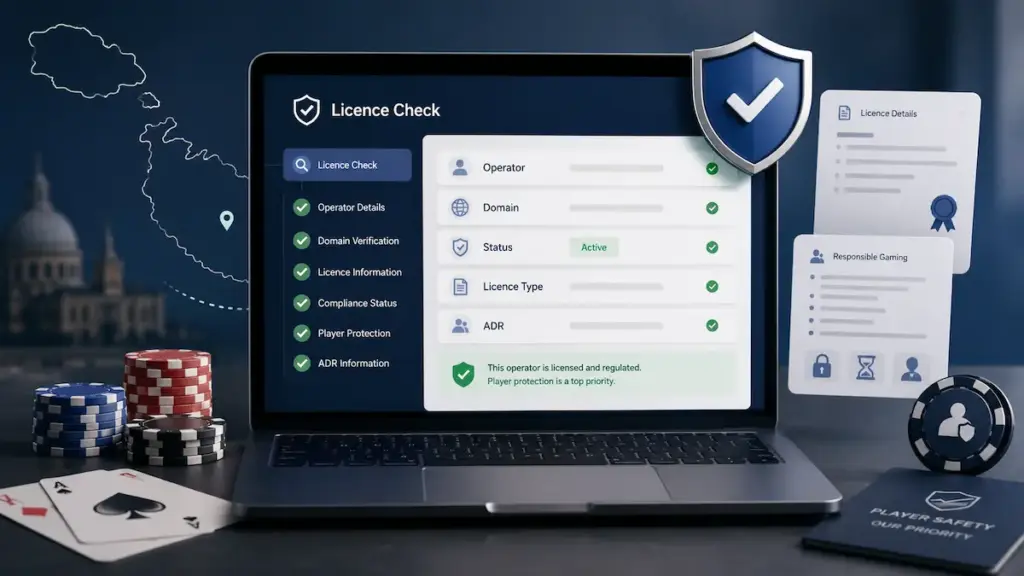
A Malta gaming license can be a meaningful trust signal when a casino’s licence claim matches official Malta Gaming Authority evidence. A logo in the footer does not prove enough by itself. The useful proof is whether the legal operator, licence number, licence status, approved website URL, game vertical, and dispute route match the official MGA record.
This matters most when an online casino with a Malta license uses an MGA badge, licence number, or MGA gaming license claim in the footer. Before depositing, compare the casino’s Terms with the MGA Licensee Register and any operator-specific MGA Dynamic Seal linked from the casino footer. The Dynamic Seal can show the licensee, licence number, status, licence type, approved verticals, ADR body, and website URLs connected to the operator.
A Malta Gaming Authority license does not remove gambling risk. It does not guarantee withdrawals, remove KYC checks, override bonus terms, or make online gambling legal in every country. Treat it as a verification tool before you deposit, not as a promise that nothing can go wrong.
Quick Answer: Is a Malta Gaming License Legit?
A Malta gaming license, sometimes described by casinos as a Malta casino license or MGA gambling license, can be legitimate when it connects to a real Malta Gaming Authority authorisation, a clear legal operator, a current licence status, and an approved casino domain.
For players, the key question is not whether a casino says “MGA licensed.” The key question is whether official MGA evidence confirms the same company and website you are using.
A strong MGA check should confirm:
| What to verify | Why it matters |
|---|---|
| Legal operator | Shows which company is responsible for the casino |
| Licence number | Helps match the casino claim with official MGA evidence |
| Licence status | Shows whether the authorisation is current or inactive |
| Website URLs | Confirms whether the exact casino domain is approved |
| Licence type | Separates player-facing B2C authorisation from supplier-facing B2B licensing |
| Approved vertical | Shows whether casino, betting, poker, or another product is covered |
| ADR body | Shows the dispute route connected to the operator |
| Terms and Conditions | Explains KYC, withdrawals, bonus restrictions, country rules, and complaints |
An MGA licence can make these checks easier. It does not guarantee that every player will have a smooth withdrawal, that the operator will skip verification, or that the site is legal to use from your country.
Key Takeaways Before You Deposit
- A Malta gaming license is useful only when the operator, licence status, approved domain, and product vertical match official MGA evidence.
- The MGA Dynamic Seal is stronger than a footer logo because it can show licence details, website URLs, ADR information, and approved verticals.
- A B2C Gaming Service Licence matters more to players than a B2B supplier licence.
- A casino may still request KYC, payment ownership proof, source-of-funds information, or wallet verification.
- An MGA licence does not guarantee withdrawals, bonus eligibility, legal access from every country, or risk-free gambling.
- If the domain is missing from the Dynamic Seal, the licence may be real but not useful for the site you are using.
What Is a Malta Gaming License?
A Malta gaming license is a regulatory authorisation connected to Malta’s gaming framework and supervised by the Malta Gaming Authority. For casino players, its practical value comes from the official information it lets you compare before risking money.
A proper Malta Gaming Authority license check connects the casino brand to:
- a legal operator;
- a licence or authorisation number;
- a current licence status;
- an approved website domain;
- a relevant licence type;
- an approved game vertical;
- an ADR or dispute-resolution route;
- current Terms covering KYC, withdrawals, bonuses, and country restrictions.
Do not treat the licence as a simple trust badge. A footer logo can be copied, outdated, or attached to the wrong domain. The stronger proof is whether official MGA evidence confirms the same operator and website shown in the casino’s Terms and cashier.
Malta Gaming License Quick Facts
| Item | What casino players should know |
|---|---|
| Regulator | The Malta Gaming Authority supervises gaming activity under Malta’s gaming framework. |
| Main player value | The licence gives players official details to compare before depositing. |
| Main evidence | The casino’s legal operator, licence number, status, domain, and game vertical should match official MGA evidence. |
| Official register | The MGA Licensee Register can be searched by licensee name, authorisation status, URL, or Gaming Service. |
| Common search wording | Players may also search for the register as the MGA license register. |
| Dynamic Seal | The MGA Dynamic Seal can show licensee information, address, status, licence number, licence type, game types, approved verticals, ADR, and website URLs. |
| Most important domain point | The casino domain should appear under Website URLs, and the seal should open on an operator-specific authorisation.mga.org.mt/verification.aspx?… URL. |
| B2C licence | A B2C Gaming Service Licence is the player-facing licence type most relevant to online casino users. |
| B2B licence | A B2B Critical Supply Licence relates to suppliers, software, platforms, or game provision. It does not prove the casino operator itself is player-facing licensed. |
| Game coverage | The approved game type and vertical should match the product being offered. |
| Complaints | Players should first use the operator’s complaint process, then consider the MGA complaint route or ADR where relevant. |
| KYC and AML | MGA licensing does not mean no KYC. Identity checks, payment ownership checks, source-of-funds review, and enhanced due diligence may still apply. |
| Crypto | Crypto support needs careful reading. Wallet control, AML review, network selection, and withdrawal verification may still matter. |
| Responsible gambling | Players should see responsible gambling information, limits, self-exclusion tools, and help links before depositing. |
| Main limitation | A Malta gaming license is useful evidence, not a guarantee of safe gambling, successful withdrawals, or local legality. |
Who Regulates Malta Online Gambling?
The Malta Gaming Authority is the regulator connected to Malta’s gambling framework. The MGA describes its role around fair and transparent gaming, crime prevention, protection of minors and vulnerable players, compliant operators, player interests, player funds, and international cooperation.
For players, that regulatory role matters most when it produces evidence they can compare. The useful question is not simply “Is Malta a known licensing jurisdiction?” The useful question is:
Does the casino’s operator, licence status, approved domain, product vertical, ADR route, and Terms match the official MGA evidence?
That is why this guide focuses on the Licensee Register, Dynamic Seal, B2C/B2B distinction, complaint route, KYC/AML expectations, responsible gambling tools, and red flags.
How to Verify an MGA Casino License Before Depositing
A Malta gaming license check should start before you create an account or deposit. Do not rely only on a footer badge, copied licence number, or short “licensed by MGA” statement. Those details matter only when they match official MGA evidence.
Use this order:
- Read the casino footer. Look for the legal company, licence number, regulator name, and responsible gambling links.
- Open the Terms and Conditions. Make sure the legal operator in the Terms matches the company named in the footer.
- Use the MGA Licensee Register. Search by operator name, website URL, authorisation status, or Gaming Service.
- Open the MGA Dynamic Seal. The seal should show official licence details, not a copied image or unofficial page.
- Match the website domain. The exact casino domain should appear under the approved Website URLs.
- Confirm the licence status. Do not rely on surrendered, suspended, cancelled, revoked, or old authorisations.
- Identify the licence type. A player-facing casino should connect to a relevant B2C authorisation or another valid authorisation route.
- Confirm the approved vertical. The approved product should match what you are using: casino, sportsbook, poker, or another product.
- Read ADR and complaint details. The dispute route should match the official evidence or the operator’s current Terms.
- Read the KYC, withdrawal, bonus, and country rules. Even a licensed operator may restrict countries, request verification, or apply promotion-specific rules.
This process should not feel like legal research. It is a practical filter. If the operator, status, domain, or product vertical does not line up, the MGA claim should carry less weight.
How to Use the MGA Licensee Register
The MGA Licensee Register, often searched by players as the MGA license register, is the official starting point for checking a Malta Gaming Authority license claim. It helps players look beyond the casino brand name and compare the company, authorisation status, URL, and gaming service behind the claim.
| What to search | Why it matters |
|---|---|
| Licensee name | Confirms the legal company behind the casino |
| Authorisation status | Shows whether the authorisation is current or inactive |
| Website URL | Helps confirm whether the exact casino domain is covered |
| Gaming Service | Helps identify whether the licence relates to casino, betting, poker, or another product |
The URL search is especially important. A gambling group may operate several brands, regional domains, casino products, sportsbook products, and poker products. A company may appear in the register, but that does not automatically mean every related website is covered.
A strong register result should answer four questions:
- Does the legal operator in the Terms match the register?
- Does the licence status still look current?
- Does the exact casino URL appear in official MGA evidence?
- Does the product match the Gaming Service or approved vertical?
If the register or seal shows a different operator, different domain, or inactive status, treat the casino’s licence claim as unresolved.
MGA Dynamic Seal Checklist
The MGA Dynamic Seal is the most useful field-by-field verification tool for players. It gives more detail than a footer badge because it can show the legal company, licence status, licence number, licence type, game categories, approved verticals, ADR body, and approved website URLs.
When you open the seal, make sure the page belongs to the official MGA authorisation system. A genuine operator seal should open on an operator-specific https://authorisation.mga.org.mt/verification.aspx?… URL. If the casino shows a seal image that does not open there, treat it as a red flag.
| Dynamic Seal field | What to look for | Why it matters |
|---|---|---|
| Licensee Information | Legal company name | Confirms who operates the site |
| Address | Registered address | Helps compare the company with the Terms |
| Status of Licence | Licensed, surrendered, suspended, cancelled, revoked, or another status | Shows whether the authorisation is current |
| Licence Number | Number shown on the seal | Should match the casino’s licence claim |
| Licence Type | B2C, B2B, or another listed type | Helps identify whether the authorisation is player-facing or supplier-facing |
| Class Type | Consumer-facing or supplier-facing classification | Helps separate operator and supplier roles |
| Game Types | Type 1, Type 2, Type 3, Type 4, or listed activities | Shows what gambling activity may be covered |
| Approved Service Providers | Listed suppliers, where shown | Helps clarify approved supplier relationships |
| Approved Vertical | Casino, betting, poker, or another approved product | Confirms whether the product you use fits the authorisation |
| Approved ADR | Dispute-resolution body | Helps identify the escalation route after the operator’s complaint process |
| Website URLs | Approved domains | Confirms whether the exact casino domain is covered |
| Authenticity URL pattern | operator-specific authorisation.mga.org.mt/verification.aspx?… URL | Helps detect copied or fake seal pages |
The Website URLs field deserves special attention. If the casino domain does not appear there, the licence may be real but not useful for the site you are using.
Match the Operator, Domain, and Terms
A Malta gaming license claim becomes stronger when three things match:
- the casino footer names the same legal operator;
- the Terms and Conditions name the same legal operator;
- the MGA register or Dynamic Seal shows the same operator and approved website URL.
If these details do not match, the licence claim needs closer review before deposit.
Operator Match
The casino brand is not always the legal operator. A brand may be owned, operated, licensed, supplied, or marketed by different companies. For players, the legal operator matters because it connects the casino to the licence, Terms, complaints process, and withdrawal rules.
Confirm:
- company name in the footer;
- company name in the Terms;
- company name on the Dynamic Seal;
- licence number;
- responsible gambling wording;
- complaint process;
- payment and withdrawal policy owner.
If the footer names one company, the Terms name another, and the MGA seal shows a third company, the licence claim needs more evidence.
Domain Match
The approved domain point matters as much as the operator point. A real MGA licence connected to one domain does not automatically cover every sister site, mirror domain, redirected cashier page, or similar-looking brand.
Look at:
- the exact spelling of the casino domain;
- whether www and non-www versions differ;
- whether a regional domain is used;
- whether registration or cashier pages redirect to another domain;
- whether the Dynamic Seal lists the domain you are actually using.
If the domain you use is not listed under Website URLs, do not assume the MGA authorisation covers that site.
Terms Match
The Terms should support the same licensing story as the footer and seal. They should explain:
- legal operator;
- licence or authorisation reference;
- restricted countries;
- account eligibility;
- KYC and verification rules;
- bonus rules;
- withdrawal limits and payment conditions;
- complaint process;
- ADR or dispute-resolution information.
A casino may display an MGA badge, but the Terms still control many practical issues. That includes whether you can register from your country, what documents you may need before withdrawal, and how bonus or payment restrictions apply.
B2C vs B2B MGA Licences
The B2C and B2B distinction is one of the most important Malta licence checks.
A B2C Gaming Service Licence is the player-facing layer most relevant to online casino users. It relates to offering gaming services to players.
A B2B Critical Supply Licence is different. It relates to suppliers, software, platforms, back-office systems, or game provision. It can matter in the wider gambling supply chain, but it does not prove that the casino operator itself is licensed to serve players.
| Licence type | What it usually means | Player-facing takeaway |
|---|---|---|
| B2C Gaming Service Licence | Operator-facing authorisation for offering gaming services to players | Most relevant when reviewing an online casino, sportsbook, or poker room |
| B2B Critical Supply Licence | Supplier-facing authorisation for software, platform, or critical gaming supply | Useful background, but not enough by itself to prove the casino operator is licensed for players |
| Recognition Notice | Recognition of another qualifying authorisation as having effect in or from Malta | Separate from a direct MGA B2C licence; confirm company, domains, number, status, and validity |
If a casino only shows a supplier’s B2B licence, the software provider may be licensed, but that does not prove the casino operator is authorised to take player deposits. The operator, domain, Terms, and Dynamic Seal should connect clearly.
Which Games Can an MGA Licence Cover?
A Malta gaming license should not be read as a single blanket approval for every gambling product under a brand. The game type and approved vertical matter.
MGA materials identify several game categories that players may see reflected in licence evidence.
| MGA game type | Player-facing meaning | Common examples |
|---|---|---|
| Type 1 | House-banked casino-style games where the operator carries the game risk | Slots, roulette, blackjack, baccarat, virtual sports, poker against the house, lotteries, secondary lotteries |
| Type 2 | Fixed odds betting based on external events | Sports betting and other fixed odds markets |
| Type 3 | Non-house-banked games where the operator usually earns commission or equivalent fees | Peer-to-peer poker, bingo, betting exchange, and other commission games |
| Type 4 | Controlled skill games | Skill-based products that fall under the controlled skill category |
This matters because a brand can offer several products. A casino page, sportsbook page, poker room, and live-dealer product may not all sit under the same vertical evidence. The Dynamic Seal and Terms should match the product you actually use.
Players should also look for clear game-rule access. MGA FAQ evidence states that online game rules should be no further than one click away from the page where the game can be played, and downloadable game rules should be available before the first wager. In practical terms, a player should not need to search through hidden menus to understand the rules before playing.
What MGA Licence Status Means Before You Deposit
A licence status is not decorative. It tells you whether the authorisation looks current, inactive, or risky.
| Status or signal | Player-facing meaning |
|---|---|
| Licensed / active | Continue reviewing domain, operator, vertical, ADR, and Terms |
| Surrendered | Do not treat it as current approval without fresh confirmation |
| Suspended | High-risk signal; avoid relying on the licence claim |
| Cancelled | Do not treat it as active authorisation |
| Revoked | Do not treat it as active authorisation |
| Recognition Notice expired or revoked | Confirm whether any valid authorisation route remains |
| Domain removed or missing | Do not assume the site is covered |
| Operator changed | Re-read the Terms, register, and seal before depositing |
Even when the status looks active, the approved website URL and product vertical still matter. A licence can be real and current while still not covering the exact domain or product you want to use.
Why Old MGA Licence Claims Can Be Misleading
Casino licence information can change. Operators can rebrand, move domains, update Terms, surrender authorisations, change corporate structures, or lose approval. Because of that, old review pages, cached footers, screenshots, and outdated affiliate pages should not replace current MGA evidence.
| Old claim type | Better current evidence |
|---|---|
| “MGA licensed” in an old review | Current MGA register or Dynamic Seal |
| Old footer screenshot | Live casino footer and current Terms |
| Old licence number in a blog post | Current official MGA evidence |
| Brand name appears in a casino list | Legal operator and approved domain evidence |
| Casino used to have Malta licensing | Current status and enforcement records |
| Sister brand has MGA evidence | Exact domain evidence for the site being used |
A past MGA licence does not automatically mean the casino remains authorised today. The current operator, current status, and current website URLs matter more than old screenshots or old review claims.
What a Malta Gaming License Does Not Guarantee
A Malta gaming license can help you verify important facts, but it should not be treated as full protection against every casino risk.
| MGA evidence can help you verify | It does not guarantee |
|---|---|
| Legal operator | That every withdrawal will be paid |
| Licence number | That the claim is enough without status and domain evidence |
| Current licence status | That future status cannot change |
| Approved website URL | That every sister brand or mirror domain is covered |
| Licence type | That a supplier licence proves player-facing operator approval |
| Approved game vertical | That every product on the site is covered |
| ADR route | That every dispute will end in the player’s favour |
| Responsible gambling tools | That gambling becomes low-risk |
| AML and KYC framework | That withdrawals will never require verification |
| Enforcement history | That old licence claims remain current |
| Player funds rules | That player balances are always safe in practice |
| Local availability | That the site is legal or eligible for every country |
A better way to use an MGA licence is to treat it as structured evidence. Confirm who operates the casino, whether the website is approved, whether the licence remains active, whether the vertical matches the product, and whether the Terms explain withdrawals, KYC, bonuses, and country restrictions clearly.
Fake MGA License Red Flags
A Malta gaming license claim becomes weaker when the casino’s public information does not match official MGA evidence.
| Red flag | Why it matters |
|---|---|
| The MGA logo appears, but the seal does not open through the official MGA authorisation system | The badge may be copied, outdated, broken, or unofficial |
| The licence number appears only as plain text | Plain text is easier to copy than a live official seal |
| The casino domain does not appear under Website URLs | The licence may not cover the site you are using |
| The footer and Terms name different legal companies | The operator behind the site may not match the licence claim |
| The licence status is surrendered, suspended, cancelled, or revoked | The authorisation should not be treated as current approval |
| The site appears in MGA Unauthorised URLs | The MGA has flagged the domain as unauthorised or misleading |
| Only a B2B supplier licence appears | Supplier licensing does not prove the casino operator is player-facing licensed |
| The casino claims no KYC is ever required | This conflicts with AML and customer due diligence reality |
| Responsible gambling information is missing or hard to find | Player protection controls may be weak |
| The Terms do not explain withdrawals, country restrictions, or complaints clearly | The licence claim does not replace the casino’s current rules |
One warning sign does not always prove fraud, but it should stop you from relying on the licence claim until you can verify the operator, domain, status, and Terms through official sources. If a casino claims “no KYC ever,” treat that as a warning sign, not a benefit.
Complaints, ADR, and Unpaid Withdrawal Problems
A Malta Gaming Authority license can give players a clearer complaint route, but it does not guarantee that every dispute will end in the player’s favour. If a withdrawal, bonus, account, KYC, or technical issue occurs, start with the operator’s support and complaint process.
Start With the Operator’s Complaint Process
Before contacting the regulator or an ADR body, collect a clear record of the issue. The operator will usually need enough detail to identify the account, transaction, and disputed event.
Prepare:
- casino website URL;
- username or account alias;
- legal operator name from the Terms;
- disputed amount;
- withdrawal request ID, payment record, or bonus reference;
- incident date and time;
- game involved, if relevant;
- cashier, transaction history, or bonus-term screenshots;
- KYC or verification correspondence;
- support replies;
- MGA register or Dynamic Seal evidence.
A short timeline usually works better than a long emotional complaint. State what happened, when it happened, what the operator said, and what evidence supports your claim.
When the MGA Complaint Form May Help
If the operator does not resolve the issue, the MGA complaint form may become relevant for disputes involving an MGA-licensed operator.
MGA complaint categories include:
| Complaint category | Typical player issue |
|---|---|
| Payment and withdrawal problems | Delayed, refused, or unclear cashouts |
| Bonus and promotions | Bonus cancellation, wagering dispute, or promotion eligibility issue |
| Responsible gaming concerns | Limits, self-exclusion, or safer gambling problems |
| Identity verification / KYC | Document review, rejected verification, or account checks |
| Technical errors | Game malfunction, session issue, or transaction error |
| Fraud and suspicious activity | Account security, suspicious action, or operator concern |
| Terms and Conditions concern | Rule interpretation or disputed clause |
| Account closure / restriction | Closed, limited, blocked, or restricted account |
The complaint route can help organise the dispute around official evidence. It is not the same as a payment guarantee.
What ADR Can and Cannot Do
ADR can matter after the operator’s internal complaint process has been exhausted. MGA player protection evidence requires licensed operators to have complaint procedures and provide access to an ADR route where relevant.
The MGA FAQ also explains that, when an ADR entity decides in favour of the player, the operator has 20 days to comply. That is useful, but it still does not mean every unpaid withdrawal will be approved, every bonus dispute will succeed, or every player complaint will produce compensation.
| Route | What it does |
|---|---|
| Operator complaint | First step through casino support or management |
| MGA complaint | Formal route for complaints involving MGA-licensed operators |
| ADR | Dispute-resolution route after the internal process, where applicable |
| Court | Separate legal route that ADR does not automatically replace |
KYC, AML, and Withdrawal Checks
A Malta gaming license does not mean no KYC. In practice, an MGA-licensed casino may still ask for identity documents, payment ownership proof, address confirmation, source-of-funds information, or enhanced due diligence before allowing a withdrawal.
Why an MGA Licence Does Not Mean No KYC
The MGA’s AML and customer due diligence guidance connects licensed gambling activity with anti-money laundering controls, risk assessment, and customer due diligence. That means verification can appear at registration, before withdrawal, after unusual payment activity, or when the operator needs more information about account ownership or funds.
Players should not treat “licensed” as “no verification.” A casino may allow registration or deposit first, then request KYC before cashout.
Documents Players May Need Before Withdrawal
| Possible check | Why it may be requested |
|---|---|
| Photo ID | Confirms identity and age |
| Proof of address | Confirms residence and country eligibility |
| Payment ownership proof | Confirms that the deposit or withdrawal method belongs to the account holder |
| Source-of-funds information | Supports AML and risk checks |
| Crypto wallet ownership evidence | Helps verify control of a wallet used for deposits or withdrawals |
| Bonus eligibility review | Confirms whether the player followed promotion terms |
| Account activity review | Investigates suspicious activity, duplicate accounts, or rule breaches |
If a withdrawal is delayed, the issue may involve licence status, KYC, bonus terms, country restrictions, payment-method rules, or account activity. These issues can overlap, so the safest approach is to read the Terms and support messages together.
What Happens to Player Funds if an MGA Casino Gets Into Trouble?
MGA licensing can give players more official information when a casino changes status, faces enforcement action, or has problems handling player balances. It does not promise that every balance is always safe or that every withdrawal will be paid automatically.
The useful player question is this: if something looks wrong, what official signs can you review?
| Situation | What it can mean for players |
|---|---|
| The licence remains active | Continue reviewing the approved domain, operator, Terms, KYC status, and withdrawal rules |
| The licence is suspended, cancelled, or revoked | Do not rely on the casino’s old MGA claim as current approval |
| The operator appears in the MGA Enforcement Register | Look for current regulatory action, directions, or status changes |
| The approved domain is missing | The site you are using may not fall under the authorisation |
| The operator has changed | Re-read the Terms, register, Dynamic Seal, and withdrawal rules before depositing |
| Player-fund information appears in official material | Treat it as part of the regulatory framework, not as a personal payout guarantee |
MGA FAQ evidence refers to player funds being segregated and separately identifiable. That is useful because it shows player balances form part of the regulatory framework. It still does not mean that every individual withdrawal issue will be solved automatically.
The practical takeaway: if an MGA casino gets into trouble, do not rely on an old review, old footer, or cached licence claim. Use the current Dynamic Seal, Licensee Register, Enforcement Register, Terms, and support messages before making any decision.
Can MGA-Licensed Casinos Use Crypto? What to Check First
Some Malta-related gambling setups may involve crypto, VFA, or DLT approval routes, but crypto support should never be treated as anonymous or automatically approved. A Malta gaming license does not remove KYC, wallet checks, AML review, network risk, or withdrawal verification.
Before using crypto at an MGA-related casino, read the cashier and Terms for these details:
| Crypto detail | Why it matters |
|---|---|
| Supported coin | Confirms whether the casino accepts the asset you want to use |
| Supported network | Reduces wrong-network transfer risk |
| Deposit address | Crypto transactions are usually irreversible |
| Wallet ownership | The operator may need proof that the wallet belongs to you |
| KYC timing | Verification may happen before or during withdrawal |
| Withdrawal asset | The casino may not always withdraw through the same route used for deposit |
| Minimum and maximum limits | Small test deposits or large withdrawals may be affected |
| Fees and exchange rates | Network fees and conversion spreads can reduce the final amount |
| Country restrictions | Crypto support does not override local or account eligibility rules |
MGA materials include VFA and DLT information, including sandbox-context rules. Some of that material relates to a specific sandbox period, so it should not be presented as a current universal rule for every MGA-licensed casino.
The practical takeaway: crypto can make payments faster or more flexible, but it can also add technical risk. Wrong-network transfers, wallet mistakes, irreversible transactions, exchange-rate movement, and extra verification can still affect the account.
Crypto Risk Warning: Cryptocurrency gambling involves high financial risk and is subject to market volatility, irreversible transactions, wallet mistakes, and network-selection errors. Participation may result in the loss of funds. This content is intended strictly for users 18+ only. Please play responsibly.
Does an MGA Licence Make Gambling Legal in Your Country?
A Malta gaming license does not make online gambling legal for every player in every country. The MGA licence may confirm that an operator holds Malta-related authorisation, but each player still needs to consider local law, casino Terms, account eligibility, and country restrictions.
Before registering, review:
- whether your country appears in the restricted countries list;
- whether the Terms allow players from your location;
- whether KYC documents must match your registered country;
- whether your payment method is available in your region;
- whether bonuses are restricted by country;
- whether withdrawals can be processed to your chosen method.
Do not assume that access to a website means you are eligible to play. Geo-access, registration availability, and legal eligibility are not the same thing.
What Is an MGA Recognition Notice?
An MGA Recognition Notice can look similar to a licence claim in a casino footer, but it is not the same as a direct MGA B2C Gaming Service Licence. It is a separate mechanism through which another recognised gambling authorisation may have effect in or from Malta.
For players, the difference matters because the official evidence may show a different authorisation route from a standard MGA B2C licence.
| Item | Direct MGA B2C Licence | MGA Recognition Notice |
|---|---|---|
| What it is | Direct player-facing authorisation under the Malta framework | Recognition of another qualifying authorisation as having effect in or from Malta |
| Main player evidence | Operator, licence number, status, domain, vertical, ADR, and Terms | Company, recognition number, underlying licence, status, approved domains, territorial scope, and validity |
| Validity focus | Current licence status and approved URLs | Recognition status, expiry or maintenance review, underlying authorisation, and domain list |
| Main risk | Assuming all sister brands or products are covered | Treating recognition as identical to a direct MGA B2C licence |
| Before deposit | Match the casino domain and Terms to official MGA evidence | Match the domain, company, recognition details, and underlying licence evidence |
A direct MGA B2C licence, a B2B supplier licence, and a Recognition Notice can mean different things. The wording in the casino footer should match the official authorisation route behind the site.
Do MGA Licences Also Apply to Poker Sites?
Yes, Malta-related authorisation can be relevant to poker sites, but the same verification rules apply. A poker room should not be treated as covered only because the wider brand group has an MGA connection.
For poker, the official evidence should support:
- the exact poker domain;
- the legal operator in the poker site Terms;
- the licence status;
- the approved vertical;
- Type 3 or another relevant game category where applicable;
- the ADR route;
- withdrawal and KYC rules;
- country restrictions.
A poker brand can appear in an MGA guide only when the evidence supports the operator and domain being discussed. If the MGA evidence points only to a casino domain, sportsbook domain, supplier licence, or sister-brand claim, do not assume it covers the poker product.
Malta Gaming License vs Other Gambling Licenses
A Malta gaming license is strongest when the player can match the casino brand to official MGA evidence: legal operator, licence number, current status, approved website URL, licence type, approved game vertical, ADR body, and responsible gambling tools. That makes Malta more useful as a player-verification framework than a vague offshore footer claim or a simple company-registration setup.
For a broader overview, see our online gambling license guides.
| Licence / jurisdiction | Most useful player-facing evidence | Practical strength | Main limitation |
|---|---|---|---|
| Malta Gaming Authority | Licensee Register, Dynamic Seal, legal operator, licence status, licence type, approved vertical, ADR, and website URLs | Strong field-by-field verification. A player can confirm whether the company, domain, vertical, and dispute route match the casino being used. | It still does not guarantee withdrawals, remove KYC, or make gambling legal in every country. |
| Curaçao gambling license | Current Curaçao certificate or licence record, operator, licence number, registered domain, B2C certificate seal, and current status | Useful when the current certificate clearly connects the operator and domain. The newer Curaçao framework distinguishes online gaming operators and suppliers. | Older Curaçao claims and legacy sublicence references need careful re-checking because the framework has changed. |
| Anjouan gambling license | Public verification result, licence holder name, licence number, licence type, B2C/B2B category, operational domain, and current status | Useful for confirming whether a company appears under an internet gaming licence and whether the licence is B2C or B2B. | Player protection and complaint expectations depend heavily on the operator; a certificate alone should not be treated as equal to stronger regulator-side dispute infrastructure. |
| Isle of Man gambling license | Licence-holder list, operator match, complaint route, player protection information, and responsible gambling expectations | Stronger player-protection framing than many offshore jurisdictions. The GSC also makes clear that complaint handling depends on the operator being licensed by the GSC. | Brand/operator matching remains essential because the GSC says it can only investigate complaints about operators it licenses. |
| Costa Rica gambling license | Company setup, data-processing permission, corporate records, and operator Terms | Useful mainly as a business-location or company-setup signal. It should not be treated like an MGA, Isle of Man, Curaçao, or Anjouan gambling licence. | Costa Rica should be handled cautiously because many operator setups rely on company registration or data-processing style arrangements rather than a player-facing gambling regulator comparable to the MGA. |
For most casino players, Malta is strongest when the Dynamic Seal clearly connects the operator, domain, status, game vertical, and ADR body. Curaçao can also help when the certificate and domain are current. Anjouan can confirm operator and licence details, but players should be more careful about complaint expectations. Isle of Man is usually stronger on player-protection framing, while Costa Rica should be treated mainly as company-registration context rather than a direct online gambling regulator.
Compared with many offshore licence claims, MGA licensed casinos usually give players more fields to compare, especially when the Dynamic Seal lists the operator, domain, status, approved vertical, and ADR body. The practical takeaway is not that one licence makes gambling safe. The takeaway is that some jurisdictions give players more checkable evidence than others.
Responsible Gambling and License Limits
A licence can help you verify an operator, but it cannot make gambling risk-free. Gambling should not be treated as income, investment, or a financial strategy. Even with an MGA-licensed operator, losses remain possible, and fast deposits can make overspending easier.
Gambling Disclaimer: Gambling involves financial risk. Please ensure you play responsibly and are aware of the legal regulations governing online gambling in your jurisdiction.
The MGA’s player protection rules support practical safer-gambling checks that players can look for before depositing.
| Player protection check | What to look for |
|---|---|
| Licensee details | The casino should clearly show the company behind the site |
| Dynamic seal or kite mark | The seal should connect to official authorisation evidence |
| Underage gambling warning | The site should display an underage gambling warning |
| Responsible gambling message | The site should explain safer gambling tools clearly |
| One-click responsible gambling link | RG information should be easy to reach, not buried |
| Pre-first-deposit tools | The site should give access to limits before or during the first deposit stage |
| Deposit or wagering limits | Players should be able to control spending or wagering levels |
| Loss limits | The site may offer tools that help control maximum losses |
| Time or session tools | Reality checks or time/session limits can help reduce extended play |
| Self-exclusion | Players should have a clear way to block access for a definite or indefinite period |
| Help organisation links | The site should point players toward support resources |
Self-exclusion
Self-exclusion deserves special attention. MGA self-barring information explains that exclusion can be definite or indefinite, and that remaining account funds are not automatically forfeited because of self-exclusion. In practice, withdrawal may still require normal verification, payment checks, and account review.
You can also read our responsible gambling guide for broader information about limits, self-exclusion, safer gambling tools, and warning signs.
Cautionary Note: Gambling should never be treated as income, investment, or a way to solve financial problems. Only gamble with money you can afford to lose, and use limits or self-exclusion if play stops feeling controlled.