
Last reviewed: October 2026
Blackjack Rules — Quick Answer
Blackjack rules are based on one simple goal: beat the dealer by finishing with a stronger hand total without going over 21. Number cards count as their printed value, face cards count as 10, and aces can count as either 1 or 11. After the deal, players usually choose whether to hit, stand, double down, split, or sometimes surrender, while the dealer must follow fixed house rules.
Gambling Disclaimer: Gambling involves financial risk. Please ensure you play responsibly and are aware of the legal regulations governing online gambling in your jurisdiction.
Blackjack is easy to start, but the game becomes more technical once you look at strategy, payouts, side bets, and house edge. This guide explains how to play blackjack, how basic blackjack strategy works, how a blackjack strategy chart is used, and what beginners should check before playing with real money.
What Is Blackjack?
Blackjack is a casino card game played against the dealer. You are not trying to beat other players at the table. Instead, your hand is compared with the dealer’s hand after all player decisions are complete.
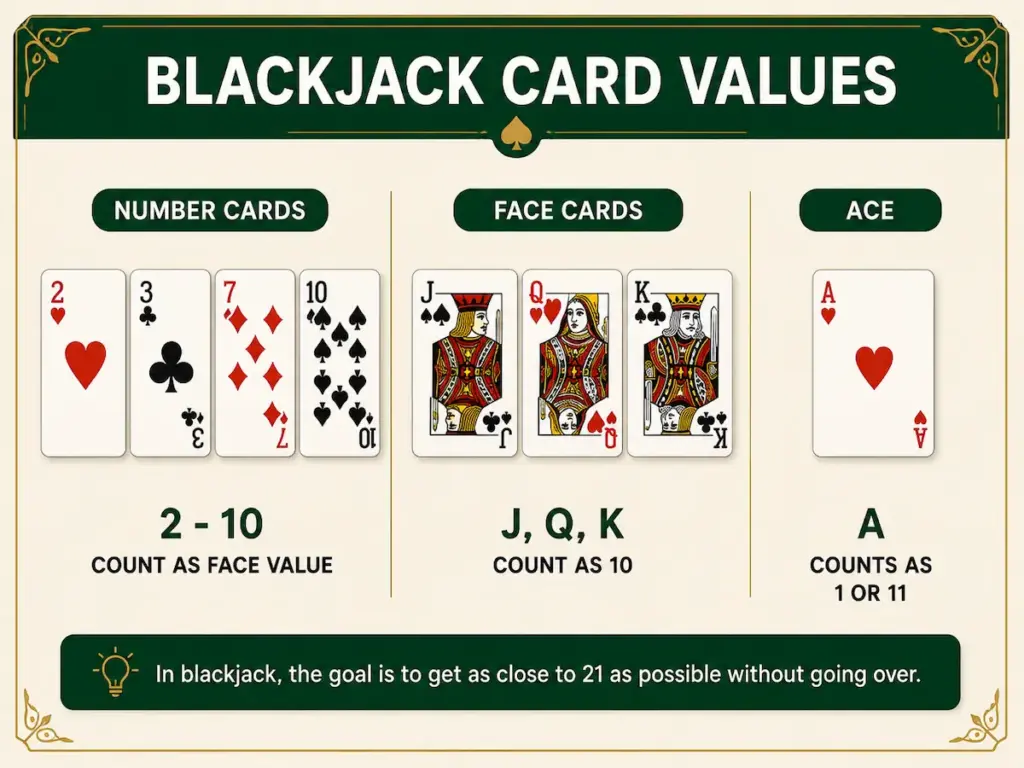
The core blackjack rules and card values are simple: number cards keep their printed value, face cards count as 10, and aces can count as 1 or 11. The objective is to beat the dealer by getting closer to 21 without going over.
The best possible starting hand is a natural blackjack: an ace plus any 10-value card as your first two cards. In many traditional games, a natural blackjack pays 3:2, although some tables pay only 6:5. That payout difference matters because it directly affects the long-term value of the game.
Blackjack is often described as a game of both luck and skill. The order of the cards is random, so no player can control which cards appear. However, player choices still matter. Decisions such as hit, stand, double down, split, and surrender can affect the long-term cost of playing.
That does not mean blackjack is a profit system. Even with correct basic blackjack strategy, the casino usually keeps a mathematical advantage in real-money games.
How to Play Blackjack Step by Step
A standard blackjack round usually works like this:
- You place a bet before the cards are dealt.
- You receive two cards.
- The dealer receives two cards, usually with one card face up.
- You choose whether to hit, stand, double down, split, or use another available action.
- After all players finish, the dealer completes the hand according to fixed rules.
- Your hand is compared with the dealer’s hand.
- You win, lose, push, or receive a blackjack payout depending on the result.
You win if your final total is higher than the dealer’s total without going over 21, and you also win if the dealer busts and your hand has not busted. You lose if your hand exceeds 21, or if the dealer finishes with a higher valid total. If your hand and the dealer’s hand have the same value, the result is usually a push, and your original bet is returned.
The most important beginner rule is simple: going over 21 is a bust. Once your hand busts, it usually loses immediately, even if the dealer later busts.
Blackjack Card Values
Blackjack card values are simple, but they are the foundation of every decision.
| Card | Value |
| 2–10 | Face value |
| Jack, Queen, King | 10 |
| Ace | 1 or 11 |
A hand without an ace counted as 11 is called a hard hand. For example, 10 + 7 is hard 17. A hand with an ace counted as 11 is called a soft hand. For example, ace + 6 is soft 17 because the ace can still change from 11 to 1 if another card would otherwise make the hand bust.
Pairs are also important. If your first two cards have the same value, many blackjack rules allow you to split them into two separate hands. For example, two 8s can often be split into two new hands, each starting with one 8.
Main Blackjack Player Actions
Most blackjack rules revolve around a small group of player actions. The exact options can vary by table, so always check the rules before playing.
| Action | Meaning | Beginner note |
| Hit | Take another card | Useful when another card may improve your hand |
| Stand | Keep your current total | Common when your hand is already strong |
| Double down | Double your bet, and take one final card | Only sensible in selected strategy spots |
| Split | Separate a pair into two hands | Rules vary by table |
| Surrender | Give up half the bet, and end the hand | Not available in every version |
| Insurance | Side bet against dealer blackjack | Usually not beginner-friendly |
Hitting gives you another card, but it also increases the chance of busting. Standing ends your turn and keeps your current total. Doubling down increases your bet, but you receive only one more card, so it should not be used randomly. Splitting can turn one weak hand into two playable hands, but it also increases the total amount at risk.
Insurance deserves special caution. It is a separate side bet offered when the dealer shows an ace. Although it may sound protective, it often carries poor value for beginners because it is not the same as improving your main hand.
Dealer Rules and Blackjack Payouts
The dealer does not make strategic choices like a player. The dealer follows fixed house rules. In many blackjack games, the dealer must hit until reaching at least 17. Some tables require the dealer to stand on soft 17, while others require the dealer to hit soft 17. This rule matters because small dealer-rule changes can affect the long-term house edge.
Blackjack payouts also matter. Standard winning hands usually pay 1:1. If you bet $10 and win a normal hand, you usually receive $10 in profit plus your original stake back. A natural blackjack may pay 3:2 on more player-friendly tables. At a 3:2 table, a $10 blackjack win pays $15 in profit. At a 6:5 table, the same $10 blackjack win pays only $12 in profit.
That difference is not cosmetic. A blackjack payout and house edge comparison shows how changing the blackjack payout from 3:2 to 6:5 can materially increase the house advantage under the same ruleset. Over repeated play, that becomes a meaningful cost difference for the player.
Blackjack Rule Variations That Change the House Edge
| Rule | Player-friendly version | Worse version | Why it matters |
|---|---|---|---|
| Blackjack payout | 3:2 | 6:5 | 6:5 materially worsens long-term value |
| Dealer soft 17 | Dealer stands | Dealer hits | H17 usually increases house edge |
| Deck count | Fewer decks, if rules remain fair | More decks / restricted rules | Affects blackjack frequency and doubling value |
| Double after split | Allowed | Not allowed | Gives players more strategic flexibility |
| Surrender | Available | Not available | Can reduce losses in poor spots |
| Side bets | Avoid / optional | Heavy side-bet use | Often higher house edge |
Rule Check: Before playing blackjack, check the blackjack payout, dealer soft 17 rule, number of decks, surrender availability, double-after-split rules, side bets, table limits, account verification requirements, withdrawal terms, and casino payment methods.
A push means your hand ties with the dealer’s hand. In that case, your original bet is usually returned, and you neither win nor lose that wager.
Basic Blackjack Strategy Explained
Basic blackjack strategy is a decision system that helps players choose when to hit, stand, double down, split, or surrender based on their hand and the dealer’s visible card. It does not rely on guessing, emotion, or streak-based thinking. It is based on long-term mathematical outcomes.
For example, a hard 16 against a dealer 10 is a very different situation from a hard 16 against a dealer 6. A pair of 8s is usually treated differently from a pair of 10s. A soft 18 can be stronger or weaker depending on the dealer’s upcard and the table rules.
Basic blackjack strategy can improve decision quality and reduce avoidable mistakes, but it does not remove the casino’s mathematical advantage, and it does not guarantee profit.
This distinction is important. Strategy helps you avoid bad decisions. It does not turn blackjack into a reliable way to make money.
How to Use a Blackjack Strategy Chart
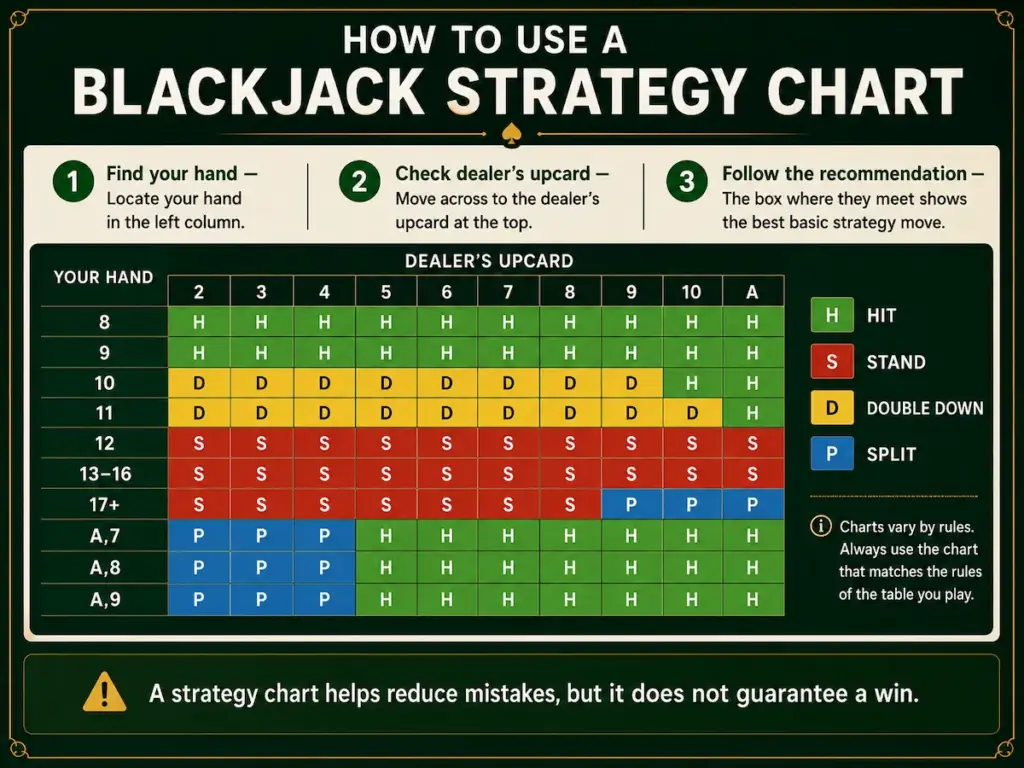
A blackjack strategy chart shows the recommended decision for different combinations of player hands and dealer upcards. The row usually shows your hand, the column shows the dealer’s visible card, and the matching cell shows the recommended action.
A blackjack basic strategy chart methodology usually separates hands into hard totals, soft totals, and splittable pairs, while also accounting for the dealer’s visible card. This is why a strategy chart is more useful than memorizing isolated rules such as “always hit” or “always stand.”
Most strategy charts separate hands into three groups:
| Hand type | What it means | Example |
| Hard totals | Hands without an ace counted as 11 | Hard 16 |
| Soft totals | Hands with an ace counted as 11 | Ace + 7 |
| Pairs | Two cards of the same value | 8 + 8 |
A simple chart may include recommendations such as:
| Player hand | Dealer upcard | Typical chart idea |
| Hard 12 | 4 | Stand may be recommended in many rule sets |
| Hard 16 | 10 | Often one of the most difficult beginner spots |
| Pair of 8s | 6 | Splitting is commonly recommended |
| Ace + 7 | 9 | Decision depends on the rules and chart type |
Beginner Blackjack Strategy Cheat Sheet
| Player hand | Dealer upcard | Beginner action |
|---|---|---|
| Hard 17+ | Any | Stand |
| Hard 12–16 | Dealer 2–6 | Usually stand |
| Hard 12–16 | Dealer 7–A | Usually hit |
| 11 | Most dealer cards | Double if allowed |
| A,7 | Depends on dealer card | Use chart |
| 8,8 | Most cases | Split |
| A,A | Most cases | Split |
| 10,10 | Most cases | Stand |
| Insurance | Dealer Ace | Usually avoid |
Table rules may change the correct decision.
How to read a blackjack strategy chart in three steps:
- Find your hand type: hard total, soft total, or pair.
- Find the dealer’s visible card along the chart.
- Use the intersecting cell to identify the suggested move.
The key point is that strategy charts are rule-dependent. A chart for one blackjack variant may not be correct for another. Deck count, surrender availability, double-after-split rules, dealer soft-17 rules, and payout structure can all affect the best decision.
For beginners, a blackjack strategy chart is best understood as a learning aid. It helps explain why certain decisions are mathematically better over time, but it cannot predict the next card, and it cannot guarantee a winning session.
Blackjack RTP, House Edge, and Odds
Blackjack RTP and house edge explain the long-term mathematics of the game.
| Concept | Meaning |
| RTP | Theoretical long-term return percentage |
| House edge | Casino’s long-term mathematical advantage |
| Variance | Short-term swings around expected results |
| Table rules | Conditions that can improve or worsen expected value |
| Strategy | Decision quality that can reduce mistakes but cannot guarantee profit |
RTP does not predict what will happen in one session. A game with a high theoretical RTP can still produce losing sessions. House edge also works over the long term, not hand by hand.
Blackjack can have a relatively low house edge compared with many casino games when the rules are favorable, and the player uses correct basic strategy. However, the exact house edge depends on the table. Important rule factors include blackjack payout, number of decks, dealer soft-17 rules, doubling restrictions, surrender availability, and side bets.
A lower house edge does not mean low risk in a single session. Blackjack still involves variance, losing streaks, emotional pressure, and the risk of rapid losses, especially when the pace of play is high.
Side bets can be entertaining, but they often carry a higher house edge than the main blackjack game. Beginners should treat them carefully and should not assume that a larger potential payout means better value.
Common Blackjack Mistakes Beginners Should Avoid
Many beginner mistakes come from ignoring the rules that affect cost.
| Mistake | Why it matters |
| Ignoring 3:2 vs 6:5 payouts | 6:5 blackjack can make the game materially worse for the player |
| Taking insurance casually | Insurance is a separate side bet, not true protection |
| Using the wrong strategy chart | Charts depend on the ruleset |
| Chasing losses | Emotional betting can increase financial harm |
| Treating strategy as a profit system | Strategy reduces mistakes, but it does not guarantee winnings |
| Ignoring limits | Fast gameplay can make losses accumulate quickly |
The biggest non-technical mistake is emotional betting. Chasing losses, increasing stakes after frustration, or treating blackjack strategy as a profit system can quickly turn a simple game into a financial risk.
Cautionary Note: Participation in gambling activities should never be viewed as a reliable source of income. It is strongly recommended that only discretionary funds be utilized for wagering purposes.
Advanced Blackjack Play and Advantage Gambling
Advanced blackjack play goes beyond the basic rules of hitting, standing, doubling, splitting, and surrendering. At this level, the focus shifts to table conditions, rule variations, deck composition, bet sizing, and long-term expected value.
This does not mean blackjack becomes a guaranteed-profit game. Even advanced strategy cannot remove variance, losing sessions, poor table rules, or casino restrictions. The goal of this section is to explain the mathematics behind higher-level blackjack play, not to present it as a reliable income method.
What Is a Blackjack Shoe?
A blackjack shoe is the device used to hold and deal multiple decks of cards in a live blackjack game. Many casino blackjack tables use six or eight decks, although some games use fewer decks or continuous shuffling machines.
The shoe matters because blackjack is partly affected by the cards that have already been dealt. When more low cards or high cards leave the shoe, the remaining deck composition changes slightly. This is the foundation behind card counting and other advantage-play concepts.
A blackjack shoe is not automatically good or bad for the player. The quality of the game depends on the full rule set. A six-deck blackjack game with 3:2 payouts, fair doubling rules, and good deck penetration may be better than a single-deck game with 6:5 payouts and restricted player options.
The most important shoe-related factors are the number of decks, blackjack payout, dealer soft 17 rule, deck penetration, shuffling method, and table limits. Continuous shuffling machines usually reduce or remove the practical value of tracking previously dealt cards.
What Is Card Counting in Blackjack?
Card counting is a blackjack strategy used to estimate whether the remaining cards in the shoe are more favorable to the player or the dealer. It does not predict the next card. Instead, it gives the player a rough mathematical signal about the composition of the cards still left to be dealt.
The basic idea is that high cards, especially tens and aces, are generally better for the player. They increase the chance of blackjack, improve double-down opportunities, and can make the dealer more likely to bust in certain situations. Low cards are usually more useful to the dealer because they help complete stiff hands without busting.
One of the most widely known systems is the Hi-Lo count. In simple terms, low cards increase the count, high cards decrease the count, and neutral cards do not change it. The player tracks a running count as cards are dealt and then converts it into a true count by adjusting for the number of decks still left in the shoe.
The true count is important because the same running count does not mean the same thing in every shoe. A +4 running count with one deck remaining is much stronger than a +4 running count with five decks remaining.
Card Counting Does Not Guarantee Profit
Card counting is often misunderstood. It is not a guaranteed winning system, and it does not remove the risk of losing money. Even when a player has a small mathematical edge, short-term variance can still create long losing periods.
There are also practical limits. A player needs enough bankroll to survive swings, enough discipline to follow the system correctly, and enough favorable table conditions for the edge to matter. Poor rules, 6:5 blackjack, limited doubling, no surrender, shallow deck penetration, or continuous shuffling can make advantage play much less effective.
Casinos may also restrict, back off, or refuse service to players they suspect of advantage play. Online casinos may limit certain betting patterns, restrict bonus use on blackjack, or treat advantage-play behavior differently in their terms and conditions.
For most players, learning basic blackjack strategy and choosing fairer table rules is more practical than trying to count cards.
Popular culture has also helped make card counting famous. The film 21 is based on the MIT Blackjack Team story and shows how blackjack advantage play became part of mainstream casino culture. However, it should be treated as entertainment, not as a reliable guide to real blackjack strategy. Real advantage play depends on table rules, deck penetration, bankroll discipline, variance, and casino restrictions.
Advanced Strategy Deviations
Basic blackjack strategy gives the best default decision for a specific rule set. Advanced players sometimes go further by using strategy deviations. This means changing the standard basic-strategy decision when the count suggests that the remaining shoe is unusually favorable or unfavorable.
For example, a basic strategy chart may recommend one action in a neutral shoe, but a high true count can make a different decision mathematically stronger in specific situations. This can affect standing, doubling, splitting, surrendering, or even taking insurance in rare count-dependent spots.
However, these deviations only make sense when the player understands the full context. The correct decision depends on the player’s hand, the dealer’s upcard, the number of decks, the dealer soft 17 rule, double-after-split rules, surrender availability, and the estimated composition of the remaining shoe.
For general players, this level of strategy is not necessary. A clean basic strategy chart and good table selection usually matter more than memorizing advanced index plays.
Blackjack Table Selection Matters
Advanced blackjack starts before the first hand is dealt. Table selection can affect the long-term math more than many small tactical decisions.
The most important rule to check is the blackjack payout. A 3:2 blackjack payout is generally much better for the player than 6:5. Players should also check whether the dealer hits or stands on soft 17, whether doubling is allowed on any first two cards, whether doubling after split is allowed, whether surrender is available, and whether the table uses a continuous shuffling machine.
Side bets also deserve caution. They can be entertaining, but they often carry a higher house edge than the main blackjack game. A player who follows basic strategy on the main hand but plays high-edge side bets heavily may still worsen their long-term expectation.
A useful beginner rule is simple: choose 3:2 blackjack where available, avoid 6:5 tables when possible, be cautious with side bets, and check the table rules before sitting down.
Insurance and Side Bets in Advanced Blackjack
Insurance is one of the most misunderstood blackjack options. Beginners often see it as protection, but in most situations it is not a good default decision. Insurance only becomes mathematically relevant in specific card-counting situations where the remaining shoe is rich in tens.
For most players, the safer approach is to avoid insurance as a standard move. The same applies to many blackjack side bets. They may offer large payouts, but they usually come with higher volatility and a higher house edge than the main game.
Side bets should be treated as optional entertainment, not as part of a serious blackjack strategy.
Online Blackjack and Card Counting
Card counting generally does not work in standard RNG online blackjack because the hands are usually dealt from independently randomized digital decks or shoe models. Since previous hands do not create the same useful shoe information, traditional card counting has little or no practical value in most RNG blackjack games.
Live dealer blackjack is closer to a real shoe game, but even there, practical limitations matter. Shuffle frequency, deck penetration, table limits, game speed, camera visibility, and platform terms can all reduce the value of advanced play.
Players using casino bonuses should also be careful. Blackjack may contribute little, nothing, or only partially toward wagering requirements. Some bonus terms may also restrict betting patterns, strategy-based play, or low-risk wagering behavior.
Advanced Blackjack Takeaway
Advanced blackjack strategy is mainly about understanding the mathematics behind the game. Basic strategy reduces avoidable mistakes. Fairer rules reduce the house edge. Card counting and advantage play try to go further by estimating when the remaining shoe becomes more favorable.
For most players, the best practical approach is still simple: learn basic strategy, avoid 6:5 blackjack, be careful with side bets, check the table rules, set a fixed budget, and never treat blackjack as a reliable source of income.
Cautionary Note: Participation in gambling activities should never be viewed as a reliable source of income. It is strongly recommended that only discretionary funds be utilized for wagering purposes.
Online Blackjack vs Live Blackjack Rules
Online blackjack generally appears in two main formats: RNG blackjack and live dealer blackjack. RNG blackjack uses software-based outcomes, while live dealer blackjack uses a streamed human dealer. Both formats can follow similar blackjack rules, but the details may differ.
Before playing online, check the table rules, payout structure, side bets, minimum and maximum bet limits, account verification requirements, withdrawal conditions, and casino payment methods. These practical details can affect the playing experience even when the core blackjack rules look familiar.
Live blackjack may feel closer to a land-based casino because a real dealer manages the game. However, it can also move quickly, and table limits may vary. RNG blackjack may offer faster rounds, which can increase the speed at which losses accumulate if a player does not set limits.
Online Blackjack Casino Checks Before You Play
Before comparing casino options, note that this site is reader-supported. If you sign up through our links or use our provided codes, we may earn a commission at no extra cost to you. These partnerships help us fund our research, testing, editorial work, and free-to-access content, without changing our review standards or recommendations.
This blackjack rules guide is not a casino ranking page. However, some readers may want to compare where blackjack is available online. If you do, focus on practical playing conditions rather than headline bonuses. The most important checks are blackjack payout rules, live dealer availability, RNG table game options, side bets, account verification, withdrawal terms, responsible gambling tools, and payment flexibility.
Where to Compare Online Blackjack Casinos
| Casino review | What to compare before playing blackjack |
| CoinCasino’s crypto-focused casino review | Compare table-game availability, payment structure, account checks, withdrawal conditions, and responsible gambling controls before playing. |
| BitStarz live casino and game-library review | Compare live casino options, provider variety, mobile usability, account conditions, and multi-currency payment flexibility. |
| Jackbit table-game and crypto casino review | Compare RNG table games, live casino access, crypto payment support, verification rules, and platform usability. |
| Shuffle Casino review | Compare blackjack availability, live casino options, platform usability, payment conditions, and player-control features. |
| Goldenbet casino review | Compare blackjack formats, live casino structure, site rules, payment terms, and responsible gambling tools. |
For blackjack specifically, do not choose a casino only because it advertises a large bonus. A better comparison starts with the rules of the table: whether blackjack pays 3:2 or 6:5, whether the dealer hits or stands on soft 17, whether doubling after split is allowed, how side bets work, and whether the table limits fit your budget.
Some reviewed casinos may support cryptocurrency deposits or withdrawals. Crypto gambling adds wallet-management risk and price-volatility risk on top of normal gambling risk.
CRYPTO RISK WARNING: Cryptocurrency gambling involves high financial risk and is subject to market volatility. Participation may result in the loss of funds. This content is intended strictly for users 18+ only. Please play responsibly.
Who Blackjack May Suit
Blackjack may suit players who enjoy clear rules, simple scoring, and decision-making. It may also appeal to players who prefer a casino game where learning the rules can reduce avoidable mistakes.
It is especially suitable for people who are willing to learn basic blackjack strategy before playing with real money. A patient beginner can start by understanding card values, dealer rules, player actions, and payout differences before moving on to a strategy chart.
However, blackjack still requires discipline. A player who understands the rules but ignores budget limits can still lose money quickly.
Who Should Avoid Blackjack
Blackjack may not suit players who want guaranteed outcomes, dislike learning rules, or feel pressured by quick decisions. It may also be unsuitable for anyone who is tempted to chase losses or increase bet size emotionally.
Players should avoid blackjack if they view gambling as a way to make a living. Even when blackjack has a relatively low house edge under favorable rules, it remains a gambling product with uncertain outcomes.
The game may also be a poor fit for players who are strongly attracted to side bets without understanding their cost. Side bets can change the risk profile of a blackjack session and should not be treated as a shortcut to better results.
Responsible Gambling and Blackjack Risk Management
Blackjack involves financial risk even when you understand the rules and use basic strategy. Strategy can reduce avoidable mistakes, but it cannot guarantee profit or remove the casino’s mathematical advantage.
Before playing blackjack with real money, review our responsible gambling guidance. Set a budget, set a time limit, and decide in advance when to stop. Do not use money needed for bills, rent, debt payments, food, or other essentials.
If gambling causes stress, secrecy, financial pressure, or repeated attempts to recover losses, stop playing and seek support. Blackjack should be treated as paid entertainment, not as a financial strategy.
Responsible Gaming Notice: Online gambling involves financial risk and the potential for addiction. Never play with money you cannot afford to lose. If you or someone you know is struggling with gambling, please contact organizations such as BeGambleAware.org