
The Enduring Appeal of Classic Formats
Various poker variations experience massive popularity phases. Fast-fold tables once seemed incredibly revolutionary. Lottery-style games promised massive, sudden wealth. High-stakes professionals briefly obsessed over stripped-deck variants. Eventually, these intense trends cool down significantly. Competitors usually return to fundamental game types. Surprisingly, classic single-table events quietly survived everything.
The Golden Era of Digital Grinding
Veterans remember a completely different online landscape. During the late 2000s, these formats dominated entirely. Major platforms hosted nonstop single-table action constantly. Internet forums brimmed with incredible volume achievements. Players proudly shared their impressive tracking charts. Completing thousands of matches annually was remarkably common. Generous loyalty rewards provided huge, reliable profit streams.
Treating Cards Like a Professional Career
This specific path lacked fame but offered consistency. Many individuals treated this as legitimate daily employment. I recall a dedicated professional doing exactly this. He maintained low living expenses while grinding daily. Playing mid-stakes matches yielded excellent annual financial returns. He ignored massive weekend tournament events completely. Yet, his loyalty bonuses guaranteed true financial stability. That lifestyle feels almost unbelievable in modern times.
Adapting to the Modern 2026 Ecosystem
Naturally, the digital economy transformed over time. Recreational participants quickly migrated toward jackpot-style offerings. Platform fees escalated while overall skill advantages narrowed. Despite these specific hurdles, this format proudly persists. The general traffic dropped, yet absolutely remains viable. They offer a phenomenal, condensed competitive poker experience. You undergo an entire tournament structure very rapidly. Everything resolves completely within sixty short minutes.
A Fast-Paced Test of True Skill
Think of these quick games like strong espresso. They deliver a rapid, intense, and stimulating boost. Unprepared competitors will find the experience quite harsh. Mastering late-game mathematics remains crucial for long-term success. Careful bankroll management ensures you survive the variance.
Understanding the Mechanics of On-Demand Tournaments
Fundamentally, these events represent the most straightforward competitive poker. Matches begin immediately after reaching seating capacity. Competitors bypass scheduled countdowns completely.
Standard formats usually feature six or nine competitors. Larger multi-group variations exist but remain relatively rare. Entry fees accommodate both beginners and high-stakes professionals. Increasing wager speeds dictate your overall strategic approach significantly. Normal paces require roughly sixty minutes to finish. Accelerated variants conclude much more rapidly. Extreme-speed matches demand incredibly aggressive, immediate decisions.
Why This Format Demands Unique Strategies
Crucially, these specific battles possess definite, unavoidable conclusions. Continuous ring tables function quite differently by comparison. Those participants may exit whenever they choose. Passive strategies fail completely during on-demand events. Escalating forced bets constantly pressure your chip supply. Rivals face elimination until one ultimate victor emerges.
Massive scheduled events demand huge daily time commitments. Single-table competitions offer a brilliant, condensed alternative. Losing money after grinding endlessly feels incredibly devastating. Fortunately, limited-entry competitions solve this specific emotional problem. Their brief nature ensures highly predictable playing sessions. Financial reward distributions remain clear from the beginning. You always understand the exact required time investment.
The Dining Metaphor for Card Games
Consider comparing different card formats to dining experiences. Endless ring tables resemble an open smorgasbord. You grab whatever appeals and depart upon satisfaction. Huge fields mimic exhausting, day-long celebratory feasts. Those massive events might leave you completely empty-handed. Meanwhile, on-demand matches represent a fast, individual meal. You consume everything quickly during one brief visit.
Exploring Various Single Table Formats
Single-table tournaments offer vastly distinct gameplay experiences. Imagine various tea preparations providing unique energy levels. Understanding these structural differences is vital for profitability.
| Match Category | Escalation Speed | Primary Tactical Focus |
| Regular Pace | Gradual | Complex street-by-street decisions |
| Accelerated | Moderate | Timely stealing opportunities |
| Ultra-Fast | Extreme | Pre-flop mathematical precision |
| Solo Confrontation | Variable | Relentless psychological pressure |
Regular Speed Competitions
Normal speeds represent a deliberate, calculated approach. Wager requirements escalate slowly over extended periods. Participants retain deep chip reserves much longer. This structure heavily rewards complex post-flop maneuvering. You have ample time for patient observation.
Accelerated Variations
These structures mimic heavily caffeinated beverages. Forced bets increase much more frequently here. Escalating chip pressure dictates earlier aggressive actions. Competitors must abandon tight playing styles rapidly. Waiting for premium holdings becomes structurally impossible.
Lightning-Fast Iterations
Ultra-fast matches deliver extreme, sudden shocks. Betting requirements double almost immediately after starting. Decisions quickly reduce to pushing or discarding. Chip advantages vanish within mere moments. Pre-flop mathematics dictate absolutely every strategic move.
One-on-One Battles
Solo competitions eliminate multiplayer dynamics entirely. Two challengers fight relentlessly for absolute victory. Every single distribution requires intense tactical interaction. It represents brutal intellectual combat using cards. Hiding from difficult situations is fundamentally impossible.
Surviving Structural Chaos
Navigating ultra-fast matches requires embracing absolute chaos. Opponents might randomly risk everything holding trash. Frequently, eliminations happen shockingly early during sessions. Players often sit bewildered after sudden defeats. Embracing massive variance is mandatory here. You must detach emotionally from individual results completely.
Distinct Phases of Every Match
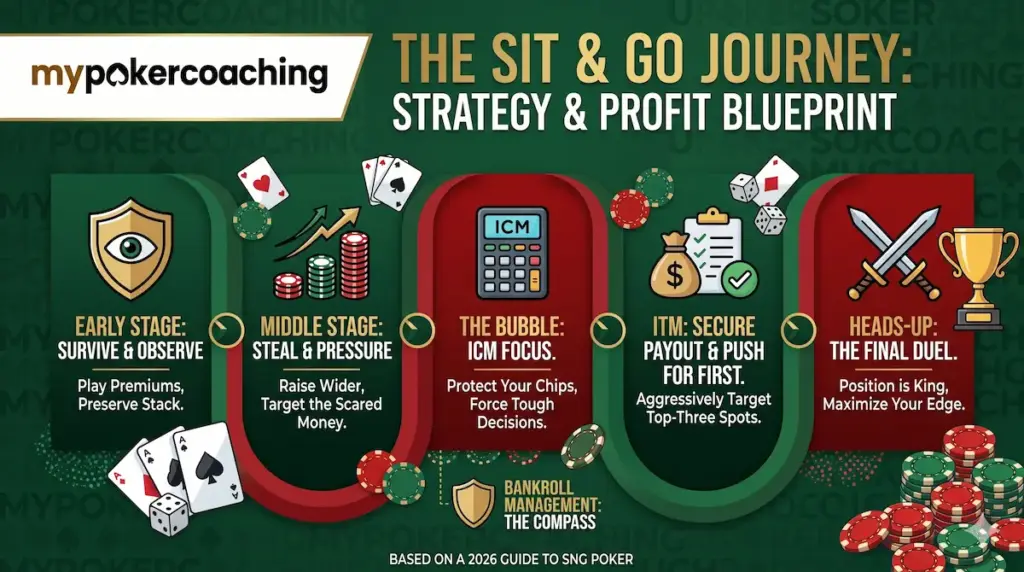
Single-table tournaments follow a highly predictable narrative structure. Each event contains a beginning, middle, and end. 📖 Bypassing any crucial chapter is strategically impossible. This rigidity teaches fundamental concepts incredibly well. We must master early, middle, and late dynamics. Understanding the financial threshold and final duel is critical.
Phase One: Navigating Initial Tranquility
Opening levels feature negligible mandatory wagers. Competitors possess massive starting chip supplies initially. Immediate survival pressure simply does not exist yet. Unfortunately, inexperienced participants frequently destroy themselves here.
They randomly risk everything holding mediocre pairs early. Others carelessly exhaust chips chasing weak combinations. Building a massive stack immediately is strategically incorrect. 🛑 Preserving your initial capital is paramount now. Aggressively accumulating chips matters less than simple survival.
Your initial tactical approach should emphasize extreme patience. Execute plays utilizing only premium starting hands. Attempt hitting valuable three-of-a-kind combinations cheaply. Otherwise, discarding weak holdings is entirely acceptable. Entering the subsequent levels safely is your primary objective.
Witnessing early eliminations holding marginal cards is common. Players often justify these errors claiming aggression. In reality, they simply surrender their entry fees.
Phase Two: Escalating Strategic Pressure
Maintaining extreme patience eventually becomes strategically disastrous. Escalating mandatory wagers demand significant behavioral adjustments now. Continuing initial tight strategies guarantees slow, agonizing elimination.
This phase demands calculated, intelligent aggressive actions. Targeting mandatory wagers from late positions becomes vital. Exploit passive competitors attempting mere survival strategies. Broaden your attacking range without becoming wildly reckless.
Observant participants quickly identify fearful opponents easily. Timid players routinely discard decent holdings under pressure. They clearly prioritize minimum financial returns over victory. These hesitant individuals become your primary tactical targets. 🎯
However, aggression requires proper contextual application always. Blindly risking half your capital is demonstrably foolish. Execute calculated maneuvers until perfect opportunities materialize.
Phase Three: The Financial Threshold
Three individuals receive compensation from four remaining competitors. This critical moment introduces immense psychological pressure. Every single decision carries massive financial implications immediately.
Mathematical models dictate optimal strategies during this phase. Theoretical chip values differ significantly from actual currency. Losing chips damages your equity tremendously right now. Conversely, doubling your stack offers surprisingly minimal benefits. Consequently, you discard holdings previously considered automatic calls.
Short-stacked competitors face strict binary choices constantly. Executing passive calls guarantees inevitable, swift elimination. Utilizing aggressive shoving generates crucial fold equity. 📉 You must leverage this advantage before vanishing completely.
Medium stacks face excruciatingly complex strategic dilemmas constantly. They lack bullying power but retain survival hopes. Navigating this specific situation requires incredible tactical precision.
Massive chip leaders wield terrifying operational advantages here. They aggressively pressure opponents holding marginal cards easily. Forcing rivals into miserable decisions generates tremendous profitability.
Witnessing premium pairs folded here feels incredibly unnatural. Yet, strict mathematical models occasionally demand such sacrifices. Correct theoretical decisions sometimes feel emotionally devastating. Embracing this harsh reality is absolutely mandatory.
Phase Four: Securing Minimum Compensation
Securing initial compensation frequently triggers dangerous psychological relief. Satisfied participants often relax their strategic focus entirely. Consequently, they slowly bleed chips until elimination.
Minimum payouts barely cover your initial investments. Massive profitability exclusively requires securing first-place victories. Consistently transforming small cashes into outright wins is vital. 🏆 Achieving this demands relentless, punishing aggressive actions. Passive strategies guarantee disappointing, low-tier financial finishes.
Your long-term profitability heavily depends upon post-bubble performance.
Phase Five: The Ultimate Solo Duel
Final confrontations ultimately determine your overall win rate. Weakness during solo play destroys potential profitability rapidly.
Aggressively attacking from advantageous positions is absolutely required. Playing extensively broad ranges becomes mathematically necessary. Ultra-fast formats require perfect memorization of specific charts. 📊 Pushing marginal holdings feels counterintuitive but remains correct. If calculated models demand aggression, you must comply.
Consider this phase exactly like decisive penalty kicks. Flawless earlier performance means nothing without finishing strong.
The Mathematical Framework Dictating Success
To put it plainly, mastering single-table tournaments requires understanding the Independent Chip Model deeply. This specific mathematical formula converts tournament tokens into actual financial value. It perfectly explains why discarding premium pairs is sometimes mandatory. Taking seemingly profitable risks before securing payouts often causes absolute disasters.
Many players initially dismiss these calculations as overly complex academic theories. Trusting standard hand strength frequently leads to agonizing eliminations right outside the payout structure. Those seemingly obvious calls actually destroy your long-term financial expectations completely. Applying these principles is absolutely mandatory for achieving consistent profitability. Think of this concept as your crucial navigational tool avoiding financial ruin.
Essential Software for Tactical Improvement
Dedicated training software provides immense value for serious competitors. Programs analyzing mathematical equity situations are absolutely vital for modern players. Practice difficult scenarios constantly using advanced digital calculators. Eventually, surrendering strong holdings will feel logically correct rather than emotionally painful.
Studying comprehensive guides detailing these fundamental theories improves your overall competitive edge immensely. These specific mathematical concepts apply universally across all competitive poker formats. Mastering them forms the absolute foundation of your winning strategy.
Protecting Your Capital Effectively
Statistical fluctuations absolutely destroy underfunded players quickly. You must maintain sufficient financial reserves always. Proper funding prevents inevitable bad luck from destroying your career.
- Normal speeds require fifty entry fees minimum.
- Accelerated structures demand seventy-five units.
- Ultra-fast matches necessitate over one hundred entries.
Ignoring these strict guidelines guarantees extreme disaster. As an AI analyzing vast historical data, I see players repeatedly ruin themselves. Taking premature risks ends terribly almost always. Losing three consecutive matches damages inadequate balances severely. Emotional frustration inevitably causes reckless subsequent decisions. Total financial ruin usually follows shortly after.
Personal pride constantly destroys player funds completely. Compete exclusively where your capital dictates safely. The cards ignore your perceived personal greatness completely.
Analyzing Financial Returns Across Eras
Historically, these formats provided incredibly easy income. Mid-level competitors generated massive wealth two decades ago. Generous platform rewards boosted overall gains easily. Opponent skill levels remained incredibly low universally.
Modern conditions present much tougher challenges entirely. The digital landscape transformed quite significantly lately. Operator charges increased while recreational traffic vanished. Amateurs favor lottery-style variations predominantly nowadays. Elite professionals accept substantially smaller profit margins today.
Expected returns hover around five to ten percent. Achieving this requires absolutely flawless emotional discipline constantly. Statistical variance complicates these theoretical numbers heavily. Flawless play cannot prevent devastating losing streaks entirely. Generating immense playing volume remains absolutely critical always.
Dedicated professionals endure grueling twelve-hour daily schedules. Earning moderate annual salaries demands exhausting daily commitments. This intense lifestyle causes severe mental exhaustion rapidly.
Seeking rapid wealth here proves utterly foolish. However, this format perfects fundamental tactical skills beautifully.
The Final Verdict on Single Table Tournaments
Single-table tournaments remain an excellent training ground in 2026. The massive, effortless profits of earlier eras have vanished. However, mastering these quick games builds incredible fundamental skills. You learn absolutely crucial concepts regarding mathematical equity constantly. They teach strict bankroll discipline better than anything else. Embrace the intense grind and manage your financial expectations realistically. Enjoy the pure, condensed competitive thrill they provide.
| PROS | CONS |
| Highly predictable duration for every single match. | Profit margins remain relatively small nowadays. |
| Excellent for learning fundamental tournament strategies effectively. | High operator fees reduce overall earnings significantly. |
| Lower variance compared to massive scheduled events. | Generating massive playing volume is absolutely mandatory. |
| Clear and fully transparent financial reward structures. | |
| Constant availability without waiting for scheduled countdowns. |
Frequently Asked Questions
Is playing Sit and Go poker still profitable in 2026?
Yes, they absolutely remain profitable for highly disciplined competitors. You must generate immense volume to secure reasonable incomes. Overcoming small profit margins requires extreme dedication. Proper capital management is absolutely mandatory for your survival.
How many buy-ins do I need for Sit and Go tournaments?
Bankroll requirements depend heavily upon your chosen game speed. Normal speeds require at least fifty entry fees minimum. Accelerated formats demand roughly seventy-five dedicated units. Ultra-fast variations necessitate over one hundred initial buy-ins.
What is the Independent Chip Model (ICM) in poker?
It is a crucial mathematical formula for tournament poker. This specific model converts your chips into real monetary equity. It accurately dictates your late-game pushing and folding strategies. Mastering this concept prevents devastating financial mistakes entirely.
Why are Sit and Go tournaments better for poker beginners?
They provide a fantastic, contained learning environment very quickly. New players experience every single tournament phase repeatedly. This repetition builds strategic familiarity incredibly fast. You successfully avoid the exhausting time commitments of massive events.