
The $5 million poker hand from the King Poker Cup Million Dollar High Stakes Poker Cash Game in Jeju was one of the largest pots ever played on a widely broadcast live poker stream. The hand began as a four-way pot at $1,000/$2,000 and eventually grew to more than $5 million by the river.
The game brought together several high-stakes regulars, including Wiktor Malinowski, better known as “Limitless”, with a $1 million buy-in that raised the session's stakes. Jeju has also become an increasingly prominent destination for high-stakes poker, with Phil Ivey recently mentioning the city as his favorite place to play poker.
A bejegyzés megtekintése az Instagramon
The hand itself involved Malinowski, Esti “ST” Wang, Aaron Zang, and HY. What started as a relatively unusual multiway pot developed over several streets, with multiple draws and strong made hands eventually leading to more than $5 million going into the middle.
In this hand breakdown, we'll go through the action street by street and examine the key decisions made by each player. We'll look at the preflop setup, the draws that developed on the flop, Zang's turn raise, and the river decision that ultimately determined who won the pot.
A Record-Breaking Moment in High Stakes Cash Game
The $1,000/$2,000 cash game in Jeju featured several experienced high-stakes players, with deep stacks and a $1 million buy-in creating the conditions for large pots. The game also used the “squid rule”, an optional rule that can encourage larger pots by increasing the value of certain hands.
The hand discussed below developed as a four-way pot and grew from $147,000 before the flop to more than $5 million by the river. While the final pot size is what makes the hand notable, the individual decisions on each street are what make it worth analyzing.
The Hand That Built One of the Largest Poker Pots Ever
The hand began with a live straddle and four players seeing the flop. Malinowski entered the pot with K♥J♣, while Aaron Zang held J♦9♣ and HY had 8♥7♥. Esti “ST” Wang called preflop with his cards remaining unknown.
From there, the pot grew on every street. Zang flopped an open-ended straight draw, Malinowski picked up top pair on the turn, and Wang's disguised hand eventually became the key to the $5 million pot.
Here's how the action unfolded.
Preflop: A Non-Standard Start
The hand begins with Esti “ST” Wang calling the live straddle from first position with his cards unknown. Aaron Zang called from the hijack with J♦9♣, followed by HY with 8♥7♥ in the cutoff.
Wiktor Malinowski then raised to $35,000 from the button with K♥J♣. ST called, and both Zang and HY came along as well, creating a four-way pot worth $147,000 going to the flop.
With three players calling the raise, Malinowski was unable to isolate a single opponent, and the pot went multiway despite the substantial preflop sizing. ST's decision to continue also meant his range remained difficult to define, as his cards were still unknown.
Flop: Multiple Draws in a $5 Million Poker Hand
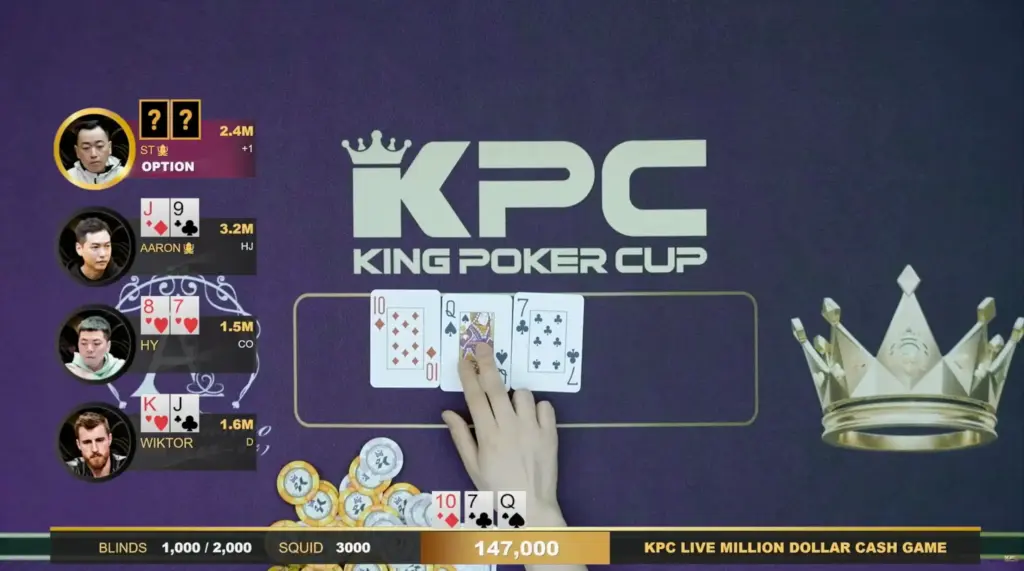
The flop came T♦ 7♣ Q♠, giving several players ways to connect with the board. Esti Wang checked from early position, while Aaron Zang checked behind with J♦9♣, giving him an open-ended straight draw. HY also checked, bringing the action to Wiktor “Limitless” Malinowski on the button.
Malinowski bet $45,000 into the $147,000 pot, roughly 1/3 of the pot. ST called, leaving his range difficult to define. Given his preflop limp-call, he could still have a wide range containing draws, pairs, or stronger hands that had chosen to play more passively.
Zang also called with his open-ended straight draw, while HY folded. The pot was now $282,000, with three players remaining.
At this point, the hand was still relatively open. Zang and Limitless had a clear drawing hand, while ST's holdings remained unknown, making the turn particularly important for how the ranges would develop.
Turn: Where Everything Changes
The turn brought the K♠, changing the hand significantly. Esti Wang checked again, while Aaron Zang had now completed a straight with J♦9♣. Limitless also improved to a pair with K♥J♣, while picking up additional straight-draw potential.
Malinowski bet $135,000 into the $282,000 pot, just under half pot. Wang called, while Aaron Zang raised to $635,000 with his straight.
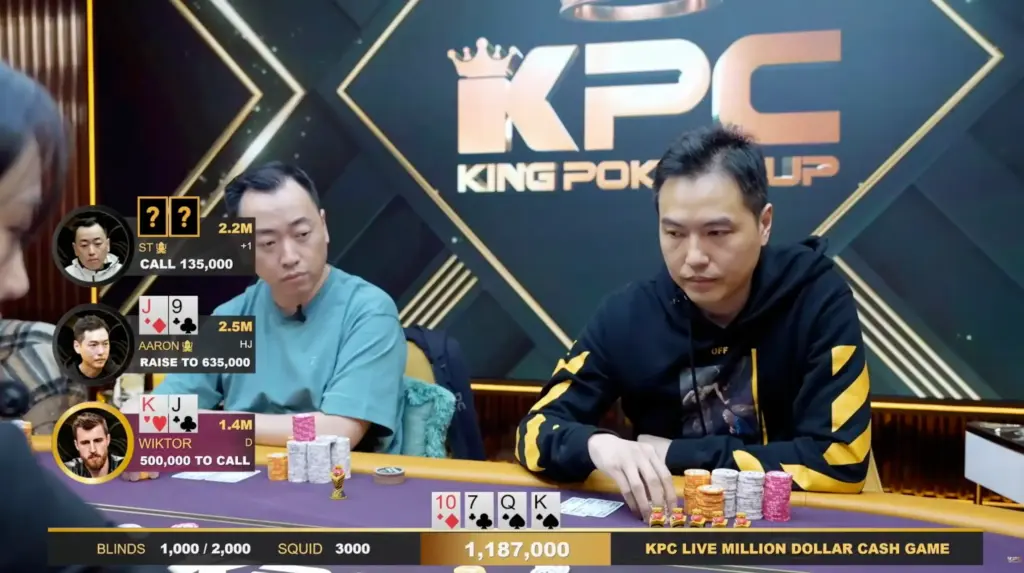
Malinowski folded his hand, leaving Wang to make the next decision. His holding was still unknown, but the turn had created a much stronger range interaction: Zang now represented a made straight, while Wang could still have a variety of made hands and draws based on his preflop and flop actions.
After a lengthy tank, ST Wang called the raise. The pot grew to approximately $1.68 million going to the river.
River: The $5 Million Decision
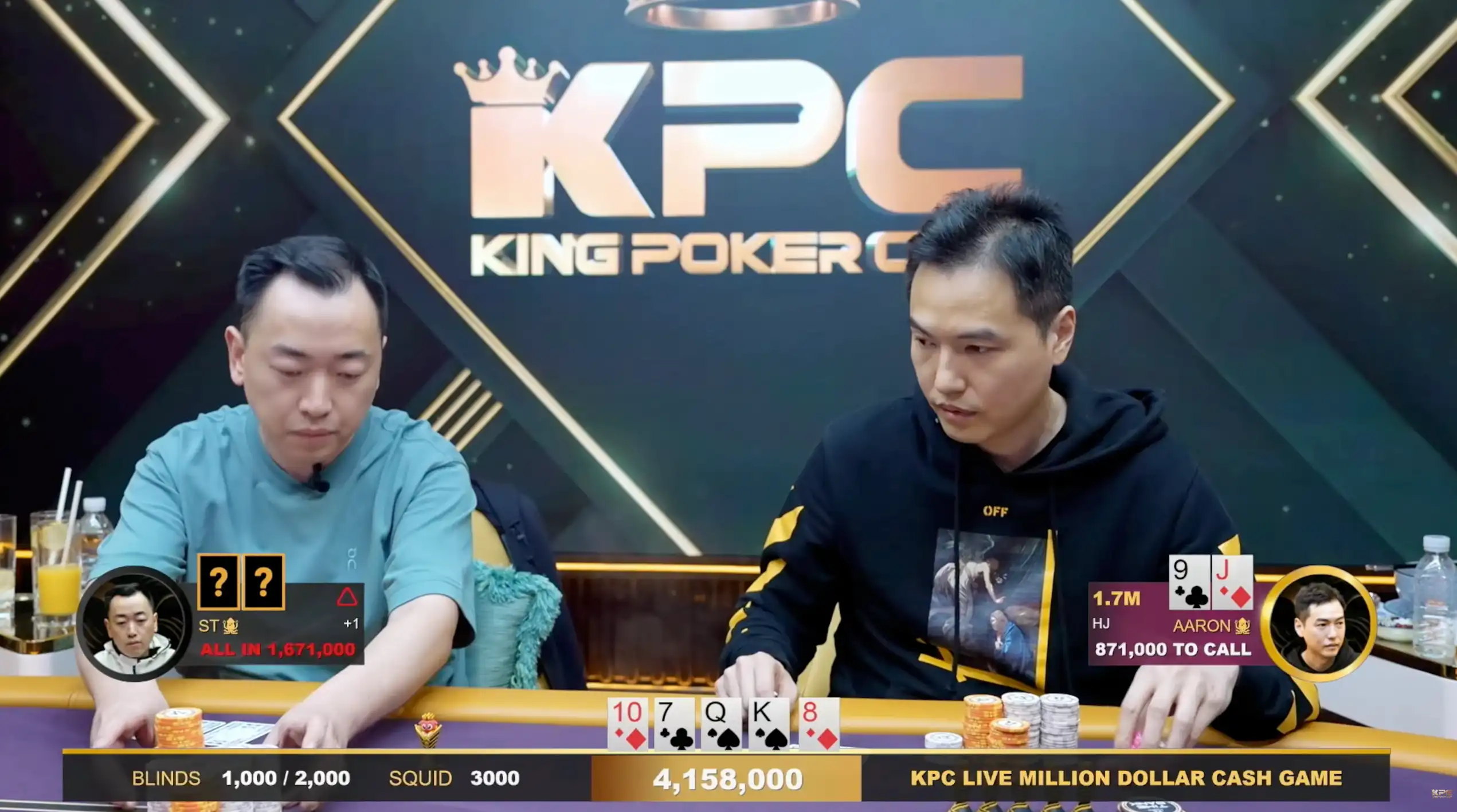
The river brought the 8♦, completing the board as T♦ 7♣ Q♠ K♠ 8♦. Esti Wang checked, and Aaron Zang was now holding the second-nut straight with J♦9♣. With $1.687 million already in the pot, Zang bet $800,000.
Wang responded by moving all-in. Zang now faced a decision for the rest of his stack with a hand that would beat almost every other straight, except A-J. After considering the action, Zang called.
Wang revealed A♥J♥, showing the nut straight. Zang's J♦9♣ was beaten, and the final pot grew to more than $5 million. What began as a $147,000 four-way pot before the flop had escalated into one of the biggest pots of the session.
What Makes This One of the Largest Poker Pots Ever So Unique?
At first glance, this hand looks like an unavoidable cooler. Wang had the nuts on the river, while Zang held the second-nut straight, making it extremely difficult to find a fold after Wang moved all-in.
What makes the hand more interesting is how Wang's strength remained hidden throughout the earlier streets. His preflop limp-call and subsequent checks gave Zang very little information about the strength of his hand, allowing Wang to reach the river with the nut straight without having clearly represented a strong holding.
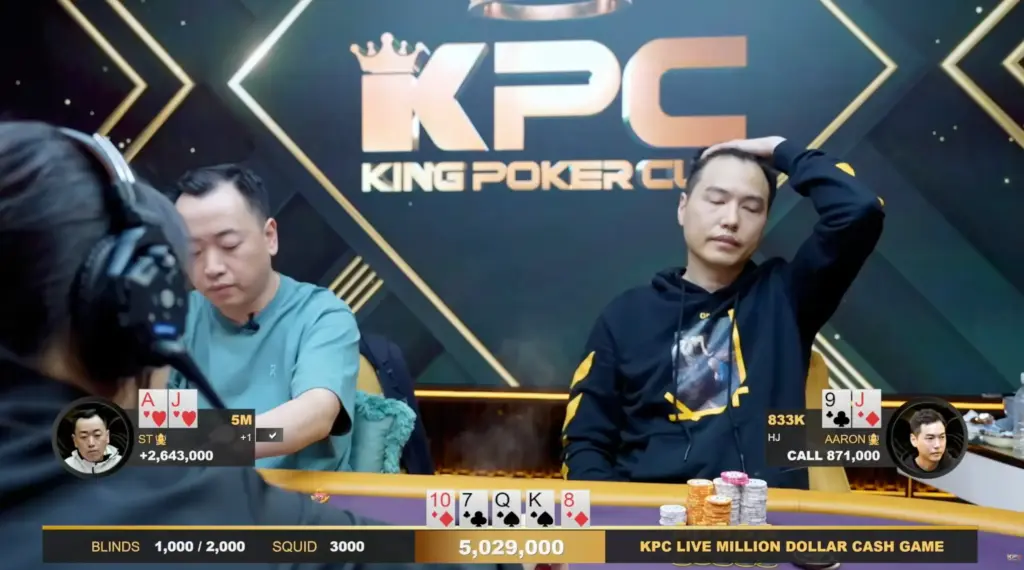
By the river, Zang had a hand that beat almost every other straight, while missed draws and weaker made hands were still possible in Wang's range. Once ST Wang check-raised all-in, however, the only hand that could beat Zang's second-nut straight was the A-J straight.
That combination – a disguised range, a very strong but non-nut hand, and a massive river decision – is what makes the hand particularly interesting from a strategic perspective.
Largest Poker Pots Ever: Where Does This Hand Rank?
Placing this hand among the largest poker pots ever is not as straightforward as it might seem.
The $5 million pot is one of the biggest ever captured on a widely shared live stream, but the broader high-stakes poker landscape is much harder to compare. There are reports of even larger pots, including some exceeding $10 million, played in private cash games or partially documented settings. Many of these hands cannot be fully verified, lack complete footage, or were never part of an officially broadcast game.
One of the most iconic benchmark hands in this category comes from Tom Dwan, who won a pot worth over $3.1 million on a live broadcast. Even earlier, Dwan was involved in another famous hand against Phil Ivey in 2009, which held the record for the largest televised poker pot of its era and was recognized by Guinness World Records at the time.
Within this context, the $5 million pot we've just analyzed clearly belongs among the largest publicly documented pots in modern live-streamed poker. Unlike some of the larger reported private pots, the entire hand can be studied street by street, making it particularly useful for understanding how a pot of this size developed.
The significance of the hand, then, is not necessarily where it sits on an all-time list. It is that a fully documented $5 million pot developed through a series of decisions that can still be analyzed in detail.
What Can We Learn From This Hand?
At the highest stakes, the biggest pots are rarely about obvious mistakes. More often, they come down to thin margins, difficult decisions, and how each player's range develops throughout the hand.
This hand highlights the value of keeping a strong holding disguised. By staying passive and keeping his range difficult to define, ST was able to reach the river with the nut straight without having clearly represented how strong his hand was.
At the same time, the hand shows how difficult these spots can be even with an extremely strong holding. Zang had the second-nut straight on the river, making a fold extremely difficult to find. But when the action and the ranges are considered together, even a hand that strong can become a bluff-catcher.
The key takeaway is simple: the strength of your hand matters, but the story your opponent is telling matters just as much. In the biggest pots, understanding that story can be just as important as the cards you're holding.
If analyzing these massive hands inspires you to hit the cash game tables, BCPoker is currently one of our top recommended platforms for grinders of all levels. You can use the exclusive bonus code VIPBONUS upon registration to claim your welcome package. For a detailed breakdown of the software, traffic, and games offered, feel free to read our full BCPoker Review.
FAQ – Largest Poker Pot Ever