
Stepping Into a Backwards Poker Dimension
Have you ever tried to lose a hand on purpose? In this fascinating format, the worst hand wins. Standard hand rankings hold absolutely no value here.
Playing this game feels like entering a backwards dimension. This bizarre and thrilling variant is 2-7 Single Draw. Many players also refer to it as Deuce-to-Seven Lowball.
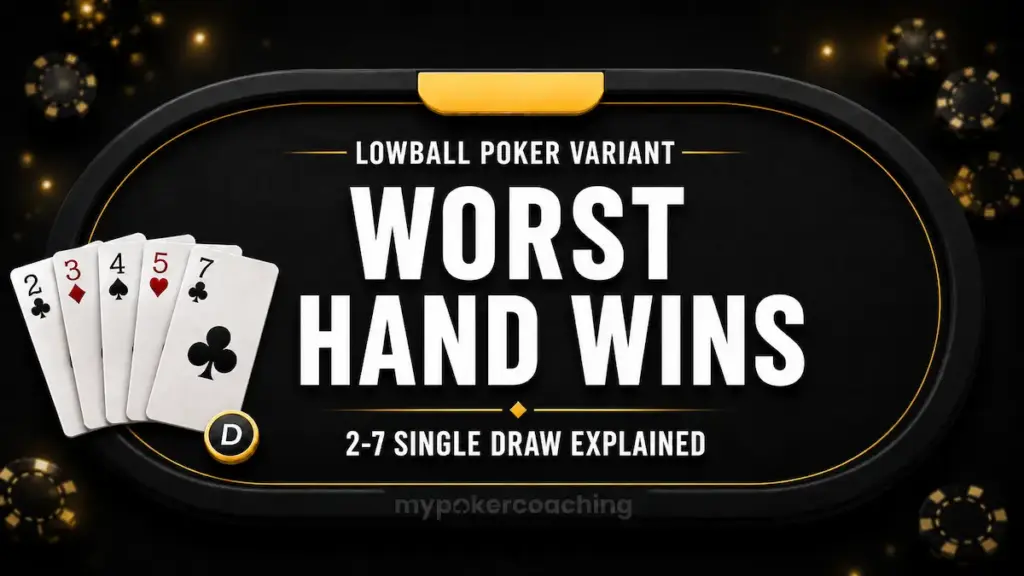
Success requires completely unlearning traditional card strategies. It creates incredibly unique strategic battles for any player. Whether a complete beginner or a seasoned pro, excitement awaits. I consider it a perfect, refreshing break from standard formats.
What This Comprehensive Guide Covers
What exactly can be expected from this article? First, the core rules and gameplay mechanics are explained clearly. Then, the rich and fascinating history will be explored.
Expect a deep comparison to classic Texas Hold’em. The major differences from Pot-Limit Omaha are also highlighted. Next, common pitfalls and costly mistakes will be revealed. Avoiding these typical traps easily protects the poker bankroll.
Finally, powerful winning strategies are broken down step by step. I have prepared both basic and advanced tactics for you.
The Fascinating History Behind 2-7 Single Draw
Today, finding online poker sites offering this specific format takes a little searching. However, high-roller cash games and elite tournaments still feature it heavily. You can easily find triple-draw or no-limit variations available. I personally find the single draw version to be the absolute purest form.
Its massive popularity actually exploded back in mid-century Las Vegas. Famous high-stakes gamblers fell in love with the intense mathematical depth. The pure bluffing dynamics attracted absolute legends like Doyle Brunson and Barry Greenstein. Their heavy influence helped cement its permanent place at the prestigious World Series of Poker. It quickly became a beloved staple in various mixed games.
Do not confuse its timeline with classic Texas Hold’em. Cowboys never played this variant in smoky Wild West saloons. Instead, these lowball mechanics emerged during the early twentieth century. Originally, only a small niche of hardcore gamblers enjoyed rewarding the worst hands.
The Rules of 2-7 Single Draw: Step-by-Step
In this game, the lowest unpaired hand takes the pot. Aces always count as high cards. Making a straight or a flush completely ruins your hand. At the final showdown, everyone reveals their five cards. The absolute worst hand mathematically wins the money.
You can play with two to ten people. A standard 52-card deck is used. Action begins with mandatory ‘blind bets' before any deal. The ‘small blind' and ‘big blind' sit left of the dealer. These bets ensure money is always in the middle. Sometimes, mandatory ‘antes' are also collected from every player.
Every player receives five private cards dealt face down. The first betting round immediately begins. You can throw your cards away and ‘fold'. Matching the big blind is called a ‘call'. Putting in extra money is a ‘raise'.
After initial betting, the drawing phase starts. You can discard anywhere from zero to five cards. The dealer replaces these with new cards from the deck. Keeping all original cards means you choose to ‘stand pat'. A final, second betting round happens after the draw.
Unlike Texas Hold’em or Pot-Limit Omaha, this is a closed game. There are absolutely no shared community cards on the table. Players only ever see their own private hands. I find that this makes bluffing and hand-reading critically important. It resembles classic 5-Card Draw, but with completely inverted goals.
Decoding 2-7 Single Draw Hand Rankings
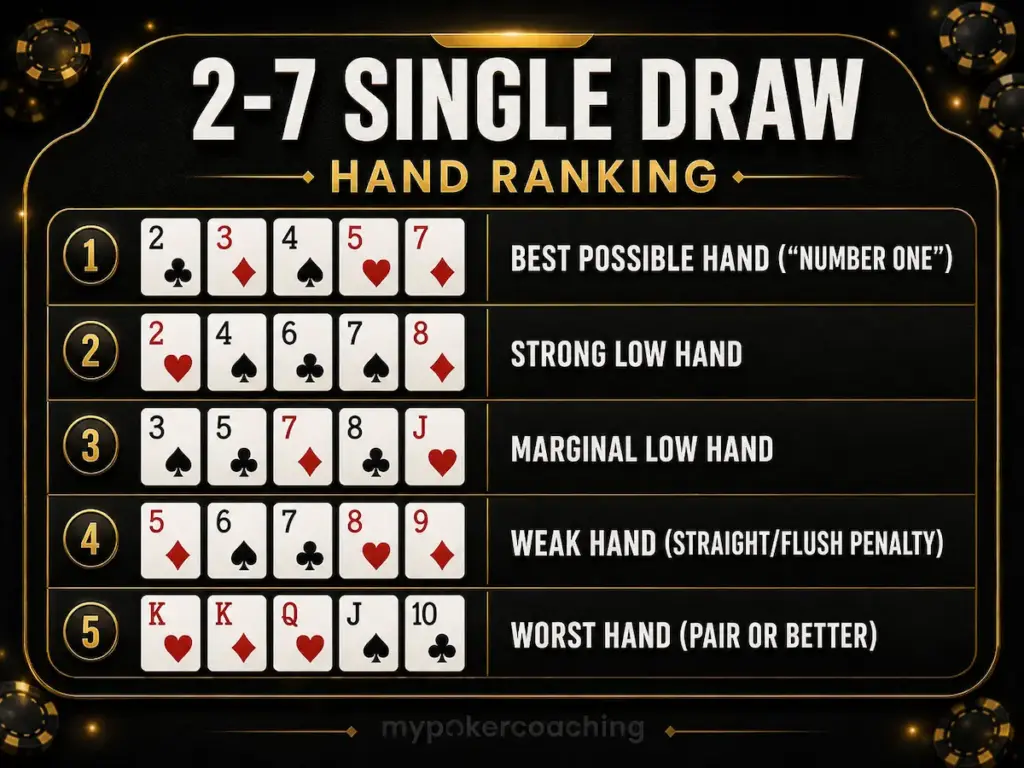
Memorizing the hand ranking hierarchy is absolutely crucial. You must correctly evaluate both your hand and opponents' ranges. Forget everything you learned about classic poker hand rankings.
| Hand Category | Example Combination | Overall Strength |
| The “Number One” Nut Low | 7-5-4-3-2 (offsuit) | Unbeatable |
| Premium Low Hand | 8-7-6-4-2 (offsuit) | Very strong |
| Marginal Low Hand | J-8-7-5-3 (offsuit) | Risky |
| Penalty Hand (Straight/Flush) | 9-8-7-6-5 (straight) | Very weak |
| High Pairs or Better | K-K-Q-J-10 | Loses to everything |
Important Note: Always double-check your suits to avoid accidental flushes.
I always remind new players to watch out for penalties. Hitting a straight or a flush is actually a disaster. Those standard strong combinations become incredibly weak here.
Holding any pair completely ruins your chances of winning. You always want the lowest unpaired, unsuited cards possible. As the table shows, an offsuit 7-5-4-3-2 is unbeatable.
Essential Strategies & Tips for 2-7 Single Draw
Mastering Starting Hand Selection
Evaluating your five private cards properly is absolutely vital for long-term success. You must ruthlessly fold weak hands before making any costly mistakes. I highly recommend sticking to combinations featuring three or more low cards.
Ideal starting hands range strictly between deuces and sevens. Always ensure these cards do not form pairs. You must also avoid combinations that risk accidental straights or flushes.
- Premium Holdings: Strong starting hands look like 2-3-5-7-8.
- Solid Draws: Play hands like 2-3-4-5-X (where ‘X' avoids pairs).
- Trouble Hands: Holding eights or nines significantly ruins your low potential.
- Hidden Traps: Three-card straights and flushes can easily backfire upon drawing.
Treating Every Draw As Information
You will quickly notice the complete lack of community cards. Players only see their own cards, creating an intense guessing game. Managing this massive risk requires extremely sharp observation skills. Therefore, the draw itself becomes your primary source of information.
Reading opponents carefully is just as crucial as your actual cards. Their drawing behavior reveals massive clues about their hand strength.
- Standing Pat: Keeping all five cards heavily signals a powerful made hand. This aggressive move can easily force opponents to fold.
- Drawing 1-2 Cards: This action shows someone is chasing a strong low.
- Drawing 3+ Cards: Replacing three or more cards usually broadcasts extreme weakness.
Always remember that any draw count can be a deceptive bluff.
Common Mistakes to Avoid in 2-7 Single Draw
Transitioning to 2-7 Single Draw is notoriously difficult. Even seasoned poker professionals stumble during this steep learning curve. Forgiving yourself for early errors is absolutely crucial here.
I have compiled the most frequent pitfalls players face. Identifying these traps early protects your hard-earned bankroll. Let us examine what behaviors you must actively avoid.
Overplaying Marginal Low Hands
Many beginners incorrectly assume any low combination guarantees victory. This dangerous assumption destroys chip stacks quickly. Holdings like J-8-7-5-3 remain incredibly vulnerable against competent opponents.
Heavy drawing action usually beats these mediocre made hands. Continuing only with premium two-card draws is highly recommended. Always aim for building strong foundations like 2-3-5-7-X.
Forgetting Straight & Flush Penalties
Keeping three connected cards often leads to absolute disaster. A starting hand like 9-8-6-5-4 looks deceptively strong initially. However, drawing one card easily completes an unwanted straight.
Avoid these dangerous connected structures whenever possible. Only retain connectors if they are extremely low. A small grouping like 2-3-4 is generally acceptable.
Discarding Too Many Cards
Replacing three to five cards relies entirely on luck. Chasing miracle improvements rarely yields any long-term profit. Being highly selective pre-draw is a far superior strategy.
Simply folding is often your most profitable mathematical decision. Do not pay precious chips just to gamble wildly.
Lacking Proper Bluffing Balance
Never bluffing makes your strategy entirely transparent and predictable. Observant opponents will quickly exploit this highly predictable style. Conversely, overbluffing drains your chips unnecessarily against calling stations.
You must carefully balance your aggressive betting moves. Target tight players strategically when executing your well-timed bluffs.
Advanced Tips & Tricks for 2-7 Single Draw
Mastering basic 2-7 Single Draw strategy is just the beginning. I want to help you elevate your game further. Implementing complex tactics separates winning professionals from average players. Let us explore some highly effective advanced concepts together.
Leveraging Your Table Position
Your physical seat dictates your entire strategic approach. Early positions lack crucial information before the drawing phase. You must play extremely tight from these vulnerable seats.
Conversely, late positions offer a massive tactical advantage. Acting last lets you observe everyone else's draws first. You should significantly widen your starting range from here.
Exploiting Specific Opponent Tendencies
Carefully categorizing opponents yields immense long-term profit. Watch their drawing habits and betting patterns very closely.
Identify the ‘calling stations' and value bet them relentlessly. Notice the tight ‘nits' who fold under heavy pressure. You can easily bluff these timid players off marginal hands. Finally, trap aggressive ‘maniacs' by slow-playing your monster lows.
Balancing Ranges and Utilizing Misdirection
Only betting premium hands makes you incredibly predictable. Observant players will easily exploit this transparent playing style. You must constantly mix well-timed bluffs with your strong hands. This balanced approach makes your strategy nearly impossible to read.
Furthermore, you can actively utilize reverse psychology during hands. Try acting extremely weak when holding an unbeatable low hand. Alternatively, project massive confidence when holding absolute garbage.
Taking Your First Steps in 2-7 Single Draw
Are you ready to try this backwards poker format? I highly recommend following a strict, structured approach initially. Proceeding carefully guarantees much faster overall improvement and success.
Building a Solid Foundation First
Surprisingly, many opponents completely misunderstand the fundamental game mechanics. Simply mastering the basic rules provides an immediate tactical advantage. However, merely knowing the rules limits your profit potential.
You must dedicate time to regular, disciplined study sessions. Consistent studying separates elite winners from average recreational players. Excellent paid and free courses exist for all levels.
Grinding Online Low-Stakes Tables
Transitioning to real money always requires extreme caution. Always start your journey at the lowest stakes available. Playing online poker accelerates your learning curve incredibly fast.
Digital platforms deal hands much quicker than live casinos. You can also easily play multiple tables simultaneously online. This massive volume builds crucial experience rapidly.
Furthermore, micro-stakes allow practice without risking your entire bankroll. Only move up in stakes after proving consistent profitability.
Where to Play Today
Are you prepared to test these new strategic skills? Excellent platforms like CoinPoker and Natural8 offer great action. You can easily compete against global opponents from home. Keep grinding, stay patient, and trust the learning process. Remember that every elite professional started as a complete beginner.
Pros and Cons of Playing 2-7 Single Draw
Before diving into the action, evaluate these vital points. Understanding these factors helps manage your expectations perfectly.
Pros:
- Refreshing Gameplay: It offers a fantastic break from standard Texas Hold’em. The unique mechanics stimulate entirely new strategic thinking.
- Psychological Depth: This format heavily rewards pure bluffing and mental warfare. Reading your opponents becomes your absolute best weapon.
- Massive Edge: Many beginners completely misunderstand the fundamental drawing rules. This confusion gives educated players a massive immediate edge.
- Intense Action: The complete lack of community cards creates incredible suspense. Every single drawing phase brings thrilling unpredictability.
Cons:
- Steep Learning Curve: Unlearning traditional hand rankings requires massive mental adjustment. Beginners often make incredibly costly mathematical mistakes initially.
- High Variance: Replacing cards introduces a very high element of luck. You will experience frustrating bad beats quite frequently.
- Limited Availability: Finding active tables online can be somewhat difficult today. Most daily action happens only in high-stakes games.
- Incomplete Information: Guessing ranges makes decision-making much harder for new players. You never get to see any shared community cards.
Frequently Asked Questions (FAQ)
What is the absolute best starting hand in 2-7 Single Draw? The absolute best starting hand is an offsuit 2-3-4-5-7. This specific unsuited combination ultimately creates the unbeatable nut low. I always advise betting aggressively with these premium cards.
How does Deuce-to-Seven Lowball differ from standard Texas Hold'em? The lowest unpaired hand wins instead of the highest. Furthermore, there are absolutely no shared community cards dealt. Players must solely use their five private drawn cards.
Do straights and flushes count against you in 2-7 Lowball? Yes, completing a straight or flush completely ruins everything. These standard high-ranking combinations actually count heavily against you. You must aggressively avoid making these connected suited hands.
Where can I play 2-7 Single Draw online for real money? Several major digital platforms still offer this fantastic variant. CoinPoker and Natural8 frequently feature active lowball cash games. You can also easily find it in major online tournaments.