
Last reviewed: October 2026
Updated for 2026
Gambling Disclaimer: Gambling involves financial risk. Please play responsibly and make sure you understand the legal rules that apply in your jurisdiction.
An online gambling license can help you check who operates a casino, whether the license appears current, whether the casino domain matches an official record, and whether a complaint or dispute route exists. It does not prove that a casino is risk-free, legal in your country, or guaranteed to pay every withdrawal.
This guide compares the main license types covered by MyPokerCoaching.com by what players can actually verify before depositing: the legal operator, license number, current status, approved domain, product scope, complaint route, KYC expectations, and red flags.
Use this page as the central comparison hub, then read the detailed jurisdiction guide when you need deeper checks for Curaçao, Anjouan, Malta, Isle of Man, or Costa Rica.
Quick Answer: What an Online Gambling License Can and Cannot Tell You
| Point | Player meaning |
| What it can help you check | Legal operator, license number, license status, approved domain, product scope, complaint route, and responsible gambling information. |
| What it cannot guarantee | Safe gambling, automatic withdrawals, no KYC, favorable bonus terms, successful disputes, or legality in every country. |
| Best first check | Compare the casino footer, Terms and Conditions, certificate or seal, and official register entry. |
| Most common mistake | Treating a logo, old footer text, or company registration as enough proof. |
| Most useful player question | Can I verify the operator, domain, status, and complaint path before I deposit? |
What Is an Online Gambling License?
An online gambling license is a regulatory authorization, certificate, register entry, or official approval route connected to a gambling operator, legal company, website domain, game type, or supplier activity. For players, the useful part is not the license label alone. The useful part is whether the casino can show verifiable evidence that matches the site you are using.
A strong check connects several details: the casino brand, the legal operator, the license number, the current status, the approved domain, the product scope, the Terms and Conditions, and the complaint route. If one part does not match, treat the license claim as incomplete until you can explain the mismatch.
A gambling license also has limits. It may show that an operator falls under a licensing framework, but it does not remove gambling risk, override local law, remove KYC checks, or make withdrawals automatic.
Online Gambling License vs Online Casino License
Players often use “online gambling license” and “online casino license” as if they mean the same thing. In practice, the broader phrase can cover casino games, sports betting, poker, bingo, lottery-style games, supplier activity, or white-label arrangements. An online casino license is narrower: it should relate to the casino product you are actually using.
That distinction matters because a license may cover one activity but not another. A brand may offer casino games, sportsbook, poker, and crypto payments under one website, while the official record may list only certain domains, verticals, game types, or supplier roles. Before depositing, check whether the license scope fits the product you plan to use.
How to Verify an Online Casino License Before Depositing
Do not stop at a footer badge. Use a short verification sequence before you deposit or claim a bonus.
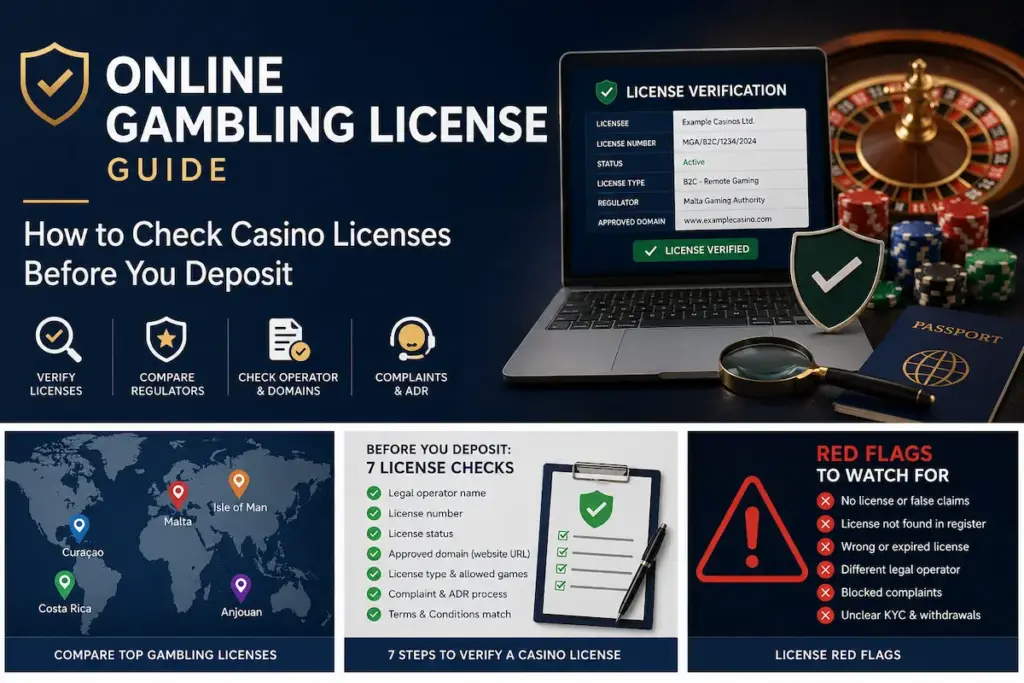
- Open the casino footer and record the legal company name, license number, regulator name, and linked certificate or seal.
- Open the Terms and Conditions and check whether the same legal operator appears there.
- Open the official register, certificate page, or dynamic seal, and check the license status.
- Compare the exact casino domain with the approved domain or website URL shown by the regulator, seal, or register.
- Check whether the approval covers the product you plan to use, such as casino games, betting, poker, or supplier activity.
- Look for complaint, ADR, KYC, withdrawal, country restriction, and responsible gambling information before you deposit.
- If the license number, operator, domain, or status does not match, do not treat the footer badge as enough proof.
Gambling License Comparison Table
| License | Public proof | What players can check | Main caution | MPC guide |
| Malta / MGA | MGA Licensee Register and Dynamic Seal | Very strong when the seal opens on the official MGA authorization domain and shows operator, status, game type, ADR, and website URLs. | MGA logo alone is not proof; B2B supplier approval is not the same as a player-facing operator license. | Malta Gaming Authority license guide |
| Isle of Man / GSC | GSC Online Gambling Licence Register | Strong public register check for license holder, status, validity, OGRA licence type, and website domain where listed. | A GSC license does not make the casino legal in every player country. | Isle of Man gambling license guide |
| Curaçao / CGA | CGA portal and certificate / seal system | Useful current-framework checks for operator, license number, approved domain, Certificate of Operation, and seal. | Old master-license or sub-license wording can mislead. Check current CGA evidence instead. | Curaçao gambling license guide |
| Anjouan | Anjouan verification page | Public lookup by license number, company name, or operational domain can show holder, license type, and current status. | Verification does not endorse the casino’s services or business practices. | Anjouan gambling license guide |
| Costa Rica | Costa Rica Law 9050 and corporate / tax evidence | Useful for checking company, tax, municipal, and operating-structure claims. | Not a conventional player-facing remote gambling license register like MGA, GSC, or CGA. | Costa Rica gambling license guide |
Malta / MGA: The Clearest Player Verification Model
The Malta Gaming Authority gives players one of the clearest verification routes because its Licensee Register can be searched by licensee name, authorization status, URL, or Gaming Service, and additional information can appear through the Dynamic Seal.
For a Malta Gaming Authority license, check whether the Dynamic Seal opens on the official MGA authorization domain, whether the website URL matches the casino domain, whether the license status remains active, and whether the license type is relevant to the product. B2C matters for player-facing casino operations; B2B mainly relates to supplier or platform activity.
MGA verification can also show details that matter during disputes, such as approved ADR information. However, a Malta license still does not guarantee withdrawals, remove KYC, or prove that online gambling is legal for every player location. Read the detailed Malta Gaming Authority license guide for a field-by-field Dynamic Seal checklist.
Isle of Man / GSC: Strong Register-Based Verification
The Isle of Man Gambling Supervision Commission publishes an online gambling licence register that lists companies granted an online gambling licence by the GSC. Where a licence holder actively offers services to the public, the relevant website address can appear in the company profile.
For players, the useful checks are company name, licence status, valid-from date, “valid to current” or expiry/status information, OGRA licence type, and website domain. This creates a stronger verification layer than a footer badge alone.
Still, the Isle of Man license should not be treated as a passport into every country. Check restricted countries, payment rules, KYC rules, and the operator’s Terms before you deposit. Read the Isle of Man gambling license guide for the full GSC register process.
Curaçao / CGA: Current Framework Checks Matter
Curaçao requires extra care because many older casino pages still use legacy master-license or sub-license language. The CGA portal states that the new National Ordinance on Games of Chance came into effect on December 24, 2024, and describes online gaming licenses and supplier licenses under the current framework.
For current checks, focus on the legal operator, license number, approved domain, Certificate of Operation, and CGA seal. The CGA portal also explains that dynamic seals for operators link to authorized domains approved by the CGA and the operator’s Certificate of Operation.
The CGA license conditions add useful player checks: player accounts, payment transactions through the player account, separate accounts for player deposits and winnings, Terms and Conditions, complaints and ADR, responsible gaming, customer identification, AML/CFT policies, and digital seal display. Use the Curaçao gambling license guide for a deeper current-framework checklist.
Anjouan: Public Verification With Extra Caution
Anjouan offers a public license verification route. The Anjouan verification page says third parties can search by licence number, company name, or operational domain, and verification results can show the licence holder’s registered name, licence number, licence type, and current status.
That is useful, but it does not make Anjouan equivalent to Malta or Isle of Man in practical player confidence. The verification page itself says verification does not endorse the licence holder’s services, products, or business practices.
For Anjouan casinos, check the license number, company name, operational domain, B2C/B2B type, current status, expiry information if visible, certificate consistency, Terms, KYC policy, withdrawal rules, and country restrictions. Read the Anjouan gambling license guide for approved examples and certificate checks.
Costa Rica: Company Structure, Not a Standard Remote Casino Register
Costa Rica needs a separate category. It should not appear in the same verification column as MGA, Isle of Man, Curaçao, or Anjouan. Costa Rican Law 9050 covers taxes for legally authorized land-based casinos and companies that receive and process data generated by electronic betting, but it does not create a player-facing online casino license register like MGA, GSC, or CGA.
When a casino lists Costa Rica, players should treat it as corporate, tax, municipal, or offshore operating-structure evidence, not as a conventional remote gambling license. Check the legal company, Terms and Conditions, payment processor, withdrawal rules, KYC policy, restricted countries, and dispute wording.
Use the Costa Rica gambling license guide when you need the full caveat, especially if a casino presents Costa Rica as if it were a standard regulator-issued online casino license.
B2C Operator License vs B2B Supplier License
A B2C operator license usually matters more to players because it relates to the company that offers gambling services to users. A B2B supplier license may matter for software, platform, sportsbook feed, or game supply, but it does not automatically prove that the casino brand itself holds a player-facing operator license.
Use this simple question: who contracts with the player? If the casino footer only points to a software supplier, payment provider, or platform license, check whether the actual operator and domain also appear under a valid player-facing authorization route.
Certificate, Dynamic Seal, Register, and Domain Match Explained
| Proof type | What to check | Common failure |
| Footer badge | Regulator name, linked certificate, legal company, and license number. | Static logo with no clickable official proof. |
| Certificate page | License holder, license number, domain, status, issue date, and certificate URL. | Certificate points to a different brand, old domain, or inactive status. |
| Dynamic seal | Official domain, legal operator, status, product scope, ADR, and website URLs. | Copied seal image or seal page not hosted by the official authority. |
| Public register | Company name, status, domain, license type, and product category. | Brand name appears, but the legal operator or domain does not match. |
| Terms and Conditions | Same legal company, same license number, KYC rules, withdrawals, complaints, and restrictions. | Terms name a different company than the footer or certificate. |
Red Flags for Fake or Weak Casino License Claims
- The casino shows a regulator logo, but the logo does not click through to an official certificate, dynamic seal, or register entry.
- The certificate lists a different legal company from the casino Terms and Conditions.
- The approved domain does not match the website you are using.
- The license status is suspended, revoked, expired, cancelled, surrendered, or unclear.
- The casino claims a regulator that does not license online casinos in that context.
- The site relies only on company registration, tax registration, or incorporation documents as if they were a gambling license.
- The casino claims “no KYC ever,” even though licensed operators may need identity, payment ownership, AML, or source-of-funds checks.
- Responsible gambling tools, complaint information, Terms, or withdrawal rules are missing or hard to find.
KYC, AML, Withdrawals, and Complaint Routes
A gambling license does not remove KYC. In practice, licensed operators may ask for identity documents, proof of address, payment ownership evidence, source-of-funds information, or enhanced review before or during withdrawal. The exact trigger depends on the operator, jurisdiction, payment method, and account risk profile.
A license also does not guarantee that every withdrawal will be paid immediately. Bonus terms, wagering rules, payment method limits, duplicate accounts, country restrictions, AML checks, and account review can all affect a withdrawal. This is why the verification process should include the casino Terms, KYC policy, payment page, and complaint process before you deposit.
If a dispute occurs, collect evidence before escalating: casino URL, legal operator, username or account alias, disputed amount, transaction history, withdrawal request ID, support replies, KYC correspondence, bonus terms, certificate or register screenshots, and timestamps. A regulator or ADR route may help you file a structured complaint, but it does not promise recovery in every case.
Crypto Casino License Checks
CRYPTO RISK WARNING: Cryptocurrency gambling involves high financial risk and is subject to market volatility, technical transfer risk, and irreversible transactions. Participation may result in the loss of funds. This content is intended strictly for users 18+ only. Please play responsibly.
A crypto casino license claim needs the same checks as any other casino license claim, plus extra payment checks. Confirm the legal operator, license number, status, approved domain, Terms, KYC policy, wallet rules, supported networks, withdrawal rules, and country restrictions.
Crypto does not mean anonymous gambling. A licensed or semi-licensed crypto casino can still request KYC, wallet ownership checks, payment proof, source-of-funds information, or withdrawal review. Wrong-address and wrong-network transfers can also create losses that a regulator may not be able to reverse.
Country Restrictions and Local Gambling Law
A foreign gambling license does not make online gambling legal everywhere. The casino may hold a license in one jurisdiction, but your own country may still restrict online casinos, crypto gambling, advertising, payment methods, or access to specific offshore operators.
Before depositing, check the casino’s restricted countries, your local rules, payment availability, and tax or reporting obligations where relevant. If a casino accepts registration from your country, that alone does not prove local legality.
Responsible Gambling and License Limits
Cautionary Note: Gambling should never be treated as a source of income, investment strategy, or financial solution. Only use discretionary funds, set limits, and stop if gambling creates financial or personal harm.
A license can create useful verification points, but it does not remove gambling risk. Check whether the casino provides deposit limits, loss limits, time limits, self-exclusion, reality checks, responsible gambling information, and clear access to support tools.
Read the MyPokerCoaching.com responsible gambling guide before using any casino if you feel pressure to chase losses, increase deposits, hide gambling, or continue playing after spending more than planned.
Which License Should Players Trust More?
Do not reduce the answer to a simple “best” or “worst” ranking. The better question is which license gives clearer evidence for the specific casino you are checking.
Malta and Isle of Man usually offer clearer public verification layers because players can check the formal register and seal information. Curaçao now requires a current CGA certificate and domain checks rather than legacy master-license assumptions. Anjouan provides public lookup, but players should apply more caution and re-check the operator, domain, and status. Costa Rica should sit outside the same ranking because it is not a conventional remote gambling license register for players.
Related Gambling License Guides
Use these detailed guides when you need jurisdiction-specific checks:
- Curaçao gambling license guide — current CGA certificate, seal, and old-license wording checks.
- Anjouan gambling license guide — public register, license number, operator, and domain checks.
- Malta Gaming Authority license guide — MGA Licensee Register, Dynamic Seal, B2C/B2B, ADR, and red flags.
- Isle of Man gambling license guide — GSC register, licence holder, status, OGRA type, and domain checks.
- Costa Rica gambling license guide — corporate/offshore setup caveats and what Costa Rica does not prove.