
A rules-first guide to Ante and Play, the Q-6-4 decision, Pair Plus, and online table checks
Last reviewed: October 2026
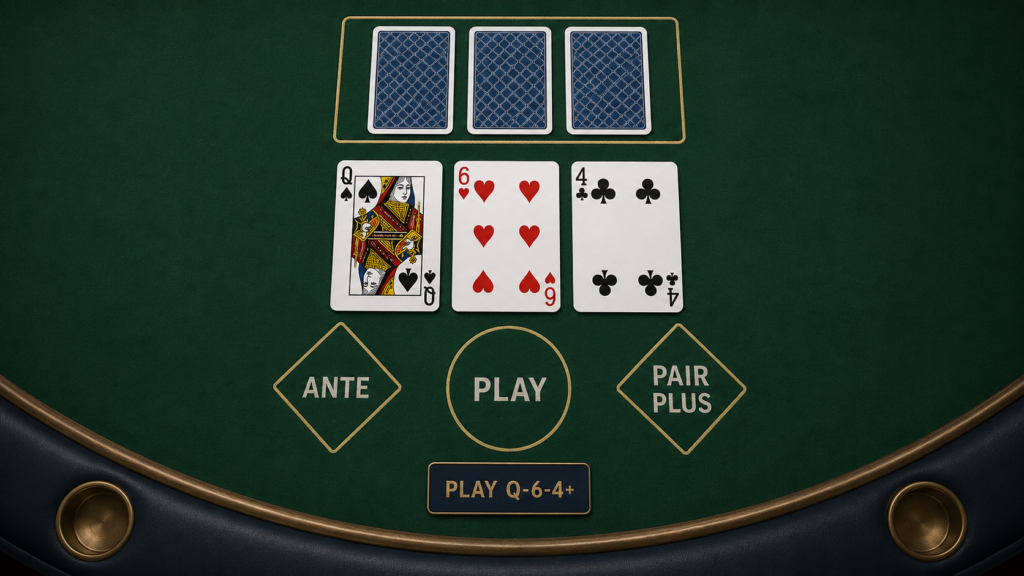
Three Card Poker is a house-banked casino card game in which you compare a three-card hand with the dealer. You start with an Ante, then either fold or make a Play bet after seeing your cards. The dealer needs queen-high or better to qualify. Under the standard rules, the most useful strategy is simple: make the Play bet with Q-6-4 or better, and fold lower hands.
That decision rule reduces avoidable errors, but it does not remove the casino advantage. Side bets, including Pair Plus and 6 Card Bonus, also use table-specific payouts. Always read the displayed rules before wagering.
Gambling Disclaimer: Gambling involves financial risk. Please ensure you play responsibly and be aware of the legal regulations governing online gambling in your jurisdiction.
Three Card Poker Quick Facts
| Feature | Standard rule |
| Game type | House-banked casino poker |
| Cards | One 52-card deck in play; three cards each for the player and dealer |
| Main decision | Fold, or make a Play bet equal to the Ante |
| Dealer qualifies | Queen-high or better |
| Basic strategy | Play Q-6-4 or better; fold lower hands |
| Standard Ante Bonus | Straight 1:1, three of a kind 4:1, and straight flush 5:1 |
| Standard Ante/Play house edge | About 3.373% of the initial Ante with optimal play and the 5-4-1 Ante Bonus |
| Element of risk | About 2.01% of the average total amount wagered under the same assumptions |
| Optional bets | Pair Plus, 6 Card Bonus, and table-specific progressives |
What Is Three Card Poker?
Three Card Poker uses poker-style hand rankings, but it is not a traditional poker-room game. You do not compete against other players, build a pot, or bluff. Instead, you play a fixed casino game against the dealer, and the posted rules determine every payout.
The game belongs to the broader casino poker category alongside Ultimate Texas Hold’em and Caribbean Stud Poker. It has two distinct components. Ante and Play form the main dealer-versus-player game. Pair Plus and 6 Card Bonus are optional side bets that can be settled from the cards without changing the main decision. This distinction matters because each wager has its own payout structure, probability, and house edge.
If you want a casino poker game with more decision points, compare the rules of Ultimate Texas Hold’em or Pai Gow Poker. If you meant competitive poker against other people, start with the online poker sites guide instead. Three Card Poker uses familiar hand names, but its strategy has much less in common with Texas Hold’em than the name suggests.
Three Card Poker Hand Rankings
Three-card rankings differ slightly from five-card poker. A straight ranks above a flush because three-card straights occur less often than three-card flushes.
| Rank | Hand | Example | Probability |
| 1 | Straight flush | 9♠–8♠–7♠ | 0.2172% |
| 2 | Three of a kind | 6♣–6♦–6♥ | 0.2353% |
| 3 | Straight | Q♣–J♦–10♠ | 3.2579% |
| 4 | Flush | A♥–9♥–4♥ | 4.9593% |
| 5 | Pair | K♣–K♦–7♠ | 16.9412% |
| 6 | High card | A♣–J♦–8♠ | 74.3891% |
A-K-Q is the highest straight, and A-2-3 is the lowest under the standard rules used in this guide. Suits have equal value and do not break a tie. A suited A-K-Q is a straight flush. Some tables call it a “Mini Royal” and give it a separate bonus payout, but that label and payout are not universal.
The probabilities above cover all 22,100 possible three-card combinations. They also explain why Pair Plus pays on only a minority of hands: high card represents almost three-quarters of all three-card hands.
How to Play Three Card Poker
The official Nevada game rules provide a useful standard baseline. Individual casinos and jurisdictions may use different side bets or settlement details, so the table rules always take priority.
- Place the initial wagers. Make an Ante to play against the dealer. Pair Plus or another side bet may be available, but it is optional.
- Receive three cards. The dealer gives three face-down cards to you and three to the dealer.
- Choose Play or fold. After looking at your hand, fold and lose the Ante, or place a Play wager equal to the Ante.
- Check dealer qualification. The dealer reveals the cards and needs queen-high or better to qualify.
- Settle Ante and Play. If the dealer qualifies, the higher three-card hand wins. If the dealer does not qualify, the standard settlement is an Ante win and a Play push.
- Settle bonuses separately. The Ante Bonus pays on a straight or better under the standard 5-4-1 schedule, regardless of the dealer’s result. Optional side bets use their posted tables.
What happens when the dealer does not qualify?
Under the standard house-banked rule, the Ante wins 1:1, and the Play wager returns as a push. Do not reverse these outcomes. Some guides incorrectly say that Play wins while Ante pushes.
What happens when the dealer qualifies?
If your hand ranks higher, Ante and Play each win 1:1. If the dealer’s hand ranks higher, both wagers lose. Equal hands push. The standard Ante Bonus still pays on your straight, three of a kind, or straight flush, even when the dealer has a stronger hand.
For example, suppose you wager $10 on Ante and then $10 on Play. If the dealer qualifies and your hand wins, both bets pay even money. If the dealer does not qualify, the $10 Ante wins $10, while the $10 Play returns without a win or loss. This example excludes any optional side bet.
Three Card Poker Strategy: The Q-6-4 Rule
The optimal standard Ante/Play decision is to make the Play wager with Q-6-4 or better and fold anything lower. Compare high-card hands from the highest card downward. Q-7-3 therefore beats Q-6-4 because the second card, seven, settles the comparison. Q-6-3 falls below the threshold.
The cutoff comes from expected value, not from a belief that Q-6-4 is likely to win the round. According to the Three Card Poker mathematical analysis, raising Q-6-4 produces an expected loss of about 0.993378 betting units, which is slightly less than the one-unit loss from folding. Raising Q-6-3 produces an expected loss of about 1.00255 units, which is slightly worse than folding.
That difference is small on one borderline hand, but consistent decisions matter across many rounds. A simpler “play any queen” rule is close, although its house edge rises to about 3.45%. Playing every hand increases the house edge to about 7.65% under the same standard analysis.
Cautionary Note: Participation in gambling activities should never be viewed as a reliable source of income. Only discretionary funds should be used for wagering. Q-6-4 minimizes expected loss under the stated rules; it does not guarantee a win or create positive expected value.
Betting progressions do not change this conclusion. A Martingale changes how much you risk after a loss, but it cannot change the probability or expected value of the next hand. It can, however, produce rapid stake growth, collide with table limits, and concentrate losses into a short session.
House Edge, RTP, Odds, and Variance
Under standard rules, optimal Q-6-4 play, and the 5-4-1 Ante Bonus, the Ante/Play game has a house edge of about 3.373% relative to the initial Ante. Expressed on that same basis, the theoretical return to player is about 96.627%.
The same analysis gives an element of risk of about 2.01%. This is not a second house-edge figure. House edge uses the initial Ante as its denominator, while the element of risk uses the average total amount wagered after accounting for the additional Play bets. Comparing 3.373% with 2.01% without explaining those denominators is misleading.
| Measure | Standard result | What it means |
| House edge | 3.373% | Expected loss relative to the initial Ante |
| Theoretical RTP | 96.627% | Theoretical return relative to that same initial-Ante basis |
| Element of risk | 2.01% | Expected loss relative to average total action |
| Round outcome | 44.91% win, 0.06% push, and 55.03% loss | Long-run distribution under the analyzed strategy and rules |
These are long-run averages, not session predictions. Short sessions can finish far above or below the theoretical return. Side bets increase the chance of a large payout, but they also create more uneven results and often carry a higher house edge than the main game.
Pair Plus and 6 Card Bonus
The “Pair Plus”
Pair Plus pays according to your three-card hand, normally starting with a pair. Its house edge depends on the exact payouts. Two tables that look nearly identical can have materially different expected returns.
| Pair Plus hand | Common example | Full-pay example |
| Straight flush | 40:1 | 40:1 |
| Three of a kind | 30:1 | 30:1 |
| Straight | 6:1 | 6:1 |
| Flush | 3:1 | 4:1 |
| Pair | 1:1 | 1:1 |
| House edge | 7.276% | 2.32% |
The one-unit difference on the flush payout changes the house edge sharply. Therefore, “Pair Plus has a 2.32% house edge” is true only for the listed 40-30-6-4-1 table. The common 40-30-6-3-1 example has a house edge of about 7.276%.
Rules can also differ when you fold the Ante hand. One official ruleset continues to settle the side bet, while a California player-dealer version forfeits Pair Plus when the player folds. Check the displayed rule instead of assuming one treatment applies everywhere.
6 Card Bonus
The 6 Card Bonus uses the best five-card poker hand available from your three cards and the dealer’s three cards. A typical table pays from three of a kind upward, but the amounts vary. Verified schedules produce house edges ranging from the mid-single digits to above 15%, so a single “standard” percentage would be inaccurate.
Before placing this bet, compare every payout from three of a kind through royal flush. Also check whether the game uses a different name, such as 3+3, and whether a progressive jackpot changes the return calculation.
Common Three Card Poker Mistakes
- Playing every queen or every hand without understanding the cost. Q-6-4 is the standard loss-minimizing cutoff.
- Treating 2.01% as the house edge. It is the element of risk that uses a different wager base.
- Assuming every Pair Plus table is full pay. The flush payout alone can change the house edge substantially.
- Confusing Ante Bonus with Pair Plus. Ante Bonus is part of the main game, while Pair Plus is a separate optional wager.
- Using a betting system to chase losses. Stake progressions do not alter the next deal’s expected value.
- Ignoring round speed. Faster online play can increase the amount wagered per hour, even when the bet size stays unchanged.
- Assuming familiar poker skills apply. Bluffing, position, and reading opponents do not affect the standard house-banked game.
Online and Live Three Card Poker Checks
RNG and live dealer versions can follow the same core rules, but never assume that the side-bet tables match. Open the game information panel before wagering and check:
- the exact game title and provider;
- whether the dealer qualifies with queen-high;
- the Ante Bonus schedule;
- the complete Pair Plus and 6 Card Bonus tables;
- what happens to side bets after a fold;
- the published RTP and the wager it describes;
- minimum and maximum bets;
- the decision timer and likely round speed;
- whether table games count toward any bonus wagering requirement; and
- your jurisdiction’s access rules, identity checks, withdrawal terms, and player-protection tools.
Our online casino reviews can help with general licensing, payments, verification, and withdrawal checks. The current Goldenbet review lists Three Card Poker among its live poker variants, but game availability, providers, and paytables can change. Confirm the live lobby before depositing. If you are evaluating an offer, read the Goldenbet bonus guide and the operator’s current terms because live and table games may contribute little or nothing toward wagering requirements.
Affiliate disclaimer: This site is reader-supported. If you sign up through our links or use our provided codes, we may earn a commission at no extra cost to you. These partnerships help fund our research, testing, editorial work, and free-to-access content, without changing our review standards or recommendations.
Three Card Poker Variants
Standard house-banked Three Card Poker should remain the baseline. Other formats need separate rules:
- California player-dealer games can use a rotating player-dealer position, collect fees, and have different side-bet settlement details.
- Ultimate Three Card Poker is a separate game with different raising options. Do not apply standard Q-6-4 guidance without checking its rules.
- Mini Royal tables add a separate payout line for suited A-K-Q, but the award varies.
- Player-wins-ties tables change the expected return and slightly alter the borderline strategy.
- Progressive and proprietary bets require their own paytable and jackpot calculation.
Is Three Card Poker Skill or Luck?
Chance determines every deal. Your only meaningful standard decision is whether to fold or make the Play bet, and Q-6-4 provides the mathematically efficient answer. This limited strategy can reduce decision errors, but it cannot control which cards appear or remove short-term variance.
The game may suit adults who want a short ruleset, quick decisions, and poker-style hand rankings without playing against other people. It may not suit anyone who finds fast repetitive wagering difficult to control, dislikes volatile side bets, or expects poker-room skills to create an advantage.
If you prefer player-vs-player decisions, compare the GGPoker review, CoinPoker review, and WPT Global review. Those are poker-room alternatives, not evidence that a platform offers the casino game. Promotional details can change, so use the online poker bonuses guide only after checking current terms.
Responsible Gambling and Risk Management
Three Card Poker has a negative expected value under standard casino paytables. Treat the house edge as a cost of play, not as a target you can recover with longer sessions. Optional side bets can create bigger single-hand payouts, but they usually increase variance and may increase the expected cost.
Set a loss limit and a time limit before starting. Keep the Ante small enough that a Play wager of the same size still fits your preset budget. Do not increase stakes to recover losses, borrow to gamble, or treat a bonus balance as risk-free money. Online rounds can repeat quickly, so track total session spend rather than focusing only on the amount of one Ante.
Use the controls explained in our responsible gambling guide, including deposit limits, session reminders, cooling-off periods, and self-exclusion where available. The National Council on Problem Gambling’s responsible-play resources also emphasize setting a plan, taking breaks, and wagering only what you can afford. If gambling stops feeling controlled, stop playing and seek confidential support in your country.