
Image courtesy of World Poker Tour
If you want to do well in online cash games where most players play fairly well, you have to focus on fundamentals.
The most important part of this is your preflop strategy. If you aren’t making sound decisions before the flop, no amount of skill after the flop will make up for losses. You will be spewing a little bit of equity to your opponents every single hand!
So, in this article, we’ll address some major areas of preflop play to quickly and significantly improve your decision-making before the flop.
–
Tip #1: Play Tight from EP & Loose from LP
If you dig into the numbers, you’ll find that a bulk of your win rate comes from the button and the cutoff, in the spots where it folds to you and you get the first action.
You are likely not making much money from early positions, and all players are losing money from the blinds, so you need to adjust your preflop strategy to account for these facts.
This means playing tight from early positions and expanding your range as you get into the later ones.
Let’s look at two charts comparing your early vs. late position opening ranges for six-max.
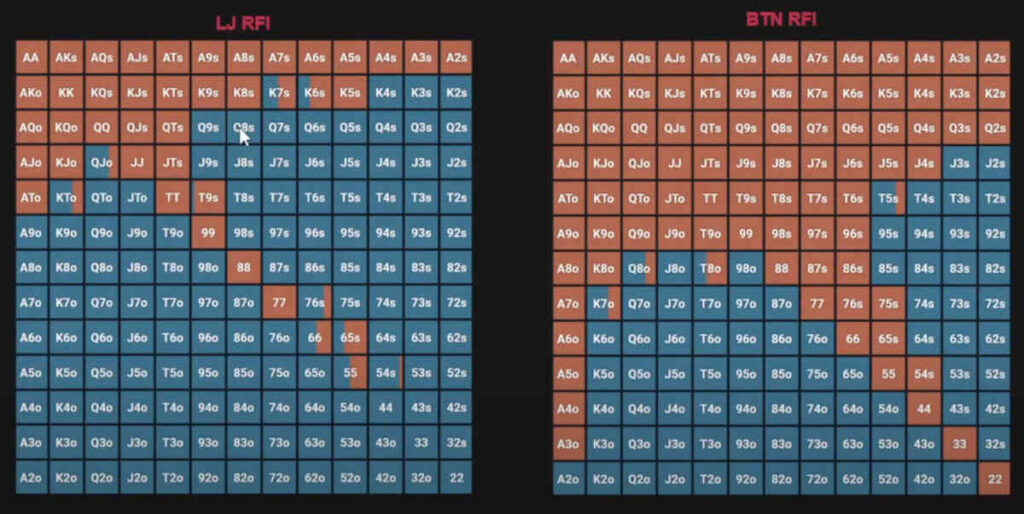
You’ll notice that we fold small pocket pairs up to pocket fives, a majority of our off-suit broadway hands, and even suited connectors like 98s and 87s from an early position.
In online cash games, rake comes out of every pot, plus you have everyone still to act to play after you. Thus, you have to stay tight and conservative; otherwise, you’ll be spewing money.
From the button, you can see that our range gets much wider: suited connectors, all pairs, broadways, etc. Plus, if you know that players in the blinds are too tight, you can go even wider than what the GTO strategy suggests.
When you are on the button and it folds to you, you know you’ll have position for the rest of the hand and only have two players to act behind. This means you can open with a much wider range. You still shouldn’t go crazy and open 100%, but you have much more freedom, especially against tight players.
Tip #2: Use Optimal Preflop Raise Sizes
To make a profit in online cash games, you need to stick to a good, strong, and fundamentally sound strategy when determining your raise sizes.
When the action folds to you, make it 2.5x, and if there is an ante in play, you can go a bit bigger. In small blind, specifically, go bigger, to like 3.5x, to discourage the big blind from defending and playing against you in position.
If the small blind limps and you are in the big blind, you should make your raise sizes three times the big blind. Of course, if you are up against the player you know will always fold to a bigger sizing, it makes sense to adjust and make it something like 4x.
When 3-betting, you’ll want to make it 3.2x – 3.5x the size of the open when in position, and 4x – 5x when out of position. You want to go bigger when out of position to maximize your fold equity and avoid having to play after the flop, if possible.
As far as determining whether to go with the smaller or the bigger end of the spectrum, a good rule of thumb is this: as your opponent’s raise sizes get bigger, your 3-bet sizes should get smaller, i.e. you should go 3.5x against a small raise, but make it 3.2x facing a bigger open.
When it comes to 4-betting, make it 2.25 – 2.5x in position, and 2.5x – 2.75x out of position.
In situations when there are limpers or action between you and the original raiser, you can use these rules:
- If there are limpers, use your standard raise size and add one big blind for every limper
- When 3-betting, use your standard size and add 1x for every caller
While this may sound a bit confusing at first, it’s really quite simple, and once you get used to these open sizes, they’ll become almost like second nature. This way, you have a solid baseline to follow every time and don’t need to come up with a number every time you want to raise or 3-bet.
Tip #3: Exploit Your Opponents by 3-Betting Too Much
In small stakes cash games, my number one exploit is to 3-bet more than GTO strategy advises and then over-fold if I face a 4-bet.
Your opponents will raise with fairly standard ranges, but when you apply aggression, they will fold too often and won’t 4-bet nearly enough.
So, by using this strategy, you’ll have opportunities to win pots before the flop or play in position and win on later streets, and you can get away when they wake up with a monster.
For example, we are in the CO with 10♠8♠ playing $1/$2, and the hijack opens to $5. We 3-bet from the cutoff and make it $18 to go. It folds back to them, and they call.
The flop comes A♥J♥6♠ and your opponent checks.
This is a situation where many players chicken out, but it is actually a great spot to fire a small continuation bet of like $18, and you will easily get them off any hand that’s weaker than a pair of jacks.
Tip #4: Stop Getting Stacked With JJ & AK Preflop
Pocket jacks and ace-king are perfectly fine hands to play on the flop or for a small to medium amount before the flop, but in many small stakes cash games, when all the money goes in preflop, you’ll find yourself against aces, kings, queens, and ace-king.
These two hands (JJ and AK) don’t fare well against that range.
If we look at two GTO charts, you’ll see that AKo is 4-betting only about half the time, while queens and jacks are never 4-betting in a lojack vs. a big blind 3-bet.
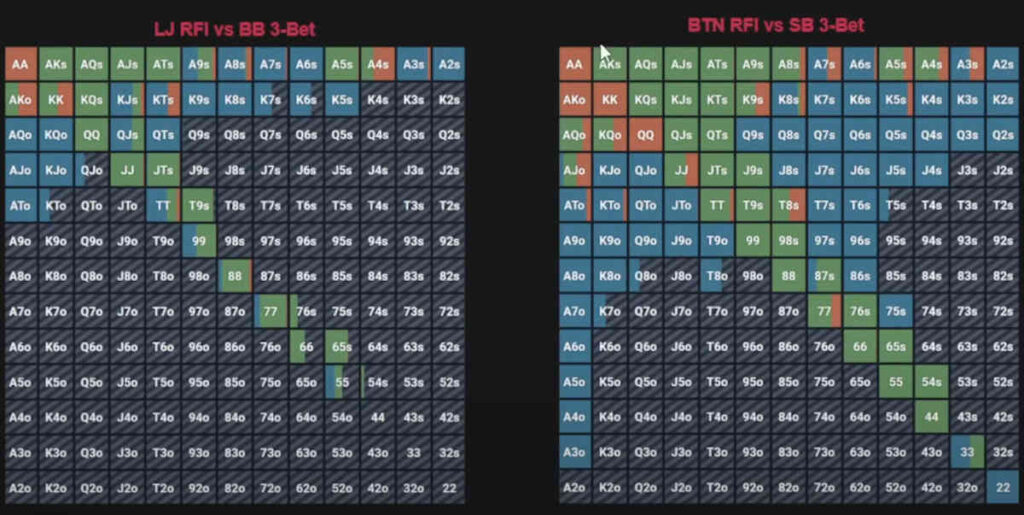
In a situation where ranges are wide, i.e. facing a 3-bet from the small blind after opening from the button, pocket jacks are 4-betting only about 40% of the time.
AKs doesn’t 4-bet at all, given the fact that we have position. AKo does 4-bet in this spot, because it doesn’t play as well after the flop, but you can definitely mix in some calling if you want.
The bottom line is, you don’t need to be 4-betting all that wide in cash games, especially when we know that other players aren’t 3-betting enough.
Tip #5: Play 3-Bet or Fold from HJ, CO, and SB
Stop splashing around and calling when you are not guaranteed to be in position and/or closing the action (i.e., you are not on the button or in the big blind).
If you face a raise and call in the small blind, the big blind can squeeze and make you fold, which is not a good result. Or, somebody calls from the lojack, you just call from the hijack – everyone still to act can 3-bet and put you in a tough spot.
By doing these things, you are leaking chips over and over, and only winning when you flop big, which is hard to do in No Limit Texas Hold’em.
If you look at the GTO charts below, there are no hands in green, which means that we have no calling range in our strategy. We are either 3-betting or folding.
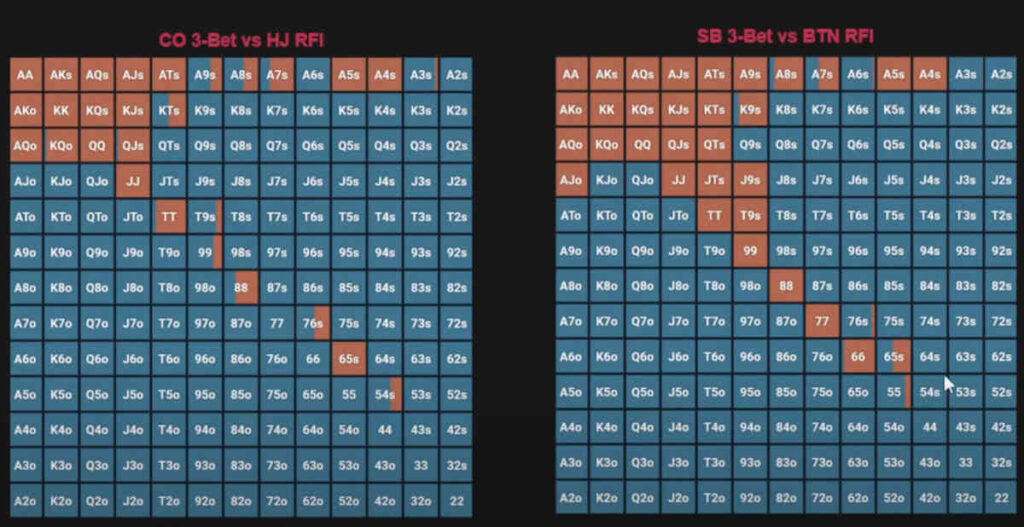
You may be surprised to see some of these folds, but there are too many moving parts for some of these hands to be played profitably.
Now, in most games, you probably need to play wider, because most players don’t 4-bet wide enough. Don’t get too carried away, of course, but if you want to add some of these hands like QJs, 97s, etc., that’s fine, as long as your opponents aren’t 4-betting that often.
So, to sum it up, if you want to improve your results in online cash games, it all starts with your preflop strategy. Make sure you have your opening ranges in order, use optimal sizes, and exploit your opponents' tendencies, and you’ll see significant improvements to your win rate.