
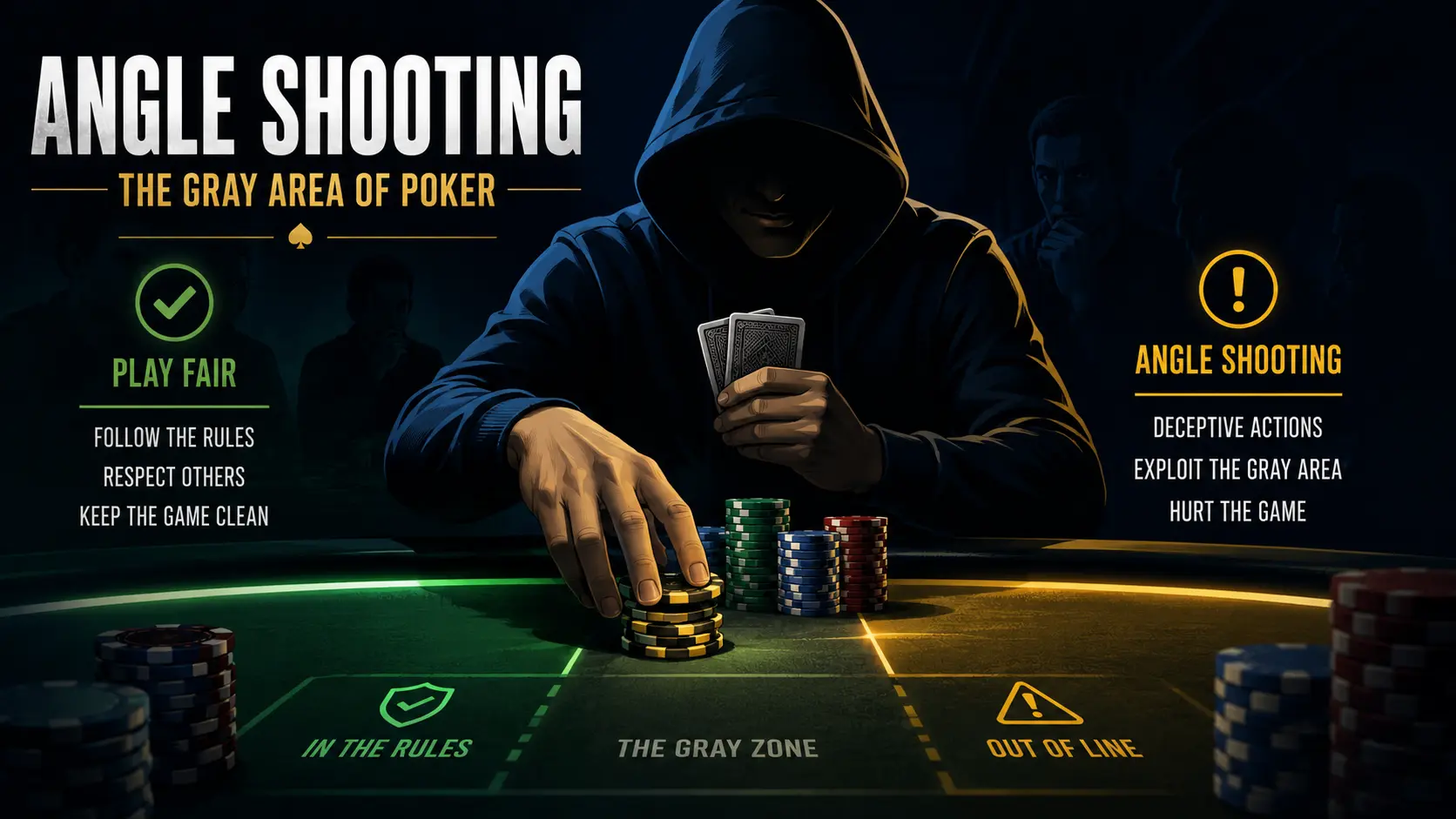
While every poker player is constantly looking for an edge over the competition, angle shooting is a practice uniformly frowned upon by the entire poker community. While technically not outright cheating, angle shooting walks the very thin line between what is legally permitted by the rulebook and what is ethically acceptable.
In simple terms, angle shooting means using deceptive, unsportsmanlike tactics to gain an unfair advantage over your opponents.
Whether you are a newcomer sitting down for your first live session or an experienced grinder, understanding how angle shooters operate is essential. This guide will expose the most common angle shooting techniques, explain why you should avoid them, and show you exactly how to protect your chips from players who abuse the rules.
-
1
 Bonus £40 Freeor £600 bonus
 - Trigger the bonus: You need to deposit at least £10 and generate £10 in rake to trigger the FREE training bonus. | 18+ | BeGambleAware T&Cs Apply
-
2
Bonus $600or $100 tickets
-
18+ | BeGambleAware T&Cs Apply | Read full T&Cs
-
3

What Exactly Is Angle Shooting in Poker?
The primary goal of angle shooting is to extract information or manipulate betting actions in a way that regular, clean play cannot achieve. An angle shooter might try to:
- Prematurely assess the strength of an opponent’s hand.
- Induce a fold by faking a specific action.
- Minimize their losses when holding a weak hand by creating confusion.
The reason angle shooting is so heavily despised is that it rarely breaks the explicit letter of the law. If a player marks cards or steals chips from the pot, the floor manager will immediately eject them from the casino. Angle shooters, however, operate in the gray area of poker etiquette.
Because their infractions often exploit loopholes in local house rules, they usually escape severe punishment. However, these actions destroy the spirit of fair competition, ruin the atmosphere at the table, and can cost unsuspecting recreational players a significant amount of money.
Top 4 Examples of Angle Shooting in Live Games
Angle shooting is far more prevalent in live card rooms than online, simply because physical chips, cards, and verbal communication offer more room for manipulation. If you play live poker, you must stay vigilant against these four classic traps:
1. The Fake Fold (Forward Motion)
In live games, an angle shooter might pick up their cards and make a sudden forward motion toward the muck when the action is on you. Their goal is to gauge your reaction. If they see you relax or reach for your chips, thinking you have won the pot, they will pull their cards back and use that physical tell to make a mathematically superior decision.
- The Danger: If you prematurely throw your cards into the muck believing they folded, your hand will be declared dead, and the angle shooter will legally scoop the pot.
- How to protect yourself: Never release your hand until the dealer explicitly confirms the opponent's cards are dead and pushes the pot toward you.
Controversy❗
Get @Stapes and @spraggy's thoughts on a possible angle in the #EPTBarcelona Main Event 👇
Cards-up coverage continues at https://t.co/hRFaQAqWdk pic.twitter.com/Ok0y6NN5rS— PokerStars LIVE (@PokerStarsLIVE) August 28, 2019
2. The Ambiguous Check
Some players constantly tap the felt, fiddle with their chips, or make vague hand gestures when it is their turn to act. When the dealer interprets the gesture as a check and moves the action to the next player, the angle shooter waits to see what happens. If the next player checks behind or bets small, the angle shooter suddenly speaks up: “Wait, I didn't check! I was just tapping my fingers.”
- How to protect yourself: If an opponent's hand movements are unclear, do not act. Look at the dealer and ask, “Is it a check?” Force a clear verbal declaration before making your move.
3. The False Raise (The Rule of One Chip)
Angle shooters often exploit local house rules regarding bet sizes. In most casinos, placing a single oversized chip into the pot without saying anything constitutes a call, not a raise. An angle shooter might silently toss out a stack of smaller chips mixed with a big chip, trying to intimidate you into folding by making it look like a massive raise. Once you fold, the dealer counts the chips and announces it wasn't a legal raise, but by then, your cards are already in the muck.
- How to protect yourself: Always wait for the dealer to count the chips and officially announce “Raise” and the exact dollar amount before you evaluate your next move.
4. The Verbal Misdeclaration at Showdown
At the end of a river betting round, an angle shooter might loudly announce, “I have the Ace-high flush!” while keeping their cards face down. A naive player, holding only a straight, might sigh and toss their winning cards into the muck without asking to see the flush. Once your cards touch the muck, they are dead, and the angle shooter wins the pot, even if they were actually holding a pair of twos!
- How to protect yourself: Never muck your cards at showdown based on what an opponent says. In poker, cards speak for themselves. Force them to turn their cards face up on the felt before you release your winning hand.
Other Live Poker Angle Shooting Techniques
While the top four examples are the most common, experienced live grinders should also watch out for these secondary maneuvers:
Hiding Big Denomination Chips: Intentionally placing large chips (like $100 or $500 plaques) behind a wall of smaller $5 chips to make their stack appear much shorter than it actually is. This tricks opponents into committing to all-in shoves they would otherwise avoid.
- Acting Out of Turn: Intentionally betting or folding out of turn to disrupt the game flow and manipulate the decisions of the players acting before them.
- The “I Didn't Look” Myth: Claiming they haven't looked at their hole cards when raising blindly, only to have secretly peeked at pocket Aces. Always assume an opponent knows their exact starting hand.
- Pushing Chips Exactly to the Line: Sliding a stack of chips right up to the betting line without crossing it to see if the table reacts as if a bet was made.
Note on Industry Regulation: To combat these deceptive tactics, international bodies like the Poker Tournament Directors Association have implemented strict standardized penalties. For a deeper look at how modern rules are evolving to punish stalling and angles, read our breakdown of the TDA Summit XII Rule Changes.
Angle Shooting in Online Poker
Because modern online poker platforms are hardcoded with strict betting rules, digital angle shooting looks very different from live play. You cannot make an “ambiguous check” or a “false raise” when clicking buttons on a screen. However, online grinders still use unethical loopholes to gain an edge:
- Ratholing (Going South): When a player wins a massive pot at a cash game table, immediately leaves the table to secure their winnings, and then rejoins the same table minutes later with the minimum buy-in. This prevents opponents from having a fair chance to win their chips back. Most modern sites now block players from rejoining with a smaller stack for a set time limit.
- Excessive Tanking on the Bubble: In multi-table tournaments (MTTs), players will intentionally let their full time bank run down to zero on every single decision near the money bubble, stalling the clock so players at other tables bust first. This has become such a major issue that live events have begun adopting strict countdowns, a trend we explored extensively in our report on the WSOP Main Event Shot Clock.
- Chat Box Abuse: Typing misleading hand information or fake verbal declarations into the chat box to trick novice players. Since online chat is legally non-binding, the golden rule is simple: ignore the chat box entirely when making strategic decisions.
How to Deal With Angle Shooters
Since angle shooting operates in a gray area, dealers cannot always issue immediate penalties. It is up to you to maintain a clean, fair table environment:
- Give the Benefit of the Doubt First: If a recreational player commits an infraction, politely point it out. Novices often make ambiguous checks or hide big chips by accident simply because they are inexperienced.
- State the Rules Clearly: If a player repeats the behavior, calmly address the table: “Please keep your large chips visible in front of your stack as per house rules”.
- Alert the Dealer: If you notice a habitual angle shooter, quietly ask the dealer to pay extra attention to their chip movements and verbal declarations.
- Call the Floor: If an opponent continually uses deceptive physical maneuvers to trap players, do not hesitate to call the Floor Manager. Even if a specific action isn't technically cheating, floor managers have overarching authority to issue penalties for chronic unsportsmanlike conduct that damages the integrity of the game.
Gray Area: Questionable Behaviors You Might Get Away With
- Hollywooding: You are entirely allowed to act at the table. Taking a deep breath, sighing, rolling your eyes, or pretending to be reluctant before making a massive raise is a classic, legal part of live poker psychology, as long as you don't slow the game down to an unbearable pace.
- Table Talk: Asking questions like “Do you want me to call?” or “Did you catch your flush?” while facing a decision is legal in most cash games (though strict silent rules apply in many tournaments).
- Cutting Out Calling Chips: Fiddling with exact calling chips next to your stack while contemplating a river decision is legal, provided you do not push those chips forward into the betting area.
Keep Your Game Clean
Angle shooting might help a desperate player steal an extra pot or wiggle out of a difficult spot in the short term, but it comes at a massive cost: your reputation.
In both local card rooms and the global poker circuit, word travels fast. Angle shooters quickly find themselves isolated, distrusted by dealers, and targeted by strong regulars. Instead of looking for cheap, unethical shortcuts, focus on mastering pure mathematical expectations and exploitative strategy. Win your chips cleanly, respect the spirit of the game, and let your skill do the talking at the showdown.
FAQ About Angle Shooting Poker