

When it comes to playing tournament or cash game poker, stack size is one of the most critical elements often neglected by novice players. Playing with a deep stack of 100 big blinds requires a completely different approach than navigating the treacherous waters with just 10 big blinds. In this comprehensive guide, we will break down the mechanics of short stack poker. You will learn the exact strategies you should apply in different positions, how to adapt as your stack dwindles, the modern mathematical concepts you need to survive, and real-world push/fold situations to help you thrive when you are running low on chips.
What Is Short Stack Poker?
The relationship between your stack size and the size of the blinds dictates your available strategic options. The fewer big blinds (bb) you have, the fewer opportunities you have to make fancy plays, float the flop, or maneuver on the turn and river.
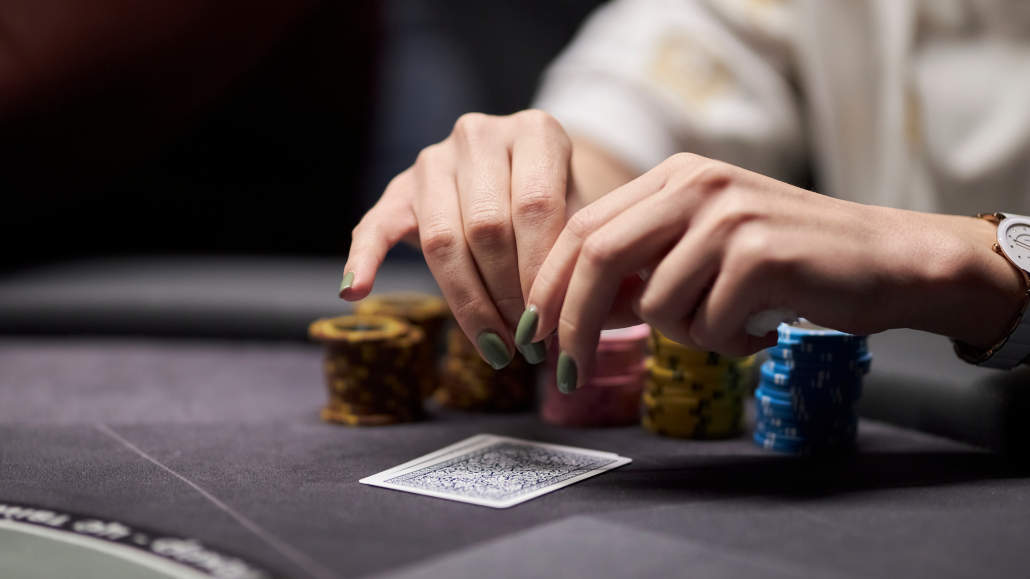
For all intents and purposes, any stack under 20 big blinds is considered a short stack. At this depth, your strategy shifts heavily toward pre-flop and flop decisions. It is also crucial to always look at the effective stack size. This means that even if you have 50bb, if the only other active player in the hand has 12bb, you are effectively playing a 12bb game, and your strategy must adjust accordingly.
The Different Zones of Short Stack Poker
Not all short stacks are created equal. Modern short stack poker strategy divides this territory into distinct zones. Here is a quick breakdown of how your primary strategy should shift based on your exact chip count:
| Stack Depth (Big Blinds) | Primary Strategy Zone | Typical Pre-Flop Action |
| 15 – 20 BB | Re-Steal & Selective Aggression | Min-raise (2x) or 3-bet All-in |
| 12 – 14 BB | High-Pressure Shove/Fold | All-in (Shove) or Fold |
| < 12 BB | Strict Mathematical Push/Fold | Pure All-in or Fold (Nash) |
How to Play a Short Stack in Early Positions?
Your strategy should depend heavily on your position at the table. If you have around 20 big blinds, you must play a solid and calculated range from early positions (UTG, UTG+1, UTG+2) since the entire table is left to act behind you.
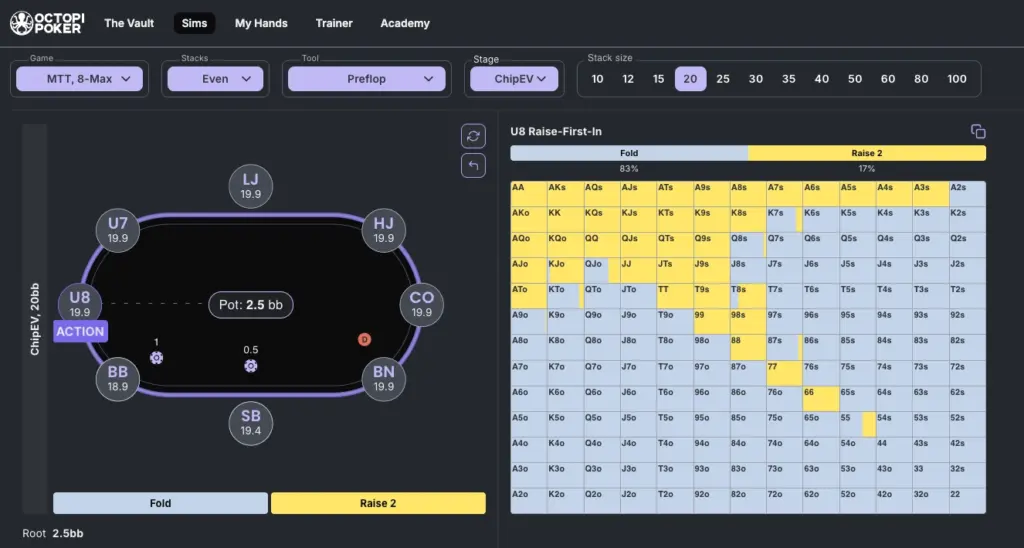
- The Core Opening Range: You should open the pot with strong value hands that have good playability. This includes big pocket pairs (
99throughAA), strong broadways (AK,AQ,AJ,KQ), and almost all suited Aces (A3sand higher). - Play Mid-Pairs, Fold Small Pairs: While medium pocket pairs like
66,77, and88are mathematically strong enough to open for a min-raise, small pocket pairs (22through55) should be folded straight-up. You simply do not have the implied odds to try and hit a set when your stack is this shallow. - Facing a Re-Raise: If you get 3-bet after opening, you should confidently get all your chips in the middle with your premium hands (
JJ+,AK,AQs), while instantly folding the bottom of your opening range.
Short Stack Poker in Middle and Late Positions
As you move into middle and late positions (Cutoff, Button), you get the opportunity to widen your range significantly and attack the blinds.
- The Min-Raise Strategy (15-20bb): From the button or cutoff, a min-raise with hands like
KQs,AJs, or99holds tremendous value. It allows you to steal the blinds and antes cheaply, but leaves you enough room to confidently call a re-shove from the big blind. - Re-Shoving Over Opens: If a medium stack opens from a middle position and you are on the Button or in the Blinds with 15bb, re-shoving all-in is an incredibly powerful weapon. Medium stacks open wide but will often fold to your shove to preserve their chips, giving you massive fold equity.
The Importance of Push/Fold Charts
When your stack drops below 12 to 15 big blinds, traditional poker strategy goes out the window. At this stage, min-raising leaves you mathematically committed to the pot anyway, meaning your only two profitable options are to go all-in or fold.
To master short stack poker, you must study Push/Fold charts (based on Nash Equilibrium). These charts calculate the exact +EV (Expected Value) hands you can shove profitably based on your position, the antes, and your exact blind depth. Memorizing these ranges removes the guesswork, maximizes your fold equity, and prevents competent opponents from exploiting you.
Push/Fold Scenarios
To truly understand how to operate in the danger zone, let's look at a couple of practical situations.
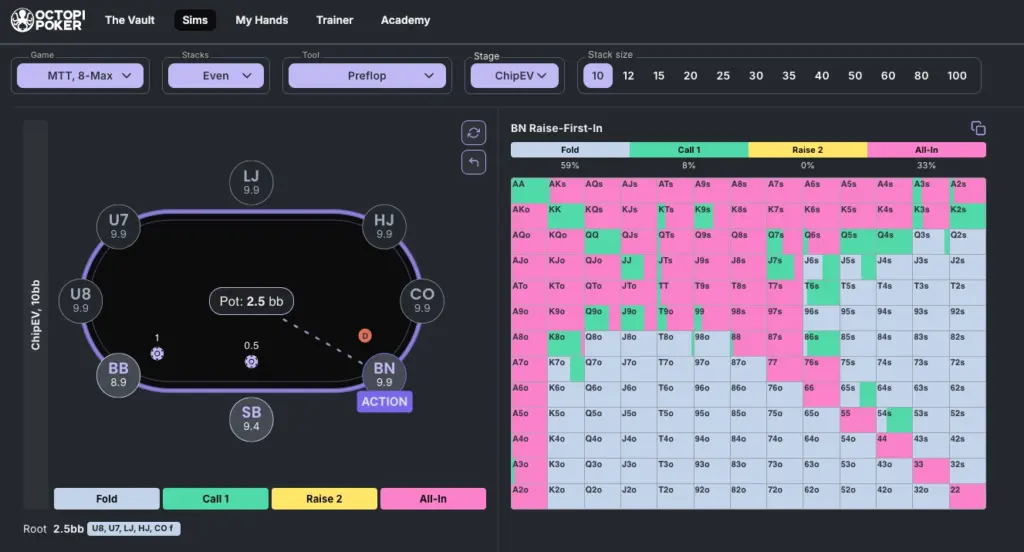
Scenario 1: 10BB on the Button (Unopened Pot)
Imagine the action folds to you on the Button, and you have exactly 10 big blinds. At this depth, you can mathematically shove a surprisingly wide range. Any Ace, any pocket pair, most suited Kings (like K5s+), and connected suited cards (like 87s) are profitable shoves. The players in the blinds will be forced to fold a massive percentage of their hands, allowing you to pick up the blinds and antes without a fight most of the time.
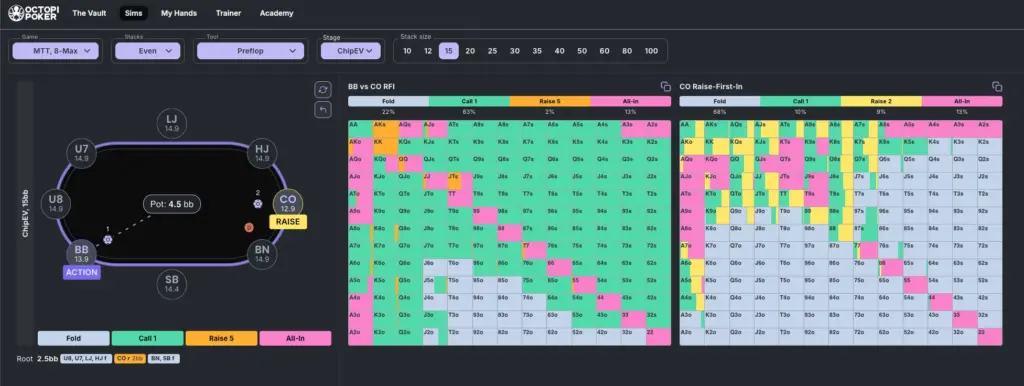
Scenario 2: 15BB in the Big Blind Facing a Cutoff Open
Imagine the action folds to you on the Button, and you have exactly 10 big blinds. At this depth, you can mathematically shove a surprisingly wide range. Any Ace, any pocket pair, most suited Kings (like K5s+), and connected suited cards (like 87s) are profitable shoves. The players in the blinds will be forced to fold a massive percentage of their hands, allowing you to pick up the blinds and antes without a fight most of the time.
Playing the Flop with a Short Stack
If you do see a flop with 15-20bb, you must understand the concept of SPR (Stack-to-Pot Ratio). With a short stack, your SPR will be very low (often under 2.0). This means you are essentially mathematically committed to the pot with any decent piece of the board.
- C-Bet Small: Whether you flopped a monster or missed completely, size your continuation bets incredibly small (25% to 30% of the pot). This sizes out opponents who missed, while risking the minimum amount of your stack.
- Commit with Top Pair: If you flop top pair with a short stack, you are almost never folding. Stack off and hope for the best; you do not have the luxury of waiting for a safer spot.
- Play Draws Aggressively: If you flop a strong flush draw or open-ended straight draw, play it fast. Shoving over a bet maximizes your fold equity while giving you the mathematical equity to win if you are called.
Defending the Big Blind
Because of modern tournament sizing (typically a 2x or 2.2x open) and the presence of big blind antes, you will be getting incredible pot odds to call from the big blind.
Even with a 15bb stack, defending hands like 87s, JTs, or K9s against a late-position open is often mandatory. The price is simply too good to pass up. However, you must be prepared to play “fit or fold” post-flop, committing your stack only when you flop a strong pair, two pair, or a high-equity draw.
Ready to Elevate Your Online Poker Game?
Mastering these short-stack scenarios takes time and practice. If you want to analyze specific situations from your own sessions or practice your push/fold strategy using the exact software featured in our examples, Octopi is the ultimate tool for the job. Check out our Octopi Poker review to discover how practicing with this software can take your online poker game to the next level!
FAQ About Short Stack Poker