

Few questions in poker start as many arguments as preflop bet sizing. Should you open to 2x? 2.2x? 2.5x? A full 3x? Ask five winning players, and you may get five different answers, and all of them can be right depending on the game they play. For something that happens on almost every hand, the correct open raise size is surprisingly unsettled.
Here is the truth up front: there is no single magic number. The “best” open size depends on a handful of factors, and once you understand them, you stop guessing and start choosing your size on purpose. This guide breaks down what actually decides your preflop bet sizing, why cash games and tournaments pull in different directions, and how live and online poker play change the math. Later, I will even put two popular solvers side by side and show that they do not fully agree either, which reveals something important about the entire debate.
What Is Open Sizing, and Why Does It Matter?
An open raise, also called raising first in (RFI), is the first voluntary action into a pot when you come in for a raise rather than limping, before anyone else has entered.
The size you choose does three things at once. It sets the price your opponents pay to continue, which controls how many of them call and how wide. It builds the pot, which shapes the stack-to-pot ratio (SPR) you will play with postflop. And it quietly defines how much you are risking to win the blinds and antes already out there.
That last point is the heart of preflop bet sizing. A smaller open risks less to steal the same blinds, which is efficient when it works.
A larger open wins the pot more often when everyone folds, but costs more when it does not, and bloats the pot when you get called. Every sizing decision is a trade-off between these forces, and the rest of this guide is about which factors should tip that trade-off one way or the other.
The Core Factors That Decide Your Open Size
If you remember nothing else, remember this: your open size should be a response to the situation, not a fixed habit. A few key factors decide what the right number is.
The Five Factors, One by One:
- Rake: In raked games, especially “no flop, no drop” structures where nothing is taken from pots that end preflop, rake quietly punishes calling and makes small opens less attractive to call. Rake is one of the biggest reasons cash and tournament sizing differ, and it is also why two solvers can disagree, as we will see.
- Stack depth: The deeper the effective stacks, the more careful you want to be about bloating the pot out of position, which favors smaller opens. As stacks get shallower, the open becomes a larger share of your stack, and the math shifts toward smaller raises or even min-raises.
- Antes: When there are antes in the pot, there is more dead money worth stealing, which encourages wider opening strategies. Antes roughly reduce the effective cost of contesting each pot, a big part of why MTT play looks the way it does.
- Position: From EP, you are likely to be out of position postflop and will face more re-raises, so a modest size keeps the pot small. From late position, you have the positional advantage and a wider range, which opens up more sizing options.
- The field: Who is behind you matters as much as any formula. A tight, aggressive table that punishes large opens with 3-bets pushes you smaller. A loose, passive table full of callers lets you size up for value.
None of these works in isolation. Your real open size is the product of all of them at once, which is exactly why a single fixed number is the wrong goal.
Cash Game vs Tournament Open Sizing
The biggest split in preflop bet sizing runs between cash games and tournaments. The two formats differ in stack depth, rake, and the presence of antes, and each of those pushes your open size in a different direction. Here is how each format shapes the decision.
Cash Game Open Sizing
The clearest split in preflop bet sizing is between cash games and tournaments, because the formats have different stacks, rake, and incentives.
In cash games, you sit deep, typically 100 big blinds or more, and the game is usually raked. Online, the standard has trended down from the old 3x to 4x opens, and these days, something around 2.5x is the most common sizing you will see at most mid and high stakes tables. Some players go smaller in specific spots, but 2.5x is a sensible, widely used default. The deeper you are and the more rake bites, the more a controlled, smaller open makes sense.
Live vs Online Preflop Bet Sizing
Even within the same format, live and online play often call for different preflop bet sizing, and the reason has little to do with theory. It is about the players.
Online pools, especially at mid and high stakes, are tougher and more familiar with modern strategy. Opponents defend correctly, punish oversized opens, and call or 3-bet at frequencies close to what solvers suggest. Against that kind of field, efficient smaller opens make sense, because larger sizes just get exploited.
Live pools are usually softer and looser. Players call far more than they should, limp more often, and rarely punish a large open with a well-timed 3-bet. Against that kind of field, sizing up is frequently more profitable, not because the “GTO” size changed, but because the best exploitative size against players who call too much is bigger.
If a table is going to pay you off, charge them. A common live adjustment is to add roughly one big blind per limper, so a 3x open becomes 4x with one limper, 5x with two. This protects your strong hands from cheap multiway pots while the calling is good.
As a default, live games reward larger, value-oriented opens, while online games reward tighter, more efficient ones. Always read the actual table in front of you.
One quirk of online poker is that you can fully customize your bet sizing in the client, including saved custom open sizes, so a player's exact sizing can itself be a read. Someone using precise, solver-style numbers like 2.1x or 2.3x has almost certainly studied with a solver or a training site, while a player who always opens a flat 3x is more likely a recreational regular. The sizes your opponents choose quietly tell you how much work they have put in away from the table.
What the Solvers Say: Octopi vs GTO Wizard
By now, you might be hoping a solver will hand you the one correct number. Here is the twist: they do not fully agree either, and that is the most useful lesson in this entire guide.
We ran the same spot through two popular solvers, Octopi Poker and GTO Wizard, to compare their preferred open sizes. The interesting part is where they line up and where they drift apart.
At 100bb, the deepest and cleanest spots, the two solvers agree almost perfectly. Open the button in a cash game or early-tournament setting, and both point to the same 2.5x. No debate there. But as stacks get shallower, small differences start to appear.
Take a button open at 50bb in an MTT. Octopi prefers a 2.3x open, while GTO Wizard leans slightly smaller at 2.1x.
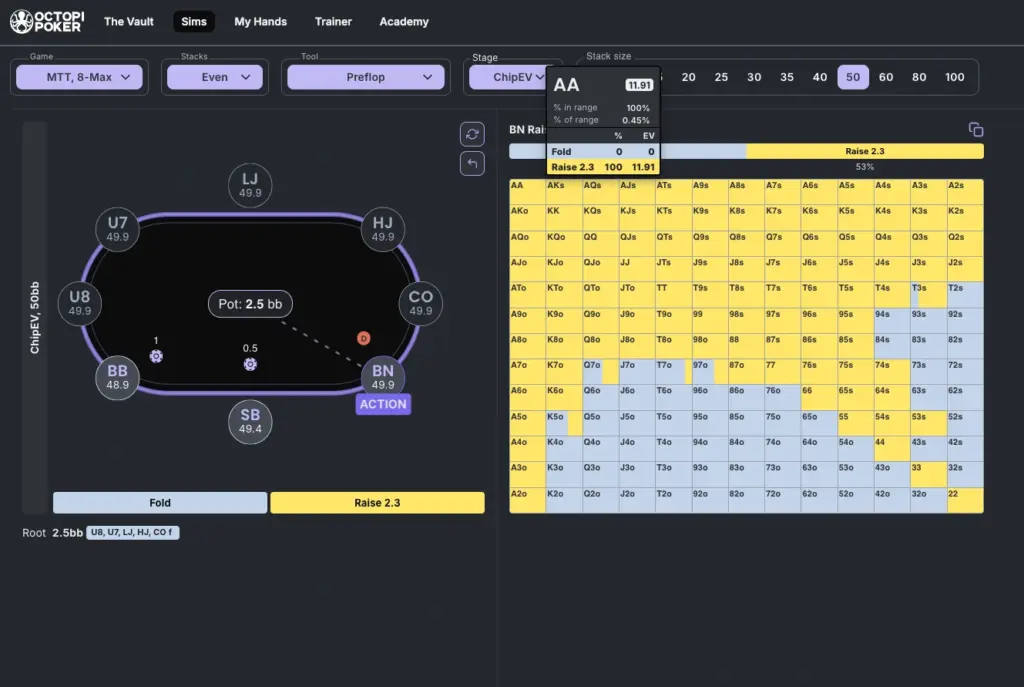
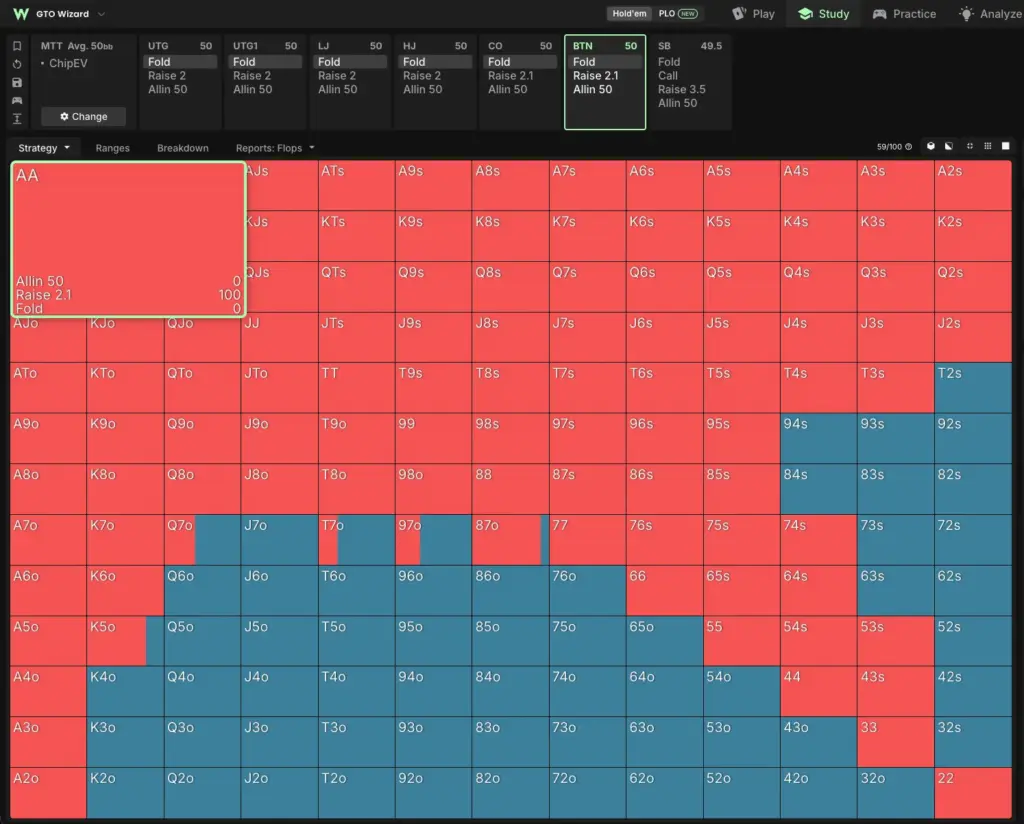
That is a difference of 0.2 big blinds, which sounds like nothing, and in practice, it nearly is. The two ranges are almost identical; only the size differs by a hair. The gap comes from the models themselves, slightly different rake assumptions, solver settings, and how each tool approximates the solution. Neither is “wrong”. They are answering the same question with marginally different inputs.
The takeaway is not “which solver should I trust”? It is that chasing two-decimal precision on your open size is a waste of energy. If two top solvers disagree by 0.2bb, that difference is firmly inside the margin of error for human play. Pick a sensible size, apply it consistently, and spend your study time on decisions that actually move the needle.
A Note on SB Preflop Bet Sizing
One spot deserves its own mention, because it surprises newer players: opening from the small blind. When the action folds all the way to the SB, the standard open size is noticeably larger than from other positions, often 3x or more.
The reason is position, in reverse. When you open the SB and the big blind defends, you are guaranteed to play the rest of the hand out of position. A larger open compensates for that disadvantage. It charges the BB more to continue, reduces how often you have to play a tricky pot from out of position, and protects your range.
The solvers show this clearly, and they show the same small disagreement we saw earlier. At 30bb in an MTT, opening from the SB, Octopi prefers 3.5x while GTO Wizard mixes around 3x.
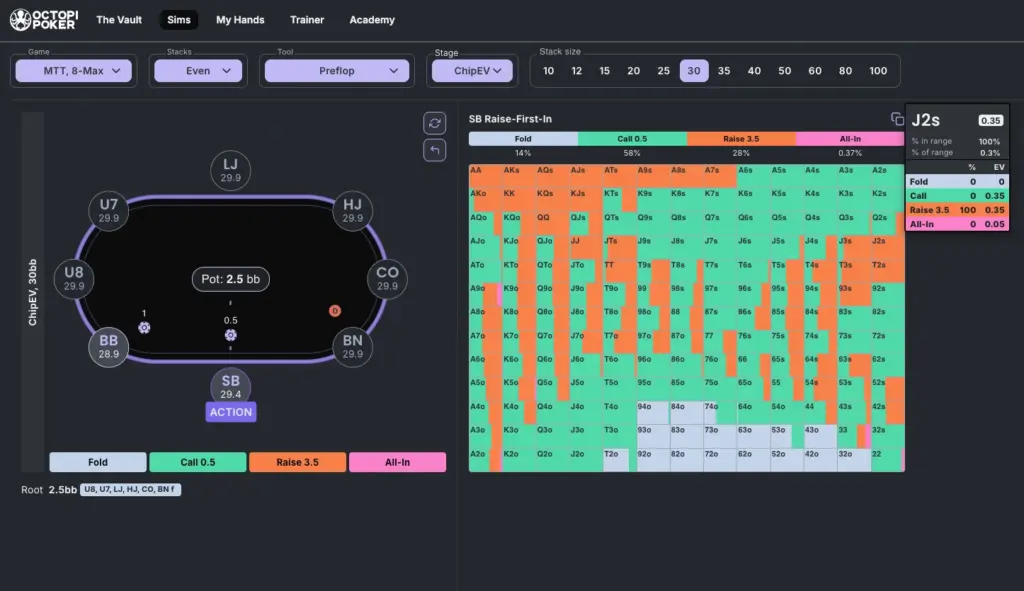
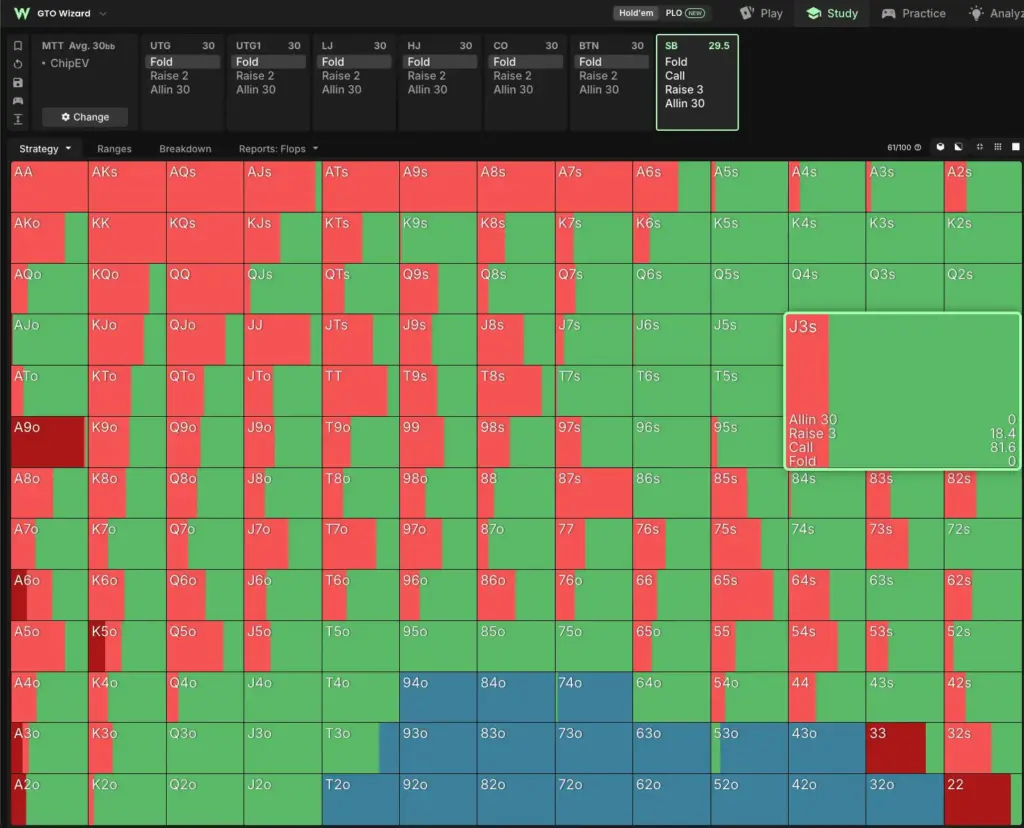
Notice two things at once. First, the SB size (3x to 3.5x) is much larger than the 2.1x to 2.3x button size from before, exactly because of the out-of-position problem. Second, the solvers again differ by roughly half a big blind, the same harmless margin. The position changes your size a lot; the choice of solver changes it barely at all.
Practical Takeaways
If you came here looking for one number to memorize, the honest answer is that no single number exists. But that does not mean preflop bet sizing is guesswork. Here is how to turn everything above into decisions at the table.
Start with a sensible default for your format. In cash games, a small open in the 2x to 2.5x range works well, leaning smaller as stacks deepen and rake bites. In tournaments, open around 2.5x early, then come down toward 2x as antes arrive and stacks get short. From the small blind, size up to 3x or more, because you will be out of position postflop.
From there, adjust the table. Size up against loose, passive players who call too much, especially live, and add roughly a big blind per limper. Size down, or just stay disciplined and small, against tough, aware opponents who punish large opens with 3-bets.
And do not agonize over tenths of a big blind. As the solver comparison showed, two top tools disagree by 0.2 to 0.5bb on the same spot, a difference too small to matter in real play. Your edge does not come from finding the “perfect” size. It comes from choosing a reasonable size for the situation and playing well after the flop. Spend your study time there.
The players who win do not all use the same open size. They use a size that fits their game, their stack, and their table, and they apply it with intention rather than habit.
FAQ About Preflop Bet Sizing