

Master poker strategy with PeakGTO. Try this poker solver for free.
Having covered a number of important strategies for tournaments, today’s lesson will focus on a somewhat narrower but still important area of the game: paired boards.
In previous lessons, we talked about different types of dry and draw-heavy textures, featuring aces, broadways, and low cards.
Today’s article will be all about tailoring your in-position tournament strategy as a preflop raiser on different types of paired flops. We’ll be focusing on the most common scenario of raising from the button and getting a call from the big blind.
Before we proceed to representative examples of these scenarios, here are a few main takeaways:
- Continuation bet 100% of flops containing a pair of aces, using 25% of the pot sizing
- C-bet small & always on high-pair boards with a low kicker
- On high-pair boards containing an ace, c-bet around 80%
- Use only small sizing on low pair boards & c-bet at around 60%
Tip #1: C-Bet Ace-Paired Flops 100%, Mostly Using Small Sizing
In terms of complexity, our strategy on flops featuring a pair of aces will be quite simple, as these are the boards we’ll be c-betting 100% of the time once the big blind checks to us.
In most common scenarios, where we are playing around 40 big blind effective, our go-to sizing on these types of boards will be a small, quarter-pot continuation bet, as we can see on the example of A♠A♥6♦:
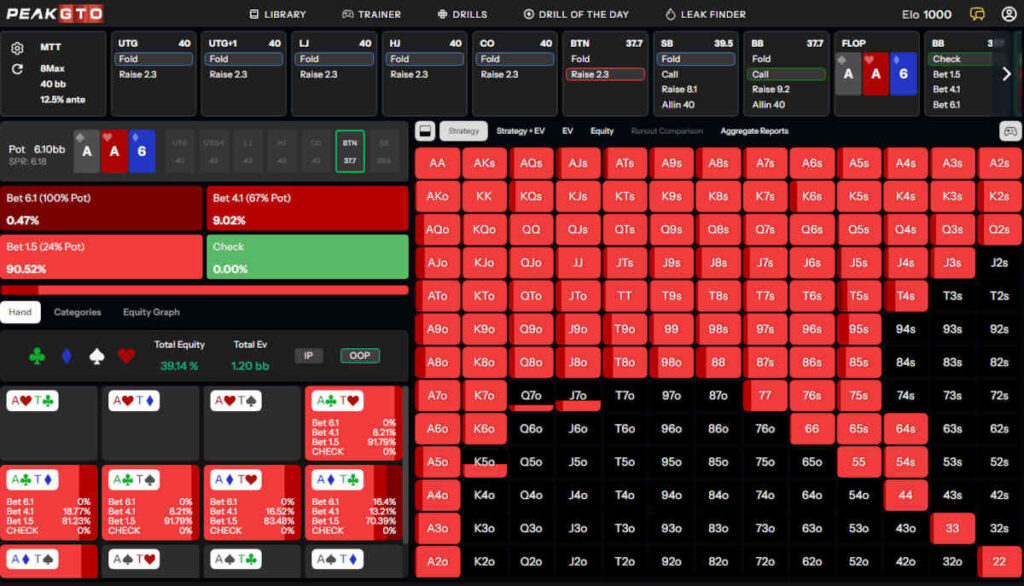
At 60 big blinds deep, our strategy doesn’t really change, as we are still c-betting every time. We are using the bigger sizing slightly more often, betting 67% of the pot around 13% of the time, primarily with hands like AK down to A7 and some weaker backdoor draws like JTo, T9o, and T7o.
Once the effective stacks get to 25 big blinds, it’s interesting that the solver starts using the larger sizing more frequently, betting 60% of the pot at a frequency of over 28%:
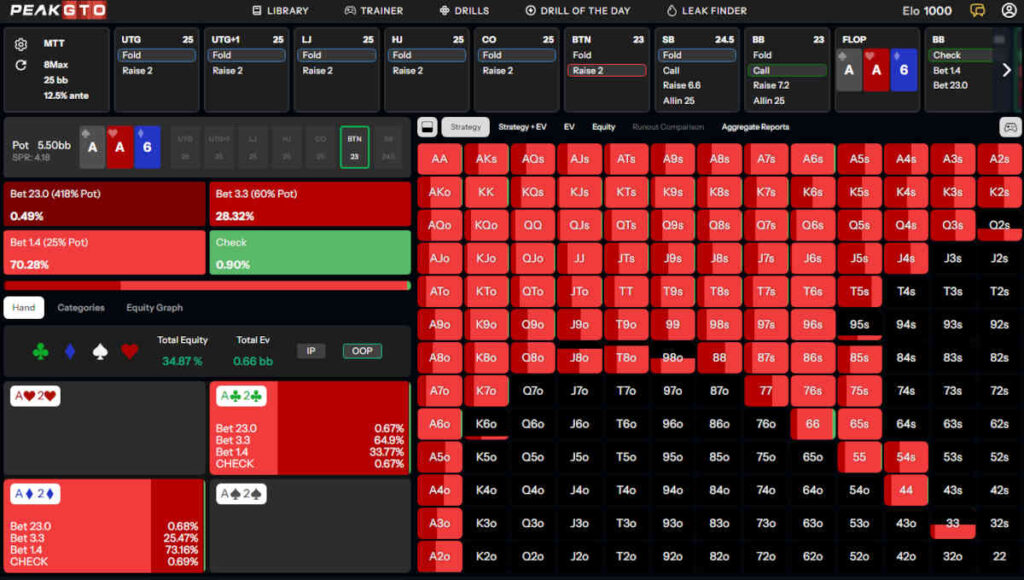
The range of hands that we’re betting big with expands to all top pairs (around one-third of the time), balancing it out by adding some extra backdoor draws to the mix.
With shallower stacks, we are perfectly happy to get chips in the middle with all strong hands, but to achieve the proper balance, we need to expand our range to include more weak hands as well. Otherwise, our strategy would be easily exploitable.
It’s important to note, however, that the small, 25% pot bet is still our default option in these scenarios, and we are using it almost with no exceptions with all strong non-made hands, like KJ, KQ, KT, QJ, etc.
Tip #2: Bet Small & Always on High Pair Flops
When it comes to flops containing a high pair, such as K♠K♥5♣, our strategy at 40 big blinds is even simpler. You’ll want to c-bet these textures 100%, and you should be using 25% of the pot sizing without any exceptions:
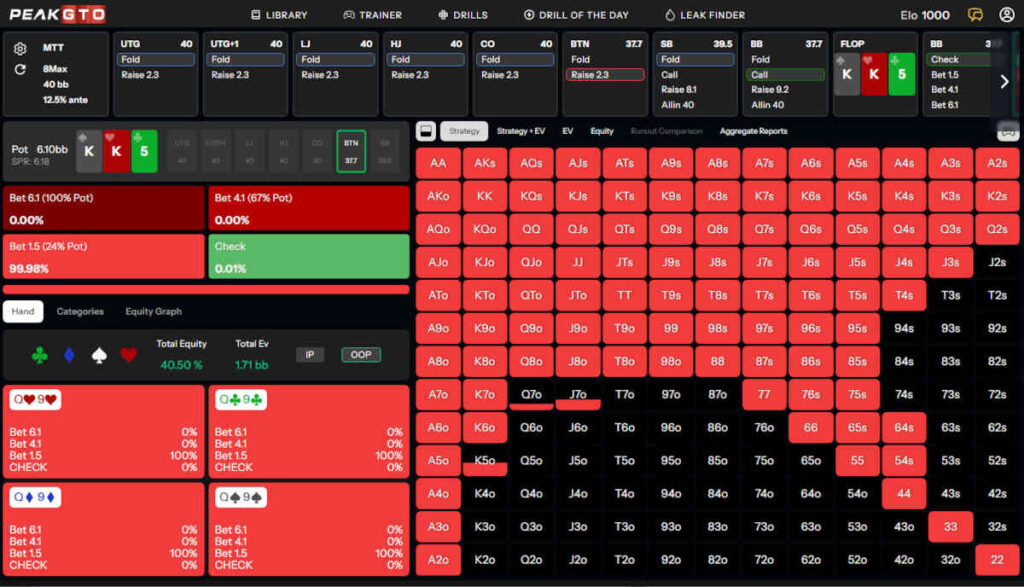
It is important to note that this strategy applies across all high-pair boards with low kicker, i.e. KKx, QQx, JJX, and even TTx. On flops containing a pair of queens specifically, we are checking back around 10%, primarily doing so with QQ, pocket aces, and pocket kings, and then a variety of hands at very low frequencies:
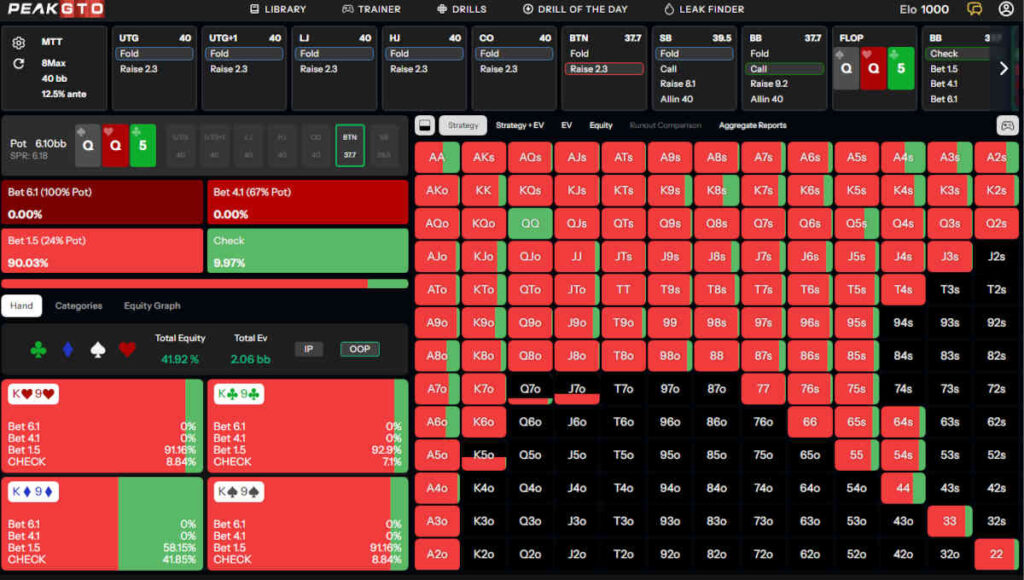
It’s interesting that the GTO strategy at effective stacks of 60 and 25 big blinds doesn’t change at all, so we are still betting all high-paired boards at 100% using a small sizing.
The only scenario where we’ll be checking back at some frequency instead of c-betting is on flops featuring a high pair and an ace. For example, on a board like A♦K♠K♥, we’ll be continuing around 80% and checking back about 20%:
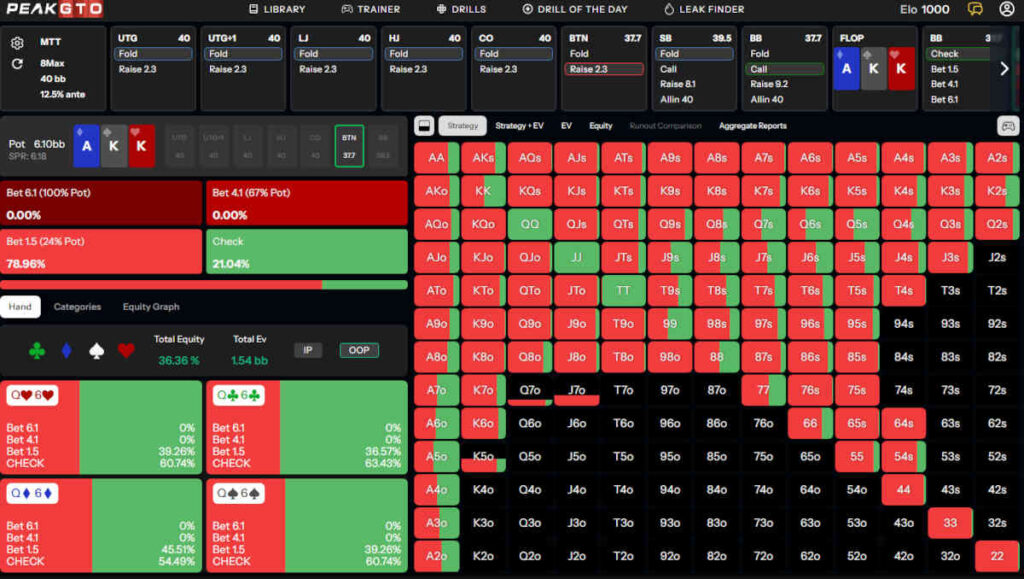
As you can see, the hands that we are checking back at some frequency (10% – 30%) are primarily hands containing an ace as well as pairs like QQ, JJ, and TT, which we are checking back 100% to protect our equity and try to reach a cheap showdown.
Tip #3: Continue around 60% on Low Pair Flops
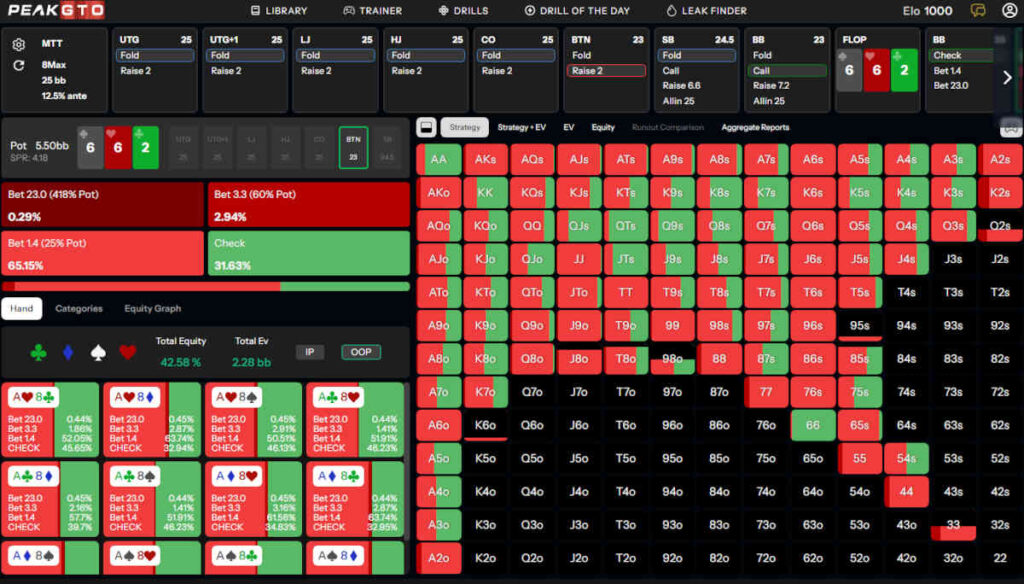
Flop textures containing a low pair and another lower card are usually more favorable to the big blind player than the button raiser. Thus, on a board like 6♠6♥2♣, we’ll be c-betting only around 65% of the time:
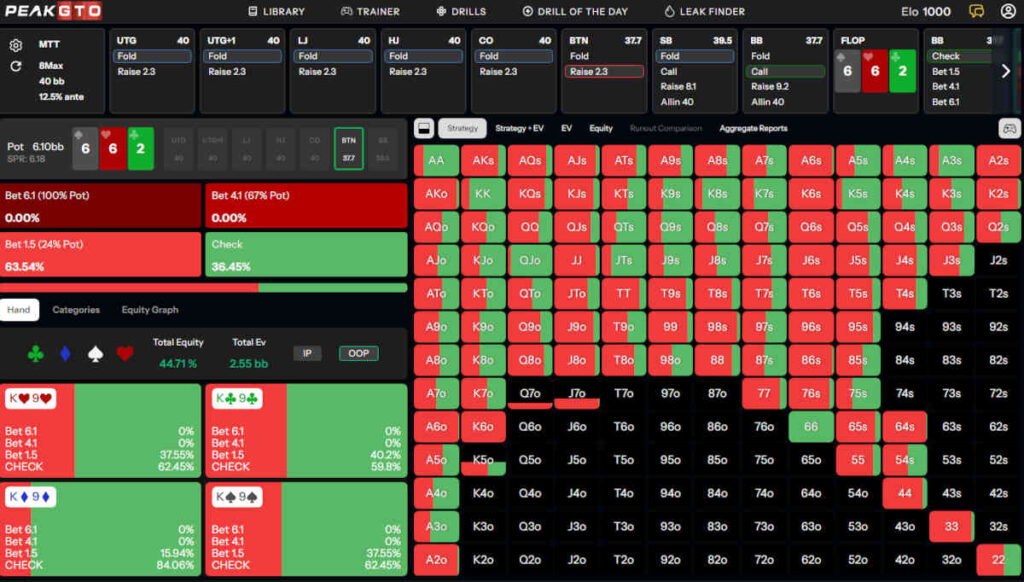
As you can see, we are always using the small, quarter-pot bet in these situations, and our c-bet range is quite spread out. Hands that we are c-betting 100% are the ones containing a six and almost all pocket pairs, but we are also continuing with a fair percentage of suited hands containing overcards, such as AK, AQ, AJ, KJ, QJ, TJ, etc.
As for the checking range, it contains a lot of off-suit ace-high and king-high combos.
A fully GTO-approved strategy in these scenarios is quite complex, but at least you don’t have to deal with different bet sizings, which makes things a bit easier. You can also make things simpler by removing any fringe frequencies and adding them to other combos.
For example, J8o c-bets at a very high frequency in these spots and checks back only a fraction of the time. You can make memorizing a bit easier by always c-betting J8o and checking back slightly more with JTs, a hand that’s already almost entirely in the check-back bucket.
As for the 60 big blind strategy, it remains virtually unchanged. The only visible change is that the solver throws in a tiny percentage of larger c-bets with a few combos, but these are so small and infrequent that you don’t need to memorize them.
Finally, at 25% big blinds effective, our c-bet frequency increases a little bit, going up to almost 69%. It is a small change, but you’ll notice how, at this stack depth, all of our pocket pairs become mandatory c-bets, and our c-betting frequency with A-x hands is slightly higher as well: