

Last reviewed: October 2026
Affiliate Disclaimer: This site is reader-supported. If you sign up through our links or use our provided codes, we may earn a commission at no extra cost to you. These partnerships help us fund our research, testing, editorial work, and free-to-access content, without changing our review standards or recommendations.
Video poker is a single-player casino card game based mainly on five-card draw poker. You receive five cards, choose which cards to hold, replace the others once, and receive any payout shown for your final hand. There is no dealer hand to beat and no bluffing against another player.
Your choices matter because holding different cards changes the expected value of the draw. However, the deal and replacement cards remain random. A strategy chart can reduce mistakes and help you reach the theoretical return of a particular game, but it cannot guarantee a profitable hand, session, or gambling career.
This guide uses 9/6 Jacks or Better as its main teaching example because it has straightforward rules and a well-documented strategy. Other versions can use wild cards, bonus payouts, multiple hands, or different minimum winning hands. Always match the strategy to the exact game and pay table shown on screen.
Gambling Disclaimer: Gambling involves financial risk. Please ensure you play responsibly and are aware of the legal regulations governing online gambling in your jurisdiction.
Video Poker Quick Facts
| Feature | Standard Jacks or Better example |
| Game format | Single-player electronic five-card draw |
| Deck | 52 cards with no wild cards |
| Main decision | Which cards to hold after the first deal |
| Number of draws | One replacement draw |
| Minimum paying hand | A pair of jacks, queens, kings, or aces |
| 9/6 theoretical RTP | 99.54% with optimal strategy and the full royal-flush payout |
| 9/6 house edge | 0.46% under the same assumptions |
| Main risks | A weaker pay table, the wrong strategy chart, fast play, and high variance |
Responsible Gambling and Bankroll Risk
Video poker's low theoretical house edge can create a false sense of safety. The percentage applies to total action, so repeatedly recycling credits can turn a modest starting balance into a much larger amount wagered. Fast online play and multi-hand formats increase that turnover further.
Set a money limit and a time limit before you start. Treat every selected hand as a separate wager, never chase losses, and do not increase the denomination to recover a poor session. Stop when gambling stops feeling recreational, even if the strategy chart says you made the correct decisions.
Our responsible gambling guide explains practical limits, warning signs, self-exclusion, and support options. US players who need confidential help can also contact the National Problem Gambling Helpline, which offers call, text, and chat support.
What Is Video Poker?
Video poker combines the hand-building decisions of draw poker with a machine-based payout system. The machine deals cards from a virtual deck, while the displayed pay table determines which final hands win and how much they pay.
Unlike traditional poker hand rankings, the ranking alone does not tell you the value of a hand. A game can attach special bonuses to four aces, require kings or better for the lowest payout, or add wild cards that make five of a kind possible. The name of the game and its complete pay table therefore matter as much as the cards.
Video poker also differs from a slot. A slot resolves a spin without asking the player to choose which symbols to keep. Video poker gives you a hold-or-discard decision after the initial deal, so correct play can change the game's long-term return. Our video poker versus slots comparison explains the practical differences in more detail.
How to Play Video Poker Step by Step
- Choose the exact game. Start with a straightforward version such as Jacks or Better. Check whether the game uses wild cards, bonus hands, a progressive jackpot, or multiple hands.
- Open the full pay table. Do not rely only on the game name. Two Jacks or Better games can return very different percentages because one pays less for a full house, flush, or royal flush.
- Set the denomination and total wager. Confirm the cost per hand and the number of credits or hands selected. In a multi-hand game, a displayed one-credit stake may apply separately to every hand.
- Deal five cards. Standard Jacks or Better uses a 52-card deck without jokers. The first five cards appear face up.
- Select the cards to hold. Keep the cards that form the highest-ranked option on the strategy chart for that exact variant and pay table. You may hold all five cards or discard all five.
- Draw replacements once. The game replaces every unheld card from the remaining virtual deck. The resulting five cards form the final hand.
- Check the pay table result. The game credits the listed payout when the final hand qualifies. A losing hand receives no payout.
- Review the next wager before continuing. Fast deal buttons make it easy to increase the amount wagered without noticing. Recheck the denomination, hand count, and session limit.
The round itself is simple. The challenge lies in reading the pay table and making consistent hold decisions instead of relying on instinct.
Video Poker Hand Rankings and Payouts
Standard Jacks or Better follows familiar five-card poker rankings. The table below lists the hands from strongest to weakest, but the exact payouts can change.
| Hand | What it contains | Standard Jacks or Better treatment |
| Royal flush | A-K-Q-J-10 of one suit | Highest payout; often has a special maximum-credit award |
| Straight flush | Five consecutive cards of one suit | Pays below a royal flush |
| Four of a kind | Four cards of the same rank | Base payout in Jacks or Better; bonus games may pay different amounts by rank |
| Full house | Three cards of one rank and two of another | The first number in a 9/6 Jacks or Better label |
| Flush | Five cards of one suit | The second number in a 9/6 label |
| Straight | Five consecutive ranks in mixed suits | Usually pays less than a flush |
| Three of a kind | Three cards of the same rank | Keep the three matching cards and draw two in standard play |
| Two pair | Two separate pairs | Keep both pairs and draw one in standard play |
| Jacks or better | A pair of jacks, queens, kings, or aces | Lowest paying hand in the baseline game |
A low pair does not pay immediately in Jacks or Better, yet it can still be the best hold because it can improve to two pair, three of a kind, a full house, or four of a kind. Wild-card and bonus variants can change both the ranking list and the optimal decision.
How to Read a Video Poker Pay Table
A pay table shows the return for each final hand at each credit level. The widely used term 9/6 Jacks or Better means that the game pays nine credits per credit bet for a full house and six for a flush. Those two rows provide a quick comparison, but you should still inspect the entire table.
Here is the common 9/6 Jacks or Better schedule:
| Final hand | One-credit payout | Five-credit payout |
| Royal flush | 250 | 4,000 |
| Straight flush | 50 | 250 |
| Four of a kind | 25 | 125 |
| Full house | 9 | 45 |
| Flush | 6 | 30 |
| Straight | 4 | 20 |
| Three of a kind | 3 | 15 |
| Two pair | 2 | 10 |
| Jacks or better | 1 | 5 |
Most rows increase in direct proportion to the credits bet. The royal flush often breaks that pattern: one credit may pay 250, while five credits pay 4,000 rather than 1,250. This jump explains why theoretical return figures often assume the qualifying maximum-credit wager.
That does not mean you should exceed your gambling budget. First calculate the total cost of five credits and, where available, select a lower denomination if the full-credit wager fits your preset limit. If it does not fit, accept the lower return, choose another game with a proportional royal payout, or do not play. A rare jackpot should never dictate an unaffordable stake.
The phrase full pay identifies a comparatively strong pay schedule for a particular variant. It does not promise that the game returns every wager or that the player will finish a session ahead.
Video Poker RTP and House Edge
Return to player, or RTP, estimates the share of all money wagered that a game returns over a very large number of hands when the player follows the assumed strategy. House edge is the remainder: an RTP of 99.54% corresponds to a 0.46% house edge.
The verified Video Poker return tables show how small pay-table changes alter Jacks or Better mathematics:
| Jacks or Better pay table | Theoretical RTP with the matching optimal strategy | House edge |
| 9/6 | 99.54% | 0.46% |
| 9/5 | 98.45% | 1.55% |
| 8/6 | 98.39% | 1.61% |
| 8/5 | 97.30% | 2.70% |
| 7/5 | 96.15% | 3.85% |
| 6/5 | 95.00% | 5.00% |
The difference between 99.54% and 97.30% may look small, but the corresponding house edge rises from 0.46% to 2.70%. The lower-return game therefore carries almost six times the theoretical casino advantage per unit wagered under the stated assumptions.
RTP does not predict a short session. A royal flush supplies a meaningful part of the 9/6 return and appears only about once per 40,000 hands under the relevant strategy assumptions. You can experience long losing stretches even when you make every hold correctly. Read our detailed guide to video poker odds and payouts for more variant-specific examples.
Jacks or Better Video Poker Strategy for Beginners
Video poker strategy ranks every viable hold by expected value. When several choices appear possible, you keep the option placed highest on the chart. The ranking depends on the paytable because a change to the flush, full house, or four-of-a-kind payouts can alter the best decision.
For full-pay 9/6 Jacks or Better, a detailed optimal chart produces a theoretical 99.54% return. A shorter 9/6 Jacks or Better simple strategy produces about 99.46%. The 0.08 percentage-point difference makes the shorter version useful for learning, but it is not identical to perfect play.
Simplified Hold Priority for 9/6 Jacks or Better
Work down this list and choose the first description that matches your initial hand:
| Priority | Hold decision |
| 1 | Keep a dealt royal flush or straight flush; keep all four matching cards from four of a kind |
| 2 | Keep four suited cards to a royal flush |
| 3 | Keep a full house, flush, or straight; keep three of a kind and draw two |
| 4 | Keep four cards to a straight flush |
| 5 | Keep both pairs and replace the fifth card |
| 6 | Keep a pair of jacks, queens, kings, or aces without an unrelated kicker |
| 7 | Keep three suited royal-flush cards |
| 8 | Keep four cards of the same suit |
| 9 | Keep a pair of tens or lower |
| 10 | Keep four cards to an outside, or open-ended, straight |
| 11 | Keep two suited high cards |
| 12 | Keep three cards to a straight flush |
| 13 | Keep the best two unsuited high cards when the exact chart supports the choice |
| 14 | Keep a suited 10 with a jack, queen, or king |
| 15 | Keep one high card: jack, queen, king, or ace |
| 16 | If none of these apply, discard all five cards |
This compact order omits some penalty-card exceptions and close expected-value decisions. Use the complete chart when exact optimal play matters, and never apply this list unchanged to Deuces Wild, Joker Poker, Double Double Bonus, or any other paytable. Our separate Jacks or Better guide provides more focused coverage.
Three Practical Hold Examples
A♥ K♥ Q♥ J♥ 7♥: The five cards already form a flush, but four cards also form a royal flush draw. Four to a royal ranks higher in 9/6 Jacks or Better, so hold A-K-Q-J of hearts and replace the seven.
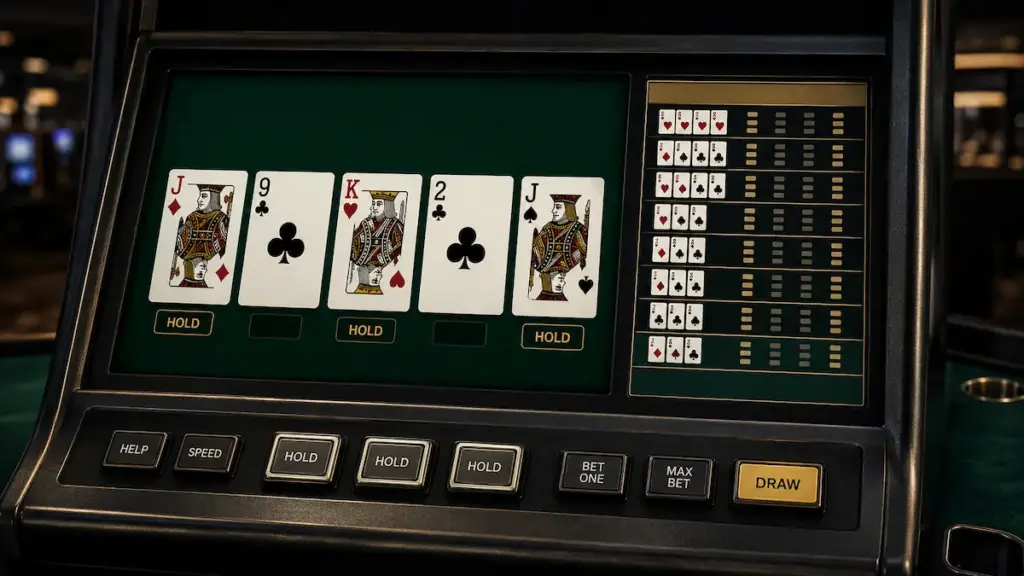
J♠ J♦ A♣ 7♥ 2♣: Hold the pair of jacks and discard the ace, seven, and two. Keeping the unrelated ace as a kicker removes one replacement card without improving the pair payout.
6♣ 6♦ K♥ Q♠ 2♥: Hold the low pair and discard the king, queen, and two. A low pair ranks above two unsuited high cards in the simplified 9/6 hierarchy.
These examples show why ordinary poker intuition can mislead. Video poker decisions compare the expected value of every possible draw, not the visual appeal of one potential hand. A video poker trainer can help you practise holds without risking money, provided the trainer uses the same variant and pay table.
Common Video Poker Mistakes
- Using one chart for every game. Wild cards, bonus payouts, and shorter pay tables change expected values and sometimes reverse the correct hold.
- Checking only the game title. A Jacks or Better label does not reveal whether the table is 9/6, 8/5, or another schedule.
- Holding an unnecessary kicker. When you keep a high pair, an unrelated ace or king usually reduces the number of useful replacement cards.
- Chasing weak inside straights. An inside straight normally has four consecutive cards, while an open-ended straight has eight. Exact exceptions depend on high cards and the strategy chart.
- Betting maximum credits without checking the total cost. The royal-flush premium may improve theoretical return, but it does not justify exceeding a preset loss limit.
- Ignoring the number of hands. Ten-play video poker places ten wagers per round. It resolves faster than playing ten single hands separately and can accelerate losses.
- Choosing a progressive jackpot over a stronger base table. A larger jackpot can raise theoretical return, but a reduced pay table or added wager can offset that benefit.
- Assuming bonus wagers count in full. Casinos often exclude video poker from promotions or apply a reduced wagering contribution. Read the current bonus terms before depositing or opting in.
- Playing too quickly. Strategy errors and wager-setting mistakes become more likely when the next deal follows immediately.
Popular Video Poker Variants
The category contains many related games rather than one universal rule set. The most popular Video Poker variants include the following:
| Variant | Main change | What to verify |
| Jacks or Better | A high pair is the lowest-paying hand | Full-house and flush rows, royal payout, and matching chart |
| Tens or Better | A pair of tens also pays | Lower payouts elsewhere can offset the easier qualifying pair |
| Bonus Poker | Extra awards for selected four-of-a-kind hands | Which ranks receive bonuses and what the game reduces elsewhere |
| Double Bonus | Larger differentiated four-of-a-kind awards | Full-house, flush, straight, and two-pair payouts |
| Double Double Bonus | Kicker-dependent bonuses for selected four-of-a-kind hands | Higher volatility and the exact kicker rules |
| Deuces Wild | Every two acts as a wild card | Minimum paying hand, wild royal, four deuces, and a Deuces-specific chart |
| Joker Poker | A joker joins the deck as a wild card | Deck size, minimum pair, wild-hand payouts, and correct strategy |
| Multi-hand Video Poker | One initial decision feeds several separately drawn hands | Total stake across all hands and the draw implementation |
| Progressive Video Poker | A jackpot grows over time | Base pay table, qualifying bet, current jackpot, and added wager |
| Multiplier games | Future or current hands can receive multipliers | Extra credit cost and how multipliers affect strategy |
Some rare full-pay schedules have a calculated return above 100% with exact optimal play. That figure describes a specific pay table under long-run mathematical assumptions; it does not establish current availability or remove variance, errors, time costs, stake limits, or gambling risk. Do not treat a historical full-pay label as proof that a particular online game offers the same return.
Online Video Poker vs. Casino Machines
The core deal–hold–draw structure can remain the same online and on a casino floor, but the interface and available checks differ.
Online games usually make the rules, provider, denomination, and pay table available through an information screen. Demo mode can help you learn the controls and verify a strategy chart, although free-play results do not predict real-money outcomes. Check the operator's licence, the named game provider, and any published testing information before wagering.
Casino-floor machines display the pay table on the screen or cabinet. Adjacent machines can use different schedules even when their artwork and game name look identical. Recheck the pay table after changing the denomination because some machines attach different schedules to different stake levels.
In both formats, confirm whether the game uses one hand or several, whether a double-up feature adds a separate gamble, and whether the royal or progressive prize requires a particular credit level.
What to Check Before Playing Video Poker
Use this quick game check before the first real-money hand:
- Exact variant and provider name
- Complete pay table, not only the advertised RTP
- Full-house, flush, straight, two-pair, and four-of-a-kind payouts
- Royal-flush payout at the selected credit level
- Wild-card, kicker, multiplier, or progressive rules
- Strategy chart that matches the exact pay table
- Denomination, credits per hand, number of hands, and total cost per round
- Whether a bonus permits Video Poker and its wagering contribution
- Demo availability for learning the interface
- Deposit, loss, session, and time-limit tools
- Local eligibility and legal-age requirements
Do not assume that a high headline RTP makes the game suitable for your budget. A multi-hand or multiplier format can create much larger swings than single-hand Jacks or Better, even when the long-run return looks similar.
Final Verdict
Video poker rewards preparation more than guesswork. The strongest practical approach is to identify the exact variant, compare the full pay table, choose an affordable total wager, and use a strategy chart built for that schedule. These decisions can reduce the mathematical disadvantage, but they cannot remove random outcomes or financial risk.
For beginners, single-hand Jacks or Better offers the clearest introduction. Learn the deal–hold–draw process in demo mode, understand the difference between simple and optimal strategies, and move to wild-card or bonus variants only after checking how their payouts and volatility change.
Cautionary Note: Participation in gambling activities should never be viewed as a reliable source of income. It is strongly recommended that only discretionary funds be utilized for wagering purposes.