
QuintAce has released an open-source tool designed to help online poker operators detect potential superusers by analyzing hand histories for suspicious playing patterns. Developed through its research arm, AceGuardian Technologies, the system combines statistical analysis, behavioral signals, and expert review to identify accounts that may have access to information other players should not be able to see.
The release comes amid a wider online poker scandal first brought to light by cybersecurity researcher @wolfsec0x0, who reported that remote-access software had been installed on poker players' computers through compromised third-party poker tools, potentially exposing their hole cards.
Although the incident is separate from QuintAce's new initiative, it has renewed questions about how poker sites can detect sophisticated forms of cheating. By making its detection methodology publicly available, QuintAce aims to give operators and researchers another way to investigate potential online poker superusers and strengthen game integrity.
Why QuintAce Superuser Detection Matters in Online Poker
A superuser is an account or player with unauthorized access to information that should remain hidden from opponents, such as their hole cards. This gives the player an unfair advantage that can be extremely difficult to detect through normal gameplay alone.
The problem is not new to online poker. In the infamous UltimateBet superuser scandal, which came to light in 2008, unauthorized software let accounts tied to the cheating scheme access opponents’ hole cards, causing substantial losses for affected players.
The recent scandal has raised similar concerns, although the alleged method was different. According to the investigation, compromised versions of two third-party poker tools, Jurojin Poker and IntuitiveTables, were used to install remote-access software on some players’ Windows computers. This potentially allowed an attacker to view their screens and hole cards without compromising the poker sites’ own systems.
This is where QuintAce's new superuser detection tool comes in. Instead of relying on individual suspicious hands or unusually high win rates, its approach analyzes patterns across large numbers of decisions to identify behavior that may indicate an unfair advantage.
How QuintAce Superuser Detection System Works
QuintAce's superuser detection system, developed through its research arm AceGuardian Technologies, is designed to identify suspicious patterns in online poker hand histories. Rather than treating a single unusual decision or an exceptionally high win rate as proof of cheating, the system looks for multiple signals that could indicate a player has access to information unavailable to their opponents.
The approach combines automated statistical analysis with expert human review. It examines how players make decisions across large numbers of hands, comparing their actions with expected outcomes, their opponents' possible holdings, and broader patterns in the player population.
The Key Steps in QuintAce's Detection Process
- Population screening: The system identifies unusual win rates and playing patterns over configurable time periods. It can also look for similarities between multiple accounts that may warrant further investigation.
- Behavioral analysis: It examines decision patterns that could be difficult to explain through ordinary poker strategy, including folds that appear to suggest knowledge of an opponent's hidden cards.
- Suspicious-hand detection: Individual hands are analyzed street by street, focusing on key decisions and how they relate to opponents' actual holdings and possible ranges.
- Hand Risk scoring: Suspicious decisions receive risk scores from 0 to 100, taking factors such as hand strength, pot size, decision type, and timing into account.
- Expert review: The flagged hands and broader behavioral patterns are reviewed by specialists before conclusions are drawn.
An important distinction is that the system does not automatically label a player a cheater because of one suspicious hand or an unusually successful session. Its purpose is to identify patterns across multiple decisions that deserve closer examination.
By releasing the methodology as open-source software under the MIT license, QuintAce aims to make this type of analysis more accessible to poker operators and researchers, allowing them to examine existing hand histories for potential signs of superuser activity.
What QuintAce's Heads-Up Investigation Revealed
To demonstrate how its superuser detection system works in practice, QuintAce analyzed a heads-up case connected to the recent remote-access scandal. According to the company's report, the sample involved 757 hands played at 25/50 stakes over ten weeks, with 95% of the hands taking place heads-up against one opponent. Across 14 sessions, the suspect won approximately $45,000.
The win rate alone would not have identified the account as suspicious. QuintAce found that the suspect's best 720-hand run ranked around the 81st percentile among 2,010 players who had played at stakes of 5/10 or higher. That result was strong, but not unusual enough to trigger a top-10% win-rate filter.
The more revealing evidence came from the player's decisions. Using a basic model that compared each decision with the opponent's actual cards, QuintAce flagged 72 hands for further review. To understand why, the researchers compared the suspect's decision patterns with those of other 25/50 heads-up players, including the 10 biggest winners at those stakes.
The case scorecard below shows how the suspect compared with the wider player pool across seven signals.
What the Case Scorecard Revealed
| Signal | Suspect's Value | Percentile | Opponent vs. Field | Top 10 Winners | 25/50 HU Median |
| Oracle-fold ratio: postflop, pair or better | 90.3% | 100th | 67.7% | 71.2% | 70.8% |
| Oracle-fold ratio: turn | 92.9% | 100th | 66.0% | 71.3% | 69.7% |
| Oracle-fold ratio: river | 91.2% | 99th | 74.4% | 76.5% | 76.7% |
| Fold to value bets | 86.2% | 100th | 57.0% | 56.2% | 53.9% |
| Fold to bluffs | 16.3% | 5th | 28.6% | 27.6% | 26.1% |
| Discrimination gap | 69.9 pts | 100th | 28.3 pts | 28.7 pts | 27.6 pts |
| Bluff success | 39.5% | 99th | 29.2% | 25.5% | 26.6% |
QuintAce's case scorecard comparing the suspect's decision patterns with other 25/50 heads-up players.
The results show an unusual pattern across multiple measures. The suspect ranked in the top 1% on six of the seven signals, while their fold-to-bluff result fell into the bottom 5%. By comparison, the top 10 winners generally ranked much closer to the middle of the population. This suggested that ordinary playing skill alone was unlikely to explain the suspect's results.
QuintAce stressed that a flagged hand is a candidate for review, not proof of cheating. The case was assessed through the aggregate patterns across the sample, expert review, and confirmation that the opponent's device had been compromised by the remote-access agent.
Two Suspicious Hands Flagged by QuintAce
The aggregate statistics show why the case attracted attention, but the flagged hands provide a clearer illustration of how the detection method works. QuintAce published several examples from the 72 hands identified by its basic model. Two stand out because the suspect folded hands that appeared strong relative to the opponent's predicted range but were behind the opponent's actual holding.
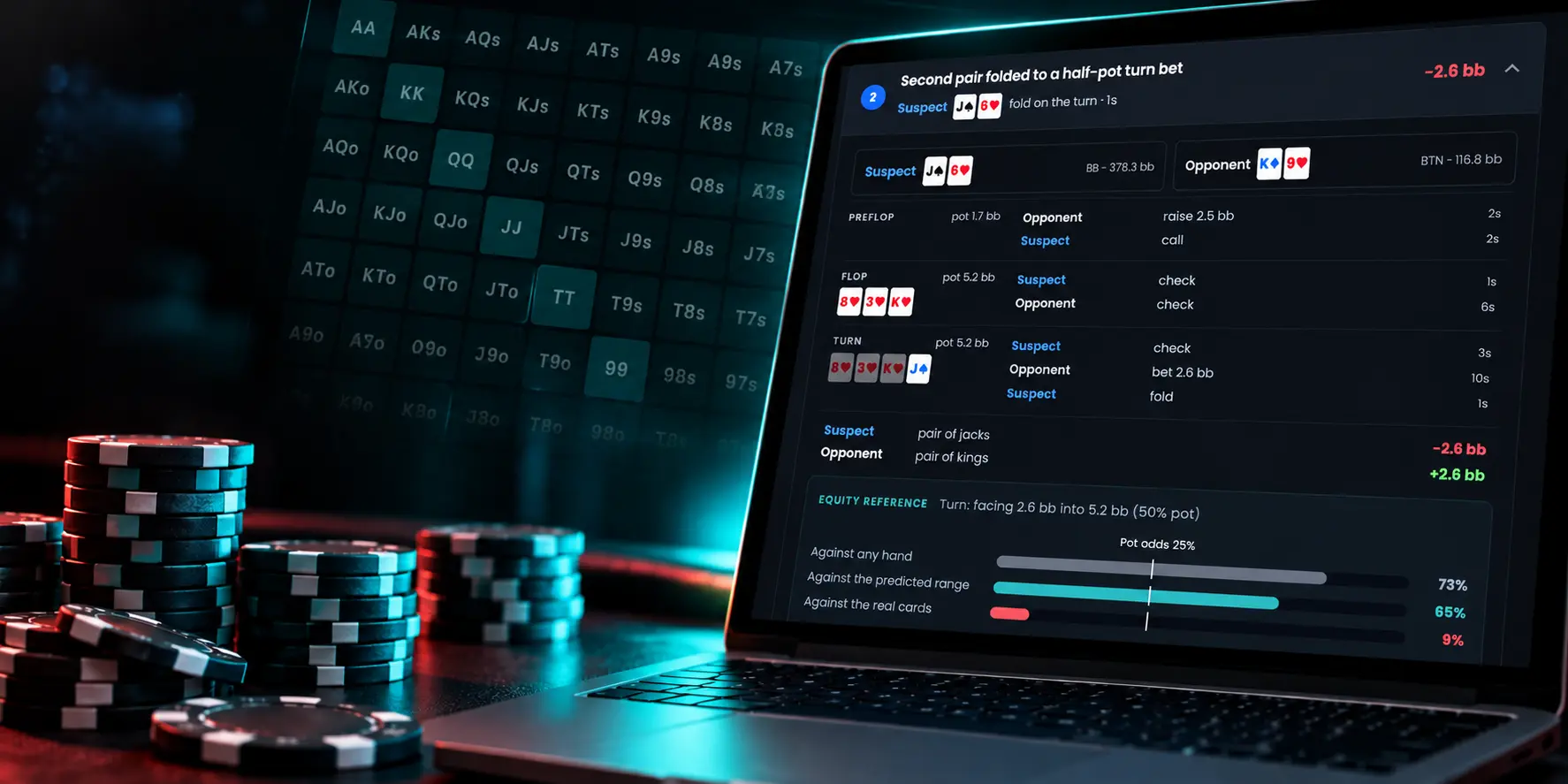
Example 1: J♠6♥ folded on the turn
In the first hand, the suspect held J♠6♥ on a board of 8♥3♥K♥J♦. After both players checked the flop, the opponent bet 2.6 big blinds into a 5.2 bb pot on the turn. The suspect folded after just one second.
According to QuintAce's analysis, the suspect had 65% equity against the opponent's predicted range, compared with only 9% against the opponent's actual hand, K♦9♥. With pot odds of 25%, the model suggested that calling would be profitable against the predicted range. The fold, however, avoided losing more chips against the opponent's actual cards.
QuintAce's analysis of a turn fold with J♠6♥, comparing equity against the predicted range with equity against the opponent's actual hand.
Example 2: Q♥8♦ folded on the river
The second hand is even more striking. The suspect held Q♥8♦ for two pair on a board of 6♠Q♠8♥3♥T♥. After the opponent checked the flop and turn, they moved all-in for 85.9 bb into a 28.2 bb pot on the river. The suspect folded within two seconds.
QuintAce's model estimated 50% equity against the opponent's predicted range, while the suspect had 0% equity against the opponent's actual hand, J♦9♣, which made a straight. The pot odds were 43%, meaning the model's range estimate suggested a call could be profitable, while folding was correct against the actual cards.
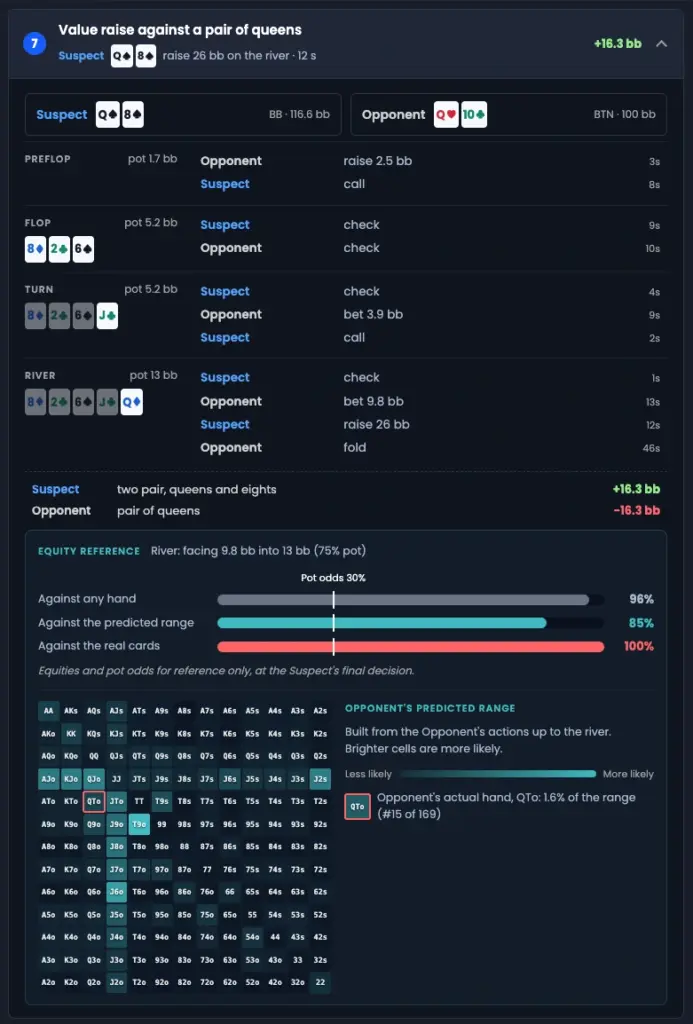
QuintAce's analysis of a river fold with two pair, where the suspect's equity differed sharply depending on whether the opponent's predicted range or actual cards were used.
Neither hand proves cheating on its own. A player can make an excellent fold based on a read, and range estimates are never perfect. What makes these examples relevant is how they fit into the wider case: across many decisions, the suspect's actions appeared to align unusually closely with the opponent's actual cards rather than the range an honest player would normally be expected to assign. QuintAce's conclusion relied on this broader pattern, supported by the scorecard and expert review, rather than on any single hand.
Can Players and Poker Sites Use the Tool?
QuintAce has released its superuser detection methodology and code as an open-source project on GitHub, allowing online poker operators to run the analysis on their existing hand histories. The system does not require previously labeled cheating cases or a complex AI model, although operators need access to players' hole cards to calculate the relevant equity comparisons.
Players can also submit suspicious hands directly to AceGuardian Research at [email protected]. The team says it will review submitted hands and return its findings as capacity allows.
The tool is designed to flag suspicious patterns for further investigation, not to automatically ban players. QuintAce emphasizes that individual hands and statistical outliers must be assessed in context, with expert review playing an important role in evaluating potential superuser activity.
Summary
QuintAce's open-source superuser detection tool offers online poker operators a way to investigate potential cheating through hand-history analysis. The company's heads-up case study showed why win rate alone may not reveal suspicious activity: the suspect's results were not extreme enough to trigger a basic win-rate filter, but multiple decision-based signals stood out across the sample. While no single hand proves cheating, combining statistical analysis with expert review may help operators identify players who appear to act on hidden information and strengthen online poker security.
FAQ About the QuintAce Superuser Detection