

Poker is a card game ruled by math, and understanding the core mathematical concepts is what separates long-term winning players from the fish. If you want to elevate your game, mastering pot odds is one of the very first steps you need to take.
In this article, we are going to explain what poker pot odds are, how to quickly calculate them at the table, and why pot odds play a central role in many of poker's most important decisions. Whether you are a beginner or just looking for a quick refresher before hitting the top online poker sites, this guide will give you the tools you need to make mathematically sound choices.
What Are Pot Odds?
In simple terms, pot odds represent the price you are getting to call, comparing the amount you must invest with the total pot you can win.
Pot odds tell you the exact “price” you are being offered to make a call and continue playing the hand. They are typically expressed as a ratio (e.g., 3:1 or “three-to-one”) or converted into a percentage representing your required equity to make a profitable call.
If your actual chances of winning the hand (your equity) are higher than the pot odds percentage being offered, calling is a profitable, positive expected value (+EV) play. If your chances are lower, you should simply fold your cards.

How to Calculate Pot Odds in Poker
Calculating pot odds at the table might seem intimidating, but it becomes second nature with a little practice. When facing a bet, you need to find out how much equity your hand needs to justify a call.
Follow these three simple steps:
- Calculate the Total Pot Size: Add the money already in the pot plus the opponent's bet.
- Calculate the Final Pot Size: Add your required call amount to the Total Pot Size.
- Find Your Percentage: Divide your call amount by the Final Pot Size, then multiply by 100.
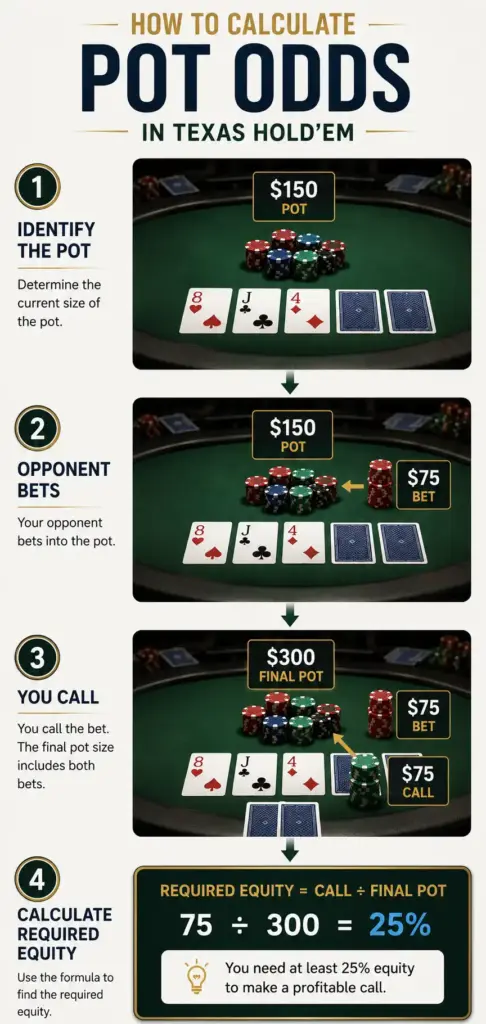
The Pot Odds Formula
Required Equity % = Call Amount / (Current Pot + Opponent's Bet + Your Call Amount) * 100
Calculating Pot Odds: A Practical Example
Let’s look at a standard $2/$5 No-Limit Hold'em cash game scenario:
- The Situation: You are on the flop. The pot is $150.
- The Action: Your opponent bets $75.
- The Math:
- Current pot ($150) + Opponent's bet ($75) = $225
- This means you are being offered $225 to $75, which simplifies to a ratio of 3:1.
- To find the percentage, apply the formula: $75 / ($225 + $75) = $75 / $300 = 0.25.
- Multiply by 100, and you get 25%.
In this scenario, you need to win the hand more than 25% of the time for a call to be mathematically profitable. If you are holding a strong flush draw (which hits about 35% of the time with two cards to come), making the call is highly profitable.
Factoring in Implied and Reverse Implied Odds
Basic pot odds only calculate the math of the current street. However, poker is a dynamic game, and you must also consider future betting rounds. This brings us to Implied Odds and Reverse Implied Odds.
1. Implied Odds Explained
Sometimes, it is mathematically correct to call a bet even if your immediate pot odds suggest a fold, provided you can win a massive pot later.
Scenario: Playing $1/$2 with deep $2,000 effective stacks.
- Your Hand: 8♥ 7♥
- Board: 5♦ 6♥ 2♣
- Action: The pot is $32. Your opponent bets $55.
To call $55, the final pot will be $142, meaning you need about 38% equity. With an open-ended straight draw, your raw equity is only around 32%, making it a mathematical fold based strictly on direct pot odds.
However, because your opponent is playing deep-stacked and likely holds a strong overpair (like AA or KK), you have massive Implied Odds. The slight mathematical loss you take by calling on the flop is vastly outweighed by the hundreds of dollars you stand to win on the turn or river when you hit your hidden straight.
2. Reverse Implied Odds Explained
Conversely, sometimes direct pot odds tell you to call, but future risks should force you to fold.
Scenario: $1/$2 game, multi-way pot.
- Your Hand: 5♠ 4♠
- Board: K♠ 9♠ 3♦
- Action: The pot is $40. A player bets $20, and three other players call.
Your direct pot odds are fantastic, and calling seems mandatory. However, you are holding a very low flush draw out of position against four opponents. If a spade hits the turn, there is a significant chance one of your opponents holds a higher spade (like the Ace or Queen). Hitting your hand could trap you into losing your entire stack. These are Reverse Implied Odds, and they often make folding the safest, most profitable play.
When to Use Pot Odds in Poker
Pot odds are not just for chasing draws; they dictate your actions across every street of the game.
- Preflop: When facing a 3-bet, look at the bet sizing. Small 3-bets give you excellent pot odds, allowing you to defend widely. Large 3-bets significantly tighten your defending range, often forcing folds from many speculative and marginal hands. In tournaments, pot odds (aided by antes) are the exact reason short-stack shoves are frequently called by relatively weak hands in the big blind.
- The Flop & Turn: This is where pot odds are most actively used to evaluate drawing hands (straights and flushes). Compare the price your opponent is laying you against the odds of hitting your outs.
- The River: With no more cards to come, your hand is final. When facing a river bet, pot odds tell you exactly how often you need to be right to catch a bluff. If an opponent bets 25% of the pot, you are getting 5:1 odds, meaning you only need to be right 16.6% of the time to make a profitable hero call. If they overbet the pot, your required equity skyrockets.
Why Pot Odds Are So Important
There are few concepts in poker more foundational than pot odds. Instead of relying on gut feelings, intuition, or trying to put your opponent on exactly one hand, pot odds allow you to make objective, mathematically sound decisions.
While you might still lose individual hands due to variance, consistently making mathematically correct pot-odds decisions is one of the key building blocks of becoming a long-term winning poker player.
Frequently Asked Questions (FAQ)