
Poker board texture is one of the most important concepts to understand when developing a strong postflop strategy. The cards on the board influence how the ranges of both players connect with the flop, which can have a major impact on everything from c-bet frequency and bet sizing to bluffing and value betting.
A flop such as A♠7♦2♣ creates very different strategic conditions from a board like J♠10♠9♦. Understanding why these boards play differently allows you to recognize which player has the range advantage, which hands benefit most from aggressive betting, and when you should be more cautious.
In this guide, we'll explain the main types of board texture in poker and show how they can affect your decisions throughout the hand. We'll cover dry, wet, connected, paired, and monotone boards, as well as the key adjustments you can make with your ranges, c-bets, and bet sizes.
What Is Poker Board Texture?
Poker board texture refers to the way the community cards interact with the ranges of the players in a poker hand. Certain combinations of cards create more opportunities for strong made hands, draws, or improving turn and river cards, while others leave most of the range relatively disconnected from the board.
Understanding board texture is important because the same hand and betting strategy can perform very differently on different boards. A flop's texture can influence which player has the range advantage, how often the preflop raiser should c-bet, which bet sizes make sense, and how aggressively each player should continue on later streets.
Board texture can also change as the hand progresses. A relatively dry flop can become much more connected on the turn, while a seemingly dangerous flop can become less threatening after a blank card. For this reason, good postflop decision-making requires you to evaluate not only the current board but also how future cards are likely to affect both ranges.
The Main Types of Poker Board Texture
Not all poker boards create the same strategic conditions. Some flops leave players with very few strong draws or combinations, while others create a large number of possible made hands and draws. Understanding the different types of board texture makes it easier to evaluate how the flop interacts with each player's range.
Dry Boards
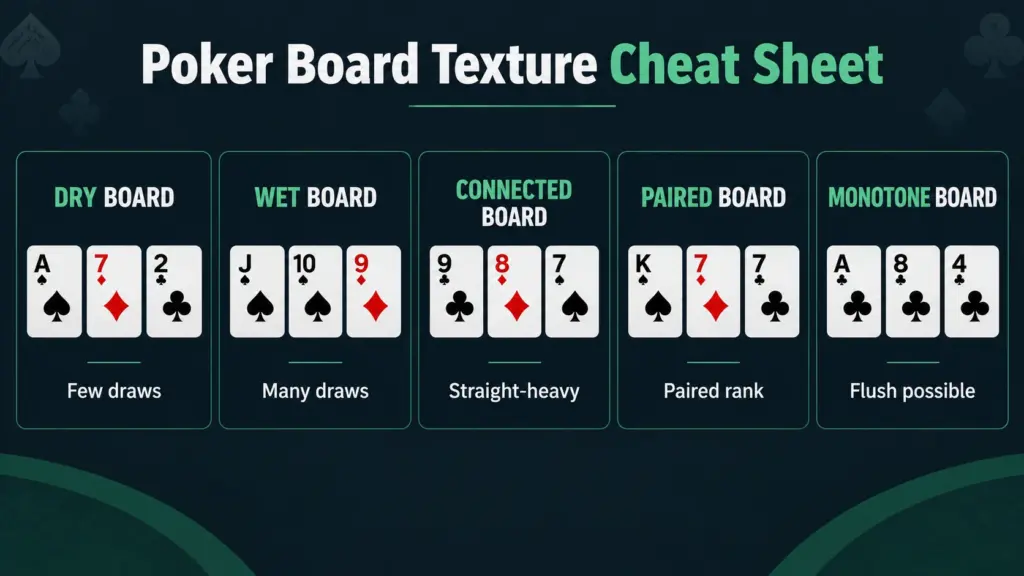
A dry board contains relatively few draws and typically has little connectivity between the cards. Boards such as A♠7♦2♣ or K♣8♦3♠ are common examples. There are fewer straight and flush possibilities, meaning the majority of both players' ranges will often miss the flop.
Because there are fewer draws to protect against, dry boards can often favor more frequent continuation betting and smaller bet sizes. The preflop aggressor can apply pressure with a wide range of hands, including many hands that are not strong enough to build a large pot for value.
Wet Boards
A wet board offers numerous drawing possibilities and creates more ways for players to connect with the flop. A board such as J♠10♠9♦ contains straight draws, flush draws, pairs, and two-pair combinations, making it significantly more dynamic than a dry flop.
On these boards, ranges interact more strongly with the community cards, so players generally need to pay closer attention to draws and potential turn cards. Bet sizing can also become larger because there are more hands that can continue against a bet.
Connected Boards
A connected board contains cards that are close in rank and can form straights or strong straight draws. 9♣8♦7♠, for example, gives players numerous ways to make or improve to a straight.
Connected boards can shift the range advantage significantly because certain preflop ranges contain more combinations that interact well with these cards. They also tend to produce more complex turn and river decisions as additional cards can complete draws or change the relative strength of hands.
Paired Boards
A paired board contains at least two cards of the same rank, such as K♠7♦7♣ or Q♥Q♣4♠. These boards change the way players construct their ranges because trips and full houses become possible, while some unpaired hands lose value.
Paired boards can also make it harder for an opponent to represent certain strong hands credibly. At the same time, the exact effect of the paired card depends on its rank and on how well the board connects with the ranges involved.
Monotone Boards
A monotone board is a flop where all three cards share the same suit, such as A♣8♣4♣. These boards immediately create a flush possibility and significantly change the distribution of strong hands and draws.
Players need to consider not only made flushes but also hands containing a single card of the relevant suit. The presence of the flush draw can affect c-betting, calling ranges, and bet sizing, while future cards can either complete additional draws or alter the strength of existing hands.
How the Poker Board Texture Affects Your Range
The texture of the flop can have a major effect on how well your range connects with the board. This is one of the key reasons why the same preflop range can require very different postflop strategies depending on the cards that come down.
On a dry, high-card board, the preflop raiser's range will often contain more strong top-pair combinations and overpairs than the caller's range. This can give the aggressor a clear range advantage and allow them to bet frequently.
On more connected or dynamic boards, the difference between the ranges can become much smaller. A board such as 9♣8♦7♠ interacts particularly well with hands that may appear more frequently in the caller's range, including suited connectors and other connected holdings. As a result, the player who raised preflop may need to be more selective with their aggression.
Board texture also affects the nut advantage, or which player is more likely to hold the strongest possible hands on a given board. A flop that creates many two-pair, straight, or flush combinations can dramatically change which range contains the most powerful hands.
It is therefore not enough to ask whether you connected with the flop. You also need to consider how the entire range interacts with the board. This range-versus-board perspective helps determine your c-bet frequency, preferred bet sizes, and which hands should continue aggressively versus those that are better suited to checking.
Poker Board Texture and C-Betting
Board texture should directly influence how frequently you continuation bet and which sizing you choose. Instead of using the same c-betting strategy on every flop, consider how the board interacts with your range and your opponent's likely holdings.
| Board Texture | Typical C-Bet Approach | Common Sizing |
| Dry | Bet frequently with a wide range | Small |
| Wet | Bet more selectively | Medium to large |
| Connected | Check more often and protect your betting range | Medium to large |
| Paired | Often supports frequent betting, depending on the paired rank | Small to medium |
| Monotone | More selective, especially when ranges connect strongly | Small to medium |
The important point is that board texture does not determine your c-bet strategy on its own. Position, preflop ranges, stack depth, and the number of players in the pot can all change the optimal approach.
For example, a dry board can still favor the caller's range, while a coordinated board may be a reasonable betting opportunity when the preflop raiser has a strong range or nut advantage. The goal is to identify how the specific board changes the relationship between the two ranges rather than following a fixed rule for every texture.
How to Adjust on Different Board Textures
Board texture should influence your postflop strategy, but it should not be treated as a set of fixed rules. The same board can call for very different decisions depending on the preflop ranges, position, effective stack size, and your opponent's tendencies.
A useful approach is to first ask which player has the range advantage and nut advantage, then consider how the specific texture affects that relationship. From there, you can adjust your checking, betting, bluffing, and check-raising frequencies rather than relying on rules such as “dry boards should always be bet” or “wet boards should always be raised”.
Dry Board Adjustments
Dry boards often allow the preflop aggressor to c-bet frequently, particularly when the flop strongly favors their range. Small bets can work well because there are relatively few draws to charge and limited incentive to risk a large portion of the pot with marginal hands.
However, a dry board does not mean the defending player should rarely check-raise. On some low-card or otherwise favorable textures, the caller can have more strong combinations than the preflop raiser. For example, on 6♥3♦2♣, the big blind can have more two-pair, straight, and strong draw combinations, creating opportunities for an aggressive X/R (check-raising) strategy.
This becomes particularly important against opponents who c-bet too frequently. When a player is betting a wider range than they should, increasing your X/R frequency can punish their weaker bets and force them to defend more of their range. In this situation, the adjustment comes from the opponent's tendency as much as from the board itself.
Wet and Connected Board Adjustments
Wet and connected boards create more combinations of strong made hands and draws, so ranges tend to interact more heavily with the flop. This can make betting less automatic and increase the value of hands that can withstand aggression or apply pressure themselves.
Consider J♠10♠9♦. Sets, two pair, straights, flush draws, and straight draws can all be present, giving both players more ways to continue aggressively. The exact strategy still depends on the preflop ranges, but the increased connectivity means decisions should be made with the likely turn and river development in mind.
Connected boards can also be particularly useful for check-raising when they favor the defending range. For example such as 9♥7♠5♥ and 6♠4♦3♥, where the big blind can have a meaningful range of strong made hands and draws that the preflop raiser may not have as frequently.
Paired Board Adjustments
Paired boards change the distribution of strong hands because trips and full houses become possible while many unpaired holdings have difficulty improving. The effect depends heavily on which card is paired and which player has more combinations containing that rank.
For instance, on K♠7♦7♣, the defending range can have a trips advantage if it contains more 7x combinations than the preflop raiser. On boards where the caller has this type of nut advantage, a more aggressive raising strategy can become possible.
Other paired boards can favor the preflop aggressor instead, so “paired board” by itself is not enough to determine the correct strategy. The rank of the pair and the preflop action remain crucial.
Monotone Board Adjustments
Monotone flops create an immediate flush possibility and therefore change the value of both made hands and draws. Players need to pay particular attention to their suit distribution, including how many strong flushes, flush draws, and blocker combinations each range contains.
On A♣8♣4♣, for example, hands containing a club can have very different strategic properties from similar hands without one. Strong flushes can form an important part of a raising range, while certain hands with a club can be useful bluff candidates because they block parts of the opponent's continuing range.
The extreme connectivity of very wet monotone boards can also reduce the incentive to simply keep increasing bet sizes. When both ranges contain many nutted hands, there can be less value in trying to generate folds from hands that are already strong enough to continue.
Practical Examples
The examples below show how the texture of a board can influence the type of adjustment you make. They are strategic patterns rather than automatic rules, since the optimal decision depends on the ranges and action in the hand.
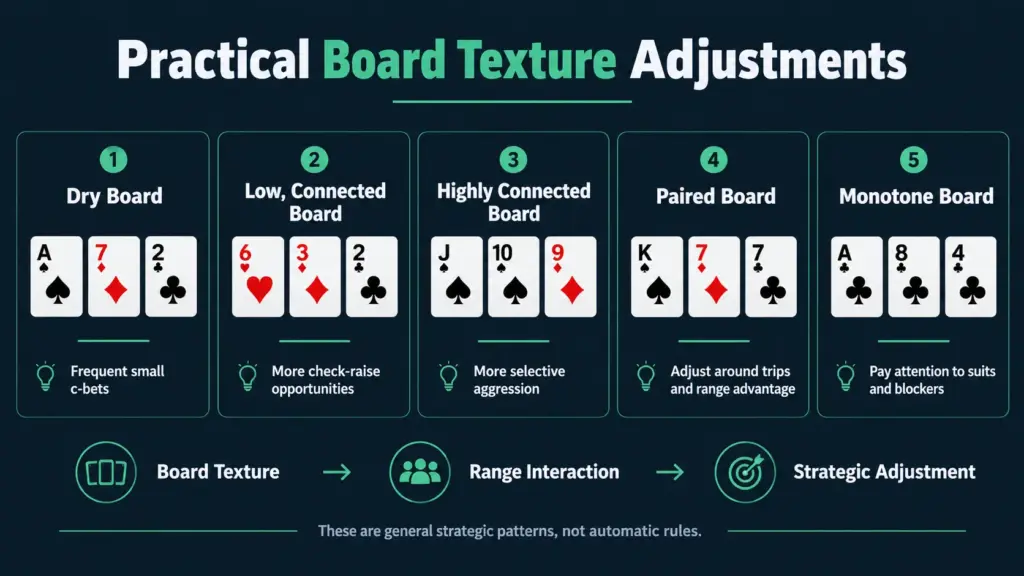
The broader lesson is that board texture should change your strategy, not dictate it. Start with the preflop ranges, identify who has the stronger overall and nutted range, and then use the texture of the board to decide which parts of your range should bet, check, call, or raise.
Final Thoughts
Board texture is a fundamental part of postflop strategy because the community cards can dramatically change how each player's range interacts with the hand. Rather than focusing only on whether your own hand connects with the flop, consider the overall relationship between both ranges and the board.
Dry, wet, connected, paired, and monotone boards can all create different strategic conditions, but there are no universal rules that apply to every example. Your position, preflop ranges, stack depth, and opponent tendencies should all be considered when deciding whether to bet, check, call, or raise.
The more effectively you can recognize how the board changes the distribution of strong hands, draws, and bluffs, the easier it becomes to build a consistent postflop strategy. This understanding can help you make better decisions across a wide range of situations, from choosing your c-bet frequency to finding profitable check-raise and bluffing opportunities.
Looking to put your board texture knowledge into practice? Online poker gives you the chance to see and play through far more hands than live poker, making it a great environment to get more postflop experience. If you're looking for a new poker site to play on, check out our hand-picked list of recommended poker rooms, where you can also find the sites where we have exclusive bonus codes available.
Poker Board Texture FAQ