
The latest High Stakes Poker session at the PokerGO Studio in Las Vegas delivered four days of spectacular action, with Andrew Robl, Eric Wasserson, Michael “Texas Mike” Moncek, Alejandro “Papo MC” Lococo, Justin Gavri and Sameh Elamawy battling it out at nosebleed stakes. The game featured a $250,000 minimum buy-in, $500/$1,000 blinds and a $5,000 BB ante, setting the stage for some of the biggest pots ever seen on the show.
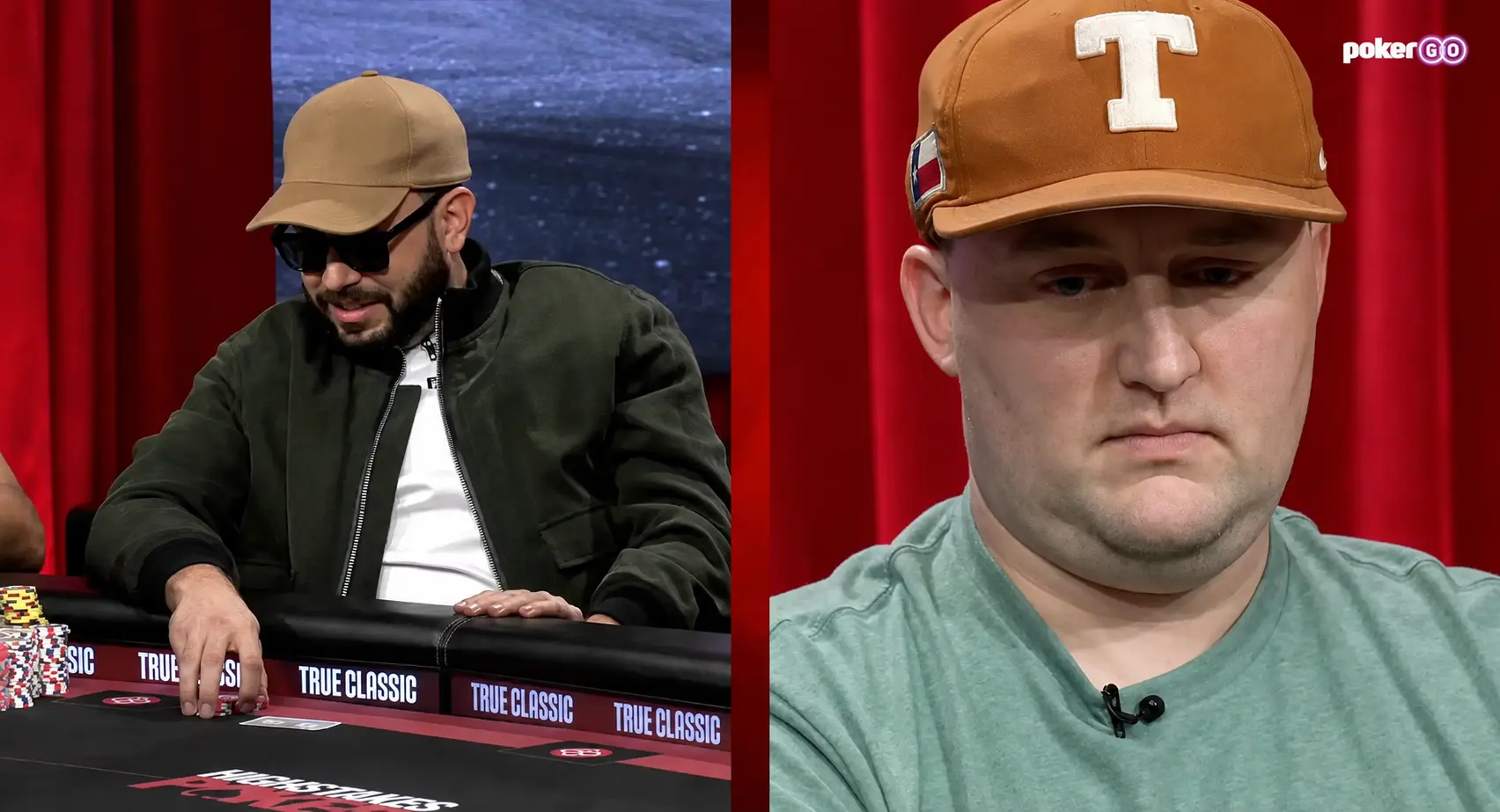
The session saved its biggest moment for last. In a hand that has already been described by many poker fans as one of the best High Stakes Poker episodes ever, Texas Mike attempted an audacious bluff against Eric Wasserson for a staggering $4.26 million pot. Holding just 10-high, Texas Mike fired three barrels before moving all-in on the river, leaving Wasserson with a decision for his remaining $1.6 million. This hand was the biggest pot in High Stakes Poker history. The full episode is available to watch on YouTube.
High Stakes Poker Returns With CoinPoker as Presenting Sponsor
The record-breaking hand came during the latest live run of High Stakes Poker, which returned to PokerGO for a special seven-day stretch from August 25-31. For the first time, the show ran live on consecutive days, bringing some of the biggest names in high-stakes cash games together for a week of action.
CoinPoker joined the show as the presenting sponsor, with its branding integrated throughout the livestream and promotional coverage. The partnership also brought CoinPoker ambassador Alejandro “Papo MC” Lococo to the table, alongside established high-stakes regulars such as Andrew Robl and Eric Wasserson.
With millions of dollars on the line and several players capable of creating huge pots, the stage was set for a memorable week. It ultimately delivered exactly that, culminating in the largest pot ever shown in High Stakes Poker.
The Biggest Pot in High Stakes Poker History
The hand began six-handed, with the action folding around to Eric Wasserson, who opened from early position to $20,000 with 9♦7♦. Andrew Robl folded, while Michael “Texas Mike” Moncek looked down at 10♣7♣ on the button and decided to 3-bet to $80,000.
The blinds got out of the way, Eric Wasserson made the call, setting up a heads-up pot of $186,000 going to the flop.
Preflop: Texas Mike 3-Bets With 10-High
At first glance, Texas Mike's decision to 3-bet with 10♣7♣ may seem unusually loose, but the button is the ideal position from which to apply pressure. He had position throughout the hand and could put Wasserson in difficult spots with a wide range of hands.
A solver comparison shows that 9♦7♦ is a standard open from the HJ, while T♣7♣ is not among the preferred 3-bet hands from the button in this configuration.
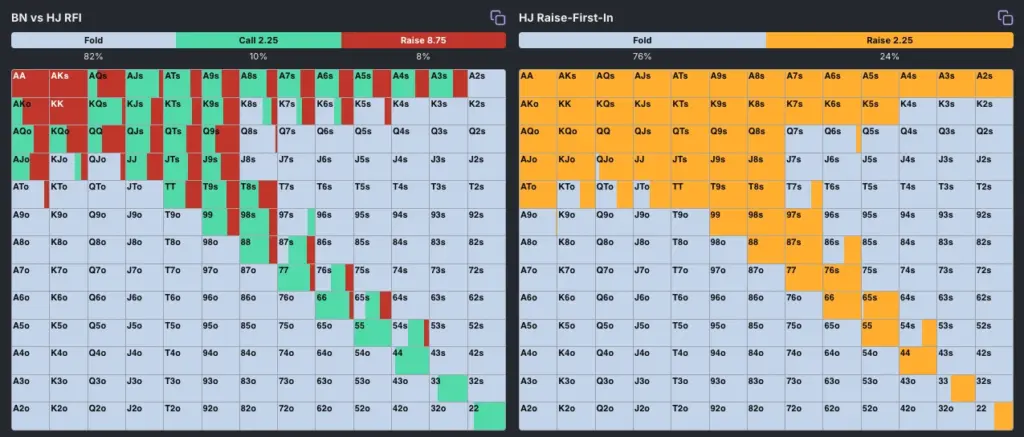
That doesn't necessarily make Moncek's decision a major mistake. In a high-stakes cash game, an aggressive player can mix in hands outside a standard solver range, particularly when taking advantage of a specific opponent or table dynamic.
Wasserson's 9♦7♦ is also a hand that can reasonably continue against a 3-bet. It has decent playability and can make strong draws and pairs on a variety of boards.
Neither player could have known just how large the pot would become over the next three streets. With $186,000 already in the middle, the flop brought one of the most important combinations of cards possible for the action that followed.
Flop: Texas Mike Fires the First Barrel
The flop came A♦ K♦ 9♣, giving Wasserson middle pair and a strong flush draw, while Texas Mike had nothing but 10-high.
Wasserson checked, and Mike continued his aggression with a $100,000 continuation bet into the $186,000 pot. The sizing was a little over half pot, putting immediate pressure on Wasserson.
Wasserson called the bet with a pair of nines and a flush draw, bringing the pot to $386,000.
Texas Mike's bluff was still very much alive, but the situation was about to become significantly more expensive.
Turn: The Bluff Gets Expensive
The 4♥ on the turn changed very little. Wasserson checked again, and Texas Mike decided not to slow down. He fired a much larger second barrel, betting $330,000 into the $386,000 pot.
Wasserson called once again with his pair and flush draw, bringing the pot to $1,046,000.
Both players still had more than $1.6 million behind, meaning the river decision had the potential to turn the already massive pot into something extraordinary. Texas Mike had now fired two barrels with just 10-high, but he wasn't finished yet.
River: Texas Mike Puts $4.26 Million on the Line
The 5♦ hit the river, completing Wasserson's flush. He checked for a third time, and Texas Mike was faced with a decision: give up with 10-high or fire the final barrel.
He chose the latter. Texas Mike moved all-in, putting Wasserson's remaining $1.6 million at risk. After betting $100,000 on the flop and $330,000 on the turn, Moncek had now committed his entire stack to the bluff.
After some tanking, Wasserson called. The pot reached a staggering $4,260,000, making it the biggest pot in High Stakes Poker history by a considerable margin. Texas Mike's three-barrel bluff with 10-high had fallen just short, while Wasserson had made the call for $1.6 million.
Why Did Texas Mike Choose an All-In on the River?
After betting the flop and firing a large second barrel on the turn, Texas Mike had already invested $430,000 into the pot with just 10-high. When the 5♦ completed the board, he had two choices: give up and check, or commit another $1.6 million to try to win a pot that had already grown to more than $1 million.
He chose the most aggressive option possible.
To understand the decision, though, it's worth looking beyond the fact that Mike was bluffing with 10-high. The interesting question is whether the story his line was telling made sense.
The Story Texas Mike Was Telling
From a GTO perspective, Wasserson's 9♦7♦ is a standard open, while T♣7♣ isn't a preferred three-bet from the button in this particular spot. That doesn't necessarily make Moncek's preflop decision a mistake, though. With deep stacks and position, three-betting a hand like T7 suited is a reasonable way to apply pressure, particularly in a high-stakes cash game where players can deviate from balanced ranges to exploit their opponents.
More importantly, the 3-bet helped establish the story Moncek would eventually try to tell on the river.
After the A♦K♦9♣ flop, his $100,000 continuation bet is easy to understand. As the preflop aggressor, he can credibly represent plenty of strong Ax and Kx hands, as well as premium pairs and even pocket nines. The 4♥ turn changed little, allowing him to continue representing that range with a $330,000 bet.
The river 5♦ completed Eric Wasserson's flush, and Texas Mike had no showdown value whatsoever. If he wanted to win the pot, he had to convince Wasserson that his range contained enough very strong hands to justify a $1.6 million shove.
That's where the hand becomes particularly interesting. Mike's line can credibly represent hands such as AA, KK, 99 and AK, which would have played this way from preflop through the river. But the question is whether he actually has enough of those combinations after taking this line, and whether Wasserson has enough hands that can realistically fold to the shove.
There is another interesting detail: T♣7♣ doesn't block the diamond flushes that Wasserson can have. From a purely blocker-based perspective, this isn't the most obvious bluff candidate. Texas Mike isn't holding a diamond that would remove any of Wasserson's potential flushes.
At the same time, T♣7♣ had essentially no showdown value, making it a natural hand to turn into a bluff.
The Call and the Conversation After the Hand
Eric Wasserson had made a flush on the river, and with 9♦7♦, only a higher diamond flush could beat him. Still, he took his time before making the call, eventually committing his remaining $1.6 million to the pot.
After the hand, Wasserson explained that the decision was difficult simply because he had never played a pot that big before. He had already said that he had a huge hand and didn't think he would be able to fold, but the sheer size of the pot still made for a lengthy tank.
Texas Mike, clearly frustrated after his bluff failed, told his opponent that it was “maybe the biggest nit-roll of all time”. Wasserson later explained his thought process, making it clear that the size of the pot was the main reason for his hesitation rather than any uncertainty about the strength of his hand.
Texas Mike later apologized publicly for the comment on X (formerly Twitter), adding another layer to a hand that had already generated plenty of discussion among poker fans.
Texas Mike Won Another $2.34 Million Pot One Hand Later
The very next hand, Texas Mike found pocket kings and got involved in another large pot, this time against Andrew Robl.
Robl held A-K, and the money went in with Moncek's kings ahead. His hand held, giving him a $2.37 million pot.
That made it the fourth-largest pot ever shown on High Stakes Poker at the time. It also meant that Moncek went from losing the record $4.26 million pot with his river bluff to winning another seven-figure pot one hand later.
Conclusion
The $4.26 million pot between Texas Mike and Eric Wasserson was more than just the biggest pot ever shown on High Stakes Poker. It was also a fascinating example of how far high-stakes cash game players are willing to push a bluff when the right story can be told.
Texas Mike's three-barrel bluff with 10-high ultimately fell short, but Wasserson's call with a flush held up. With another $2.34 million pot following immediately afterward, the session produced some of the most memorable action in the show's history.
For poker fans, the hand is a great reminder that at the highest stakes, even a very strong hand can lead to an extremely difficult decision when millions of dollars are in the middle.
FAQ About the Biggest Pot in High Stakes Poker History