
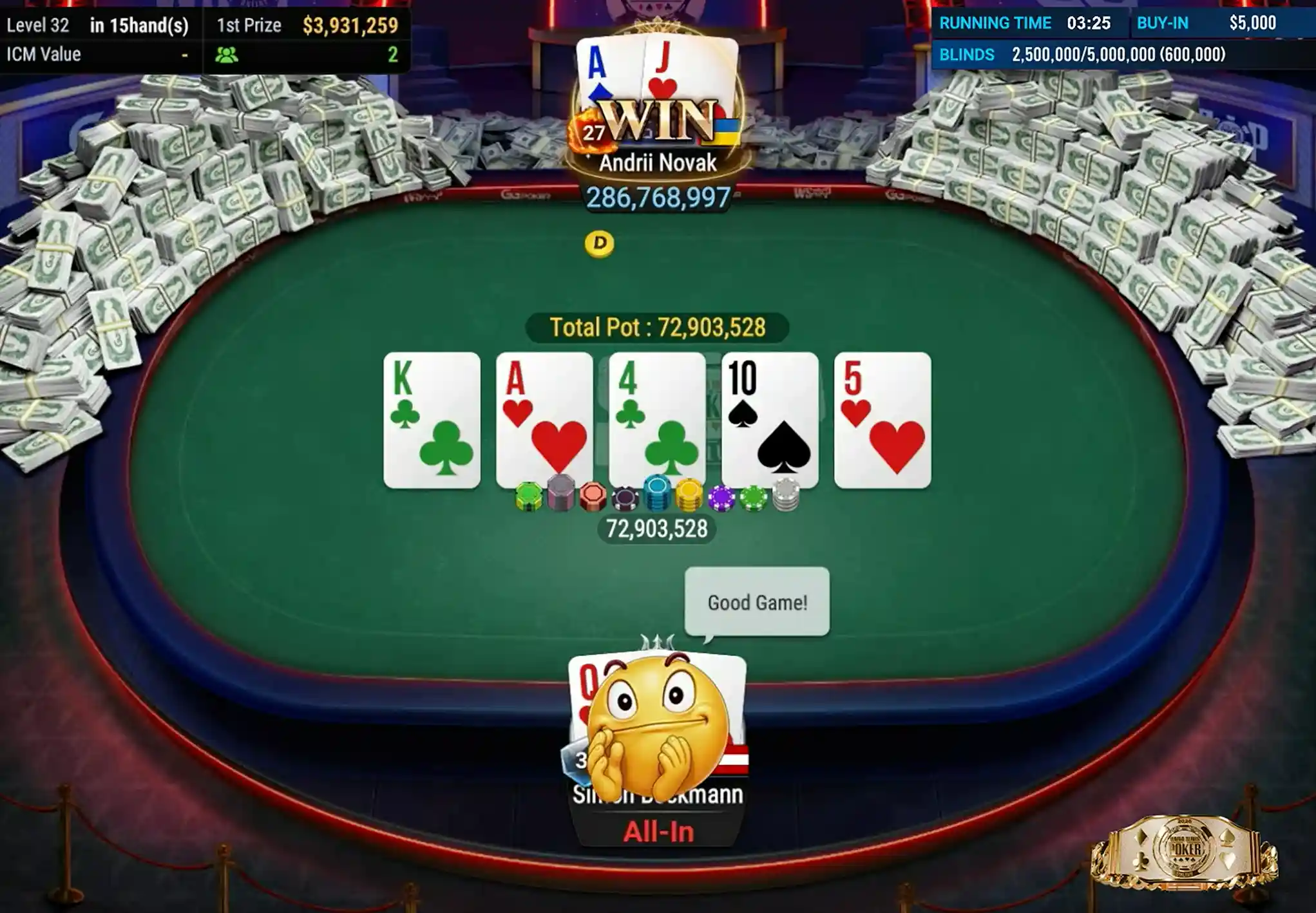
Andrii Novak has won the 2026 GGPoker WSOP Online Main Event, defeating Simon Beckmann heads-up to claim $3,931,259, his first WSOP bracelet, and a $30,000 Super Pass to the WSOP Paradise Super Main Event.
While the result itself made Novak the latest online poker world champion, the final table also produced plenty of interesting strategic decisions. In this week's Hand of the Week, we'll take a closer look at one of the key hands from the broadcast, with commentary from Phil Hellmuth and Jeff Gross, and break down the decision from a strategic perspective.
Want to watch the full final table? The broadcast is available on YouTube for age-verified users.
The 2026 GGPoker WSOP Online Main Event
The 2026 GGPoker WSOP Online Main Event featured a $5,000 buy-in, a $25 million guarantee, and 6,008 entries. The field generated a $28.538 million prize pool, with $3.93 million going to the eventual champion.
Novak entered the final table as the pre-event favorite according to GGPoker's published odds and went on to defeat Simon Beckmann heads-up. Beckmann earned $3,030,487 for second place, while Moyan Chen completed the podium with a $2,336,939 payday.
The WSOP Online Main Event Final Table
| Place | Player | Country | Prize |
| 1 | Andrii Novak | Ukraine | $3,931,259 |
| 2 | Simon Beckmann | Austria | $3,030,487 |
| 3 | Moyan Chen | China | $2,336,939 |
| 4 | Fernando Liano | Austria | $1,802,142 |
| 5 | Charles La Boissonniere | Canada | $1,389,755 |
| 6 | Pavlo Yakovliev | Ukraine | $1,071,761 |
| 7 | Arian Hassankashani | Hong Kong | $826,556 |
| 8 | Yury Nadinsky | Kazakhstan | $637,477 |
| 9 | Pablo Silva | Brazil | $491,676 |
The Hand That Changed the Heads-Up
The heads-up started with Simon Beckmann holding roughly 70 big blinds, while Andrii Novak had around 30 BB. Beckmann maintained the chip lead as the match progressed, and when the following hand took place, the stacks had shifted to approximately 56 BB for Beckmann and 33.5 BB for Novak.
With the tournament effectively reduced to a heads-up battle for the online WSOP bracelet and more than $3 million in first-place money, Beckmann picked up Q♠5♠ and entered the pot against Novak.
The hand would become one of the defining moments of the heads-up. Rather than simply looking at the result, however, it is worth asking a more important question: how does Q5 suited actually perform in this stack configuration?
What Does Q5s Look Like in a Heads-Up Range?
Heads-up poker requires players to enter pots with a much wider range of hands than they would in a full-ring game. With only one opponent remaining, hands such as Q5 suited can become playable because they have reasonable postflop potential and benefit from the positional and range dynamics of heads-up play.
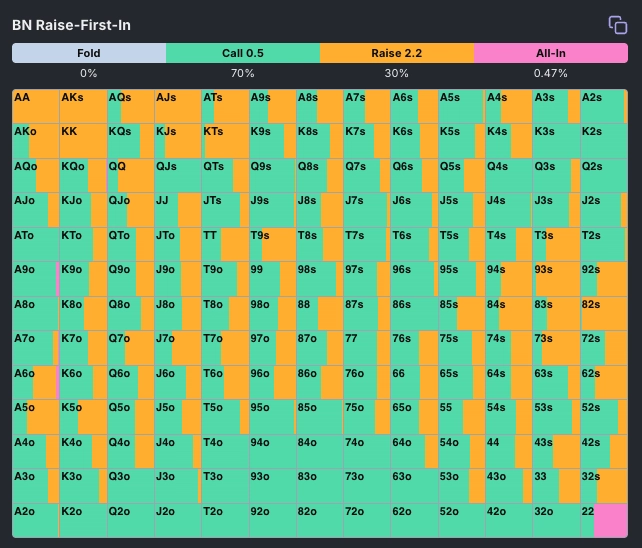
In a 30 BB effective-stack simulation, Octopi Poker‘s solution gives Q5 suited a clear role in the Button's strategy. Rather than treating it as a hand that should simply be shoved, the model uses it primarily as a limp, with the hand also raising at a lower frequency.
The Big Blind's Isolation Range
An isolation raise from the Big Blind is a standard response when facing a limp in heads-up. With A-K offsuit, for example, raising for value is an obvious part of the strategy. However, the Octopi simulation shows that the Big Blind's isolation range is much more complex than simply raising strong hands.
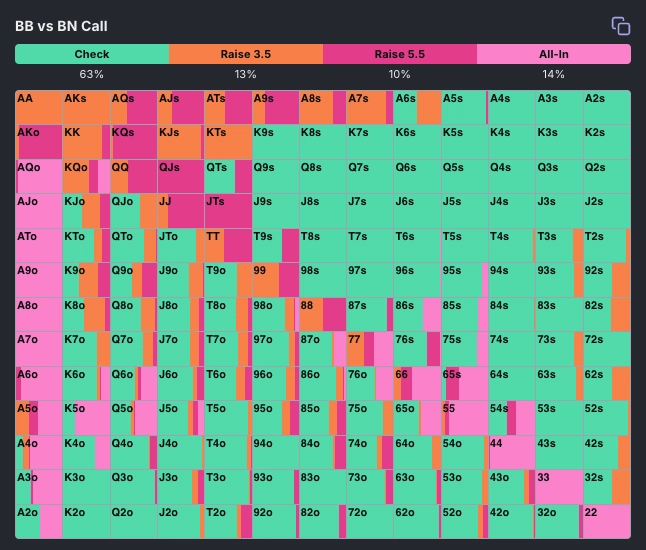
At these stack depths, the model uses all-in isolation raises with a significant portion of offsuit Ax hands and smaller pocket pairs, putting maximum pressure on the limper's range. At the same time, there is a wide selection of non-all-in isolation raises, including hands that are not strong enough to commit the entire stack preflop.
This creates an important dynamic for the limper. Facing an isolation raise does not automatically mean that the hand should be folded, but the correct response depends heavily on the strength and playability of the hand, as well as the sizing used by the Big Blind.
How Should Q5s Respond to the Isolation Raise?
Facing an isolation raise does not automatically mean that Q5s should be folded. In the 30 BB effective-stack simulation, Octopi Poker shows Q5s continuing primarily by calling, rather than turning the hand into a preflop all-in.
This makes sense when we consider the nature of the hand. Q5s has relatively little raw hand strength, but its suitedness gives it additional postflop potential. Calling also allows the hand to realize that equity without risking the entire stack before the flop.
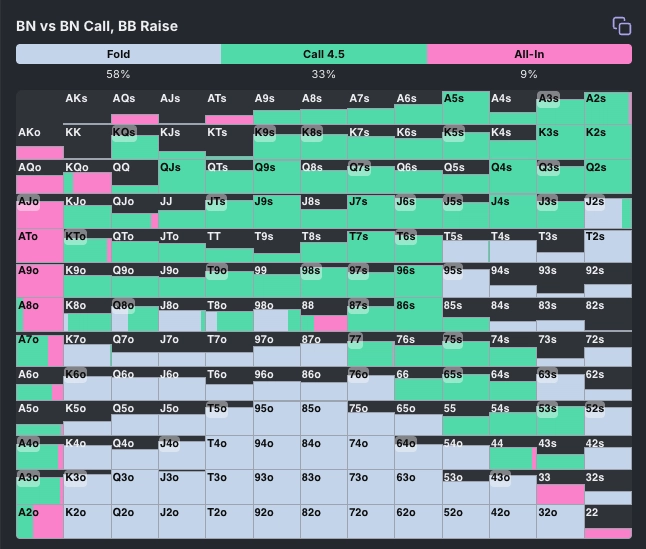
The key distinction is that Q5s can be a profitable hand to limp and defend without being a natural limp-shove. The simulation therefore provides useful context for the actual hand: simply seeing Beckmann hold Q5s does not tell us whether his decision was correct. We need to look at how he entered the pot and how much of his stack he ultimately committed.
Was Beckmann's Q5s Play a Mistake?
At first glance, Beckmann's decision to limp-shove with Q5s may look questionable. Q5 suited is a relatively weak starting hand, and committing more than 30 big blinds with it in a tournament heads-up match is certainly not a decision to make lightly.
The Octopi simulation gives us an interesting baseline for comparison. With an effective stack of around 30 BB, Q5s is primarily a limping hand, but when facing an isolation raise from the Big Blind, the model prefers always calling rather than limp-shoving with the hand.
The actual hand was played with 33.5 BB effective, making the 30 BB simulation a reasonably close approximation of the situation. While it does not reproduce the exact tournament spot, it gives us a useful framework for evaluating Beckmann's decision.
Beckmann's limp-shove therefore represents a significant departure from the strategy shown by the simulation. The question is whether the tournament context and Novak's tendencies could justify deviating from that baseline.
Key Takeaway
Q5s is not simply a weak hand that should be folded heads-up. At around 30 BB effective, it can be part of a profitable limping range and can continue against an isolation raise. However, there is an important difference between playing Q5s aggressively and committing your entire stack with a limp-shove.
The hand is a good reminder that hand strength alone should not determine a preflop decision. Stack depth, position, ranges, and the action you face all matter. In heads-up poker, marginal hands can become playable, but that does not mean every aggressive line with those hands is equally profitable.
FAQ About the WSOP Online Main Event