
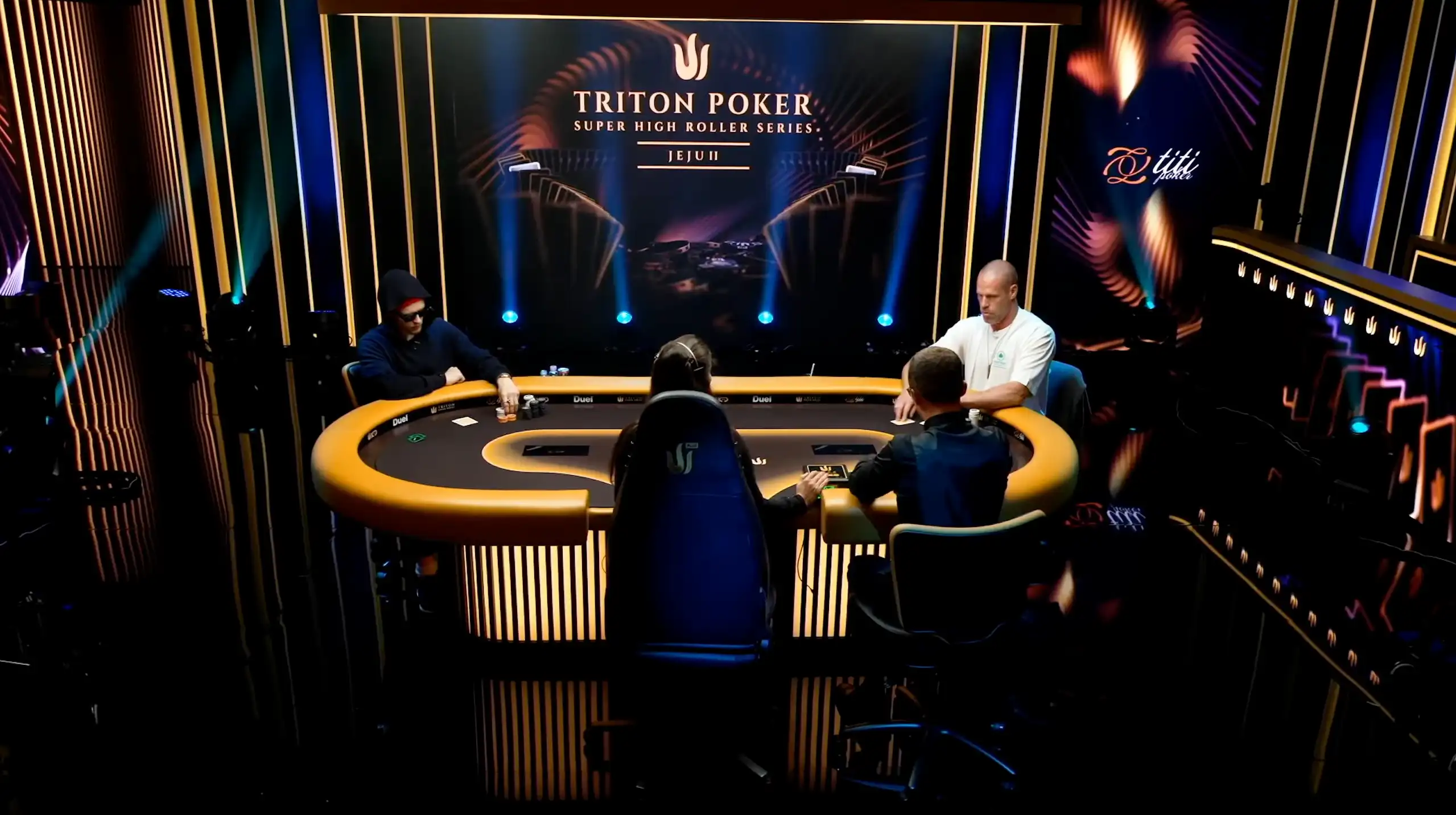
The $20 million heads-up match between Ossi “Monarch” Ketola and Patrik Antonius was the biggest one-on-one poker battle ever streamed. The two Finns each put up $10 million for the winner-takes-all Duel Heads-Up match at Triton Jeju II, with $20 million on the line and blinds of $50,000/$100,000. The match lasted just over four hours before Ketola claimed the entire prize pool.
While the final result made headlines, the match featured several remarkable hands along the way. One of the most memorable came less than an hour into the session, when Ketola attempted a $1.8 million bluff with five-high, firing a massive turn overbet into a $1.2 million pot while Antonius held top pair.
In this hand breakdown, we'll take a closer look at the five-high bluff and examine why Ketola chose such an aggressive line, how the board affected both players' ranges, and what Antonius had to consider before making his decision. We'll also look at some of the other key moments from the record $20 million heads-up match. The full heads-up is available to watch on YouTube.
The Record $20 Million Heads-Up Match
The scale of the match was only part of what made it unusual. For more than four hours, Ketola and Antonius played with millions of dollars constantly shifting across the table, but the session remained remarkably close for long stretches. Antonius reached his lowest point at $6.1 million, only to fight his way back to almost an even stack before the match entered its decisive final stage.
The turning point came late in the session. Ketola built his stack to $15.95 million after Antonius folded to a massive river shove with a king-high straight, leaving Antonius with just $4.1 million. The very next hand, the remaining chips went in preflop with Antonius holding A-K against Ketola's K-J, and a jack on the turn ended the match.
The $1.8 Million Five-High Bluff
Less than an hour into the match, Ketola found himself in a pot where he had almost nothing – at least in terms of made hand strength.
The blinds were $50,000/$100,000, with Monarch holding $11.9 million (119 BBs) on the button and Antonius $7.8 million (78 BBs) in the big blind. Ketola opened to $250,000 with 5♠2♠, and Antonius called with T♦9♦, creating a $500,000 pot.
Flop: T♣ A♣ 6♠
Patrik Antonius flopped second pair with T♦9♦, while Ketola had just five-high and a backdoor spade draw. Antonius checked, and Ketola made a continuation bet of $350,000 (⅔ pot). Antonius called, bringing the pot to $1.2 million.
Turn: 4♠
This was where the hand changed. Ketola still had only five-high, but the 4♠ gave him a straight-flush draw and a gutshot to the wheel, significantly increasing his equity. Antonius remained well ahead with his pair of tens, holding approximately 73% equity at this point.
Antonius checked again, and Ketola responded with a bet of $1.8 million into $1.2 million. That represented a 150% pot overbet, an enormous second barrel considering Ketola still had no made hand.
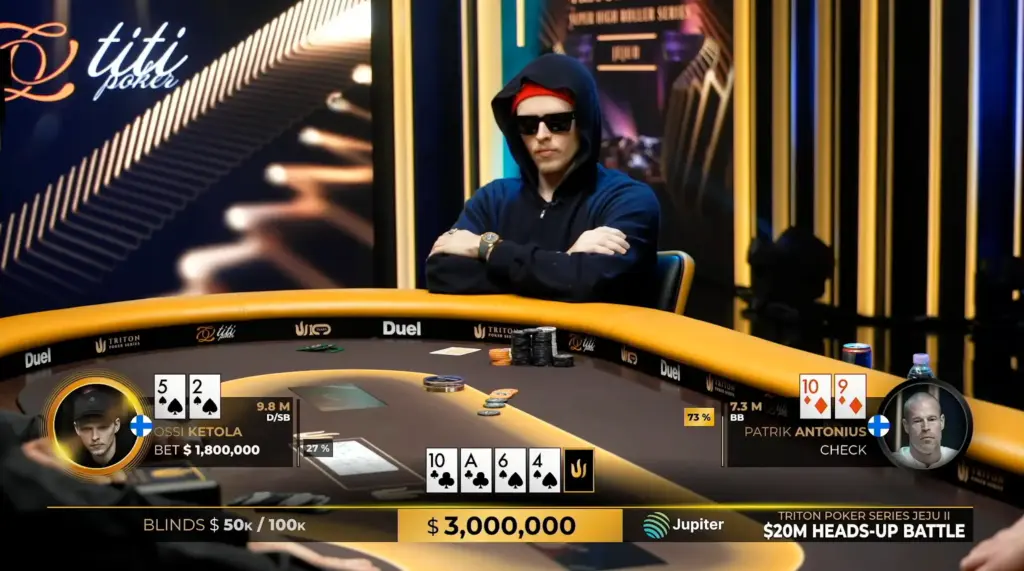
Antonius folded, and Ketola collected the $1.2 million pot without having to show his cards.
Why Did Ketola Overbet the Turn?
The key to Ketola’s bluff was not simply that he picked up a draw. The turn gave him additional equity, but the $1.8 million sizing suggests that the goal was to put maximum pressure on a range that contained plenty of hands capable of calling a smaller bet but far fewer that could comfortably continue against such a large one.
The board texture is also important here. After Antonius called the flop, his range could contain plenty of one-pair hands, while Ketola could credibly represent stronger holdings and powerful draws. The turn also gave Ketola additional outs, meaning he was not relying entirely on Antonius folding. If called, he still had ways to improve on the river.
The 150% pot overbet makes the decision particularly difficult for Antonius. A smaller bet would give a pair of tens a relatively straightforward price to continue, but Monarch's sizing forces Antonius to risk a much larger portion of his remaining stack. With millions already in play, the difference between facing a normal barrel and an overbet becomes significant.
There is also an important range consideration. When a player uses an overbet, their range is generally expected to become more polarized: they are representing very strong value hands alongside bluffs. Ketola's five-high hand was therefore a natural candidate for the bluff because it had very little showdown value, while the additional draw equity gave him some protection if Antonius did call.
That does not mean every five-high hand should be turned into a $1.8 million bluff. The effectiveness of the play depends on the specific board, the ranges that reach the turn, the stack sizes, and the opponent's willingness to defend against an extreme sizing. Here, Ketola combined those factors into a line that put Antonius in an unusually difficult spot.
What Does GTO Say?
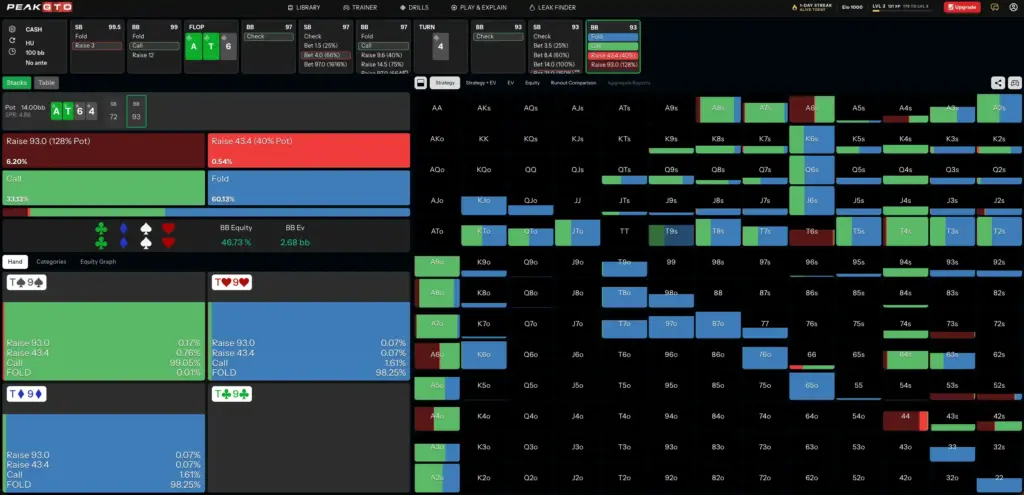
The hand becomes even more interesting when we compare Monarch’s decisions with a GTO-based solution. While we cannot reproduce the exact hand perfectly, the PeakGTO simulation uses a 100bb heads-up setup rather than the precise stack sizes from the stream; it provides a useful approximation of the strategic principles behind the decisions.
One of the first things that may surprise players accustomed to full-ring poker is how wide the button's opening range becomes in heads-up play. In this GTO solution, Ketola's 5♠2♠ is a 100% raise from the small blind at 100bb effective stacks, with a 3bb opening size.
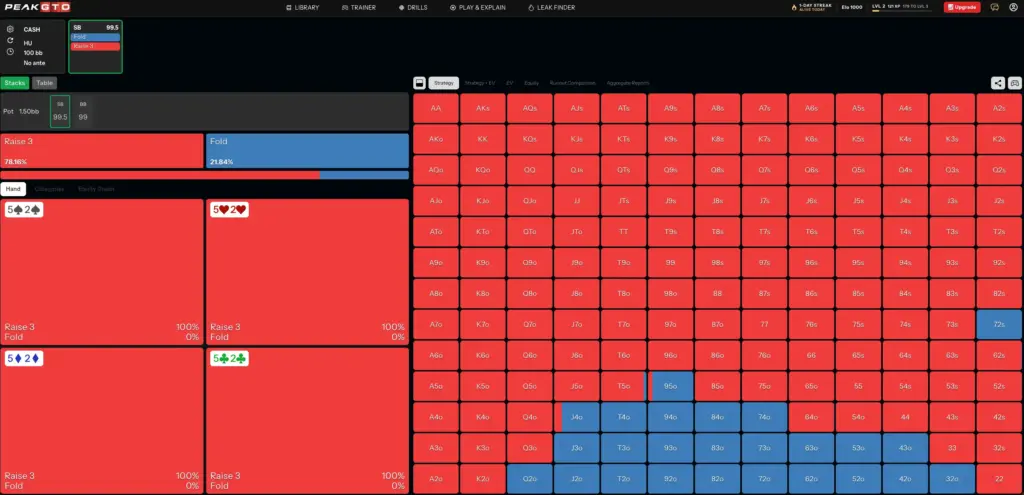
So while five-high looks like an unusual hand to open if you're thinking in full-ring terms, there is nothing inherently strange about Ketola putting it into his opening range heads-up. With only one opponent left to act, the small blind is effectively the button, and the need to play a much wider range changes the value of hands that would almost always be folded in a full-ring game.
Postflop: From Five-High to a $1.8M Overbet
The postflop simulation is where things get particularly interesting. On the A-T-6 flop, GTO gives 5♠2♠ a mixed strategy, with checking as the most common option but several betting sizes also available. The hand can therefore continue as a bluff even though it has virtually no showdown value.
The turn is even more relevant. After the 4♠ arrives, the solver continues to use 5♠2♠ as a bluffing hand, including the 150% pot overbet that closely matches Ketola's actual $1.8 million bet into $1.2 million. In the GTO solution, the 150% sizing is used around 16% of the time with this exact hand, while smaller bets are also available. Checking remains the most frequent option.
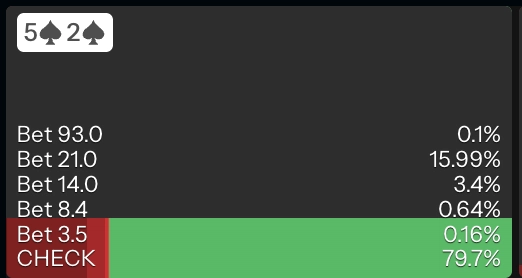
That distinction matters. The solver is not saying that Monarch should automatically fire $1.8 million every time he reaches this turn with 5♠2♠. Instead, it shows that an overbet of this magnitude is a legitimate part of the strategy, and the actual hand landed on one of the sizings the model uses.
The response from Antonius is just as interesting. Against the 150% overbet, PeakGTO folds T9s almost 98% of the time in the comparable setup, with calling occurring only occasionally.
That does not prove that Antonius' exact decision was mathematically mandatory in the live game. The stacks, ranges and betting history were not identical to the simulation. But it does provide strong context for the fold: even a hand as strong as top pair can become extremely difficult to continue with when facing a highly polarized overbet on this type of board.
Why Did Patrik Antonius Fold?
At first glance, Antonius' fold is difficult to understand. He flopped a pair of tens and still had about 73% equity when Ossi Ketola bet the turn. But Antonius didn't know Ketola had five-high with draws; he had to evaluate the hand against Ketola's entire betting range.
The first factor was the pot odds. With $1.2 million already in the pot, Monarch bet $1.8 million, meaning Antonius had to call $1.8 million to compete for a final pot of $4.8 million. He therefore needed approximately 37.5% equity for the call to break even.
The problem was that Ketola's huge sizing represented a highly polarized range. Antonius needed to believe that Ketola was bluffing often enough, roughly 37.5% in a simplified value-bet-or-bluff model, to justify continuing with top pair. The stronger Ketola's value range appeared, the more difficult it became for Antonius to reach that threshold.
The 150% pot overbet also meant that Antonius could not simply defend every hand with reasonable showdown value. Calling would commit another $1.8 million on the turn, with the possibility of facing further pressure on the river.
So the decision was not really about whether top pair was strong enough to beat five-high. It was about whether it was strong enough to continue against the range Ketola was representing with such an extreme sizing. Antonius ultimately decided it was not, allowing Ketola to take down the $1.2 million pot.
Other Highlights From the $20 Million Heads-Up Match
Ketola's five-high bluff was one of the most memorable hands of the match, but it was far from the only remarkable moment. Later in the session, Antonius found a $4.2 million hero call, while Ketola continued to apply pressure with unconventional lines, including a four-bet with K4 suited that forced Antonius to release a suited connector. The match remained remarkably close for much of its four-hour duration, with Antonius recovering from a $6.1 million low point to sit only $500,000 behind with less than an hour remaining.
The decisive swing came in the final minutes. Ketola made a straight flush and eventually moved all-in for $10.975 million on the river, forcing Antonius to fold a king-high straight. Antonius was left with $4.1 million, and the very next hand ended the match when Ketola shoved over his three-bet. Antonius called with A-K against Ketola's K-J, but a jack on the turn gave Ketola the winning hand and the entire $20 million heads-up match.
FAQ About the Ossi Ketola vs Patrik Antonius $20 Million Heads-Up Match