

Master poker strategy with PeakGTO. Try this poker solver for free.
Our last article covered the topic of continuation betting in 3-bet pots when playing dryflops in position. In this lesson, we’ll be doing the same thing, but focusing on wet boards instead.
Wet, draw-heavy flops are generally harder to navigate, and things get even trickier in 3-bet scenarios, where a lot of money went into the pot before the flop.
So how do you navigate wet boards in 3-bet pots in position, when playing 40 big blinds deep, and what are the correct strategies for different types of textures?
As always, we’ll be going through some representative examples using solvers to break down different scenarios, but before that, here are a few main takeaways from this lesson:
- Always bet on ace-high flops, mixing between small and larger sizing
- At shorter stacks, solvers prefer using larger (60%) sizing on ace-high wet boards
- C-bet around 65% on wet king-high boards
- Check back around 50% on queen-high wet flops
- C-bet around 45% on low connected flops, using 67% pot sizing
Tip #1: Bet A-High Wet Flops 100% of the Time
We’ll first look at ace-high wet boards, as these are the ones that players are often not certain about. The good news is that we should be betting pretty much always in these situations, varying between the small and big bet sizing pretty evenly.
You can see that on the example of the A♠9♦8♦ flop:
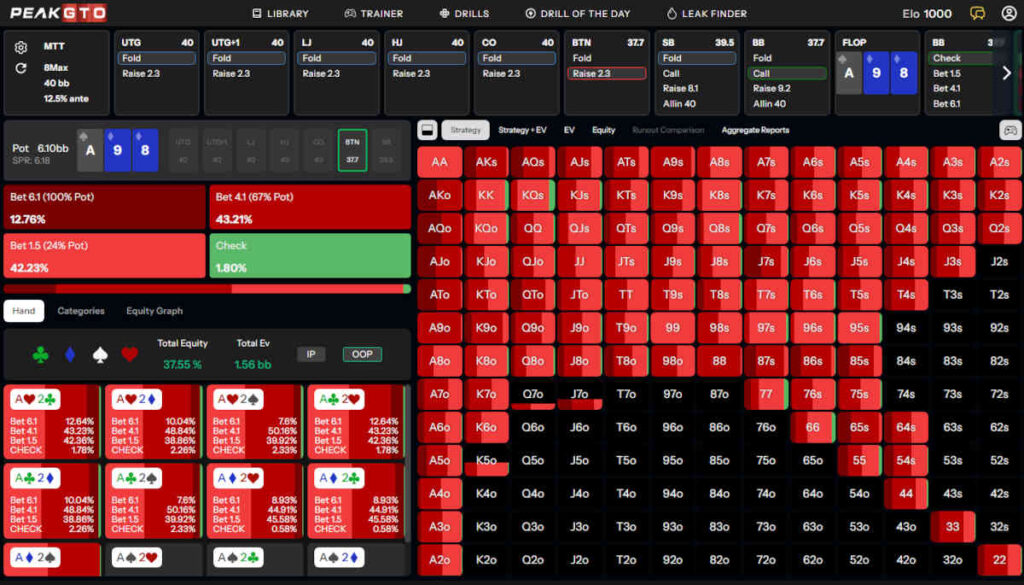
As for our c-bet sizing, you’ll notice that we are sticking to the small (quarter-pot) sizing with our strongest hands, i.e. top and middle sets, and a variety of weaker hands with decent showdown such as 97s – 95s, K8s, Q8s, etc.
Hands that prefer larger sizing are strong but vulnerable ones such as AK down to A9, TT, and even the bottom set. Then, there is a variety of weaker holdings with some backdoor potential, and even some low pocket pairs that prefer larger sizing to create better odds of winning on the flop.
As you can see in the picture, the sizing breakdown isn’t the easiest thing to memorize in these spots. You can use the above tips as base guidelines, but if you really want to bring your game in this spot close to the GTO, you’ll need to do some memorizing.
When it comes to other stack sizes, there aren’t significant changes to our overall strategy:
- At 60 big blinds effective, we are betting at near enough 100% frequency, splitting between the big and small sizing.
- At 25 big blinds effective, we should always c-bet, with a heavy preference for a larger, 60% sizing.
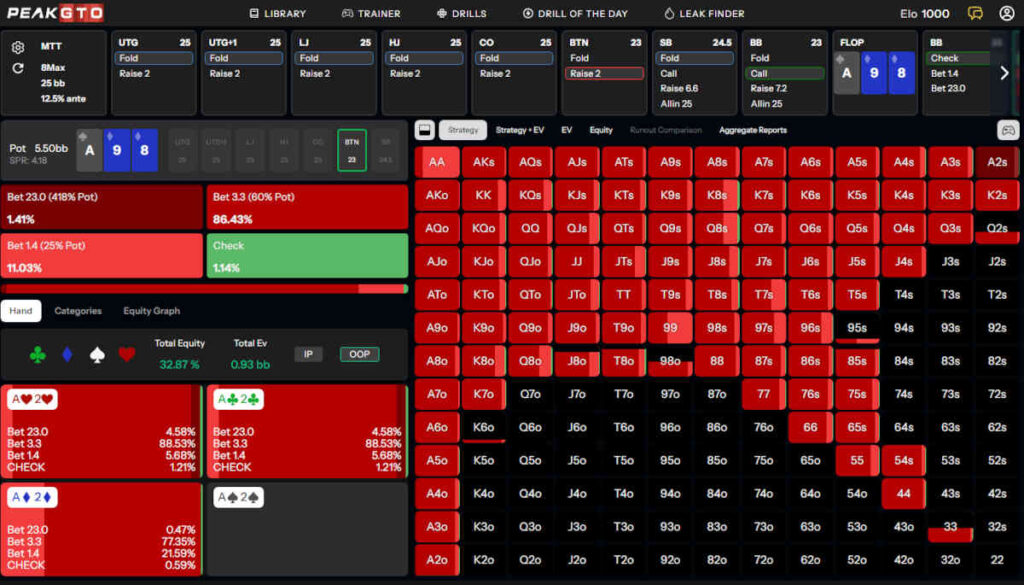
The fact that we don’t have to worry too much about splitting sizes at lower stack depths helps further simplify our strategy in these situations. There are only a few hands that we’ll be betting small. With the rest of our range, we can confidently bet 60% of the pot every time.
Tip #2: Mix Between Checking & Betting on High-Card Dry Flops
When it comes to high-card flops, our c-betting strategy in position isn’t as simple as that for boards containing an ace, and it changes depending on the board makeup and the high card.
Let’s first look at the board of K♠9♥7♥:
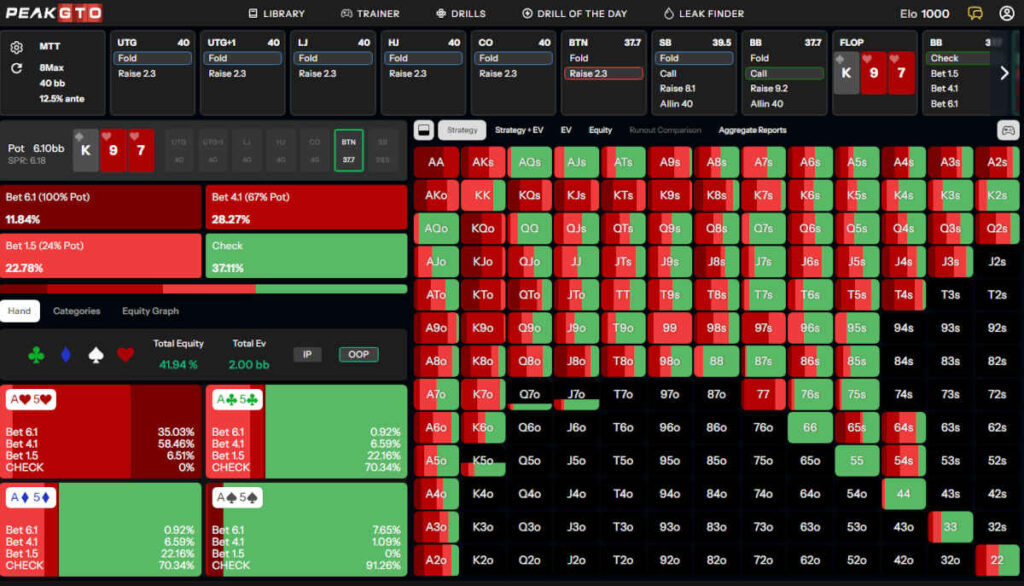
In these spots, solver suggests c-betting at a frequency of around 63%, so we are doing a lot of checking. While there are only a couple of pure checks in these spots, there are quite a few hands that prefer checking over c-betting, such as:
- Small pocket pairs
- Strong suited ace highs (AQ, AJ, AT)
- Hands with decent showdown (middle and bottom pairs, as well as weaker top pairs)
The range that we are betting with in this spot consists of our strongest holdings, namely top pair and better, combined with some straight and flush draws, ace highs, and small connectors with some backdoor properties.
In terms of sizing, it is distributed fairly evenly between, small, medium, and large, with our strong holdings that need protection (such as solid top pairs) preferring a large, pot-sized continuation bet.
As mentioned, not all high-card flops are created equal. In a different configuration, our c-betting strategy changes as well, as we can see on the example of a Q♠8♥7♥:
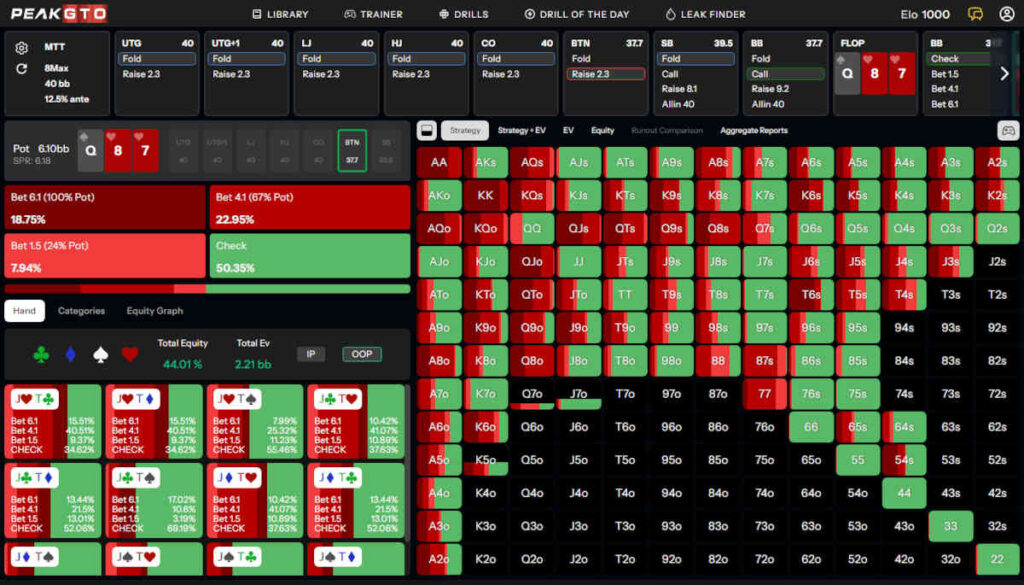
Here, our continuation bet percentage drops significantly, to just 50%. As you can see, we are checking back a lot of decent holdings, including most of our weaker top pairs and ace-highs.
Hands that we are betting with, such as sets, two pair combos, over-pairs, and strong top pairs, prefer larger sizing, splitting between 67% and 100% of the pot.
These types of flops coordinate better with the big blind’s range, which is why our strategy is more cautious (more checking back) and more aggressive when we do c-bet, looking to deny equity using larger bets.
As for our strategy at other stack depths (60 and 25 big blinds), they don’t change significantly in these spots. There are some slight adjustments in terms of bet sizing, but our c-betting and checking frequencies remain largely unchanged.
Tip #3: Check Back Over 50% on Low Connected Flops
Finally, on wet flops containing low cards, we will be doing a lot of checking back, as these types of flops connect very well with the big blind defending range, as we can see on an example of the 8♥6♥4♦:
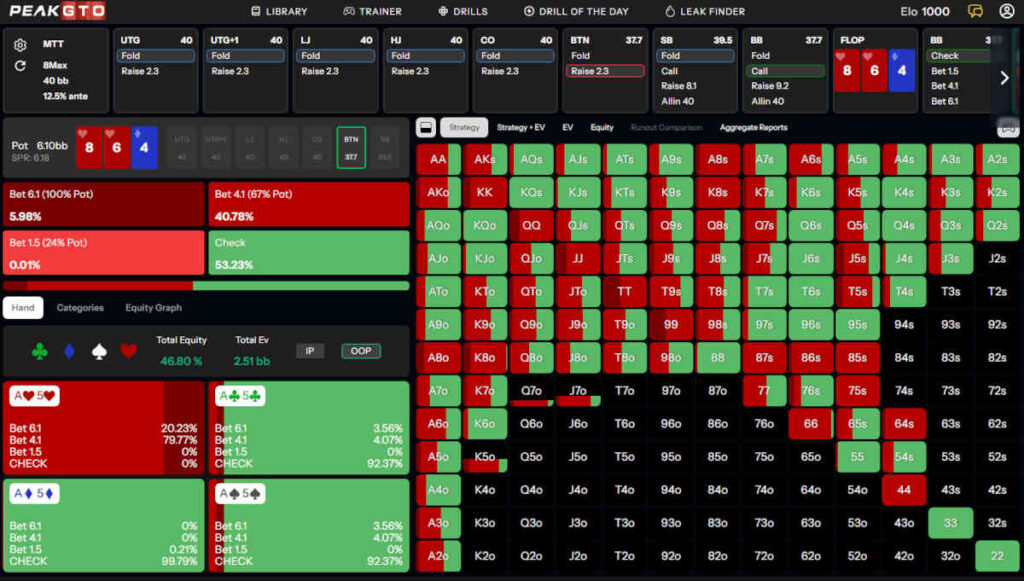
The most interesting takeaway in these spots is that the hands that we do bet with, we are using a larger, 67% pot sizing as well as some 100% bets. Once again, we do it to deny equity and get value from the opponent’s hands that connected with the flop but are behind.
In that vein, the hands that we are betting with are straights, sets, two-pair combos, overpairs, top pairs, as well as some pair plus draw combos. Hands that we are checking back with are those containing over-cards and weak hands with showdown value that don’t gain much from betting.
The solver uses the same strategy at the other two stack depths as well, so at 25 and 60 big blinds effective, our overall approach remains unchanged. The only significant adjustment is that our big bet at 25 big blinds is somewhat smaller, i.e. it drops to 60% instead of 67% of the pot.