
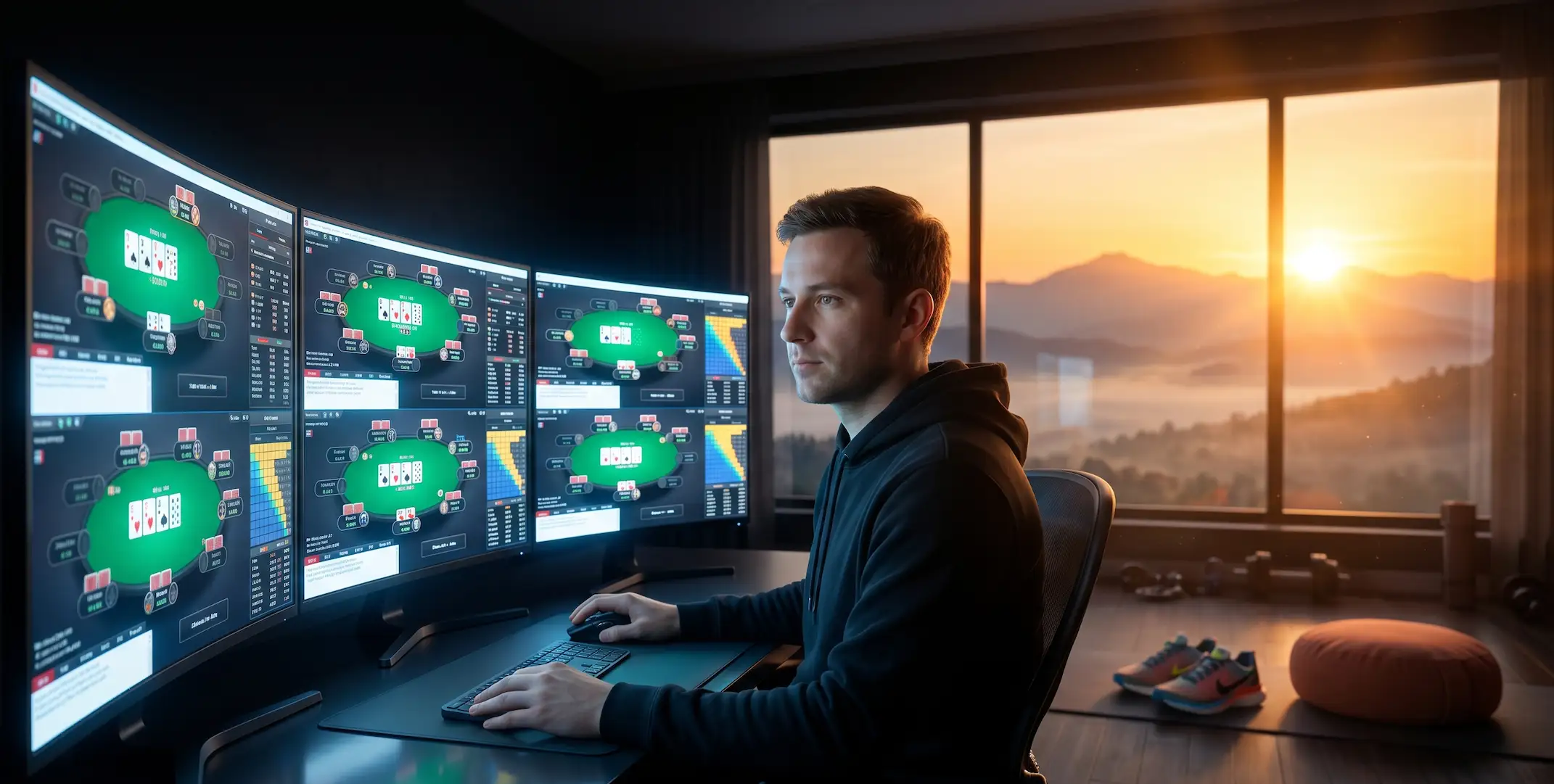
Poker mindset is not just about staying calm at the table, it’s about how the game slowly starts to shape your entire life.
For many online poker players, the problem isn’t just tilt or bad decisions. It’s the fact that poker doesn’t really “end”. There’s always another table, another session, another spot you could have played better. Over time, the line between work and life begins to blur, days blend together, sleep schedules drift, and your mood starts to follow your graph more than anything else.
What makes this even harder is how invisible the problem is. From the outside, it looks like freedom. You work from home, set your own hours, and answer to no one. But in reality, many players end up stuck in a loop of inconsistent routines, mental fatigue, and quiet isolation, constantly thinking about poker, even when they’re not playing.
And that’s where most people get it wrong.
Balancing poker and life isn’t about playing less or forcing discipline for a few days. It’s about building a structure that protects your mental game and energy, your relationships, and your decision-making over the long run. Because in the end, your results don’t just depend on how you play your hands. They depend on how you manage everything outside of them.
Why Poker Mindset Matters
One of the biggest challenges with the poker mindset isn’t what happens at the table, it’s everything that happens around it.
Unlike most jobs, poker has no clear boundaries. There’s no fixed schedule, no defined end to the workday, and no external structure forcing you to stop. You can always play more, study more, or jump into a better game. And while that flexibility looks like freedom at first, it often turns into the exact opposite.
The problem is that poker rewards short-term decisions that can hurt long-term balance. You stay up late because the games are good, extend sessions because you’re stuck or chasing a win. You skip rest days because you feel like you’re “missing out”.
Over time, these small decisions start to compound:
- Sleep becomes inconsistent, and energy levels drop.
- Your focus at the table slowly declines, even if you don’t notice it right away.
At the same time, there’s a deeper psychological layer. When you spend most of your time playing, studying, or thinking about poker, your results start to feel personal. A downswing doesn’t just affect your bankroll; it affects your confidence, your mood, and sometimes even your sense of self-worth.
And because online poker is often played in isolation, there’s very little to balance that out. No coworkers, no natural breaks, and no separation between “work mode” and “life mode”. Everything happens in the same space, on the same screen.
The Hidden Cost of Poor Poker Discipline
Lack of poker discipline rarely shows up in obvious ways. It’s not just about playing too many hands or making bad calls. In fact, most players don’t even realize they have a discipline problem, because it doesn’t feel like a mistake in the moment.
You play longer because the games are good. You open another table because you “should be maximizing EV”. Each decision makes sense on its own. But over time, this is where things start to break down.
Without structure, sessions become unpredictable. Your schedule constantly shifts, which makes it harder to build a consistent poker routine. And consistency is where real performance comes from.
As mental fatigue builds, your mental game and decision-making start to slip through small, almost invisible leaks. You take slightly worse spots, miss thin value, or fail to recognize when you’re no longer playing your A-game.
This is where discipline matters the most: not when everything is going well, but when it’s time to stop.
One of the biggest mistakes players make is treating time as an unlimited resource. In reality, your mental energy is far more limited than your available hours. After 4–6 hours of focused play, most players experience a noticeable drop in decision quality. That’s why discipline isn’t just about how much you play. It’s about knowing when not to.
5 Poker Habits to Build a Strong Poker Mindset
Improving your poker mindset and mental game isn’t about motivation or willpower; it’s about building systems that protect your focus, energy, and decision-making over the long run. The goal is to create a structure where your best decisions become the default.
Here are five poker habits to help you do exactly that.
1. Separate Your Identity From Results
One of the most dangerous traps in poker is letting your results define how you see yourself. When you’re playing and studying every day, it’s easy for your graph to become your self-worth.
If your confidence depends on short-term results, you’re constantly riding emotional swings that you can’t control. The solution isn’t to ignore results, but to create distance from them. Having a hobby or a skill that has nothing to do with money gives you a stable source of feedback where progress doesn’t reset after every session.
2. Create a Post-Session Cool-Down Routine
Most players focus on how they start a session, but almost no one thinks about how they end it. After a long session, your mind doesn’t just switch off. You’re still replaying hands or stuck on a bad beat.
If you immediately jump into family responsibilities or conversations, you carry that mental noise with you. A simple cool-down routine, a short walk, reviewing key hands, or just sitting quietly, creates a clear transition between “playing mode” and “life mode”. If you don’t consciously end your session, it never really ends.
3. Master Your Schedule (Sleep, FOMO & Time Limits)
Online poker runs 24/7, which means many players don’t really control their time, the games do. This is where FOMO (Fear Of Missing Out) quietly takes over. You delay sleep because you don’t want to miss value, losing something far more important: your ability to play well.
Personal Insight: When I was playing full-time, the biggest breakthrough for my mental health wasn't a new strategy, it was setting non-negotiable hours. I decided exactly which days I would play and when I would stop. Setting a time-based “stop-loss” prevented me from playing like a zombie just because a fish was at the table.
Set playing hours. Set an end time. And most importantly, stick to it. A shorter session played in your A-game will always outperform a longer one played in B or C-game.
4. Separate Your Life Roll From Your Bankroll
If your bankroll and your everyday finances are mixed, every decision at the table carries extra weight. It’s no longer just about making the best play, it’s about paying your bills.
These thoughts don’t just create stress, they change the way you play. They make you risk-averse in some spots and overly aggressive in others. Separating your life roll from your bankroll creates a buffer. That buffer is what allows you to think clearly, stay consistent, and trust your process during downswings.
5. Build a Life Outside the Game
If poker is the only thing in your life, it will eventually start to control how you feel about everything else. This is especially true for online players who spend most of their time alone.
A Cautionary Tale: I have a friend who has crushed online games and made a living from poker for 15 years. My friend's results are very good, but the isolation has taken a massive toll. His anxiety regarding social interactions has grown so high that he actively avoids them. His bankroll is healthy, but his well-being is not.
A strong poker mindset is supported by what you do away from the tables. Sports, social time, or learning something new provides perspective. When your entire world is poker, every downswing feels huge. When poker is just one part of your life, handling the variance becomes much easier.
Building a Routine to Protect Your Poker Mindset
One of the biggest differences between struggling players and consistent winners is having a clear, repeatable poker routine. Without it, you only play when you feel like it, leading to inconsistency in both volume and performance.
You don't need a perfect routine, but you need an intentional one. Here is an example of a balanced schedule based on what worked for me during my full-time grinding days:
The “Structured Grind” Schedule Example
- Playing Days (Tuesday – Saturday): * 06:00 AM – 12:00 PM: Deep work grind. Six hours of focused play with short breaks.
- 12:00 PM – 13:00 PM: Lunch and complete mental disconnect.
- 13:00 PM – 14:00 PM: Study session. Reviewing marked hands from the morning grind.
- After 14:00 PM: “Work” is over. A strict boundary to stop thinking about poker.
- Weekly Collaborative Study: One dedicated session a week with a poker friend or coach to discuss deeper concepts and break the isolation.
- Off-Days (Sunday – Monday): Zero poker. Dedicated to social life, physical movement, and real-life responsibilities.
The Key Takeaways for Your Routine:
- Built-In Stop Times: Time limits protect you from slipping into autopilot. When the clock hits your stop time, you close the client.
- Non-Playing Days With Purpose: Don't just sit at home. Actively use off days to reset your mental energy.
- Clear Separation of Space: If you play from home, play in a dedicated area. When your session is done, physically leave that space.

The Biggest Poker Mindset Mistake Most Players Make
The biggest mistake most players make isn’t a strategic one. It’s believed that more volume will solve everything.
Play more. Study more. Push harder. On the surface, it sounds logical. But without a solid poker mindset, more volume often just amplifies the same problems: fatigue, inconsistency, and emotional swings.
Your results are not limited by how much you play. They’re limited by how well you think. And thinking well requires energy, structure, and recovery. The real edge in poker isn’t just found in solvers or hand histories. It’s found in how you manage your time, your focus, and your life outside the game.
A Final Note: Intentionality Over Perfection
Does this mean you should strictly follow your schedule and quit a table when the biggest recreational player of the year sits down, just because your alarm went off?
Of course not.
There are always exceptional, highly profitable situations where extending your session makes perfect sense. The goal of a poker routine isn’t to turn you into a robot, but to give you a baseline. If you decide to break your own rules for a massive +EV spot, do it consciously, and make sure you compensate by taking extra time off later.
At the end of the day, balancing poker and life isn’t about being overly strict with yourself. It’s about intentionality. It’s about being fully aware of both your grind and your life, and making sure you remain in control, not the game.
Because at some point, every player hits a ceiling. And more often than not, that ceiling has nothing to do with skill. It has everything to do with mindset.
FAQ – Poker Mindset