
Six-handed online cash games are a great way to build your bankroll. To be a winner in these games, all you really need is to play a fundamentally solid strategy and then adjust it to fully take advantage of the mistakes your opponents make.
This article aims to give you useful tips to crush 6-max cash games online by devising correct preflop strategies, improving your play from the big blind to lose less, navigating pots with marginal made hands, and more.
By the end of it, you should be able to recognize and fix some of the common leaks in your own game, as well as take advantage of some of the most usual mistakes by your opponents.
–
Tip #1: Stick to a Tight & Aggressive Strategy
Many players believe that the correct approach to 6-max games is to be loose, aggressive, and even splashy. The truth is, all you really need to do is play good, strong, fundamentally solid poker. In games where there is rake taken out of every pot, playing a fairly tight strategy makes sense.
The picture below shows our opening and calling ranges from different positions at a 6-max table.
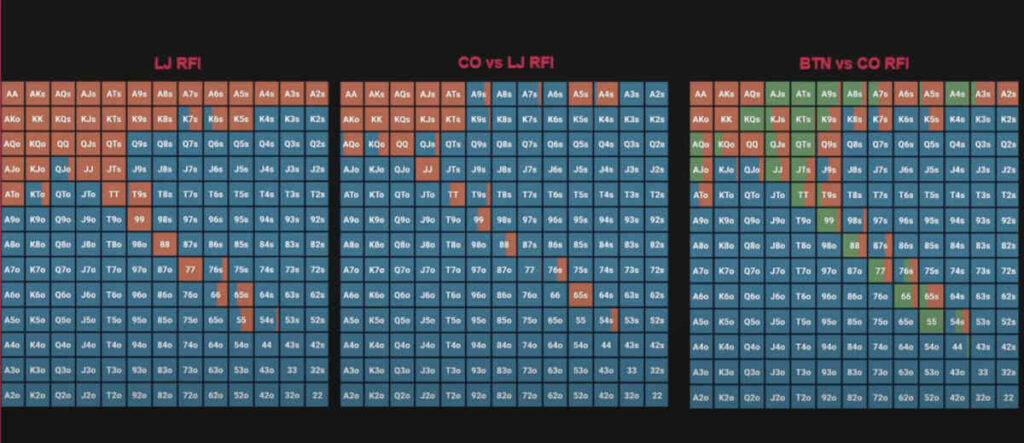
You’ll notice that when playing from the lojack (which is the first to act in 6-max), our range is quite tight. Some of the weaker hands that we can open in these spots are lower suited kings, but you’ll notice that we’re only opening offsuit aces down to AT.
Hands like K9o, QTo, and even Q9s are pure folds when you’re first to act.
As is always the case, in games where your opponents will not 3-bet enough or where there is an incentive to play a bit wider (such as games with antes), you can expand a bit by increasing your open percentage with hands that feature mixed strategies.
Strategy Facing a Raise
Most semi-serious players eventually figure out opening ranges. There are many resources out there, and memorizing the charts for different positions isn’t that hard.
However, many players continue to struggle with scenarios where they are facing an open.
If you check out the image above, you’ll notice that the cutoff has absolutely no calling range facing a lojack open in 6-max games. It is a pure raise or fold strategy.
The problem with calling in these spots is that it gives the big blind really good odds to get involved, and that’s far from ideal. So, 3-betting with all the hands that you want to play is a much better approach.
There is also the added benefit of winning the pot before the flop, and many poker sites will not charge you any rake in this scenario.
If we move positions one spot, you’ll notice that the button vs. the cutoff situation features a fairly substantial calling range (all hands in green).
Not surprisingly, the calling range consists of hands that really want to see the flop, so you don’t want to use them as a 3-bet and then be forced to fold. We are talking a variety of pocket pairs (from JJ all the way down to 55), as well as suited aces and broadway hands.
The hands we’re 3-betting here are our best holdings (QQ+, AQ+) and a selection of hands that are on the cusp of playability, such as small suited aces, some suited kings, and marginal suited connectors like J9s and T9s.
Tip #2: Tighten Your Big Blind Defense Range
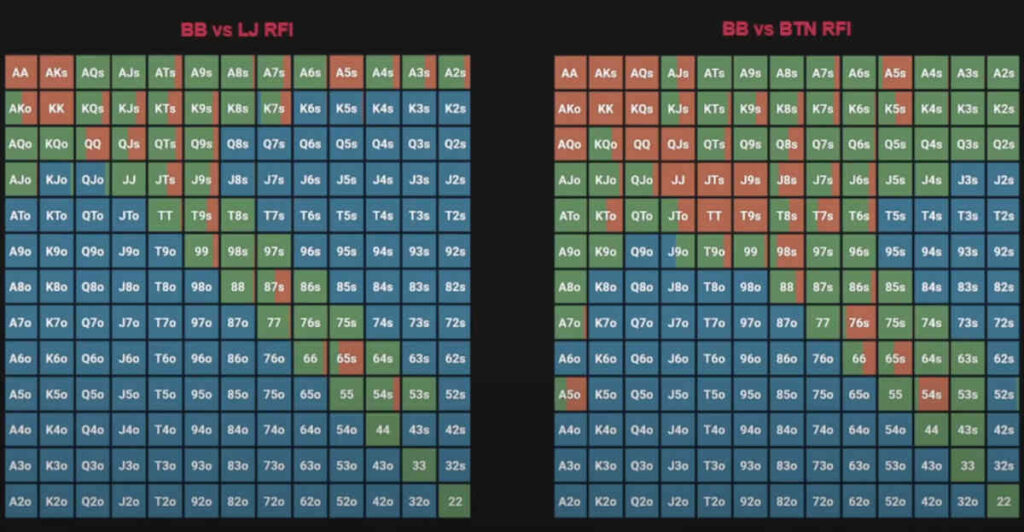
Many players in 6-max cash games tend to defend almost any two cards from the big blind. However, if we look at the charts below, you’ll notice how tight we actually need to be in these spots.
Your calling range against an early position opener should be fairly strong. You are playing out of position and, as we saw in the previous tip, the opener’s GTO range is actually quite tight.
This is an extremely important consideration for cash games, where your stack will tend to grow the longer you play. As the session goes on, you might get up to 200 or 300 big blinds effective, and you really don’t want to be playing marginal hands in these deep stack scenarios.
It is worth mentioning that in games with antes, like the ones on CoinPoker, when you are facing a min-raise, you do need to expand your defense range a bit, as you’re getting much better odds.
When defending your big blind against a button open, your range will naturally be much wider. The most common mistake players make in this spot is forgetting to 3-bet with a certain portion of hands in the middle, such as JTs, J9s, T9s, and 98s.
Even still, we are getting rid of all of our weakest suited hands and a bunch of offsuit hands, and this even includes the weakest aces, like A6o down to A2o (with A5o being an exception that we always call or 3-bet with).
Tip #3: Stay Passive With Marginal Hands
Many small stakes players tend to overplay marginal made hands, leading to them staying in pots for too long and getting stacked.
In these spots, you have to pot control and induce bluffs. Get over your fear of getting out-drawn: it is simply a part of poker!
Even as a preflop aggressor, you don’t always need to continuation bet. In fact, you need to have a checking range and protect it by checking with some of the marginal stuff and a few strong hands as a trap.
For example, we raise with A♥7♦ from the button and the big blind calls. The flop is A♦K♥8♠. Once the big blind checks, it’s perfectly fine to check behind. We have a decent hand in our top pair, but it’s a spot where we’d hate to get check-raised.
That said, this particular board texture isn’t the one where we’ll get check-raised a lot, but the concept still applies. The scarier the texture, the more you should be inclined to check back with your marginal made hands and protect your equity.
Tip #4: Apply Pressure When Bluffing
One common leak that many smaller stakes players have in their game (whether it’s 6-max or full ring) is that they are lazy with their bluffs. Often, they’ll put out a medium-sized bet without giving it much thought and hope their opponent folds.
Remember, the game is No Limit Texas Hold’em. If you want to steal more pots, you must think about the most common bluff-catcher your opponent is likely to have and then put pressure on that type of hand.
So, you can use small bluffs when your opponent’s range is mostly weak hands. However, if their range consists mostly of top pair-type of hands, you’ll need to bet huge to make those hands fold.
Tip #5: Don’t Be Afraid to Go for Thin Value
Many players are afraid to go for thin value in certain spots as they are concerned about facing a raise. However, this isn’t something you should worry about too much. Instead, you should look for spots where you can extract thin value, and if they raise you, you can simply fold.
The fact of the matter is that most small stakes players don’t bluff nearly often enough, and that’s especially true on the river. So, if you know that you won’t get bluff-raised often enough, you can print money by going for thin value and comfortably folding when you face a raise.
Let’s look at an example.
We are on the button with J♠J♣ playing $1/$2 and raise it to $5. The big blind calls, and we see the flop of K♥10♦3♣. The big blind checks, we c-bet for $3, and they call.
The turn is the 7♠ and the opponent checks. At this point, we have a pretty marginal made hand, so checking behind here is a pretty solid line.
The river comes an absolute blank in the 2♥ and the opponent checks one more time. This is the spot where you want to bet for value.
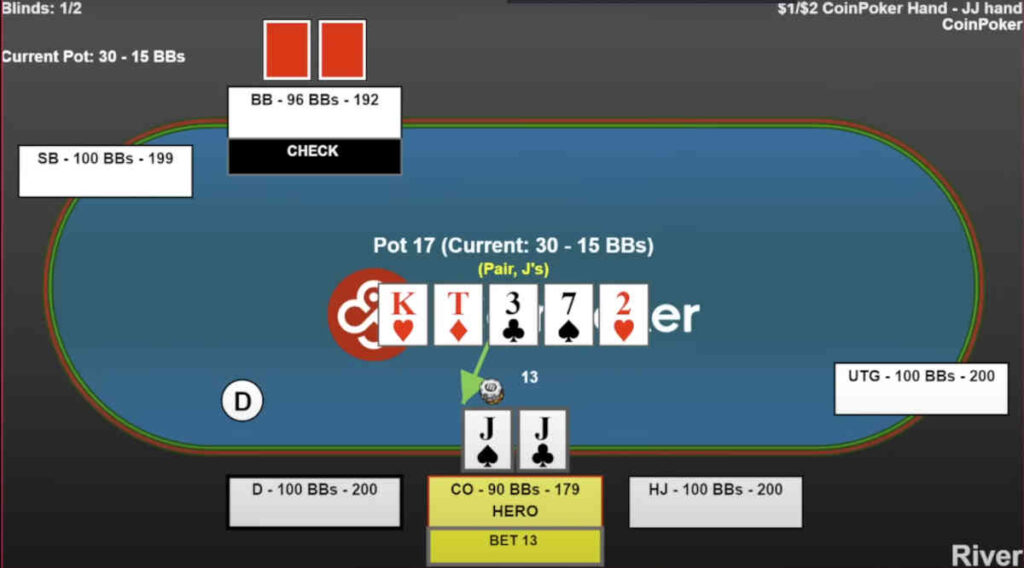
Let’s think about the opponent’s play throughout this hand. They didn’t check-raise the flop, which they would do with most of their strongest kings. If they did have a medium-strength king, once the action checks through on the turn, they’d be inclined to bet the river.
We can be pretty safe that the opponent has a ten or worse, so the question now becomes how much we expect them to call with that type of hand.
A medium-size bet should work nicely in this scenario, so something like $9 into the pot of $17. Of course, this is somewhat opponent-dependent.
If you know the opponent and that they like calling down with marginal hands, you can go for a bigger bet; conversely, against tighter players, a smaller bet like $7 could be a sweet spot.
With these types of poker hands, you don’t want to go too big, though. As your size increases, you’re removing more and more bluff-catchers from your opponent’s range, which means that they’ll start calling you more with hands that actually have you beat and folding the rest.