
Progressive Knockout (PKO) tournaments have become one of the defining formats of modern online poker. Unlike traditional Multi-Table Tournaments (MTTs), where your primary objective is to accumulate chips and survive through the payout structure, PKOs add another source of expected value to almost every decision: the bounty.
When you eliminate an opponent, you receive an immediate cash reward while also increasing the bounty on your own head. This creates a unique dynamic where accumulating chips and hunting bounties are constantly competing, and sometimes complementary objectives.
If you apply standard MTT strategies to a PKO without accounting for the bounty structure, you can leave significant amounts of expected value on the table. To succeed, you need to understand bounty mathematics, stack coverage, changing calling ranges, and the relationship between bounty EV and ICM.
Understanding Modern Bounty Formats
Before diving into strategy, it is crucial to understand the exact format you are playing, as the mechanics dictate the mathematics.
Standard KO
In a standard Knockout tournament, a fixed portion of the buy-in is assigned to each player's bounty. When you eliminate a player, you receive that predetermined amount.
The bounty does not increase during the tournament, so every elimination carries the same immediate reward.
Progressive KO (PKO)
Progressive Knockout tournaments work differently.
In a typical PKO, 50% of the buy-in goes into the regular prize pool, while the other 50% becomes the player's starting bounty. When you eliminate an opponent, you immediately receive 50% of their current bounty as cash. The remaining 50% is added to your own bounty.
For example, if a player has a $100 bounty, eliminating them gives you $50 immediately, while your own bounty increases by another $50.
This creates the defining feature of PKOs: the more players you eliminate, the more valuable you become as a target.
Mystery Bounty
Mystery Bounty tournaments use a fundamentally different system.
Instead of having a known bounty that progressively increases, players who make it to the bounty phase receive a random reward when they eliminate an opponent. The reward can range from a relatively small amount to a major jackpot.
This distinction matters strategically. Before the Mystery Bounty phase begins, there is generally no immediate bounty incentive attached to eliminating an opponent, making the early stages much closer to a traditional MTT. Once the bounty phase begins, however, the possibility of a very large random reward can dramatically change the value of eliminating opponents.
Mystery Bounty is therefore not simply another name for a PKO – it is a different tournament format requiring its own strategic adjustments.
The Math: How the Bounty Factor Changes Your Equity
The biggest mistake players make in PKOs is treating every all-in decision as if they were playing a standard MTT.
In a normal tournament, when you face an all-in, the basic question is whether your equity against your opponent's range is sufficient to justify the amount you have to call. In a PKO, you also have the opportunity to win the opponent's bounty.
That bounty has a real monetary value and can be converted into a chip-equivalent value for decision-making purposes. As a result, the equity required to call an all-in can be significantly lower than it would be in a regular tournament.
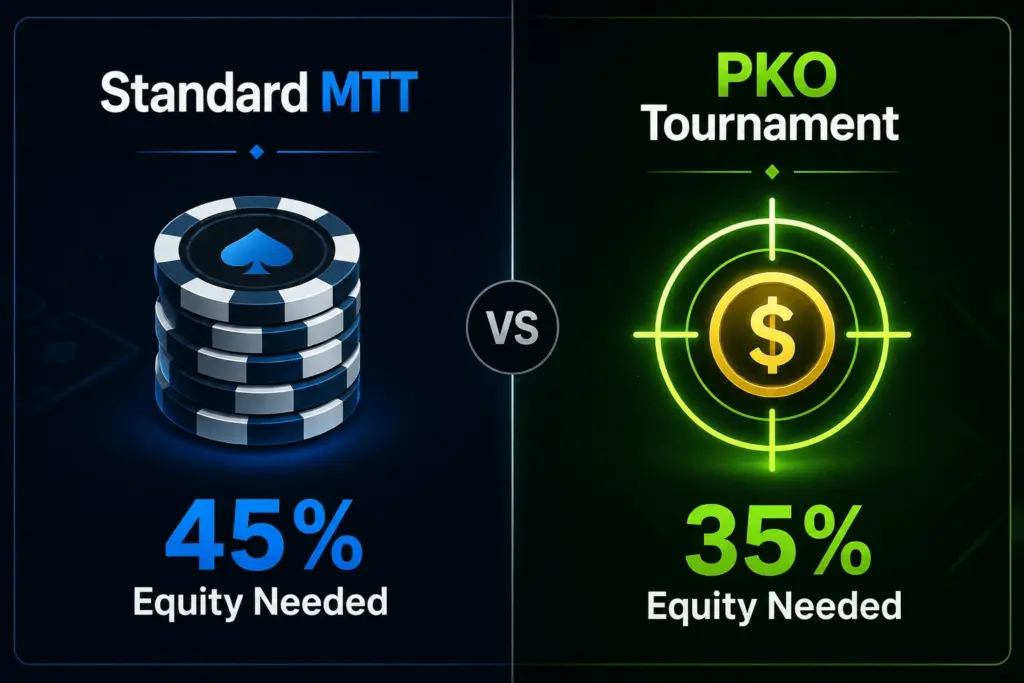
For example, imagine a short stack shoves 10 BB and you cover them. In a standard MTT, calling may require close to 40–45% equity depending on the exact pot and action. Now imagine the same player has a large bounty. The bounty effectively adds additional value to winning the hand. If the bounty is large enough relative to the amount you have to risk, a call that would be unprofitable in a regular MTT can become profitable in a PKO.
The bigger the bounty relative to the effective stack you are risking, the wider you can potentially call. However, this does not mean you should blindly call every short-stack shove. Your own tournament equity, stack size, position, opponent's range, and later ICM pressure still matter.
Bounty Value: When Is a Bounty Actually Worth Chasing?
Not every bounty is equally attractive. A $10 bounty attached to a player with 100 BB behind is very different from a $10 bounty attached to a player who has just shoved for 5 BB.
The key question is: How much are you risking to win the bounty?
This is why short stacks become particularly important in PKOs. If an opponent has 8 BB and a large bounty, you may be able to call considerably wider than you would against a 50 BB stack with the same bounty. You are risking fewer chips to gain the same immediate bounty reward.
Bounty value is most powerful when you can win it without risking a significant portion of your tournament equity.
The Most Critical Mechanic in Progressive KO Poker: Stack Coverage
One of the most important concepts in PKO poker is stack coverage. You can only win an opponent's bounty if you have enough chips to eliminate them.
When You Cover Your Opponent
If you cover your opponent, you have access to their bounty. The most important advantage here is the strategic asymmetry: you can eliminate them and collect their cash reward, while they cannot win your bounty unless they double up through you first. This unique dynamic gives you the green light to apply maximum pressure.
When You Are Covered
Being the covered player is much more uncomfortable. Your opponent can win your bounty, while you cannot win theirs.
Because they have a financial incentive to knock you out, your fold equity decreases significantly. Opponents will call your bluffs and all-ins much lighter than in a standard MTT. This means you must tighten up and realize that survival is your primary goal when clashing with larger stacks.
The Paradox of Success: The Bigger Your Bounty, the Bigger the Target
PKOs create a unique paradox: the better you perform, the more valuable your bounty becomes.
Eliminate several opponents, and you may have accumulated a large stack and a huge bounty. That is fantastic for your immediate tournament position, but it also puts a price on your head. A player with a large bounty can therefore expect opponents to take more risks against them when they have the opportunity to win that bounty.
However, a large bounty does not automatically make you vulnerable to everyone. If you have a massive stack and cover most of the table, many opponents cannot actually win your bounty. In this situation, your large bounty can coexist with enormous strategic power because you are simultaneously threatening their tournament lives and their bounties.
Preflop Adjustments in PKOs
The Progressive KO poker preflop strategy cannot simply copy standard MTT ranges. The most obvious adjustment occurs when you are covering a short stack with a valuable bounty. You can often:
- Call all-ins wider.
- Isolate short stacks more aggressively.
- 3-bet wider against players you cover.
- Defend more hands when the bounty makes the pot attractive.
However, if a big stack covers you, they are incentivized to call your shoves more frequently because they can win your bounty. A useful question before making a marginal preflop decision is: “Who covers whom, and whose bounty am I actually playing for?”
Postflop Strategy: Bounty Value Changes Your Commitment Threshold
The bounty also affects postflop decisions. Imagine you flop top pair against a short-stacked opponent with a large bounty and you have them covered. In a normal tournament, you might find a fold in a marginal situation. In a PKO, the additional bounty equity can make continuing substantially more attractive.
The opposite situation can be equally important. If a big stack covers you and you hold a marginal hand, you should be aware that your opponent has an additional incentive to continue against you. Stack coverage should remain part of your thought process on every street.
Adapting Your Strategy Through the PKO Tournament
A winning PKO strategy is highly dynamic. The relative importance of the bounty changes dramatically throughout the tournament.
Early Stage
At the beginning of a PKO, everyone's bounty is usually at or near its starting value. Deep stacks also mean that players have to risk a significant number of chips to win those relatively small bounties. Risking 80 BB for a bounty worth only a small fraction of the buy-in is rarely justified simply because the tournament has a knockout component. The primary objective remains accumulating chips.
Middle Stage and Late Registration
This is where PKO dynamics become much more pronounced. Players have accumulated bounties, stacks have become more uneven, and short stacks with attractive bounties start appearing.
Players entering late may have relatively shallow stacks but still carry the tournament's starting bounty. If you have a large stack and cover a large portion of the table, these late registrants can become particularly attractive targets. (Note: Always check specific tournament rules, as re-entries usually start with the standard starting bounty, not the accumulated one.)
Short Stacks and Big Bounties
Imagine a player has only 10 BB remaining but has accumulated a $500 bounty. Their bounty may be worth a significant portion of the buy-in, while you only need to risk 10 BB to attempt to eliminate them. In some situations, hands that would be clear folds against a 10 BB shove in a normal MTT become profitable calls in a PKO, provided you cover them.
The Bubble: ICM vs. Bounty EV
In a normal MTT, approaching the bubble creates significant ICM pressure. In a PKO, you have another source of value competing with ICM: the bounty.
The value of surviving can become enormous, particularly for medium stacks approaching major pay jumps. If losing the hand would destroy a significant amount of your tournament equity, the bounty may not compensate for the risk. The correct approach is to balance: Chip EV + Bounty EV + Tournament/ICM EV.
The Final Table: Bounties vs. Pay Jumps
The final table is where the conflict between bounty value and ICM becomes most extreme. A $5,000 bounty might look irresistible until you realize that finishing one place higher could be worth $15,000 or $20,000 more in tournament equity. Blindly hunting the largest bounty can be a costly mistake.
How Your Own Bounty Changes Your Strategy
As your bounty grows, your strategy must adapt:
- Opponents have more incentive to call your shoves.
- Your fold equity can decrease.
- Marginal bluffs become less attractive.
- Value hands can become more profitable because opponents may over-defend.
- Players who cover you have a stronger incentive to enter pots against you.
Common PKO Mistakes to Avoid
- Chasing Every Bounty: A bounty is not a reason to play every hand. Compare the potential reward with the equity you are risking.
- Ignoring Stack Coverage: A $1,000 bounty is irrelevant to you if you cannot actually win it.
- Treating Every Stage the Same: A $100 bounty early in the tournament and a $100 bounty near the final table have very different strategic implications.
- Applying Standard MTT Calling Ranges: PKO calling ranges must be significantly wider in certain situations, especially against covered short stacks.
- Overvaluing the Bounty Near the Final Table: A huge bounty does not automatically justify risking your tournament life when an important pay jump is at stake.
Progressive KO Poker Strategy vs. Mystery Bounty Strategy
Although both formats reward players for eliminating opponents, they create different incentives:

In a PKO:
- Bounty value is known and grows progressively.
- Large bounties become increasingly attractive.
- Stack coverage is fundamental throughout the entire tournament.
In a Mystery Bounty:
- Bounty value is unknown until the envelope is opened.
- The major bounty incentive usually begins only after the designated bounty phase (often in the money).
- Early tournament strategy strongly resembles a standard MTT.
If you want to put your new PKO skills to the test, CoinPoker is a fantastic place to start bounty hunting. For the full breakdown of the platform, check out our honest CoinPoker review.
Take advantage of their Welcome Bonus: 150% first deposit bonus up to $2,000, with a minimum qualifying deposit of $10, using the exclusive CoinPoker promo code VIPBONUS
Final Thoughts: Think in Three Dimensions
The biggest adjustment when moving from traditional MTTs to PKOs is learning to stop thinking purely in terms of chips. Every important decision involves three different forms of value:
- Chip EV: How many tournament chips do I expect to gain or lose?
- Bounty EV: How much is the opponent's bounty worth if I eliminate them?
- Tournament/ICM EV: How does this decision affect the actual monetary value of my tournament equity?
The best PKO players are constantly balancing all three. They know when a bounty is worth risking chips for, when their own bounty makes them vulnerable, and when ICM makes even a huge bounty not worth chasing.
Progressive KO Poker FAQ