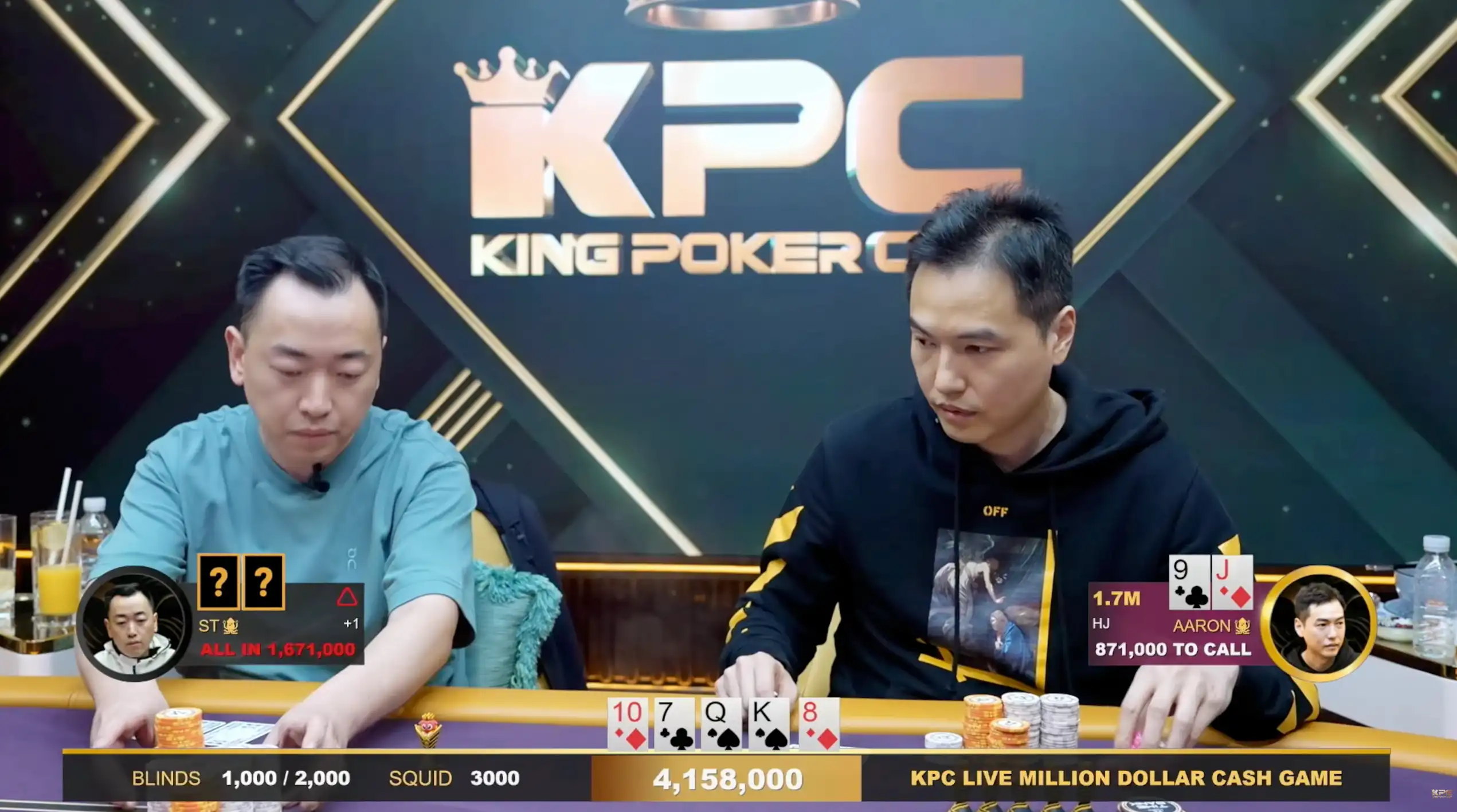

The latest high stakes poker action from The Lodge Livestream attracted plenty of attention before a single card was even dealt. Much of that interest came from the return of Garrett Adelstein, who made one of his first major public poker appearances since the controversial J4 hand that dominated poker discussions for years. Yet by the end of the night, the biggest story wasn't Adelstein's comeback but a memorable Alan Keating poker hand against Doug Polk.
The table was packed with familiar faces. Alongside Adelstein sat Doug Polk, Alan Keating, Senor Tilt, and several other regulars from the high-stakes livestream scene. With so much experience and aggression concentrated at one table, big pots felt almost inevitable.
The game began as a $100/$200 cash game, but the action quickly escalated. By the time the night's biggest hand took place, the stakes had increased to $200/$400, creating significantly larger pots and encouraging wider preflop ranges.
While Doug Polk ultimately won the largest pot of the stream, the overall session told a different story. The signature loose-aggressive Alan Keating poker style prevailed once again, as he finished as the biggest winner of the night, booking more than $1 million in profit across the eight-hour session. Polk also ended the game in the black, while several other players endured significant losses.
One of the biggest reasons Keating remained the session's top winner despite losing a $650,000 pot was his willingness to play unconventional lines and put opponents in difficult situations. Ironically, that same approach would soon lead him into the most talked-about hand of the entire stream.
Doug Polk and Alan Keating Clash in the Biggest Pot of the Night
The action began with a live straddle in play. Alan Keating entered the pot from the hijack by completing to $800, and the action folded around to Doug Polk in the small blind.
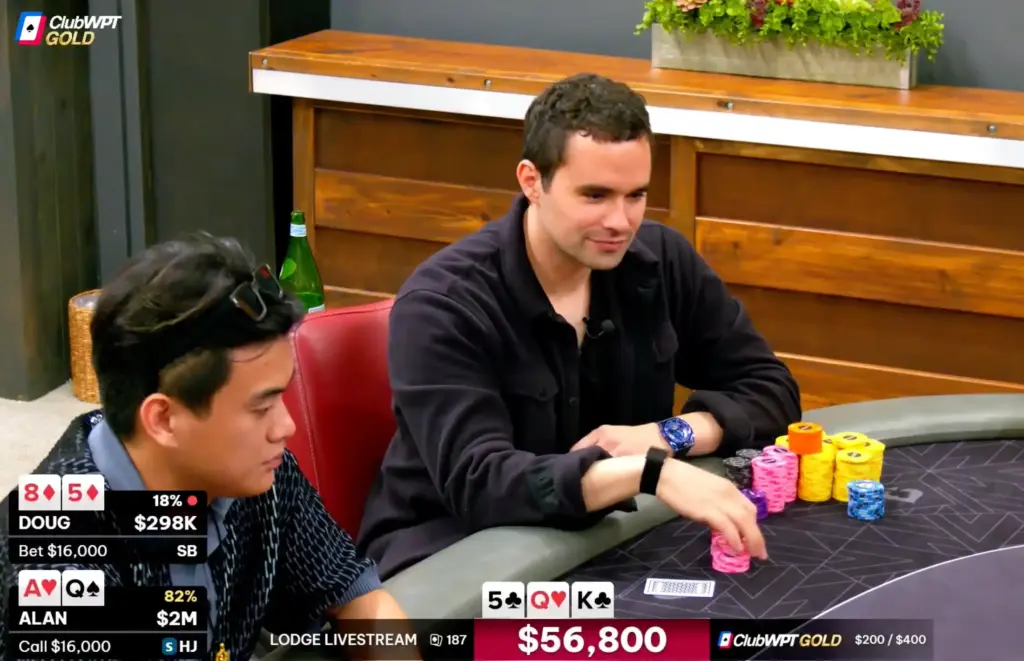
Holding 8♦5♦, Polk decided to apply pressure immediately, raising to $8,000. Jasper, sitting under the gun with A♠9♥, called, and Keating also continued with A♥Q♠. With three players heading to the flop, the pot had already grown to $24,800.
The dealer spread K♣Q♥5♣, connecting in different ways with all three players. Polk held the bottom pair, Keating flopped a middle pair with top kicker, while Jasper completely missed the board.
Polk continued the aggression with a $16,000 continuation bet, sizing it at just over half the pot. Jasper quickly released his Ace-high. Keating, holding a pair of queens and backdoor possibilities, made the call, bringing the pot to $56,800 heading to the turn.
The turn card, the 8♥, dramatically improved Polk's hand. What had been a relatively standard continuation bet spot suddenly turned into a value situation, as Polk improved to two pair. Rather than choosing a conventional sizing, Polk reached for an aggressive overbet of $85,000 into the $56,800 pot. The sizing immediately put maximum pressure on Keating's one-pair holdings and forced him to decide on a potentially massive pot.
Remarkably, Keating barely seemed fazed. After a brief look at the board and his opponent, he made the call, setting up a river that would eventually produce the largest pot of the entire livestream.
Why Doug Polk's Turn Overbet Was so Interesting
At first glance, Doug Polk's $85,000 bet into a $56,800 pot looks like a classic bluff. After all, most recreational players associate large overbets with attempts to force folds and win pots without a showdown. Modern cash game strategy tells a different story.
In today's games, overbets are commonly used with both strong value hands and carefully selected bluffs. The goal is not simply to make an opponent fold, but to put maximum pressure on the part of their range that forces them to make a very difficult decision.
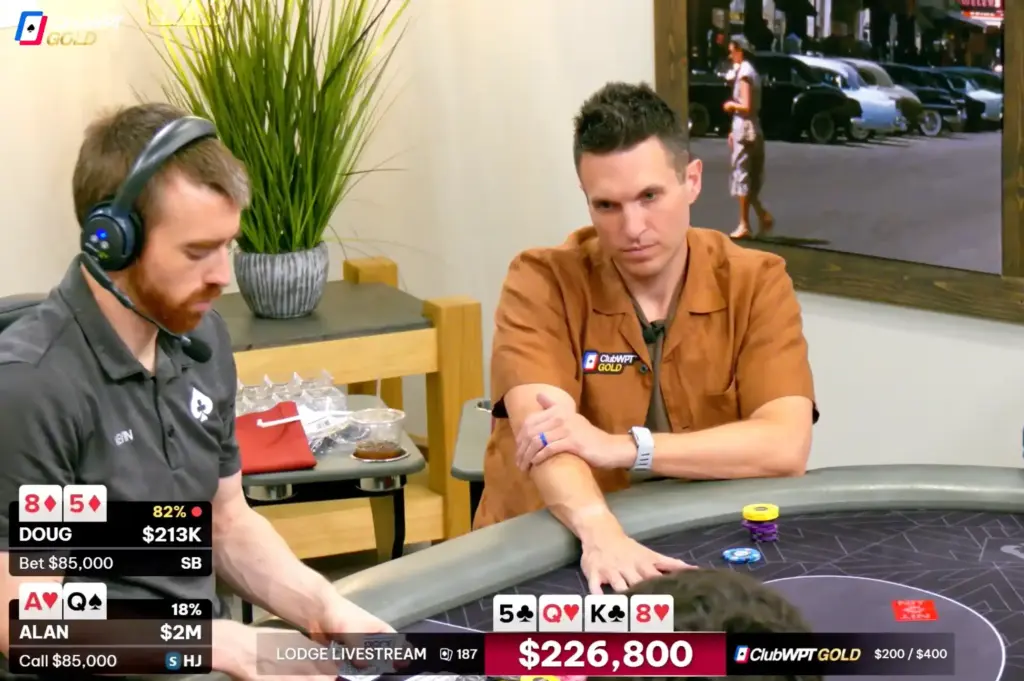
After the 8♥ landed on the turn, Polk improved from bottom pair to two pair. While his hand was now quite strong, it remained vulnerable to a variety of river cards. Flush and straight draws were still available, and many one-pair hands could still improve.
By choosing a 1.5x pot overbet, Polk accomplished several things at once. He immediately extracted value from strong kings, queens, and drawing hands while simultaneously making it extremely difficult for his opponents to continue with marginal holdings.
From Alan Keating's perspective, the situation was far from comfortable. Holding A♥Q♠, he had a reasonably strong bluff catcher, but he was now facing a sizing that typically represents a very polarized range. Polk was effectively saying that he either had a very strong hand or a bluff powerful enough to withstand maximum pressure.
This is one of the reasons the hand became so interesting from a strategic perspective. The overbet wasn't simply about building a bigger pot. It forced Keating to think in terms of ranges rather than individual hands, a dynamic that would become even more important once the river card arrived.
Was Alan Keating's River Call Actually Bad?
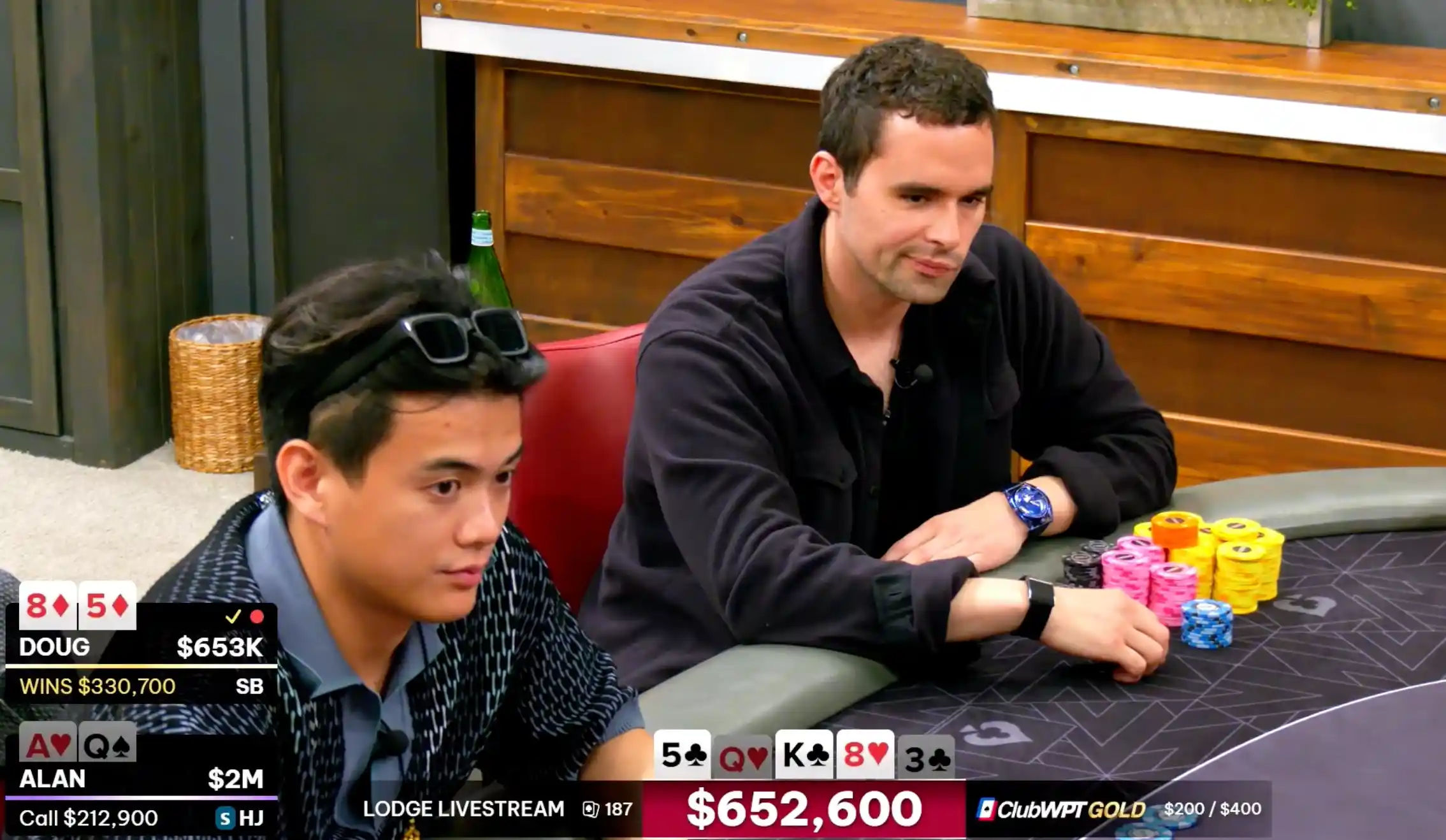
The river brought the 3♦, a complete blank. Flush and straight draws missed. After a brief pause, Doug Polk moved all-in, putting Alan Keating to the ultimate test.
Holding A♥Q♠ on a K♣Q♥5♣8♥3♦ board, Keating had just one pair. Against a value hand, he was beaten; against a bluff, he would win. This exact scenario is what players call a bluff catcher, a hand that beats bluffs but loses to value bets. The challenge is determining if the opponent is bluffing frequently enough.
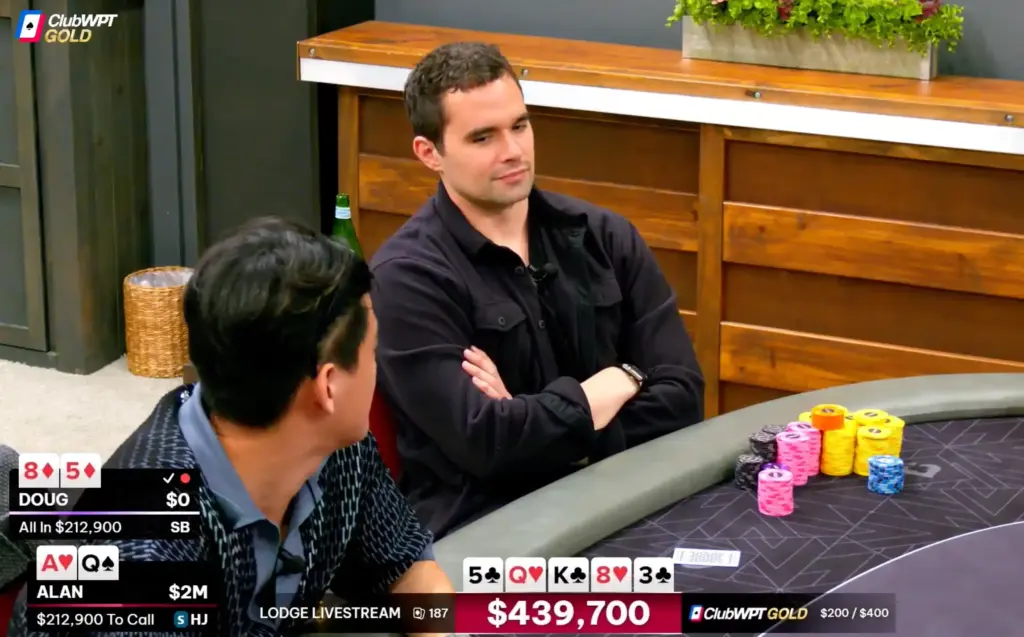
Theoretically, Keating’s situation was grim. Polk's aggressive line, a preflop squeeze, half-pot flop c-bet, massive turn overbet, and river shove, represented extreme strength, easily containing sets, two pairs, or premium hands like AK.
However, Polk is known for applying relentless pressure where others play conservatively. This reputation alters the dynamic. When analyzing any Alan Keating poker decision, we must remember that while a solver evaluates ranges mathematically, live poker takes the human element into account. Keating’s call likely relied less on the raw strength of A♥Q♠ and more on his specific read, suspecting enough missed draws and bluffs remained in Polk's range to justify calling.
Ultimately, Polk turned two pair and was ahead, winning the massive pot. Yet, this hand perfectly illustrates the clash between mathematical theory and real-world reads in high-stakes decisions.
What Can Recreational Players Learn From This Alan Keating Poker Hand?
Most players will never find themselves involved in a $650,000 pot, but the strategic concepts from this hand apply at every stake level.
- Overbets Are Not Always Bluffs: The first lesson is that large bets do not automatically mean a player is bluffing. Many recreational players see an overbet and immediately assume their opponent is trying to force a fold. In reality, strong players often use large sizings with both value hands and bluffs like GTO do.
- Understanding the Bluff Catcher: The second takeaway is the importance of understanding this concept. Alan Keating's A♥Q♠ was strong enough to beat missed draws and bluffs, but not strong enough to beat most value hands. Situations like this force players to think in terms of ranges rather than individual holdings.
- Stay Objective Against Aggression: Finally, this hand highlights the importance of remaining objective when facing aggression. Whether you decide to call or fold, the decision should be based on your opponent's likely range, not on a desire to “catch them bluffing”.
While Doug Polk won this particular battle, the hand serves as an excellent reminder that great poker decisions are rarely about the cards alone. They are about understanding ranges, bet sizing, and the story each player is trying to tell throughout the hand.
Final Thoughts
The biggest pot of the night may have gone Doug Polk's way, but the hand itself offered much more than an entertaining showdown. It showcased how modern high-stakes cash games are often decided by pressure, bet sizing, and range construction rather than simply who holds the better cards.
Polk's massive turn overbet demonstrated how elite players use polarized sizing to put opponents in difficult situations, while Keating's willingness to call down with a single pair highlighted the confidence and intuition that have made him one of the most talked-about players in streamed poker.
In the end, Polk collected the $650,000 pot, but Alan Keating still finished the session as the biggest winner by a considerable margin. For poker fans, that made the hand a perfect snapshot of what makes high-stakes cash games so fascinating: one pot can create the headline, but a full session is what ultimately determines the winner.
Check out the final profit and loss numbers from this incredibly wild high-stakes session below:
| Player | Cumulative Winnings |
| Alan Keating | +$1,041,300 |
| KBM | +$743,300 |
| Bill | +$149,100 |
| Doug Polk | +$95,000 |
| Garrett Adelstein | -$13,100 |
| Senor Tilt | -$217,300 |
| EZ | -$438,800 |
| Taras | -$551,600 |
| Jasper | -$865,000 |
Ready to Hit the Tables?
If reading this got you in the mood to play some poker yourself, it is important to choose a secure and trusted platform. We have carefully evaluated and selected the best places to play, ensuring you can enjoy the game in a completely safe environment. Check out our list of the top online poker sites to find the perfect room for your needs and join the action at our verified partners today!
FAQ About this Alan Keating Poker Hand