
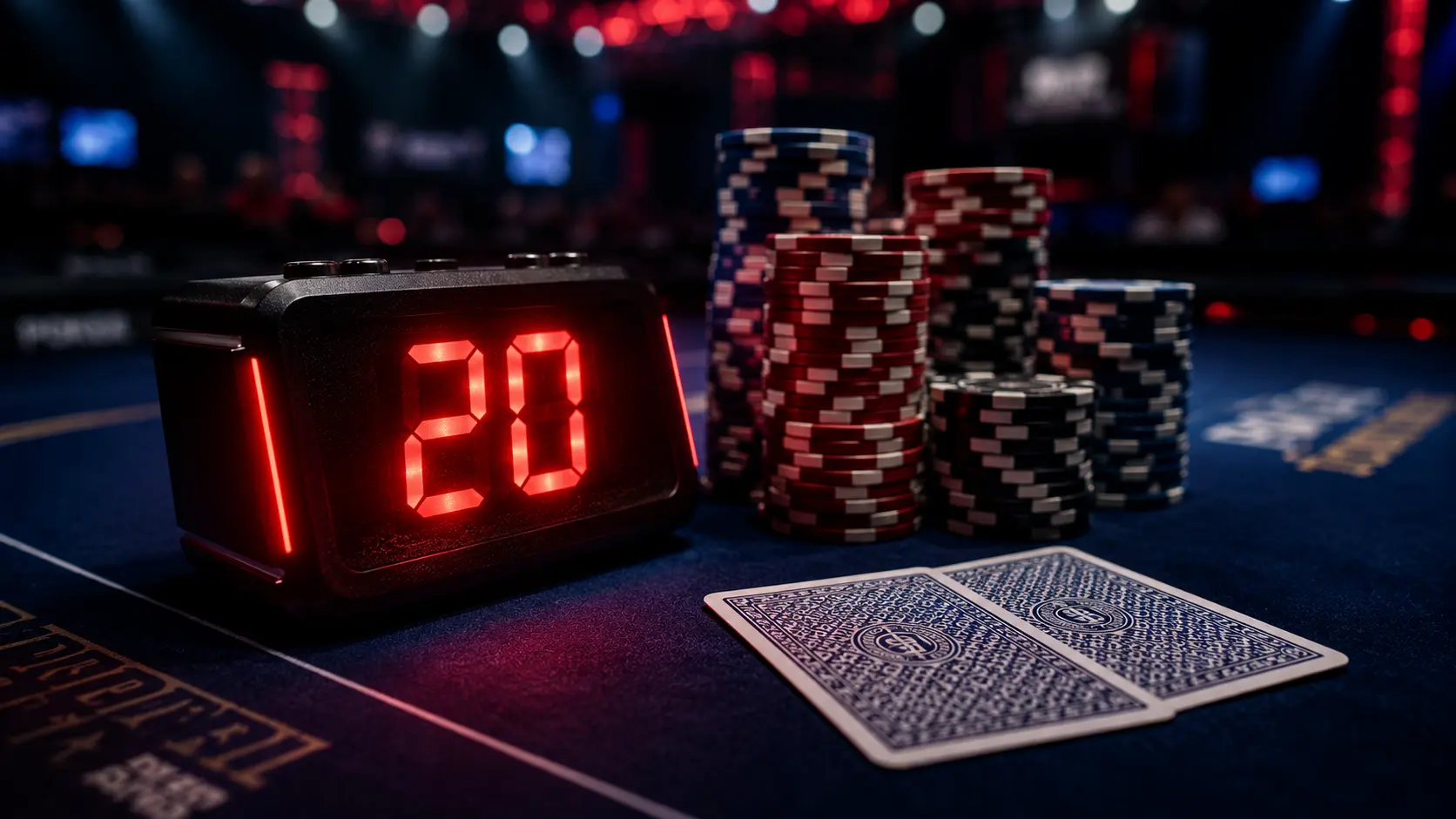
For the first time in its 57-year history, the WSOP Main Event is being played with a shot clock. Introduced mid-tournament on Day 7, the new WSOP Main Event shot clock gives every remaining player just 20 seconds to act before their hand is automatically checked, or declared dead if facing a bet.
The decisive move follows days of growing frustration and intense criticism over excessive tanking deep in poker's most prestigious event. While the WSOP has experimented with action clocks in selected high-roller events before, implementing the system during the flagship Main Event itself marks one of the most significant rule changes in World Series of Poker history.
As expected, the announcement has divided the poker community. Some players believe the shot clock is a necessary step toward reducing unnecessary delays and improving the viewing experience, while others argue that introducing such a major rule change midway through the tournament puts recreational players at a disadvantage.
Quick Facts: The 2026 WSOP Main Event Shot Clock
| Key Detail | Official Information |
| Tournament | WSOP Main Event 2026 |
| Rule Introduced | 20-second shot clock |
| Effective From | Day 7 (Mid-tournament) |
| Time Bank Chips | 6 per player |
| Extra Time Given | 30 seconds per time bank chip |
| Penalty for Expiration | Automatic check (if no bet) or dead hand (if facing a bet) |
| Primary Reason | To eliminate excessive tanking and maintain game flow |
Why Did the WSOP Introduce a Shot Clock?
The decision to introduce a shot clock wasn't made in a vacuum. It came immediately after one of the most controversial moments of the 2026 summer, when Loren Klein spent approximately 15 minutes deciding what to do with a single chip remaining in his stack late on Day 6.
With just one big blind left, Klein was intentionally stalling to outlast another elimination at a neighboring table and jump up the payout ladder before committing his final chip. While laddering is a standard tournament strategy, players, commentators, and fans unanimously agreed that a 15-minute tank crossed the line of sportsmanship.
15 Minute Tank in Main Event
Loren Klein was looking to survive another pay jump on Day 6 of the 2026 WSOP Main Event as he went into one of the longest tanks of the summer. pic.twitter.com/RxbON81Pc3
— WSOP – World Series of Poker (@WSOP) July 12, 2026
The hand quickly spread across social media, sparking criticism from both professional players and viewers. Many argued that excessive tanking had become an increasingly common issue deep in major tournaments, hurting both the pace of play and the viewing experience.
Less than 24 hours later, the WSOP announced that an action clock would be introduced for the remainder of the Main Event starting on Day 7. While tournament organizers did not explicitly state that Klein's tank was the sole reason behind the decision, the timing left little doubt that the controversy played a significant role in accelerating the change.
Pros Are Split: Necessary Fix or Unfair Precedent?
The introduction of the WSOP Main Event shot clock has quickly become one of the most debated topics of the 2026 World Series of Poker. While almost everyone agrees that deliberate stalling is a problem, the poker community is sharply divided on how and when this clock was implemented.
The Critics: “Mid-Tournament Changes Are Unfair”
- Chris Brewer slammed the decision as “insanely unfair” to recreational players. He argued that while high-stakes pros grind with action clocks daily on the PokerGO Tour, amateur players are not conditioned to make life-changing financial decisions under a strict 20-second countdown.
- David Williams (Former WSOP Main Event runner-up) echoed these concerns, arguing that tournament directors should punish individual offenders rather than punishing the entire field.
Actually, Chris is right. This is a bad idea. The floor should just use their discretion in spots where someone is being egregious like Loren and numerous others yesterday. One chip back (or similar).. instant 30s clock. https://t.co/GJAkpXnEeH
— David Williams (@dwpoker) July 12, 2026
The Supporters: “It's About Time”
- Allen Kessler welcomed the change, pointing out that players are often afraid to “call the clock” on tablemates near money bubbles, meaning staff intervention is the only way to keep play moving.
- Galen Hall (WSOP Bracelet winner) noted that a faster pace creates a healthier environment for players and a much better television product, adding that time banks still allow plenty of time for genuinely complex river decisions.
As I said before, I am very pro timebanks in the main, but introducing them mid tourney is crazy. The "does it help recs or pros" conversation is glossing over a few key things:
The first impact of a shot clock is that your brain now has to play a completely new game in addition…
— Galen Hall (@galenhall) July 13, 2026
The debate ultimately comes down to one question: should tournament directors deal with excessive stalling on a case-by-case basis, or is a universal shot clock the fairest long-term solution?
What Does the Shot Clock Mean for Your Tournament Strategy?
Whether you support the mid-stream rule change or not, the WSOP Main Events shot clock highlights a critical reality in modern poker: making high-quality decisions under strict time pressure is now an essential survival skill.
For professional grinders, especially online poker players, 20 seconds is plenty of time. Regulars are already accustomed to calculating stack depths, pot odds, and range interactions instantly. However, that speed doesn't come from natural instinct; it comes from rigorous preparation away from the table.
When you only have 20 seconds to act for your tournament life, attempting to calculate a complex hand from scratch leads to panic, mistakes, and timed-out dead hands. The only way to thrive under a shot clock is by automating your baseline decisions.
Pro Tip: Train Your Decision Speed Away from the Table. You can dramatically reduce your table anxiety by studying standard preflop ranges and post-flop board textures using cloud-based tools like GTO Wizard. By drilling familiar spots away from the poker room, you won't need to waste time thinking when the 20-second clock is ticking down; your intuition will already know the mathematically correct play.
Could This Change Future WSOP Events Forever?
For now, the new WSOP shot clock only applies from Day 7 of the 2026 WSOP Main Event. However, its introduction raises a much bigger question: is this simply a one-time response to an extraordinary situation, or the beginning of a broader shift in how major live tournaments are run?
While the World Series of Poker operates under its own tournament rulebook, the timing of the decision is particularly interesting. Just weeks earlier, tournament directors from around the world gathered at TDA Summit XII, where several new rules were approved to improve game flow, reduce angle shooting, and modernize tournament procedures. Although the shot clock wasn't one of those changes, both decisions reflect the same broader trend: tournament organizers are placing greater emphasis on keeping the action moving while maintaining competitive integrity.
If this Day 7 experiment produces a clean, exciting, and controversy-free final table, do not be surprised to see action clocks introduced from Day 1 of the 2027 Main Event, or expanded across the entire summer bracelet schedule. The era of the 15-minute tank is officially over, and tournament poker is far better off because of it.
FAQ About the WSOP Main Event Shot Clock