
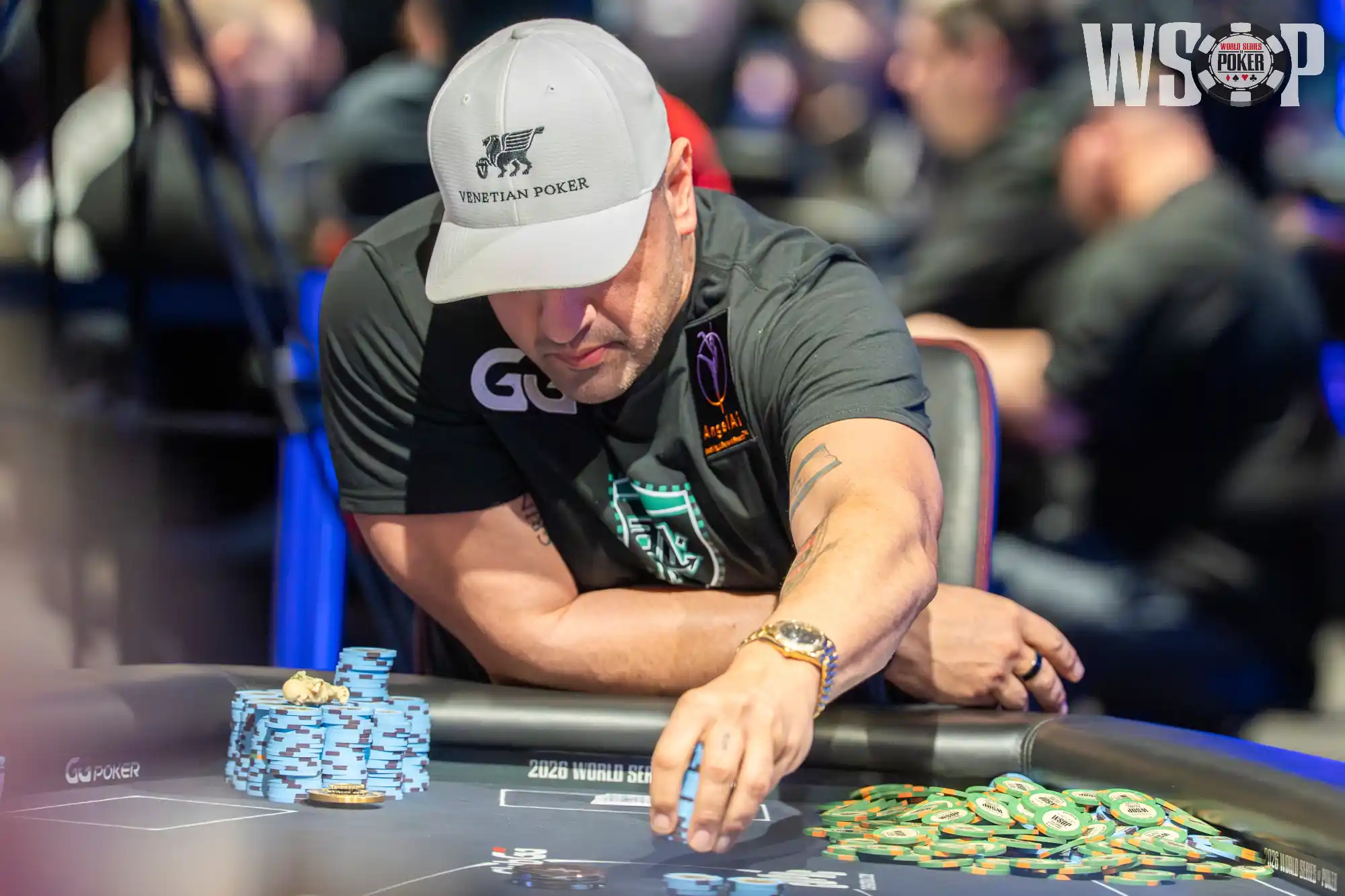
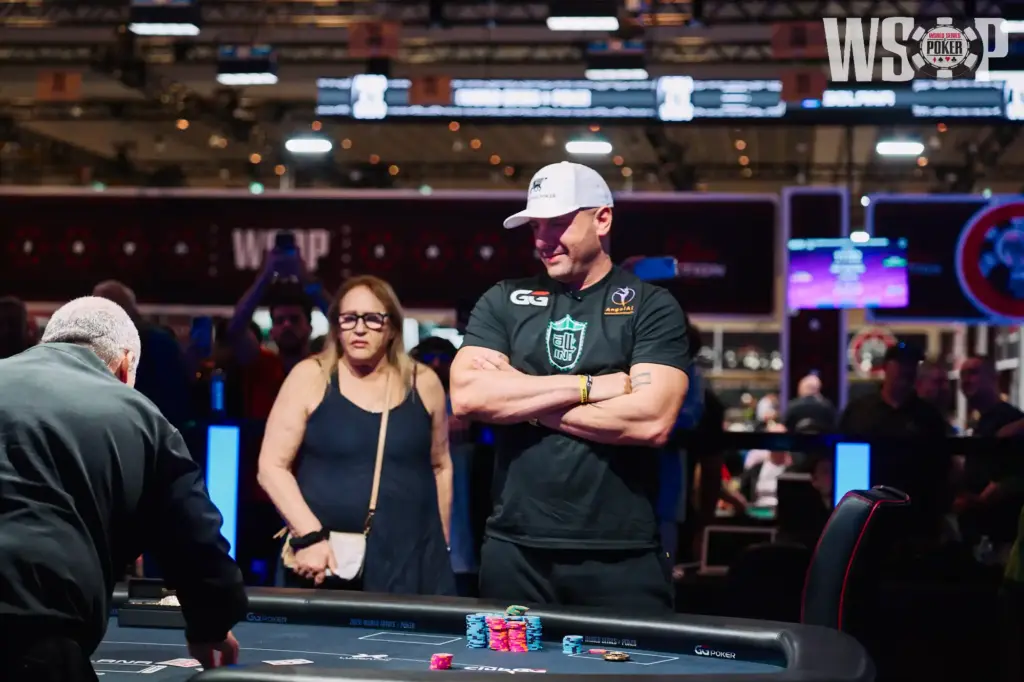
The list of Michael Mizrachi bracelets just got one longer. On June 29, 2026, “The Grinder” won the $10,000 Pot-Limit Omaha Championship at the World Series of Poker for $1,350,203, claiming the ninth WSOP bracelet of his career and joining one of the most exclusive clubs in poker. It also came almost exactly a year after he authored one of the greatest series performances ever seen, winning both the $50,000 Poker Players Championship and the WSOP Main Event in 2025.
For a player who already has nothing left to prove, the win said a lot about what still drives him. Fresh off a defending world champion's summer, Mizrachi made his goal clear the moment the last card fell: he is chasing Phil Hellmuth‘s all-time record.
Who is Michael “The Grinder” Mizrachi?
For anyone new to the name, Michael Mizrachi is a 45-year-old American professional from Miami, Florida, widely regarded as one of the greatest mixed-game and high-stakes tournament players of all time. His nickname, “The Grinder”, is well earned: he has been a fixture at the toughest tables in poker for two decades.
His resume is staggering. Before this latest win, he already held a record four victories in the $50,000 Poker Players Championship, the event many consider the hardest tournament in poker to win because it requires mastery of many different games. In 2025, he added the WSOP Main Event title for $10,000,000, and 18 days after his fourth PPC win, a run so remarkable it earned him an immediate induction into the Poker Hall of Fame. He also has two World Poker Tour titles and, with this PLO win, has pushed his career live tournament earnings past $30 million.
A note on the money: while his tournament earnings are a matter of public record on The Hendon Mob, Mizrachi's overall net worth is not public, and any specific figure would be guesswork. What is documented is his on-felt record, and that alone places him among the elite.
Michael Mizrachi's Ninth Bracelet: What Happened
Mizrachi's ninth bracelet came in Event #70, the $10,000 Pot-Limit Omaha Championship, one of the toughest PLO tournaments on the calendar. The event drew 836 entries and built a prize pool of $7,774,800, paying 126 players.
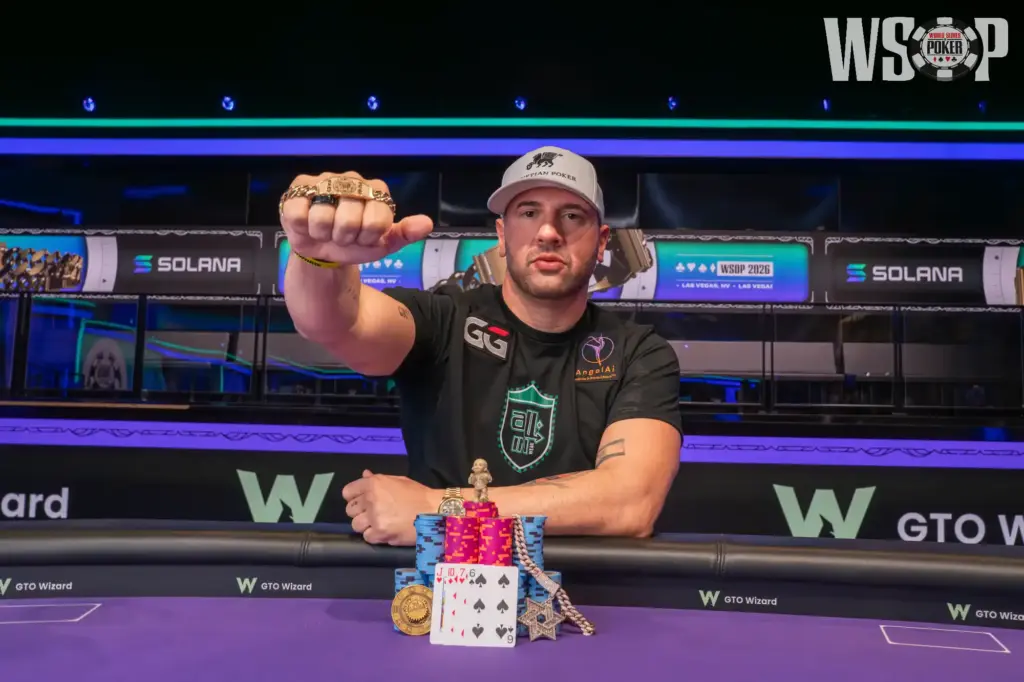
The win was notable for a specific reason: it was Mizrachi's first bracelet in a standalone Pot-Limit Omaha event. A player defined by his mixed-game mastery had just added another discipline to his trophy case. As he told WSOP interviewers afterward, the timing was poetic. His fourth PPC win had come on June 29 the year before, and here he was winning again on the same date, a year later, in a different game. He wanted to change it up, and he did.
He also did it in dominant fashion, leading essentially wire-to-wire across four days. Mizrachi carried a massive chip lead into the final table and never surrendered it, at one point holding around 80% of the chips in play three-handed. In the end, he defeated India's Zarvan Tumboli heads-up, a rivered straight, sealing the title.
Here is the full list of Michael Mizrachi bracelets to date:
- 2010 — $50,000 Poker Players Championship (8-Game) — $1,559,046
- 2011 — €10,400 Mixed No-Limit Hold'em (WSOP Europe) — $448,861
- 2012 — $50,000 Poker Players Championship — $1,451,527
- 2018 — $50,000 Poker Players Championship — $1,239,126
- 2019 — $1,500 Seven Card Stud Hi-Lo 8 or Better — $142,801
- 2024 — $888 Crazy 8's Encore (Online) — $108,815
- 2025 — $50,000 Poker Players Championship — $1,331,322
- 2025 — $10,000 Main Event World Championship — $10,000,000
- 2026 — $10,000 Pot-Limit Omaha Championship — $1,350,203
The Final Hand: A Fitting Way to Win
Mizrachi carried such a dominant chip lead into heads-up play that the ending felt inevitable, but the final hand still captured something worth understanding about Pot-Limit Omaha.
The action started with Mizrachi raising to 1 million on the button with J♥ 10♦ 7♥ 6♠. Tumboli three-bet to 3 million holding A♠ A♥ 6♦ 3♥, and Mizrachi called. The flop came 8♠ 8♥ J♠, and Tumboli committed the rest of his chips with his pair of aces. Mizrachi called.
At that moment, Mizrachi was a big underdog. His hand had only about 26% equity against Tumboli's aces. But his four connected cards gave him the kind of straight and flush potential that a pair of aces cannot block, and that is exactly what came through. The turn brought the 4♣, and the 9♠ on the river completed his straight, seven through jack, beating Tumboli's two pair. With that, had his ninth bracelet.
This is the lesson hiding in the final hand. Tumboli got his money in well ahead, as a roughly 3-to-1 favorite, and still lost. That is not simply bad luck; it is the nature of PLO. With four cards in every hand, drawing hands carry far more equity than they appear to, and even a “big favorite” is often anything but safe.
Understanding that equities are compressed in Omaha, and that a 70% favorite loses nearly a third of the time, is one of the first steps toward playing the game well and keeping your composure when your aces get cracked.
Why It Matters: The Chase for the Most WSOP Bracelets
With this win, Mizrachi joined an exclusive group. Here are the top 10 players with the most WSOP bracelets of all time:
- Phil Hellmuth — 17
- Phil Ivey — 11
- Doyle Brunson — 10
- Erik Seidel — 10
- Johnny Chan — 10
- Benny Glaser — 9
- Johnny Moss — 9
- Michael Mizrachi — 9
- Shaun Deeb — 9
- Daniel Negreanu — 8
That context matters because the number of Michael Mizrachi bracelets is now part of a bigger conversation: the chase for the most WSOP bracelets of all time. Asked whether he could catch Hellmuth, Mizrachi did not flinch. He said he needs to average two or three bracelets a year, hoping for one more in the summer and a few more at WSOP Paradise in the winter.
It is an enormous mountain to climb. Eight bracelets separate him from Hellmuth, and even the greatest players go years between wins. But Mizrachi is uniquely positioned to try, precisely because of the kind of player he is.
What Poker Players Can Learn From Mizrachi's Bracelets
Look closely at the list of Michael Mizrachi bracelets, and a pattern jumps out. Four Poker Players Championships. A Seven Card Stud Hi-Lo title. An 8-Game. And now a PLO Championship. The overwhelming majority of his bracelets come in mixed games and non-Hold'em disciplines, not in the No-Limit Hold'em events that draw the biggest fields.
This is the real takeaway, and it applies at every stake. The most valuable edge in poker is often found in the games other people neglect. No-Limit Hold'em is the most studied, most solved, and most competitive format in the world; edges there are thin and shrinking. Mixed games like PLO, Stud, and the events that combine several disciplines are far less crowded. Fewer players study them seriously, so the skill gap between a dedicated student and the field is much wider. Mizrachi built a Hall of Fame career by being willing to master the games most players avoid.
For a recreational or improving player, you do not need to learn eight games to benefit from this idea. Even adding one new discipline, such as PLO, to your repertoire can open up softer tables and new opportunities, both live and online poker. The players who put in that work tend to find their edge grows fastest where the competition is thinnest.
A Word on Variance
There is one more lesson hiding in that key hand against Lonis, and it is about variance. Mizrachi got a huge stack in as a favorite, but a marginal one, and he needed to dodge a long list of outs to win. He did. On another night, a jack or a seven lands on the river, Lonis doubles, and the whole tournament tells a different story.
That is worth remembering whenever you see a dominant result. Mizrachi is an elite player who earned his chip lead through skill and relentless pressure, but even the best runs require the cards to cooperate at the key moments. PLO in particular is a high-variance game, where four-card hands mean equities collide, and swings are larger than in Hold'em. Winning a $10,000 PLO Championship takes world-class skill and a run of holding up in the big spots.
The professional mindset is to separate the two. Judge your decisions by whether they were correct given the information available, not by whether the river cooperated. Mizrachi's shove with aces was a reasonable spot; the king on the river was variance breaking his way.
Over a long enough career, good decisions win out, but no single tournament, however dominant it looks, is free of luck. It is also worth noting the discipline behind the run: Mizrachi has spoken about losing 40 pounds and training twice a day since the last Main Event, a reminder that stamina and focus are part of the skill set in these grueling multi-day events.
FAQ About Michael Mizrachi Bracelets