
Poker After Dark results offer a unique look at some of the biggest names in poker history. First launched in 2007, the show became one of the defining poker programs of its era, with Shana Hiatt serving as its original host and stars such as Phil Hellmuth, Daniel Negreanu, Doyle Brunson, and Phil Ivey.
While much of today's high-stakes cash game action reaches audiences through live-streamed shows like Hustler Casino Live, Poker After Dark helped establish the televised poker format that made watching elite players compete a mainstream part of poker culture. The show eventually evolved beyond its original Sit & Go format to include high-stakes cash games and other unique setups.
In this article, we break down the most successful players across both formats, including the all-time SNG leaders, biggest net results, and the top cash game earners.
Note on Data: Because Poker After Dark spanned several distinct eras, we treat SNG and cash game results separately. SNG statistics are based on recorded tournaments in our database, while the cash game leaderboard reflects televised cash sessions tracked on HighRollPoker. The 2023 Game of Gold series is excluded as it used a fundamentally different format.
Poker After Dark SNG Results
The Sit & Go format was at the heart of Poker After Dark during many of its most memorable years. The original version of the show featured six-player, winner-take-all tournaments, but later seasons experimented with different buy-ins and payout structures, making the SNG history more varied than the classic $20,000 format might suggest.
Across the SNGs included in our database, some players stood out not only for their number of appearances, but for their ability to consistently reach the top of the standings. Phil Hellmuth became one of the show's most frequent participants, while players such as Johnny Chan and Howard Lederer established themselves as particularly successful winners.
To compare players fairly, we track several different aspects of SNG performance, including appearances, wins, top-three finishes, and net results after buy-ins. This allows us to distinguish between players who simply appeared frequently and those who consistently turned their Poker After Dark appearances into strong results.
Most SNG Appearances
The appearances leaderboard highlights the recurring faces of the show's SNG era. High participation provided longevity, though it did not always guarantee top financial results.
| Rank | Player | Appearances |
| 1 | Phil Hellmuth | 22 |
| 2 | Mike Matusow | 19 |
| 3 | Chris Ferguson | 13 |
| 4 | Howard Lederer | 12 |
| 5 | Doyle Brunson | 12 |
| 6 | Daniel Negreanu | 11 |
| 6 | Jennifer Harman | 11 |
| 8 | Antonio Esfandiari | 8 |
| 8 | Erik Lindgren | 8 |
| 10 | Gus Hansen | 7 |
| 10 | Phil Ivey | 7 |
| 10 | Phil Laak | 7 |
| 10 | Jennifer Tilly | 7 |
Most SNG Wins at The Poker After Dark
Winning a Poker After Dark SNG was a significant achievement, particularly during the show's original winner-take-all era. A small group of players managed to win multiple events, with Johnny Chan and Howard Lederer both recording four victories in the SNGs included in our database.
| Rank | Player | Wins |
| 1 | Johnny Chan | 4 |
| 1 | Howard Lederer | 4 |
| 3 | Phil Hellmuth | 4 |
| 3 | Clonie Gowen | 3 |
| 3 | Gabe Kaplan | 3 |
| 3 | Chris Ferguson | 3 |
| 3 | Gavin Smith | 3 |
| 3 | Maria Ho | 3 |
Poker After Dark SNG Net Results
Raw winnings can be misleading when comparing players with very different numbers of appearances. To provide another perspective, we calculated each player's net SNG result by subtracting their total buy-ins from their recorded tournament winnings.
This produces a very different leaderboard from the one based purely on victories. Huck Seed leads the all-time list with a net result of $420,000, while Johnny Chan follows at $360,000. Seed's result is particularly notable because he achieved it with just one victory, coming in the show's largest $100,000 buy-in SNG.
| Rank | Player | SNGs Played | Wins | Total Winnings | Buy-ins | Net SNG Result |
| 1 | Huck Seed | 5 | 1 | $600,000 | $180,000 | +$420,000 |
| 2 | Johnny Chan | 6 | 4 | $480,000 | $120,000 | +$360,000 |
| 3 | Gavin Smith | 5 | 3 | $360,000 | $100,000 | +$260,000 |
| 3 | Clonie Gowen | 5 | 3 | $360,000 | $100,000 | +$260,000 |
| 5 | Howard Lederer | 12 | 4 | $480,000 | $240,000 | +$240,000 |
| 5 | Gabe Kaplan | 6 | 3 | $360,000 | $120,000 | +$240,000 |
| 7 | Jason Koon | 3 | 1 | $300,000 | $100,000 | +$200,000 |
| 8 | Allen Cunningham | 4 | 1 | $300,000 | $110,000 | +$190,000 |
| 9 | Vanessa Rousso | 4 | 2 | $240,000 | $80,000 | +$160,000 |
| 10 | Tom Dwan | 3 | 1 | $300,000 | $170,000 | +$130,000 |
Poker After Dark Cash Game Results
While Sit & Go tournaments were central to the show's early years, Poker After Dark cash game results provide a very different picture of its history. The format allowed some of the game's biggest names to play deep-stacked cash games on TV, producing memorable sessions and some enormous swings.
The cash game leaderboard below is based on recorded Poker After Dark sessions tracked by HighRollPoker.com. It should therefore be viewed as a record of televised Poker After Dark cash game results, rather than a measure of the players' overall live cash game careers.
Biggest Poker After Dark Cash Game Winners
Tom Dwan leads the all-time Poker After Dark cash game leaderboard with more than $933,000 in net winnings across his recorded appearances. Andrew Robl and Matt Kirk follow, although their much smaller samples demonstrate why the leaderboard needs to be viewed alongside the number of hours played.
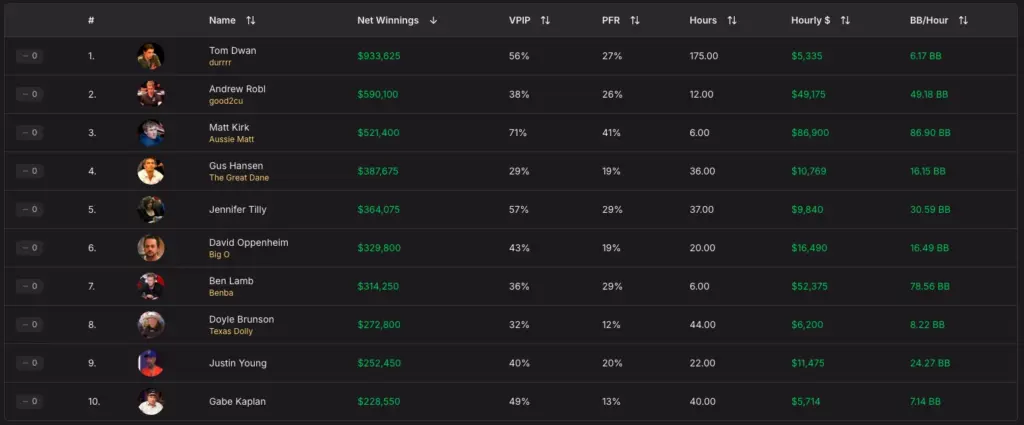
Dwan's position at the top is particularly notable because he accumulated his result over a much larger sample than several of the players immediately behind him. By contrast, some players recorded extraordinary hourly results after appearing in only a handful of sessions.
This makes the leaderboard useful for identifying the biggest overall winners, but less suitable for determining who was the “best” cash game player based purely on the numbers. Sample size and volume matter, particularly when comparing players with dramatically different amounts of televised action.
The Biggest Poker After Dark Winners
The different formats of Poker After Dark produced very different kinds of success. While some players built their reputations through repeated Sit & Go appearances, others became major winners in the show's televised cash games.
That makes it difficult to create a single all-time leaderboard, since an SNG victory and a cash game session are measured in completely different ways. Instead, several players stand out for particularly strong performances within one or both formats.
SNG Legends
Phil Hellmuth (The SNG Mainstay): Few players were as closely associated with the original Poker After Dark format as Phil Hellmuth. He is among the show's most frequent SNG participants and leads the all-time top-three leaderboard with 16 finishes and also won 4 times, demonstrating just how often he reached the latter stages of the six-handed tournaments.
Hellmuth's record is particularly interesting because his strength was not simply winning individual events. His longevity and repeated deep finishes made him one of the most consistent tournament performers in Poker After Dark history.
Johnny Chan (Extraordinary Efficiency): Johnny Chan has one of the most impressive SNG records in the database. He won four of his six recorded SNG appearances, giving him the strongest win rates among players with a meaningful sample.
His four victories also put him tied for the most SNG wins in our database, alongside Howard Lederer. Chan's record is a perfect example of why appearances, wins, and net results can tell very different stories.
Howard Lederer (Sustained Volume): Matching with Chan and Hellmuth with 4 SNG victories, Lederer achieved his titles over a larger sample of 12 appearances, demonstrating long-term dominance in the $20K era.
Huck Seed (High-Stakes Precision): Despite fewer appearances, Seed secured the highest net SNG profit ($420,000) by winning the prestigious $100,000 Super High Roller SNG.
Cash Game Giants
Tom Dwan (The Cash Game Leader): Dwan stands as the undisputed king of PAD cash games with over $933,000 in earnings across high-volume sessions.
Andrew Robl & Matt Kirk: Both players sit near the top of the overall earnings list, representing extraordinary hourly win rates in deep-stacked televised games.
How Poker After Dark Changed Over the Years
Poker After Dark has gone through several distinct eras since its 2007 debut, and the format of the show changed significantly along the way. What began primarily as a six-handed, winner-take-all tournament series eventually expanded into televised cash games, higher buy-in tournaments, and later a PokerGO-era revival with a mixture of formats.
The Original $20K SNG Era
The early years established the format that became synonymous with Poker After Dark. Six players would compete in a winner-take-all Sit & Go, with the classic buy-in set at $20,000. The format gave the show a relatively simple structure and brought many of poker's biggest stars to the same table, helping establish Poker After Dark as one of the defining poker programs of the era.
Although the $20K format dominated the early SNGs, the show was willing to experiment with bigger events. The Mega Match in Season 2, for example, used a $50,000 buy-in, demonstrating that the organizers were already willing to move beyond the standard format.
Cash Games Enter the Picture
Season 4 in 2008 marked a major turning point, as Poker After Dark filmed cash games for the first time. The first cash game week featured a 200/400 No-Limit Hold'em game, while another cash game week appeared later in the season. The same season also introduced the $50,000 Heads-Up Challenge, showing how the show was beginning to move beyond its original six-handed SNG concept.
This change fundamentally expanded what Poker After Dark could offer. Instead of every episode being built around a tournament winner, viewers could watch deep-stacked cash games unfold over several nights, with some of the biggest names in poker playing for substantial sums of money.
The High-Stakes Tournament Experiment
By the 2011 era, Poker After Dark was experimenting with much larger SNG buy-ins, including $50,000 and $100,000 events. These tournaments produced some of the show's biggest winner-take-all prizes and represented a significant departure from the original $20K format.
The show therefore never followed a simple progression from small tournaments to cash games. Instead, different formats coexisted, with high-stakes SNGs, cash games, and other special events appearing at different points in its run.
The PokerGO Revival
After a period away from television, Poker After Dark returned with a new era of programming in 2017. The revived series again mixed different formats, including cash games and Sit & Gos, but the buy-ins varied considerably.
The SNGs included everything from $10,000 and $25,000 events to $50,000 tournaments, while cash games became an increasingly important part of the PokerGO-era product. Later seasons continued this mixture rather than returning to the rigid $20K format of the show's early years.
The result is why today's all-time SNG statistics need to be viewed in context: a $5,000 SNG from the later era and a $100,000 SNG from 2011 were both Poker After Dark tournaments, but they represented very different stakes and circumstances.
The Final Poker After Dark Era
The PokerGO version continued into 2021, when Poker After Dark was still producing both cash games and tournament-style episodes. One example was the $10,000 Fight Night SNG-style event, which featured seven players and paid $50,000 to the winner and $20,000 to the runner-up.
The show's official website now also lists Season 12, Season 13, and the later Game of Gold content under the Poker After Dark brand. Game of Gold was produced in collaboration with GGPoker and introduced a very different team-based tournament and reality-show format, which is why we treat it separately from the traditional Poker After Dark SNG and cash game results.
Game of Gold – Official Trailer (HD)#Poker #RealityShow #GameOfGold pic.twitter.com/5dkyiECZab
— GGPoker (@GGPoker) November 1, 2023
That history is important when interpreting the results in this article. Poker After Dark was never just one format or one era. Its SNGs evolved from the classic $20K winner-take-all games into a much wider range of buy-ins, while cash games became a major part of the show's identity. That makes separating the SNG and cash game leaderboards essential when comparing its biggest winners.
Final Thoughts
Poker After Dark Winners came in many forms. Legends like Phil Hellmuth, Johnny Chan, and Howard Lederer carved out their legacies in the classic Sit & Go era, while Tom Dwan and modern crushers reshaped the show through high-stakes cash games.
By separating SNG performance from cash game results, we get a clear picture of how different generations of poker players adapted to one of the most iconic televised shows in history.
Frequently Asked Questions