

Master poker strategy with PeakGTO. Try this poker solver for free
Continuing on our previous article, today’s lesson will focus on tournament continuation betting strategy in 3-bet pots, playing out of position and on wet flops.
To explore this topic, we’ll use the usual setup of button vs. blind, focusing primarily on effective stacks of 40 big blinds, but also considering 60 and 25 big blind effective scenarios.
Compared to a strategy for 100 big blinds, there are some very notable differences, and the most glaring one is that our overall c-bet percentage is much higher, across all types of wet flops.
As always, we’ll break down some specific examples using solvers to explain correct strategies, but before we do, these are some of the main takeaways from this lesson:
- Continuation bet ace-high flops at 95% using primarily 25% of the pot sizing
- Fire a c-bet at 100% on king-high wet flops playing 40 big blinds effective
- C-bet only around 75% on queen and jack-high wet boards
- Continuation bet around 85% on low and connected boards
Tip #1: Always C-Bet on Ace-High Wet Flops
When it comes to wet boards containing an ace, we’ll be c-betting these at about 95%. For example, on the board of A♠9♥8♥, we are continuation betting pretty much always, defaulting to using a quarter pot sizing:
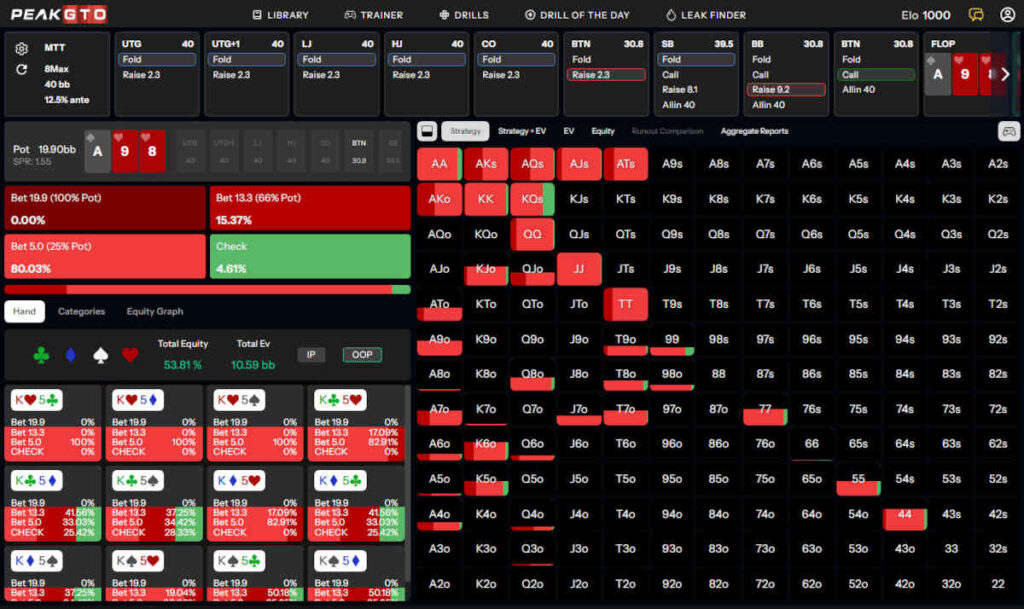
As you can see, we are doing very little checking on these boards, and when we do, we are primarily doing it with the strongest of our hands, i.e. flopped sets.
The default sizing to use in these spots is 25% of the pot. However, we should utilize larger, 66% pot bet at a low frequency (around 15%) with hands like AK, AQ and a few of our small aces (about half the time). For balance, we’ll also use the larger sizing with hands like QJ and TT (for its blocking properties and backdoor potential).
Since we are checking these boards so infrequently, there is no need to dive deep into that part of the tree. In general, we’ll be continuing around 60% of the time after we check and face a small bet from the button opponent.
So, does our strategy change at other stack depths? The adjustments are fairly small, namely:
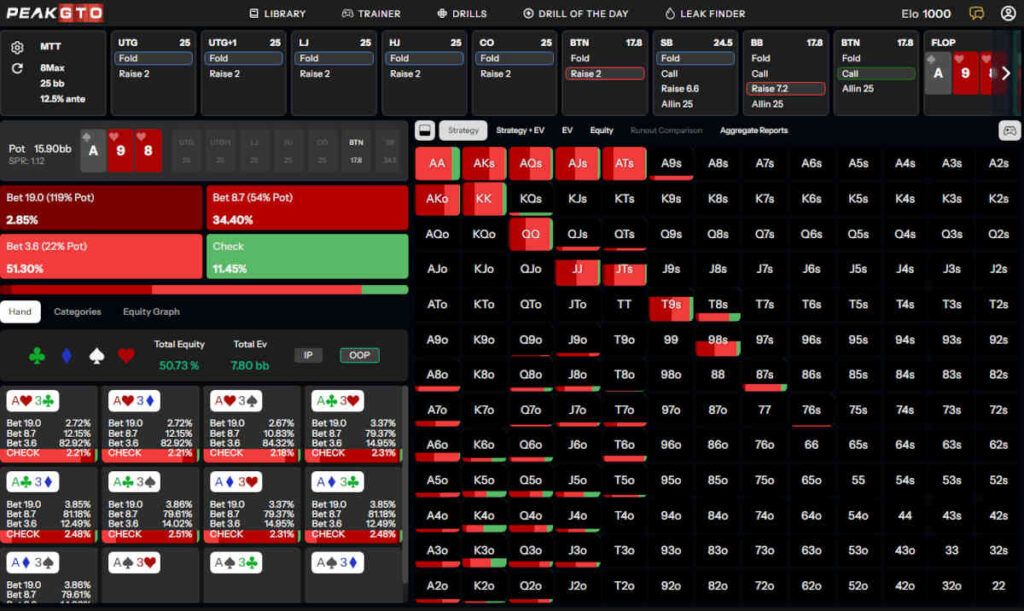
At 25 big blinds effective, we are checking around 11% of the time, but we are also utilizing the larger sizing three times as often:
Playing 60 big blinds deep, our strategy starts getting closer to that used at 100 big blinds. We are now checking almost 17%. As four our continuation betting choices, we are using small and big sizes, pretty much at two-to-one ratio:
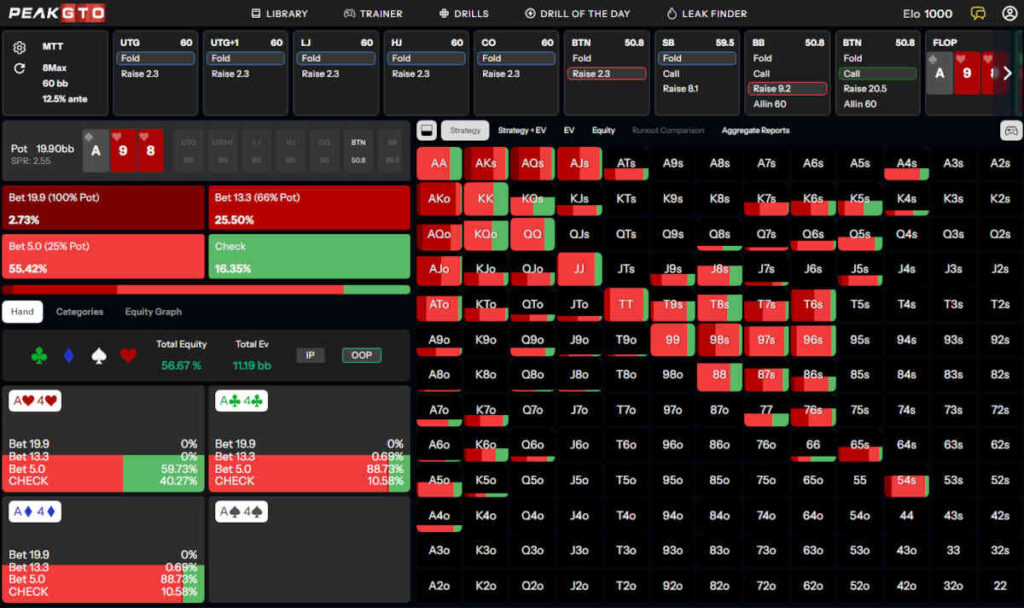
To sum it up, on ace-high wet flops, we are c-betting at a very high frequency when playing 3-bet pots out of position. At 40 big blinds, our go-to sizing is 25% of the pot, while at other stack depths (25 and 60), we’ll be mixing our betting strategy to include some larger sizes as well.
Tip #2: C-Bet King-High Wet Boards 100% of the Time
The strategy for high-card wet flops varies depending on the high card present on the flop. King-high boards are the simplest as we are always c-betting in spots like K♠8♥7♥:
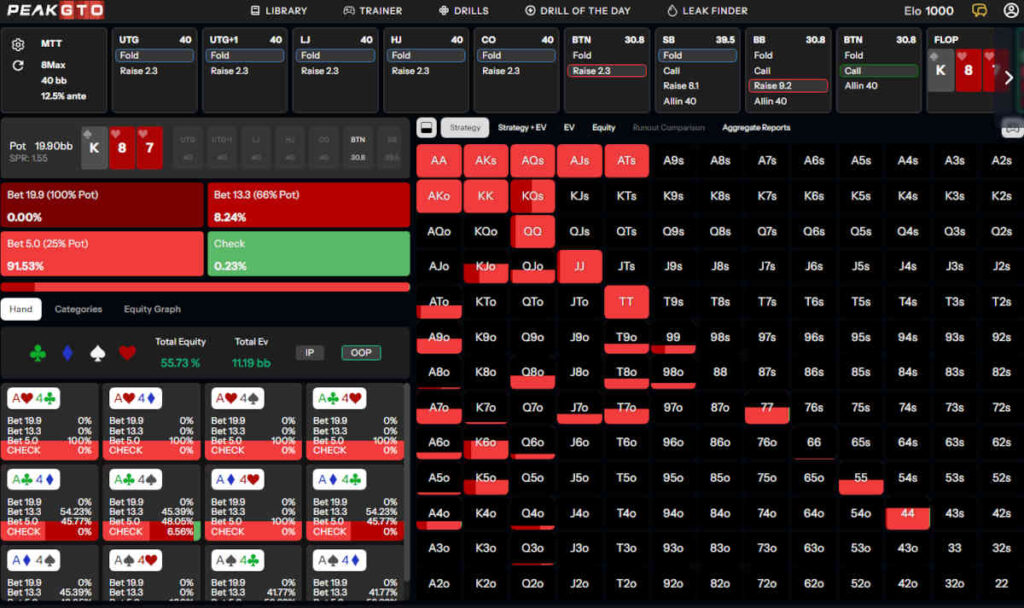
Once more, the default sizing in these spots is 25% of the pot, with only about 8% of larger c-bets added to the mix. The large sizing is reserved almost exclusively for a select few hands, namely KJ, KQ, K6, K5, and 99. On average, you should be betting 66% pot with these hands about one third of the time.
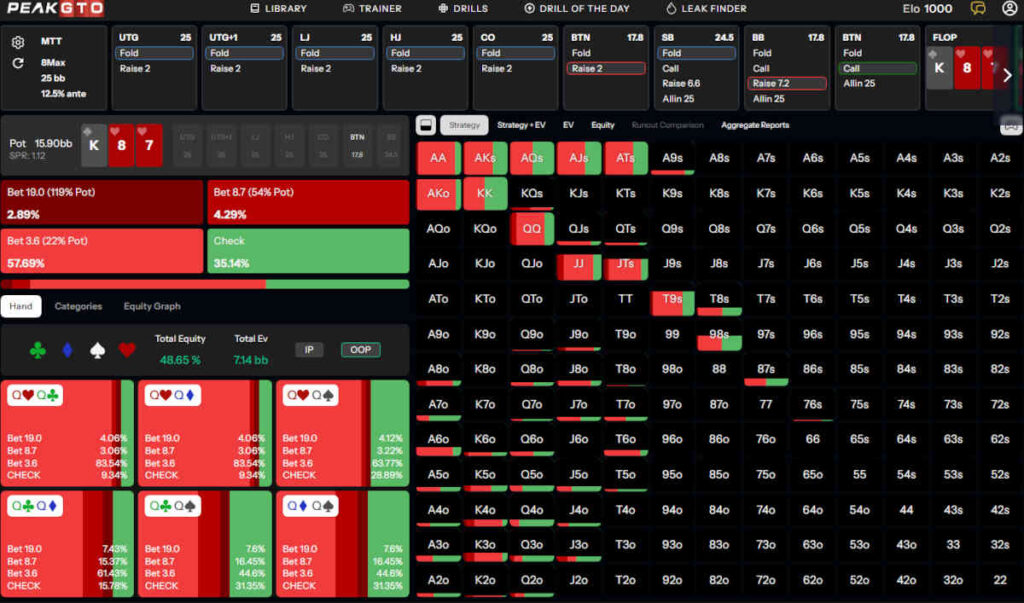
What’s really interesting here is that our strategy for 25 and 60 big blinds effective differs quite a bit from that for 40 big blinds, which is usually not the case.
At 25 big blinds, we are c-betting only about 65%, using almost exclusively small (22% pot) sizing. As you can see, our checking and betting range is pretty well balanced between strong and weak hands:
When playing 60 big blinds effective, we are c-betting just under 80%, splitting our sizing strategy between small and large at about two-to-one:
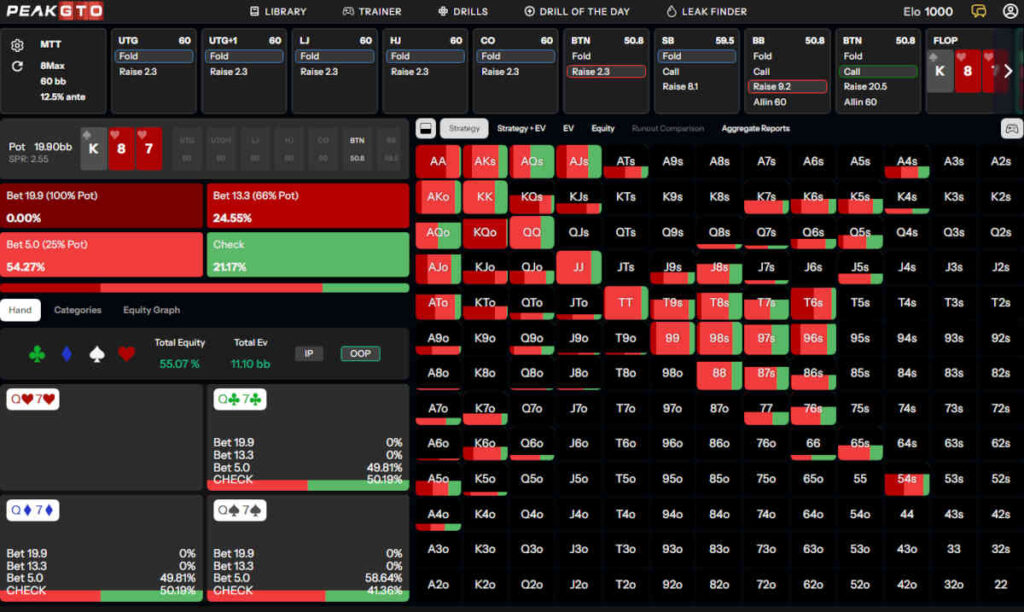
As for deciding when to use the larger sizing, you can see that it is primarily reserved for rather strong but vulnerable hands, such as pocket aces, KQ, KJ, and KT. We balance it out by also betting big with hands like T6s, 96s, and some strong aces.
Queen & Jack-High Wet Flops
Unlike the strategy for king-high flops, our approach to queen and jack-high boards includes much more checking. For example, on the board of J♥8♠7♠, we are continuation betting just under 75%:
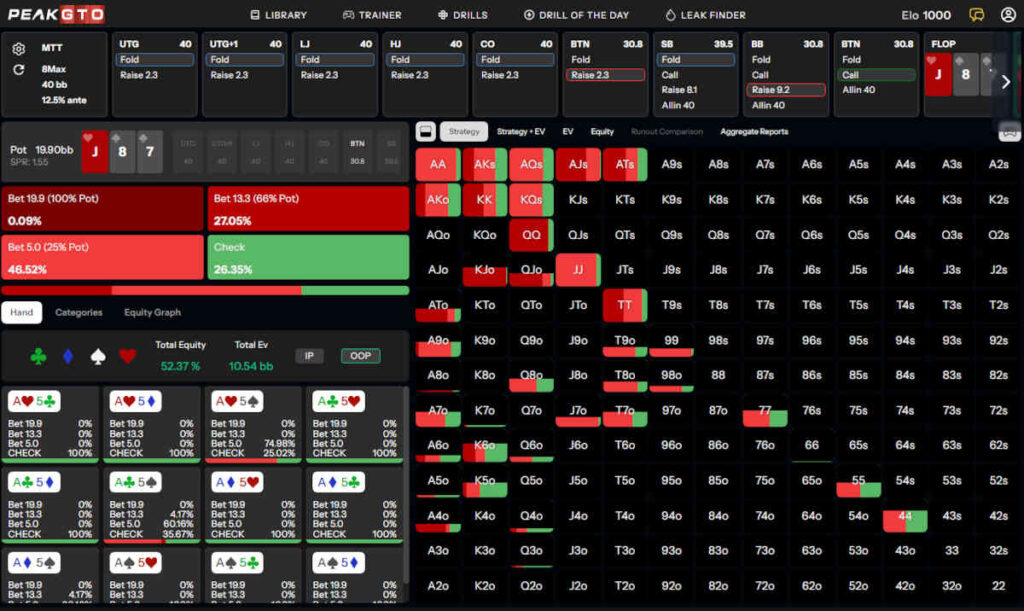
Our c-bet sizing is once more split between small and large, with certain hands gravitating heavily toward using the larger (66% pot) size, such as KJ, QJ, QQ, KK, and TT.
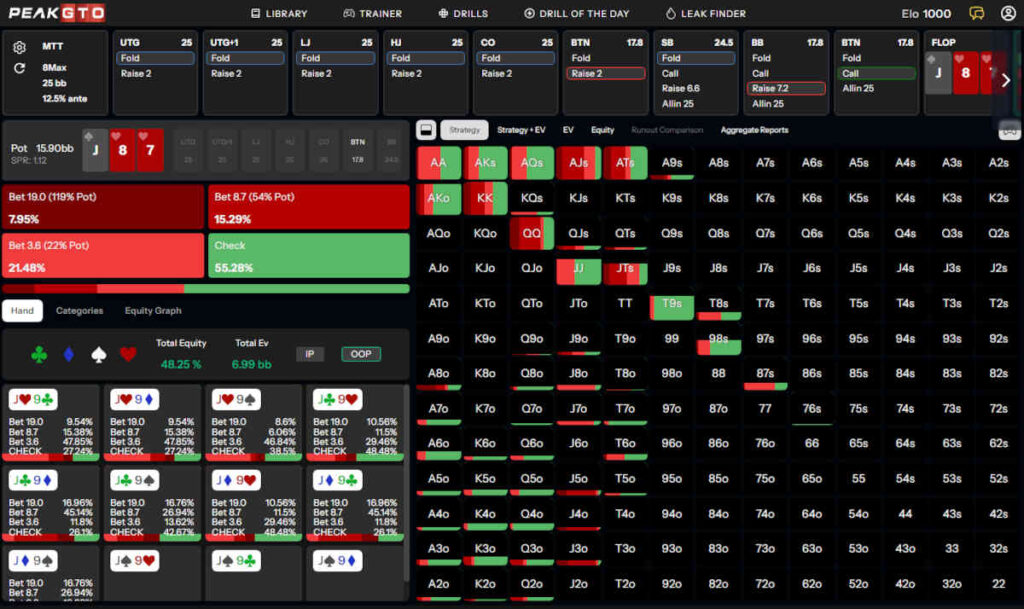
At 25 big blinds effective, we are playing these spots even more cautiously, checking over 55% of the time. Our c-betting range consists primarily of value hands, balanced with a variety of bluff (non-value) hands that we continue with at a very small frequency:
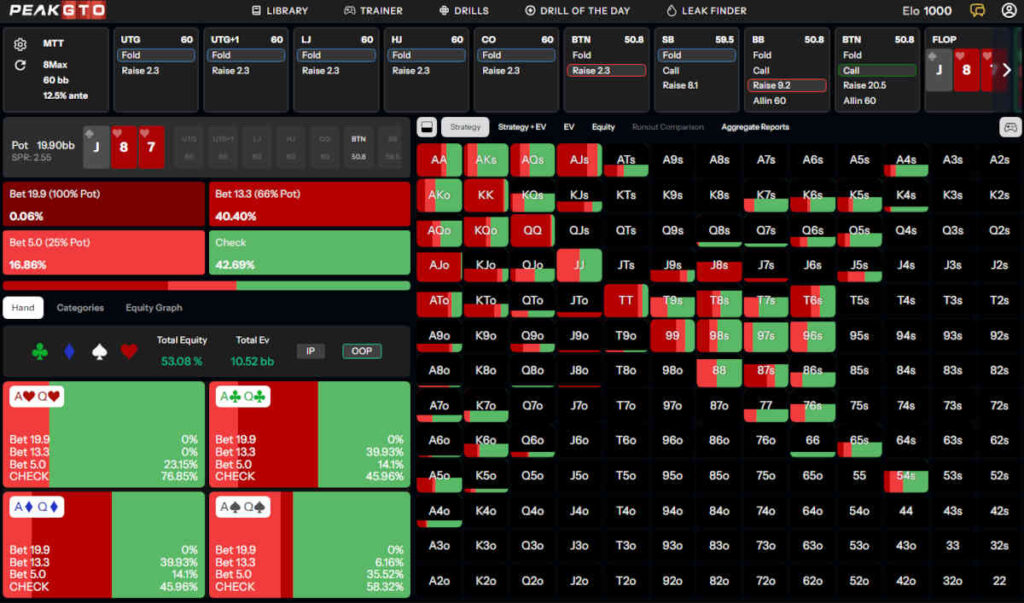
At 60 big blinds effective, we are continuing around 60% of the time, and in this scenario, we are using primarily the larger, 66% pot sizing.
Tip #3: Continue Over 80% on Low Connected Flops
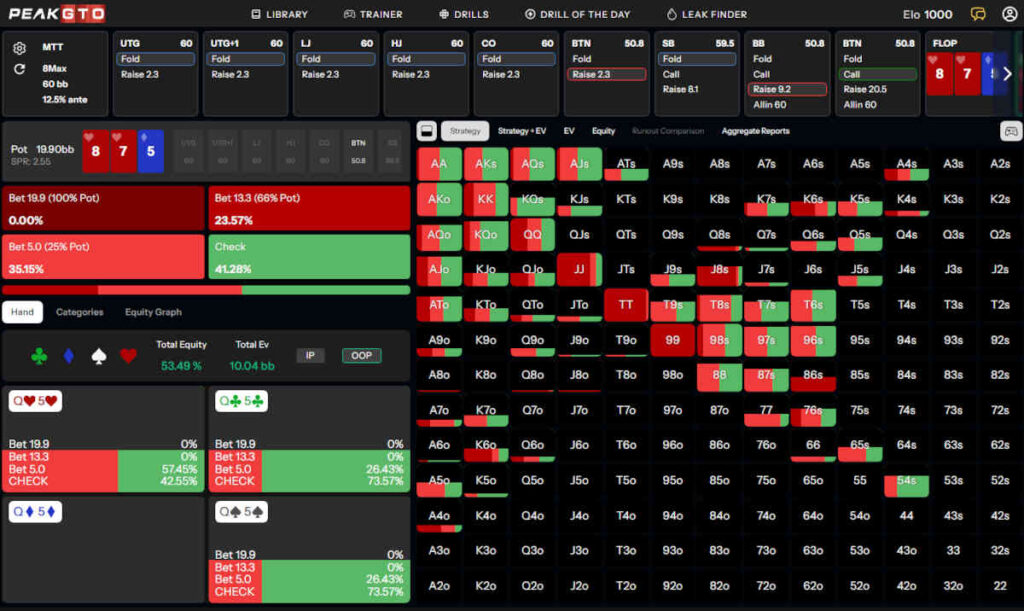
When it comes to low and wet boards like 8♥7♥5♦, we should be c-betting at around 85% in these spots, using primarily smaller sizing, but also mixing in some larger bets:
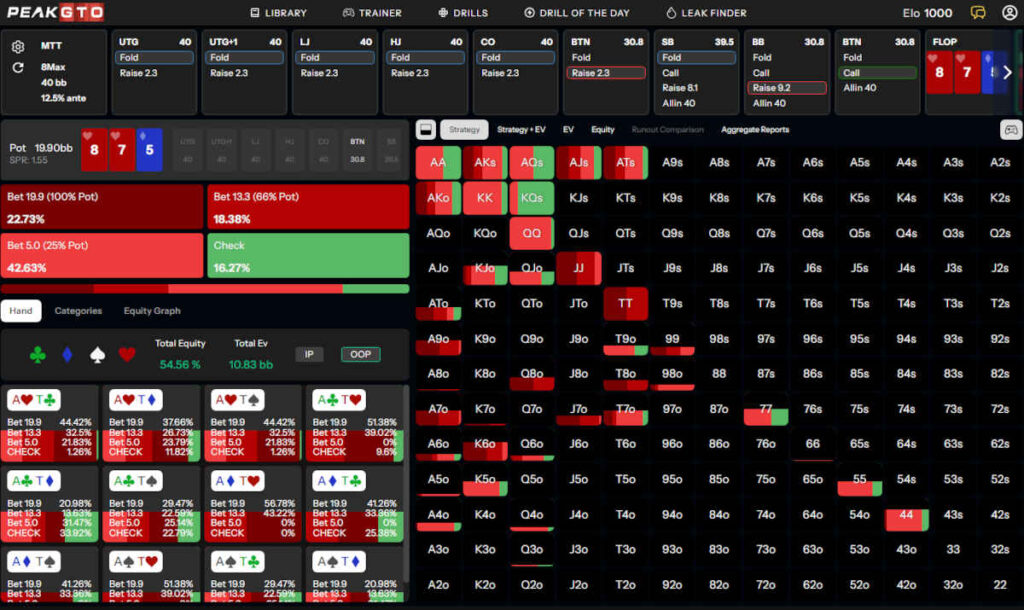
Hands that we are checking are some of our strongest holdings, such as 77 and 55, as well as a mix of hands containing overcards and backdoor draws that benefit from seeing a cheap turn. Therefore, our main plan of action in these spots is to check-call if the opponent decides to take the initiative.
With shorter stacks, we are doing more checking. At 25 big blinds effective, we are c-betting only about 40% of the time, and about half the time we are using an overbet, i.e. 120% of the pot sizing:
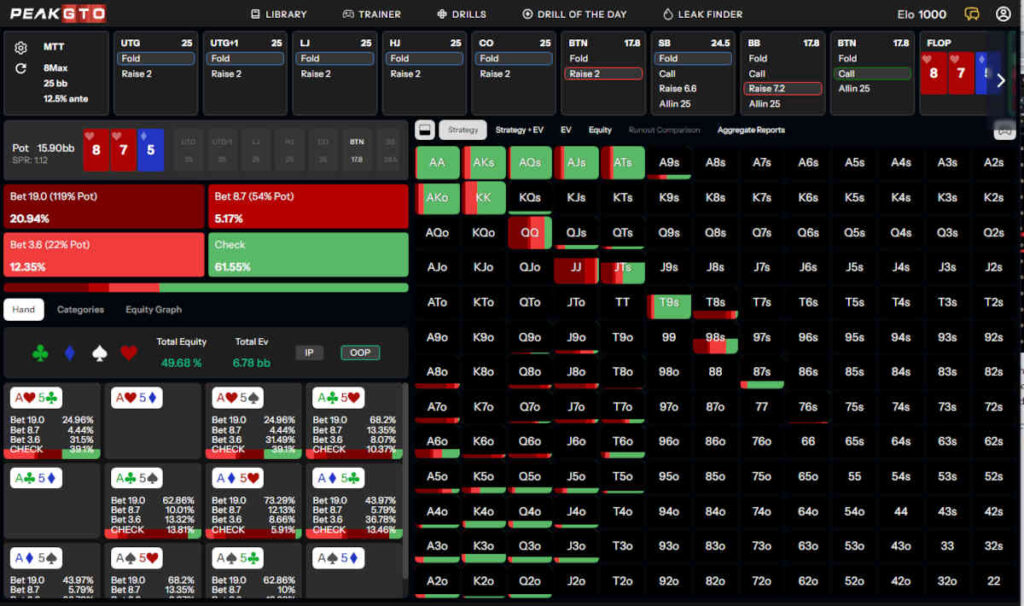
When stacks are shallow, we have a certain range of hands that we are willing to commit with, and these hands benefit from the super-large sizing as there is very little the opponent can do to counter it.
Finally, playing 60 big blinds effective, we are c-betting about 60% of the time, using a more standard approach of splitting our sizing between small and larger (25% and 66%):