

Master poker strategy with PeakGTO. Try this poker solver for free
Defending your big blind correctly is a big part of a successful tournament strategy. In the GTO world, facing a standard button open and playing 40 big blinds effective, you will be defending over 70%, with around 61% of your hands played as a call preflop.
This means you’ll have to deal with many different types of flops, playing out of position. The flop texture will largely define how you should play after checking and facing a c-bet from the button opponent.
In this article, we’ll cover the GTO strategy for the big blind defense against the button continuation bet on dry boards, focusing on scenarios with 40 big blinds effective.
Additionally, we’ll address situations when playing slightly deeper (60 big blinds) and when navigating a relatively short stack (25 big blinds).
Before we dig into specific examples of representative boards, here are a few main takeaways to guide you through the article:
- We are continuing about 40% on dry ace-high flops
- Check-raise on ace-high dry boards only when facing a small c-bet
- We are defending 60% on dry high-card flops with frequent raises
- Defend against a c-bet about 50% on low-card disjointed flops, check-raising about a quarter of the time
Tip #1: Call Around 40% & Only Raise Facing a Small Bet on Ace-High Dry Flops
On ace-high dry flops, such as the A♠9♥5♣, the button player is supposed to continuation bet 100% of the time. These types of textures favor the raiser and don’t coordinate well with the hands in our calling range.
What’s interesting is that the button should be using three different bet sizes:
- Small (24% of the pot) – around 62% of the time
- Big – (67% of the pot) – around 21%
- Over-bet (100% of the pot) for the rest
We will not go into how the button’s c-betting range breaks down across these different options, as that’s a topic for a different article, but the size they choose will largely affect our big blind defense strategy.
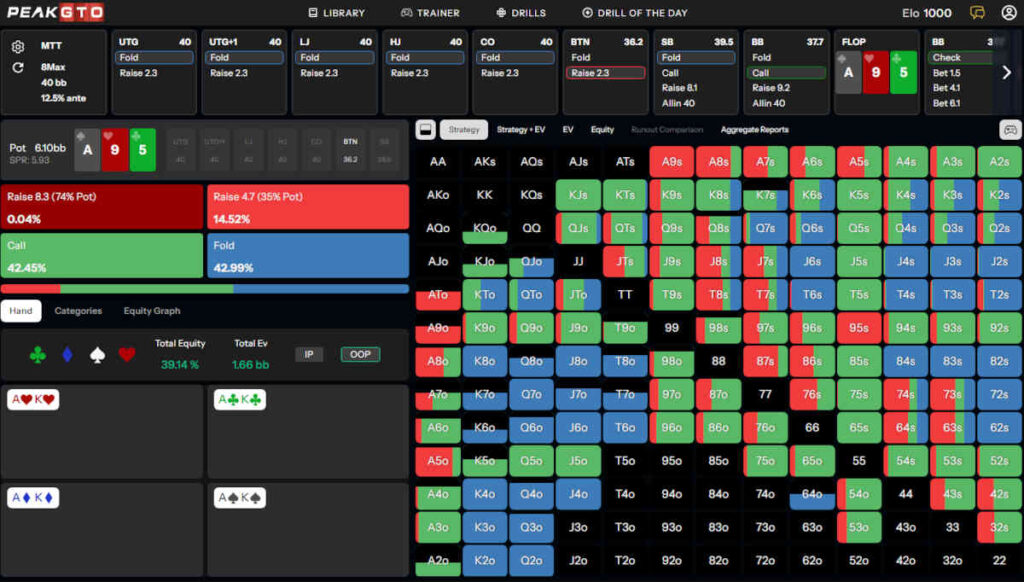
- Against an over-bet, we are calling around 35% and have no raises (except 9-5 and AT specifically). Our calling range consists of all pairs (folding the weakest bottom pairs some of the time) and gutshot straight draws.
- Facing a big (67%) bet, our calling range increases to 40% and we are raising about 3%. Slight adjustments to our strategy vs. the one we use against an overbet are primarily that we are now always calling with all bottom pairs and also raising at a small frequency (15% or so) with our gutshots.
- Against a small bet – we are continuing at 57%, which includes over 14% raising. Our strongest top-pair combos, such as AT – A7 become good raise candidates facing a small bet, while we can now also raise more liberally with gutshots and even have a selection of bluffs with no showdown and only some backdoor potential (like T7s, 74s, and 63s)
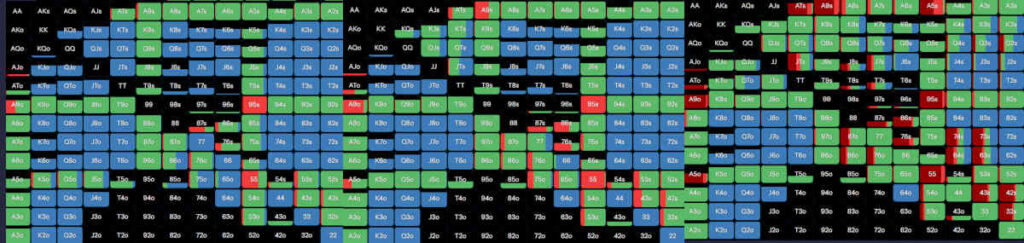
Not surprisingly, the strategy at 60 big blinds effective isn’t much different. Perhaps the most notable difference is when facing a small bet. In those situations, we are calling around 50% and only raising about 3%, as with deeper stacks, we aren’t as willing to commit to the pot with some of our marginal strong holdings like A8 and A7.
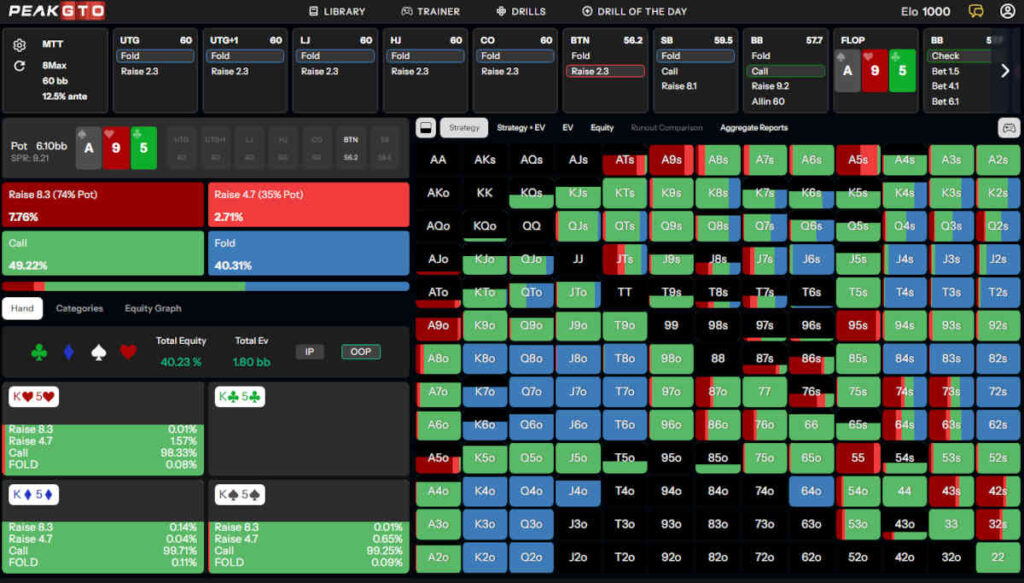
At 25 big blinds effective, our big blind strategy against a c-bet is quite a bit different and rather simple. The button is only supposed to utilize the 60% pot sizing, and facing that bet, we are calling with 15% of our range and folding the rest.
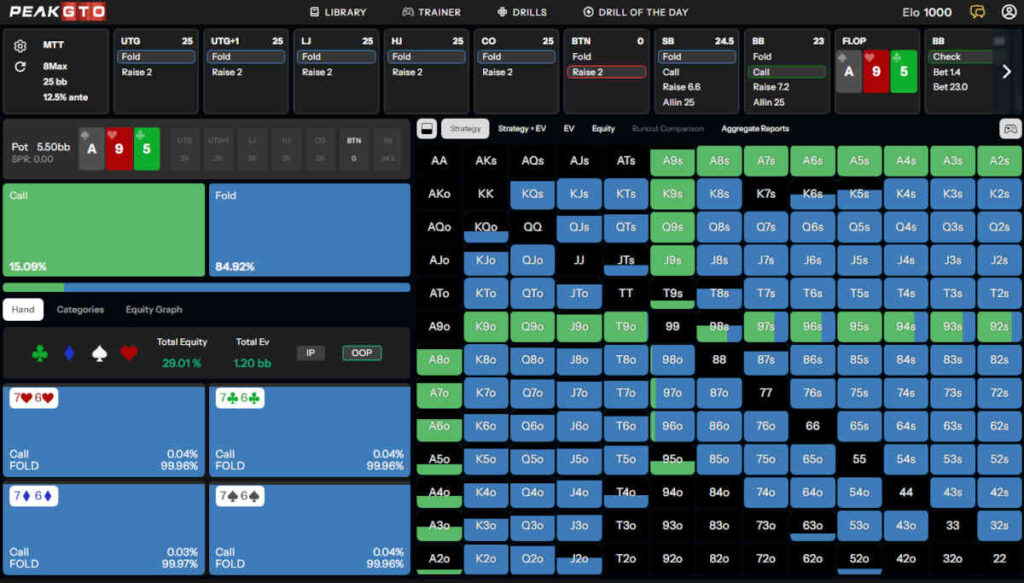
The reason there are no 3-bet jams available is that we lack strong hands on this texture that we wouldn’t 3-bet before the flop.
Tip #2: Defend at 60% on Dry High-Card Flops With Frequent Raises
Unlike ace-high dry flops, which, as you can see, are quite complicated to play, dry flops featuring a high card are fairly straightforward. On a board like K♠8♥4♦, the button will utilize the small sizing of 24% of the pot pretty much exclusively, and against that sizing, we are continuing with 60% of our range:
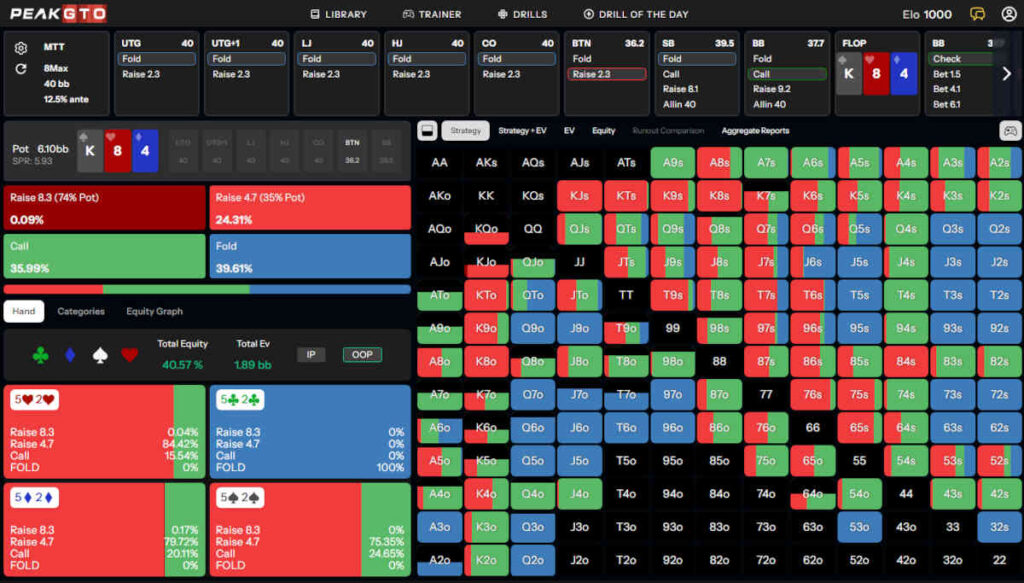
As you can see, we have quite a big raising range in these spots, as the hands we defend with from the big blind will coordinate much better with high-card boards.
The hands we’ll be check-raising with include:
- Two pair combos (K8, K4)
- Almost all top pair hands, at least at some frequency
- Middle pairs + backdoors
- Gutshots
The hands that we’ll be calling with exclusively are largely bottom pairs and the weakest of our middle pairs, combining that with some of the weakest top pair holdings for balance.
At the stack depth of 60 big blinds, we see the usual adjustment, where our defense range moves up slightly (to 65% overall), but we are check-raising less frequently. At this stack depth, hands like middling top pairs (K7, K6) move primarily to the call bucket, and we are also adding some calls with our relatively strong top pairs like KT and KJ.
When playing 25 big blinds effective, the button will use 25% pot sizing exclusively when c-betting (about 90% of the time). Against that bet, our strategy is pretty much identical to the one we use at 40 big blinds, continuing at 60% with almost 25% check-raise because of the odds.
Tip 3: Defend Just Under Half the Time on Low Disconnected Flops
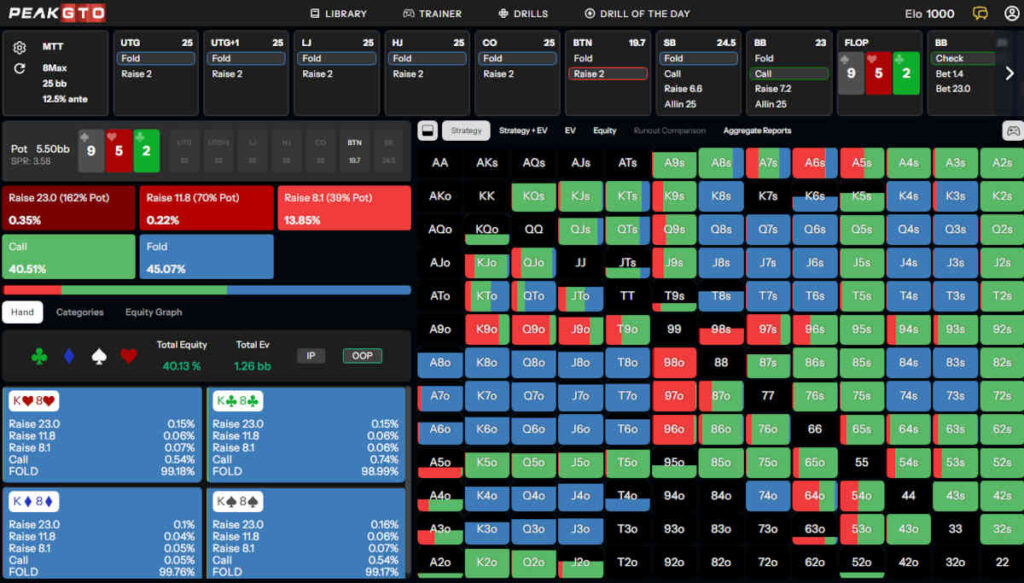
On low-card dry flops like 9♠5♥2♣, you’ll mostly face a large, pot-sized continuation bet. Despite the big sizing, we are still continuing with around 45% of the range, playing it primarily as a call, with about 20% raises:
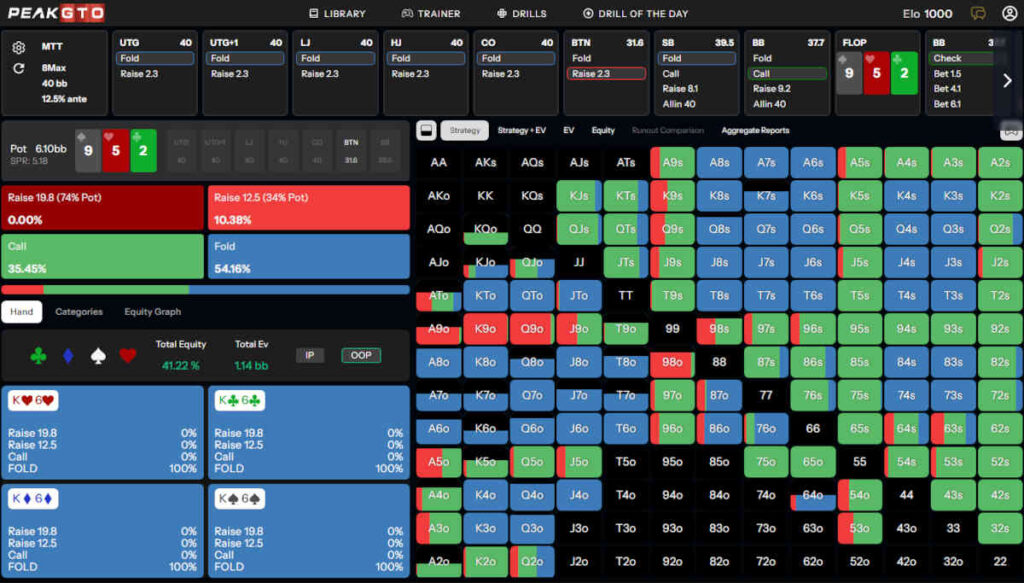
As you can see, we are continuing with all the hands that hit the board, including all pairs. The best of those hands, we are playing as raises.
We are also calling and occasionally raising with some of our gutshot draws, but these dry boards don’t lend themselves to many strong draws, which is why these raises make up only a small part of our continuing range.
When playing 60 big blinds deep, our raising percentage decreases slightly, while our calling percentage increases slightly. Our overall continuing range remains pretty much the same, though, without any major differences meriting a detailed discussion.
At 25 big blinds effective, the button player will mostly utilize the 60% sizing (due to shallower stacks). Facing that bet, we should continue just over half of the time (53%), check-raising about a quarter of the time.
The overall strategy is quite similar to that we utilize at 40 big blinds, but slightly wider as certain marginal hands become more playable as the SPR decreases: