

Master poker strategy with PeakGTO. Try this poker solver for free
We’ve already covered the strategy for c-betting on dry boards out of position when playing 100 big blinds deep. In this article, we’ll look to see how things change in tournaments, primarily when playing 40 big blinds effective.
The principle that we are c-betting much less frequently out of position still applies, but there are some important adjustments as stacks get shallower.
So, in this article, we’ll examine GTO c-betting strategies on dry boards when playing out of position at 40 big blinds effective, using the cutoff vs. button scenarios.
Like in previous lessons, we’ll also address situations with shorter (25bb) and deeper (60bb) stacks.
Before we move on to specific examples, here are a few main takeaways from this lesson:
- C-bet around 30% on ace-high dry flops
- After checking, we are calling or raising over 60% on ace-high boards
- At 60 big blinds effective, we are c-betting over 50% on ace-high dry boards
- C-bet around 30% on high-card dry flops using mixed sizing
- We are continuing at close to 70% after checking on a high-card dry flop
- C-bet at close to 40% on low-card dry flops using large sizes
Tip #1: C-Bet Around a Third of the Time on Ace High Dry Board
On dry flops containing an ace, we should be continuation betting around 30%, using the small sizing of one-quarter pot.
We can see this from an example of the A♠9♥4♣ flop:
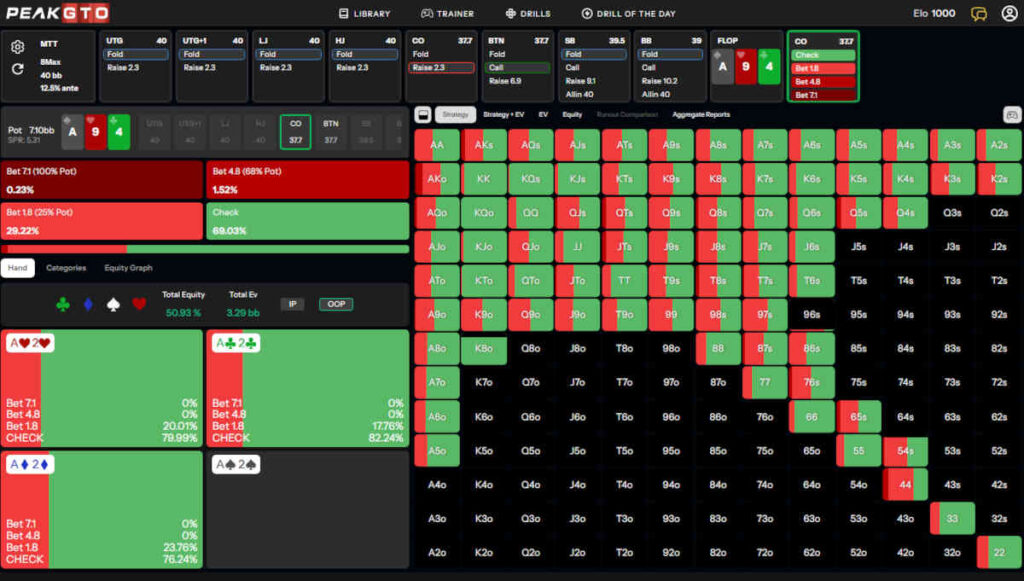
We are c-betting a decent portion of our range in these spots, but at different frequencies. The only hands that we are almost always checking are good king-highs and pocket kings specifically.
Since we are checking close to 70% in these scenarios, it’s important to note that the idea behind this strategy is to allow us to have plenty of hands that we can call a bet with. In fact, after checking, we’re calling and/or raising with over 73% of the hands when the button bets:
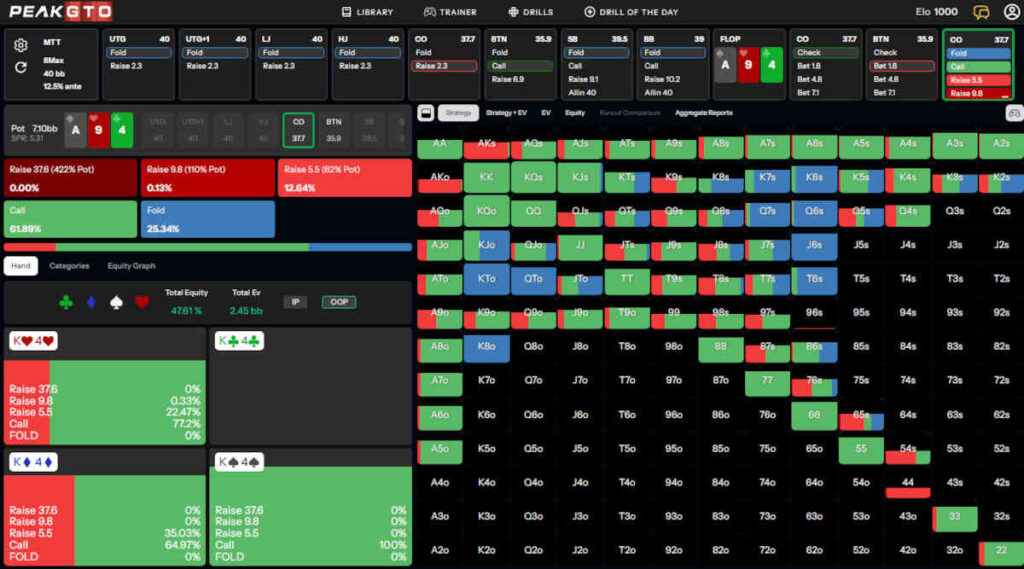
As you can see, after checking, we are calling with all of our pairs as well as all of those strong king-high hands. As for the hands we’re check—raising, these include the strongest top pairs, two pair combos, and middle and bottom sets.
For balance, we are also including hands like 76s, T7s, and J8s with backdoor flush draws.
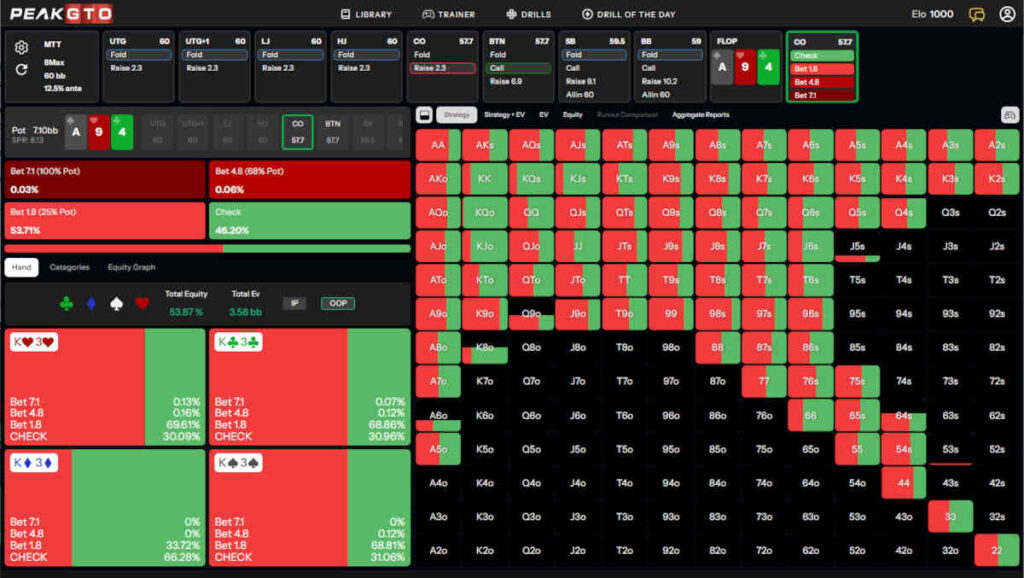
At 60 big blinds deep, our c-bet percentage increases quite significantly, to close to 54%. With deeper stacks, we have a bit more room to maneuver, which allows us to increase our c-bet frequency with some hands that prefer checking in 40 big blind scenarios:
At 25 big blinds, our c-betting strategy on these flop textures is very similar to the one used in 40 big blind situations. The only difference is that we are using the large (60% pot) sizing a bit more frequently, primarily with our strongest top pair combos (AK, AQ), balanced with a few bluffs like T7s and 76s.
Tip 2: C-Bet Around 30% on High-Card Dry Flops Using Mixed Sizing
The GTO c-betting strategy on dry flops featuring high cards isn’t much different to the one used on ace-high boards, at least when it comes to percentages.
We are also continuation betting at a frequency of around 30% in these situations, but we are balancing our sizing between small (25%) and big (68% of the pot), as we can see on the example of the K♥6♠2♦ flop:
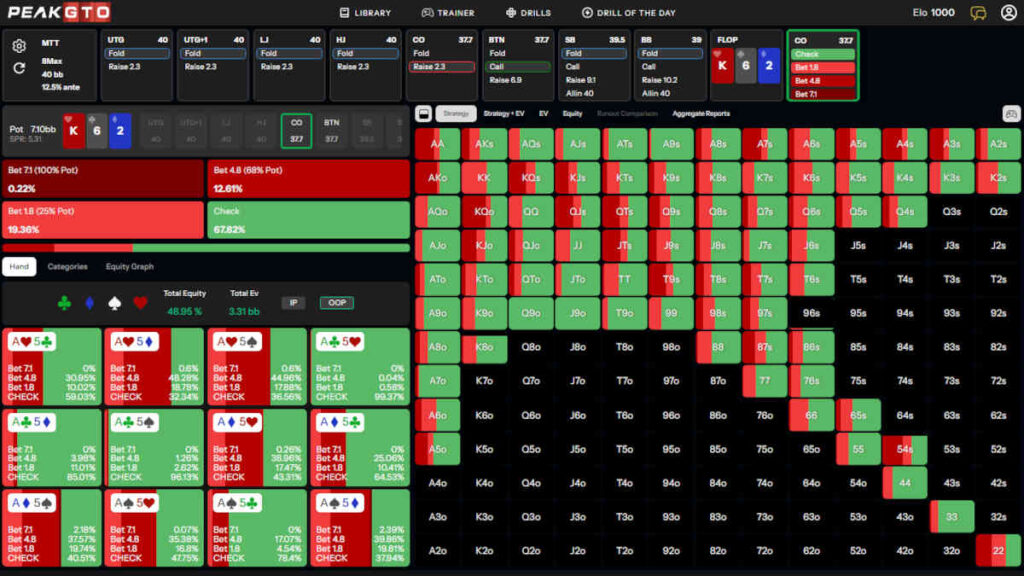
Hands like best top pairs and the bottom set prefer the larger bet size, which is balanced by also using the big sizing with a selection of bluffs like JTs, QJs, QTs, and T9s.
Once more, we are checking at over 70%, with certain hands, like J9o, Q9o, and JTo checking pretty much always, while the rest of our range balances between checking and betting.
After checking on these boards, we can expect the in position player to take over the initiative and start betting almost 60% of the time, using primarily the small (quarter of the pot) sizing.
Our response to this bet is to fold only 33%, while calling 43% and raising 23%:
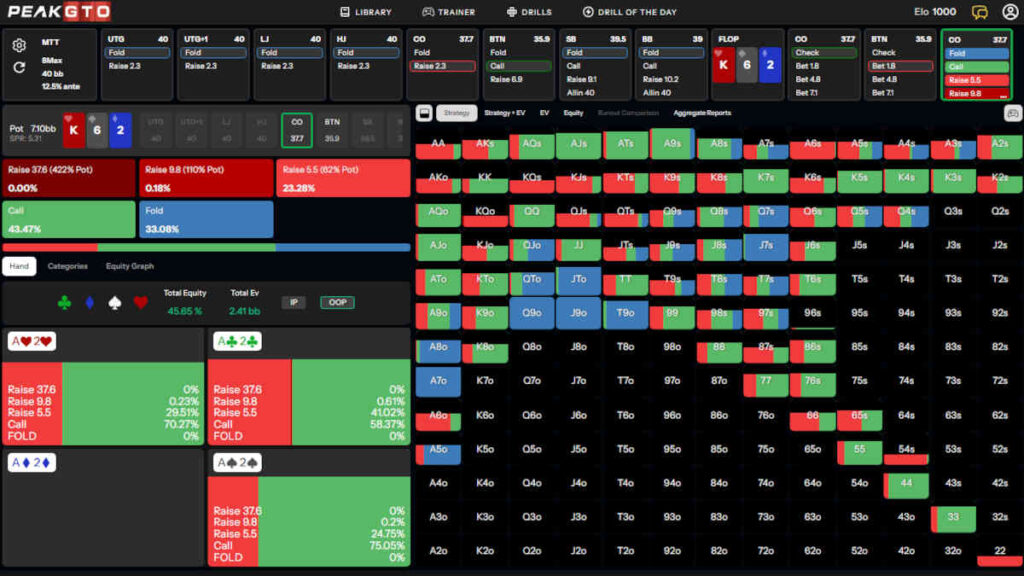
As you can see, the only hands that we won’t be continuing with are the hands that have no equity. The rest of our range is played as either a call or a raise, which is exactly why we are checking so frequently in these spots.
Our checking range is strong enough to continue at a high frequency, which makes it harder for the opponent to win pots by auto c-betting every time we check.
It’s interesting that our strategy at 60 big blinds changes quite a bit. While our c-betting percentage drops to just 23%, we are gravitating much more towards really big, 100% of the pot sizing when we do decide to c-bet:
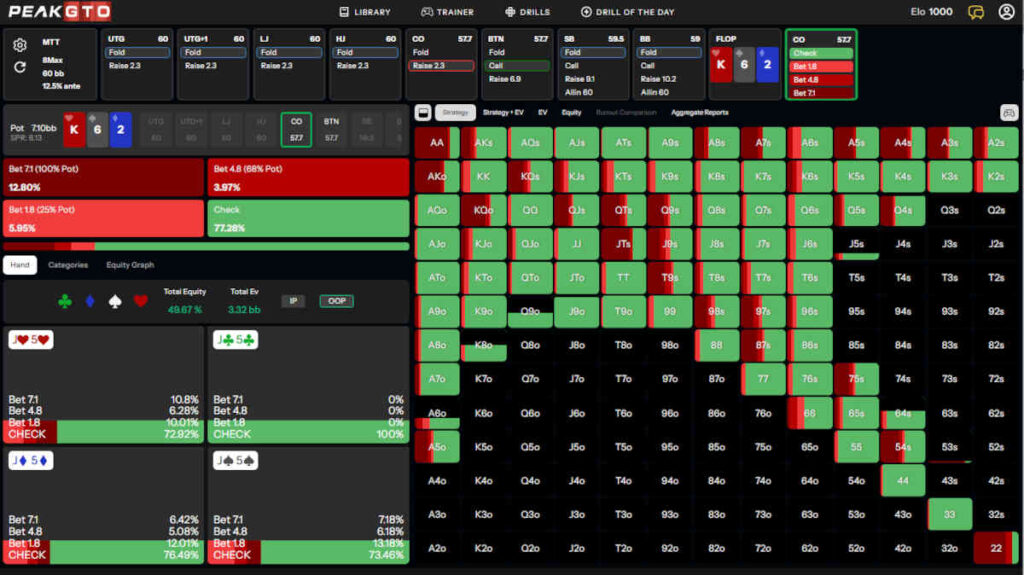
In these scenarios, we are mostly only c-betting our strongest hands and a few bluffs for balance. The rest of our range plays much better as a check.
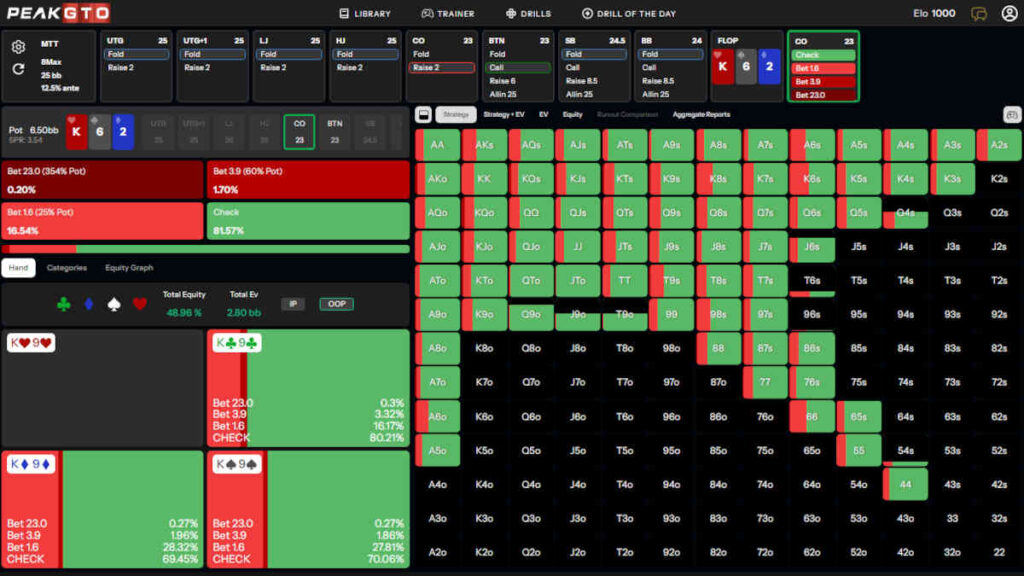
At 25 big blinds effective, we have yet another situation, where we are c-betting just under 20%, and using the 25% pot sizing almost exclusively.
As you can see, even our strongest hands prefer to check in these situations because we are shallow enough to be able to get our chips in the middle on turns and rivers. By checking at a high frequency, we are protecting our range and giving ourselves a better chance to get value with strong poker hands.
Tip 3: C-Bet 40% on Small Disconnected Flops
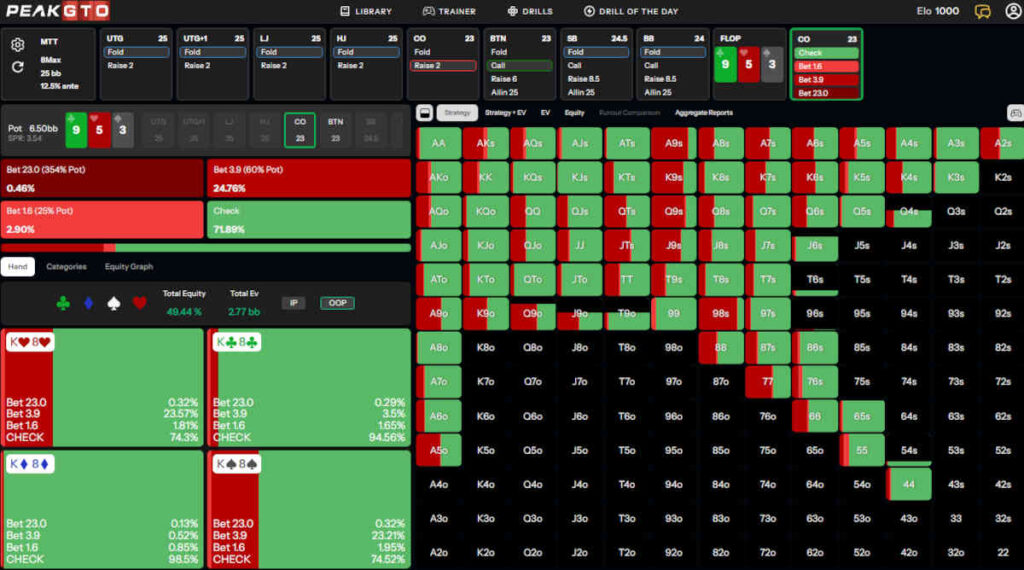
Finally, we arrive to small, disjointed flops. While our default strategy on these boards at deeper stacks involves a lot of checking, at 40 big blinds, we can c-bet at almost 40% since our opponent will not have that many strong starting hands in their range to connect with these textures.
For example, let’s look at the board of 9♣5♥3♠:
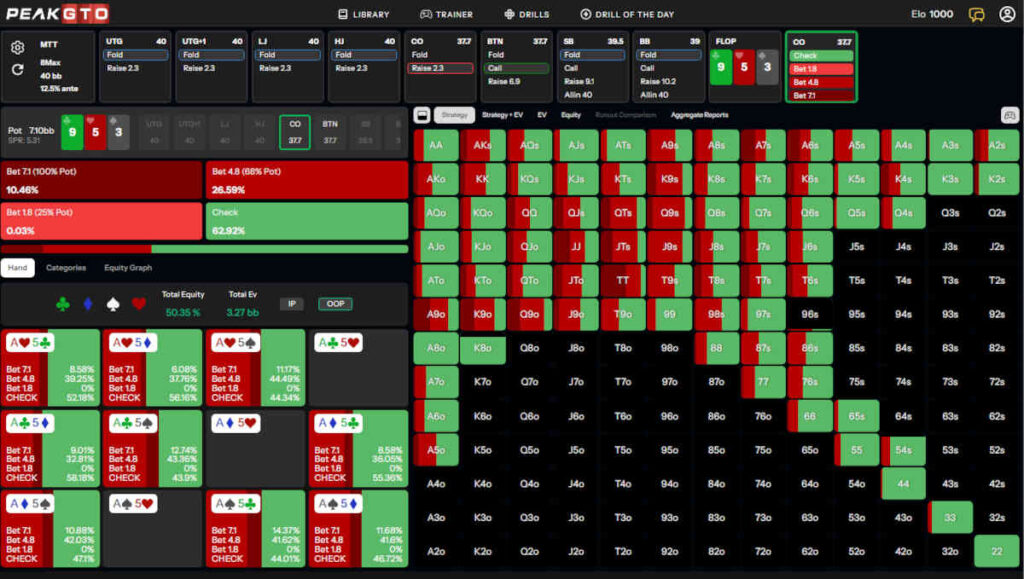
As you can see, we should be using bigger sizings in these spots, betting either 60% or 100% of the pot when we do bet.
Our checking range here consists mostly of hands that we can easily check-call with, such as big aces, strong broadways, smaller pocket pairs, and combos containing an over-card and a backdoor draw, such as K8 and Q8.
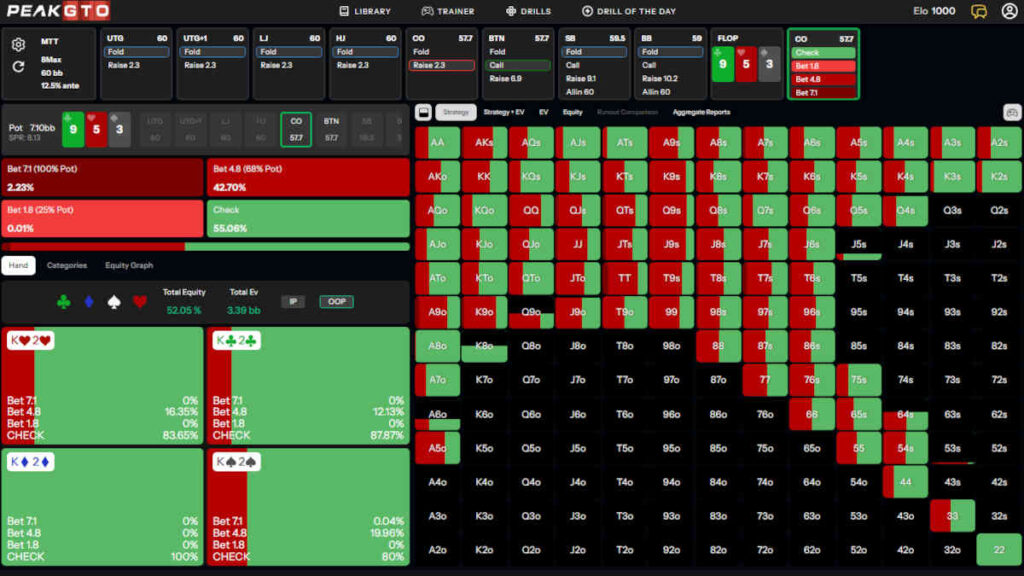
At 60 big blinds, we are c-betting at a higher frequency of 45%, but using the uniform bet sizing of 60% of the pot across the board:
Finally, at 25 big blinds effective, we are c-betting at just under 30%, using predominantly the 60% sizing. All top pair combos bet at a high frequency, as do over-pairs and some of our strongest ace-high holdings: