

The poker strategy has grown and developed tremendously over the years. Many things we thought we knew about the game have become obsolete due to new findings and advancements in the GTO strategy. However, one fundamental aspect remains consistent: mastering your cash game opening ranges is still the absolute foundation of a winning player.
Cash game opening ranges.
If your preflop foundation is weak, nothing else will save you. No postflop creativity, no fancy bluffs, no hero calls. Solid preflop ranges are the blueprint for consistent profit.
In this guide, we’ll break down optimal 100BB preflop opening ranges for every position at the table. You’ll learn why ranges tighten early, expand late, and how positional advantage shapes everything in a cash game.
Why Cash Game Opening Ranges Matter
In 100BB cash games, stack depth allows for multiple betting streets and strategic flexibility. Because stacks are deep, mistakes made preflop compound over time.
Strong opening ranges help you:
- Avoid dominated hands
- Reduce difficult postflop spots
- Maintain range advantage
- Prevent being exploited by aggressive players
- Build a balanced strategy
The earlier your position, the tighter your range must be. The later your position, the wider you can open – especially from the button and small blind.
Let’s break it down position by position.
UTG Opening Range (100BB Cash Games)
Opening from UTG (Under the Gun) is the most demanding spot in a full-ring game. You have eight players left to act, which means a high probability of running into strong hands or facing a 3-bet.
A solid UTG opening range in 100BB cash games is approximately 10% of hands.
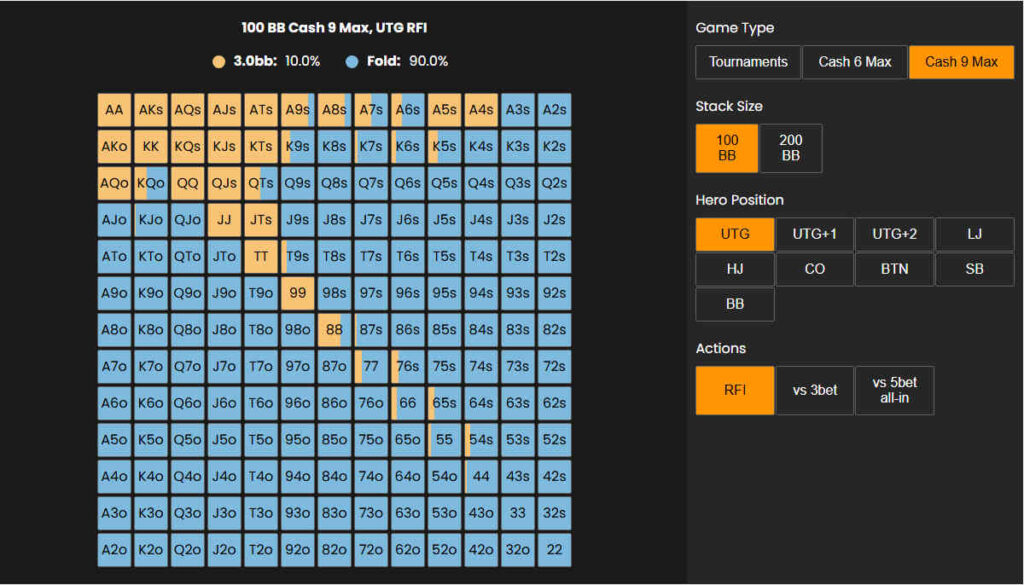
Typical UTG Opening Composition:
- AK, AQ (offsuit)
- All suited aces except A2s–A3s
- Pocket pairs down to 99 (88 mixes)
- Suited broadways (KQs, KJs, QJs, JTs)
- KQo at low frequency
Why So Tight?
From UTG, your range must:
- Withstand 3-bets
- Play well out of position
- Avoid reverse implied odds
- Maintain strong top-pair equity
Many micro-stakes players open too wide here. Hands like small suited connectors or low pocket pairs may look playable, but they often create difficult postflop decisions when stacks are deep.
6-Max Adjustment
In 6-max, UTG is effectively closer to lojack in full ring. The opening percentage can increase to roughly 15–17%, adding more suited connectors and mid pocket pairs.
Facing a 3-Bet
Against aggressive opponents, you must:
- Continue with strong suited aces
- Defend high pocket pairs
- Fold dominated broadways
Understanding how your UTG range interacts with 3-bet ranges is critical for maintaining profitability.
UTG+1 and UTG+2 Adjustments
As players are removed behind you, your range can expand slightly.
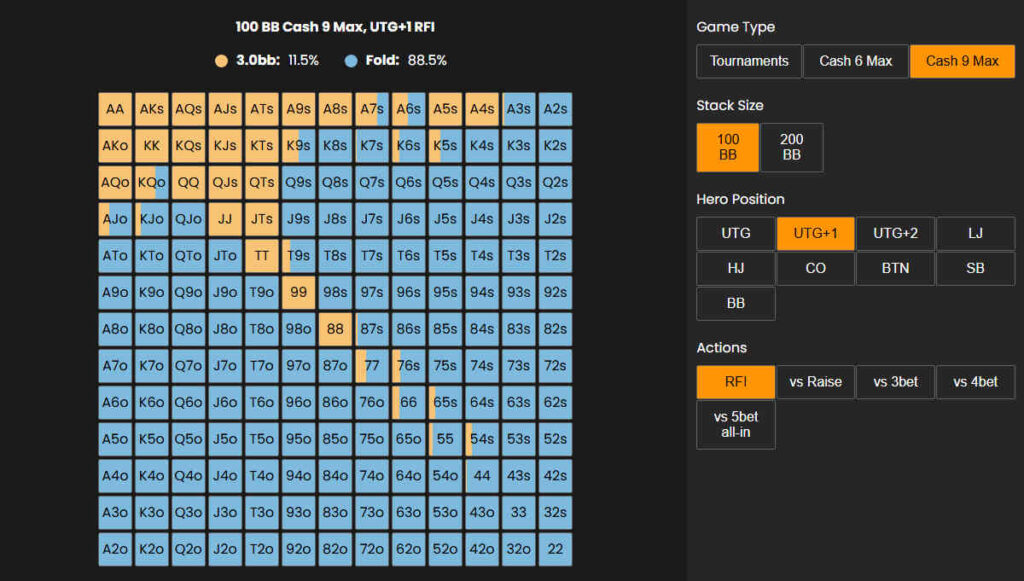
UTG+1 (~11.5%)
You may mix in:
- AJo at low frequency
- KJo occasionally
- More 88 combinations
Still tight. Still disciplined.
UTG+2 (~13%)
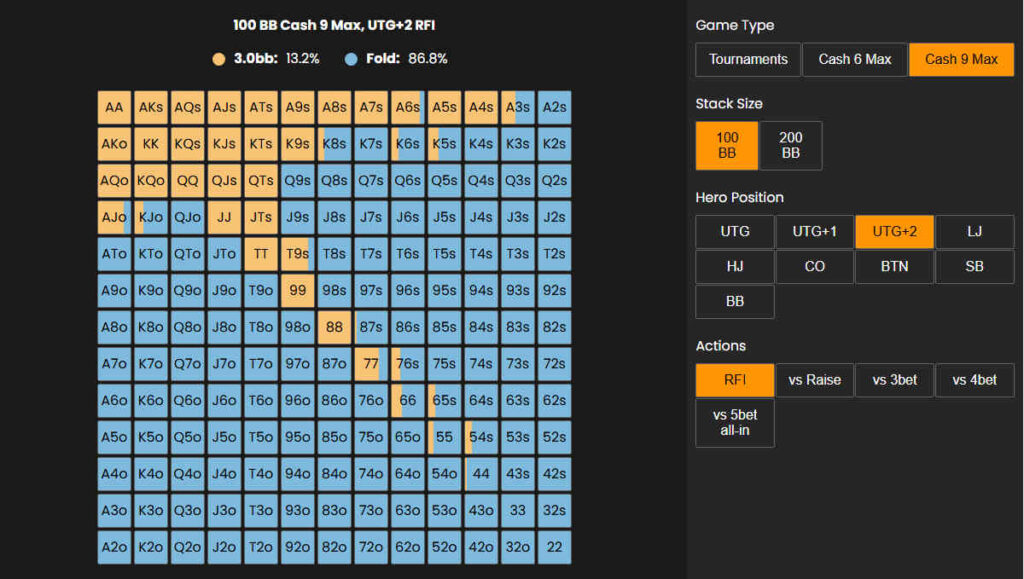
As you can see in the picture, the biggest differences are:
- AJo is now a fairly standard open
- T9s also become a standard open
- Open pocket pairs down to 77
- All suited kings down to K9s raise 100% of the time
However, this remains early position. Avoid over-expansion.
Lojack – Opening 15-16%
Playing from the lojack position, we should be opening close to 16% of our range, so there are more opportunities to go after the blinds.
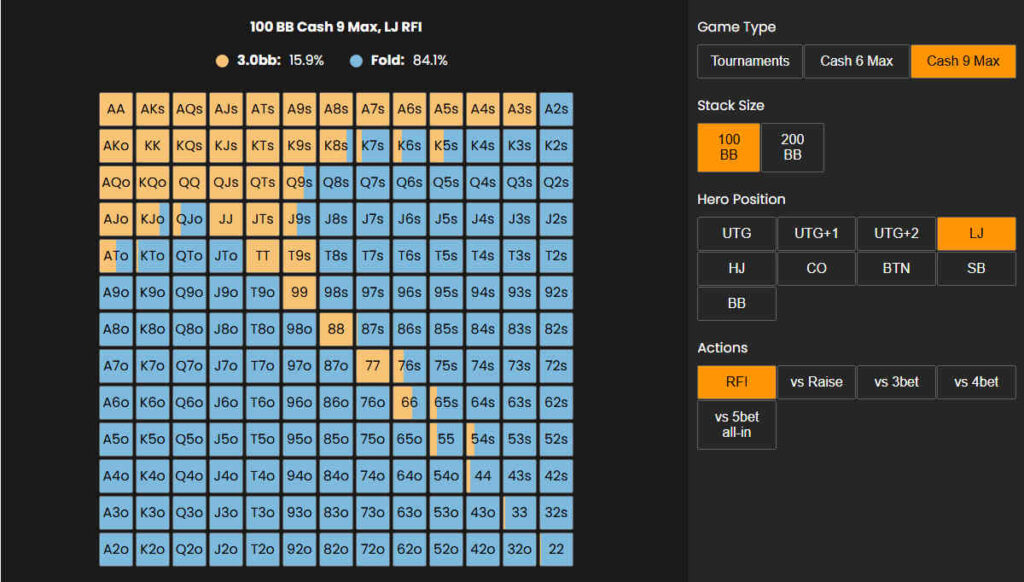
- We are now opening all off-suit aces down to AJ & AT about 50% of the time
- All suited aces open 100% of the time except A2s
- Suited kings down to K8s
- All pocket pairs down to 77 open 100%, while 66 – 44 mix between raising and folding
- KJo opens about 70% of the time
Still avoid weak offsuit broadways. Position improves, but not enough to justify marginal opens.
Hijack Opening Range (~20%)
Hijack is the first position where our opening range should start getting wider. From this particular position, we should be opening with around 20%:
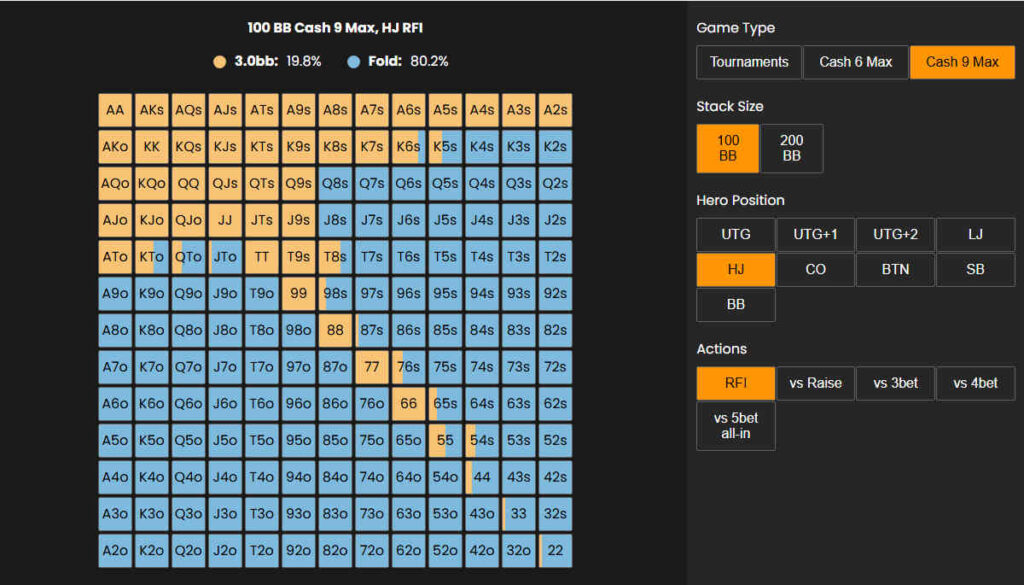
Playing from hijack, we can start including hands like:
- Off-suit broadways down to QT
- All pocket pairs with some frequency (although the lowest pairs are still folds most of the time)
- Mixing in suited connectors like T8s and 98s
- All suited aces
- Off-suit aces down to AT
- Suited Kings down to K5s
With fewer players to go through and less chances of getting 3-bet, the hijack opening range is a bit more flexible. Still, as you can see, many hands that a lot of players would routinely open at a cash game table don’t make the cut at all or open very infrequently.
Cutoff Opening Range (25%+)
The cutoff is one of the most profitable positions in cash games.
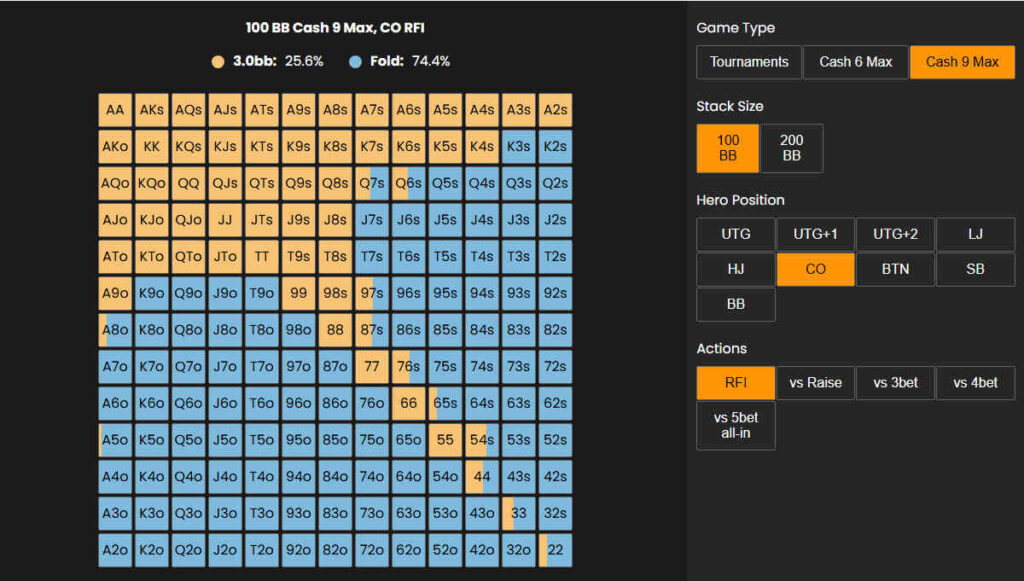
A proper cutoff opening range includes:
- All off-suit aces down to A9 at 100%
- Suited kings down to K4s at 100%
- We always raise with pocket pairs down to 55
- Suited queens down to Q6s become good opens
- Suited connectors like 98s, 97s, and 87s finally become good raising hands
We only have three players to get through, and there is only one player in position to us, which makes it possible to open wider and either win the blinds before the flop or play the flop in position more often than not.
Button Opening Range (40%+)
While opening ranges from one position to another tend to change only slightly, there is a big change moving from cutoff to button. Playing from the button, you should be opening 40% of your entire range:
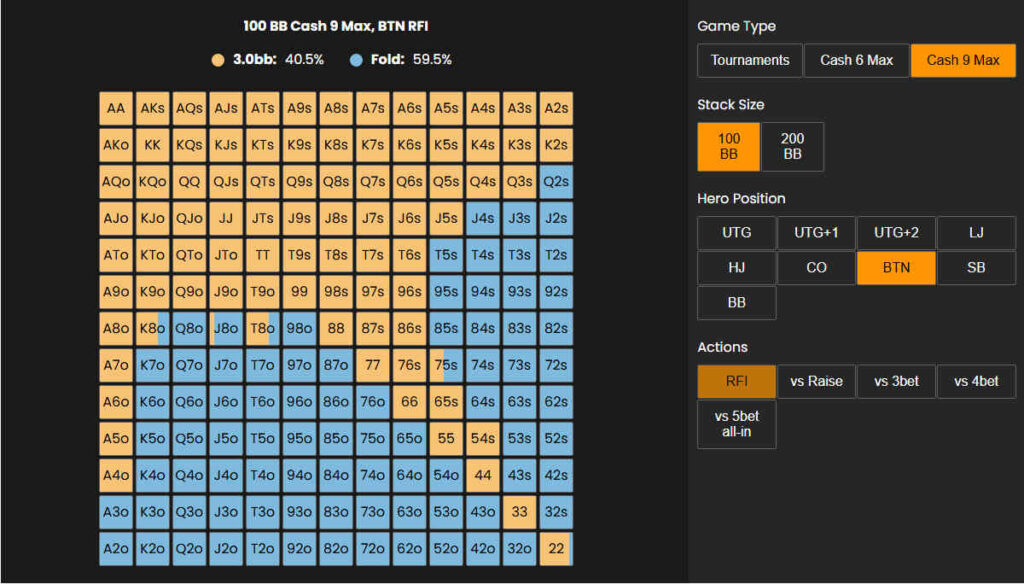
The reason for this is two-fold. First of all, you are raising two players who had to put the money into the pot without looking at their cards. Secondly, no matter what happens, you are always guaranteed to play in position after the flop.
A strong button opening range in 100BB cash games includes:
- All suited aces
- Offsuit aces down to A4
- Suited kings
- Suited queens down to Q3
- Suited jacks down to J5
- Offsuit broadways down to Q9
- Suited connectors down to 54s
- All pocket pairs
Why so wide?
- You always play in position postflop
- Blinds hold random hands
- You can apply pressure with c-bets
This is where disciplined aggression prints money.
Playing from the button, we have the best possible position at the table, and our raising range reflects that fact.
Small Blind – Opening (46%+)
The final position we’ll look at is the small blind. If it so happens that the action folds to you and you have the first option, you should be raising with over 46% of your entire range:
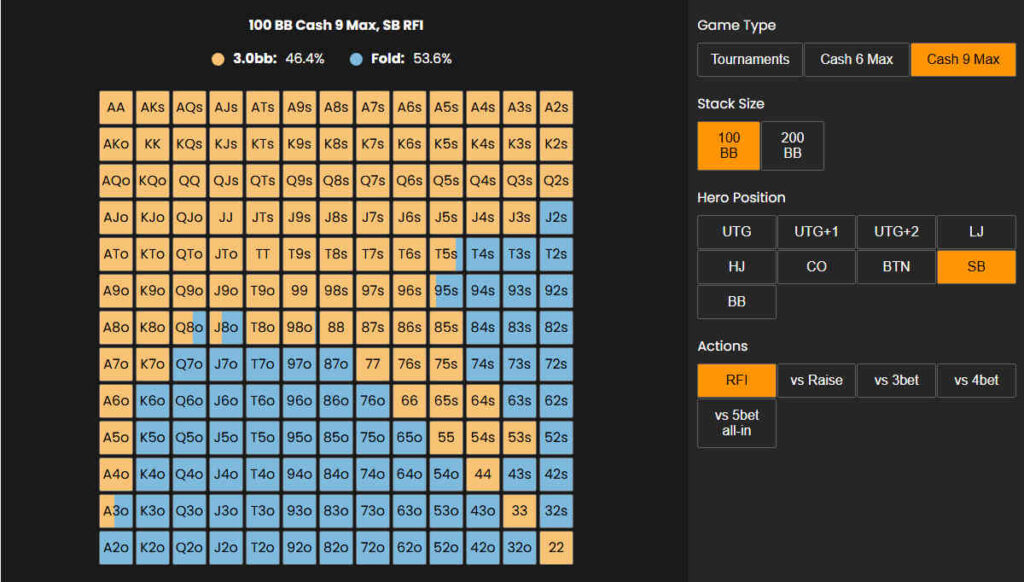
The small blind raising range is even wider than that on the button as you only have one player to go through, and they have two random cards. We can freely raise with:
- All aces except A2o
- All suited broadways except J2s
- Off-suit broadways down to J8o
- Suited tens down to T5s
- Almost all suited connectors and one-gappers
As you can see, the only hands we are not raising are the weakest off-suit connectors (from 87o and below), the lowest suited connectors, and hands with very poor playability, such as T5o, 93o, 83s, etc.
6-Max vs Full Ring Differences
Opening ranges expand significantly in 6-max formats.
Key differences:
- UTG is effectively lojack
- Overall ranges increase 3–5%
- Blind stealing becomes more important
- Postflop aggression increases
Always adjust based on table format.
GTO vs Exploitative Opening Ranges
Solver-based cash game opening ranges aim for balance and long-term equilibrium.
However, at lower stakes:
- Players overfold blinds
- Players under-3-bet
- Players defend too wide from BB
Exploitative adjustments may include:
- Wider button steals
- Tighter UTG opens
- Reduced small blind limp frequency
Knowing when to deviate is what separates strong regulars from average players.
Common Preflop Opening Mistakes
- Opening too wide from early position
- Overvaluing suited conncetors UTG
- Ignoring stack depth
- Failing to adjust to 3-bet frequency
- Playing the same ranges in 6-max and full ring
Disciplined range construction is non-negotiable.
How to Study and Memorize Opening Charts
To learn cash game opening ranges:
- Study one position at a time
- Drill with flashcards
- Use solver outputs
- Focus on pattern recognition
- Review post-session mistakes
Memorization is only step one. Understanding why each hand is included is what builds true skill.
Practice These Ranges in Real Games
Studying cash game opening ranges is only the first step. Real improvement comes from applying these strategies consistently at the tables.
If you're looking to practice 100BB cash game strategy in competitive and secure environments, you can check our updated list of recommended online poker sites. We regularly review platforms based on traffic, rake structure, bonuses, and overall player experience.
Frequently Asked Questions About Cash Game Opening Ranges
Final Thoughts
Cash game opening ranges are the foundation of winning poker. Whether you’re grinding micro stakes or battling regulars at mid-stakes, disciplined preflop strategy determines your long-term results.
Master the fundamentals. Build from UTG outward. Respect the position. Adjust intelligently.
Everything else builds from here.