

Tournament poker is unpredictable. One minute, you are the table captain, and the next, you are staring at a dwindling stack. Learning exactly how to use a push fold chart is the single most important skill to master when you reach the late stages of a poker tournament. In this detailed step-by-step guide, we will break down the math behind the moves, show you exactly how to use the MyPokerCoaching push-fold chart, and teach you when to stick to the chart and when to adjust like a pro.
How to Use a Push Fold Chart Under 20BB
Before you dive into the grids, you need to understand the fundamental premise of a short-stack push-fold strategy. Why do our strategies change so drastically when we get short?
The answer lies in mathematical leverage. When you have 40 or 50 big blinds, you have plenty of room for post-flop maneuvers, c-bets, and floating. But as your stack dips below the 20 big blind mark, your options begin to narrow significantly.
While it is a misconception that poker becomes purely “push or fold” at this depth – we will talk about trapping and Heads-Up play shortly – the reality is that standard open-raising often leaves you “pot committed”. The push-fold chart acts as your mathematical safety net, showing you which hands are profitable to simply shove pre-flop to maximize your equity and avoid awkward post-flop spots.
The Engine Under the Hood: What is the Nash Equilibrium?
The colors and hand ranges you see on a push-fold table aren't just random guesses made by professional players. They are powered by rigorous mathematics, specifically by a concept called the Nash equilibrium push-fold strategy.
Named after the brilliant mathematician John Nash, this game theory concept calculates the mathematically perfect way to play a hand based on stack sizes, blinds, and antes.
When you follow a Nash-approved chart, your strategy becomes unexploitable. This means that even if your opponents know exactly what you are doing and what hands you are shoving with, it is mathematically impossible for them to win money from you in the long run. The chart makes the correct decision for you based on pure mathematical expectation (+EV).
Step-by-Step: How to Use a Push Fold Chart
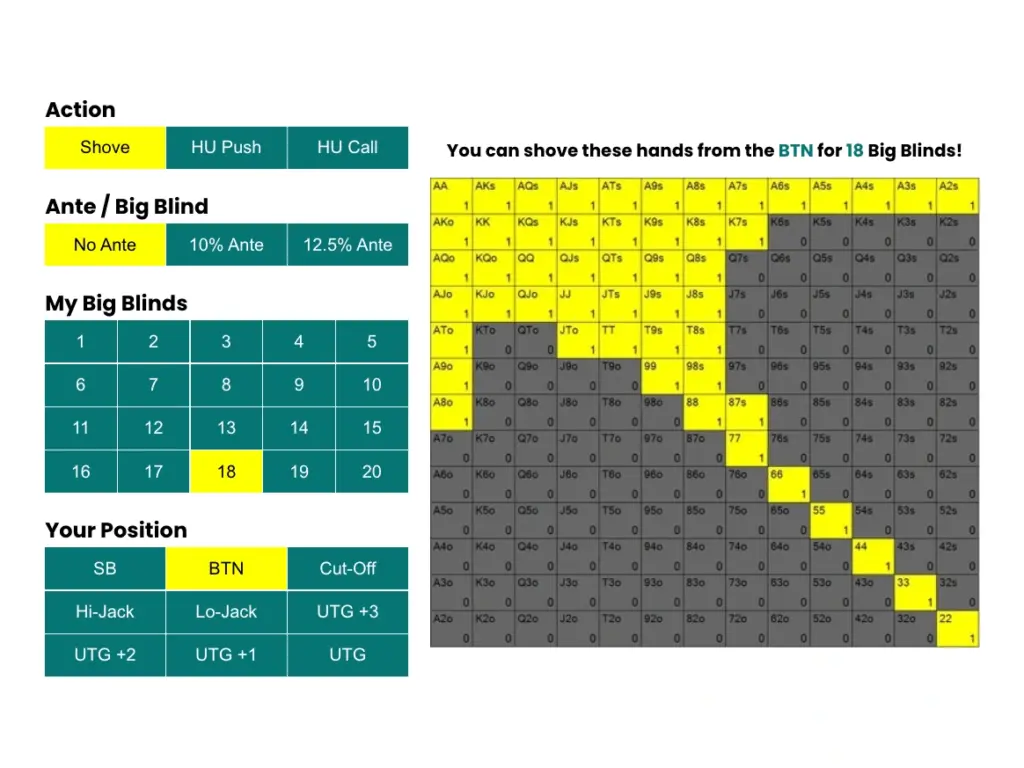
Our interactive chart is designed to give you the perfect GTO (Game Theory Optimal) answer in seconds. Here is how to use it correctly:
Step 1: Select Your Action (Shove vs. Call)
Understanding the difference in poker shove vs call situations is absolutely critical for beginners.
- Shove: This means the action folds to you, and you are the one moving all-in. Here, you have “fold equity” – the chance that your opponents will fold and you win the blinds and antes without a fight.
- Call (HU Call): This means someone else has already moved all-in before you. You have zero fold equity, meaning you must have a much stronger hand to call than you would need to shove. Make sure you have the correct tab selected!
Step 2: Set the Antes and Big Blinds
Tournaments usually introduce antes in the middle stages. Antes create “dead money” in the pot. The more dead money there is, the wider (and weaker) the hands you can profitably shove to steal it.
Step 3: Input Your Stack Size (1-20 BB)
Select your exact stack size in big blinds. Notice how the chart changes dynamically? The shorter your stack, the more the grid lights up yellow (indicating a profitable shove).
Pro Tip: Try clicking on “1 BB” from the Small Blind (SB) position. The entire grid turns yellow! The math proves that with only 1 blind left, the pot odds are so overwhelming that you should literally shove “Any Two Cards”.
Step 4: Pick Your Position
Your position at the table dictates your range. If you are Under The Gun (UTG), you have to get through the entire table without anyone waking up with a monster, so your shoving range will be very tight. If you are on the Button (BTN), you only need to beat the two players in the blinds, allowing you to shove a much wider variety of hands.
When to Ignore the Chart: Pro Adjustments and Mistakes

A chart is an incredible baseline, but applying it blindly without understanding table dynamics leads to massive push-fold chart mistakes. Here is when you should deviate from the standard colors:
- Don't Shove “Monsters” Every Time: > Important Note: Just because a premium hand like AA or KK is highlighted in yellow at 18BB, it does not mean you are forced to open-shove it! While shoving is mathematically profitable, min-raising to “trap” an aggressive opponent into shoving over the top is often a much higher-value play.
- Never Limp… Except in Heads-Up: In a full-ring or 6-max game, just calling the big blind (limping) with 12BB is usually a massive leak that drains your chips. However, in Heads-Up (HU) play, this rule completely changes. Even at 10-12BB depths, completing the Small Blind (limping) is a standard part of an elite strategy, allowing for post-flop play and keeping your ranges balanced.
- Adjusting for ICM (Independent Chip Model): Standard charts calculate how to win the most chips (ChipEV). If you are on the money bubble or at a final table, tournament payouts matter. You must play significantly tighter than the chart suggests to survive the pay jumps.
- Exploiting Weak Players: If the Big Blind is a “Calling Station” who never folds, tighten your shoving range and drop the marginal hands. If they are a “Nit” who only calls with premium hands, shove wider than the chart recommends to constantly steal their blinds.
Play Safely and Build Your Bankroll
Now that you understand the math behind the short stack push fold strategy, the most important next step is putting it to the test. Memorizing charts is great, but the best way to internalize these ranges is to practice them in a safe, secure, and regulated online environment.
Whether your goal is to grind low-stakes tournaments or higher stakes to build your bankroll, choosing the right site is crucial. You need a room with soft competition, reliable payouts, and fair software.
To save you time and protect your money, we have put together a strict, approved list of the best online poker rooms and the best bonuses on the market.
Conclusion
A push-fold chart calculator is your best friend when the pressure is on. Use it as your primary study tool to understand the mathematical baseline, but always keep your eyes on table dynamics, stack depths, and your opponents to make the perfect adjustments. Don't panic when your stack gets short – trust the math, find your spot, and push your chips in with confidence.
FAQ About How to Use a Push Fold Chart