
In the latest High Stakes Poker episodes, an interesting Senor Tilt poker hand unfolds where we once again get an incredibly strong and action-packed lineup in a $500/$1,000 No-Limit Hold’em cash game. The table features well-known high-stakes regulars like Alan Keating and Andrew Robl, alongside players who are not afraid to embrace both big money and high variance.
With lineups like this, high-level action is guaranteed. Yet among recent high stakes poker hands, this particular hand stands out – not because of an unavoidable cooler, but for the exact opposite reason. By the river, we reach a decision point that appears deceptively simple: for most players and viewers, this looks like a clear fold.
And that’s precisely what makes the hand so interesting. How do we end up in a situation where an apparent “easy fold” turns into a call? What kind of thought process leads to this decision – and where does it go wrong?
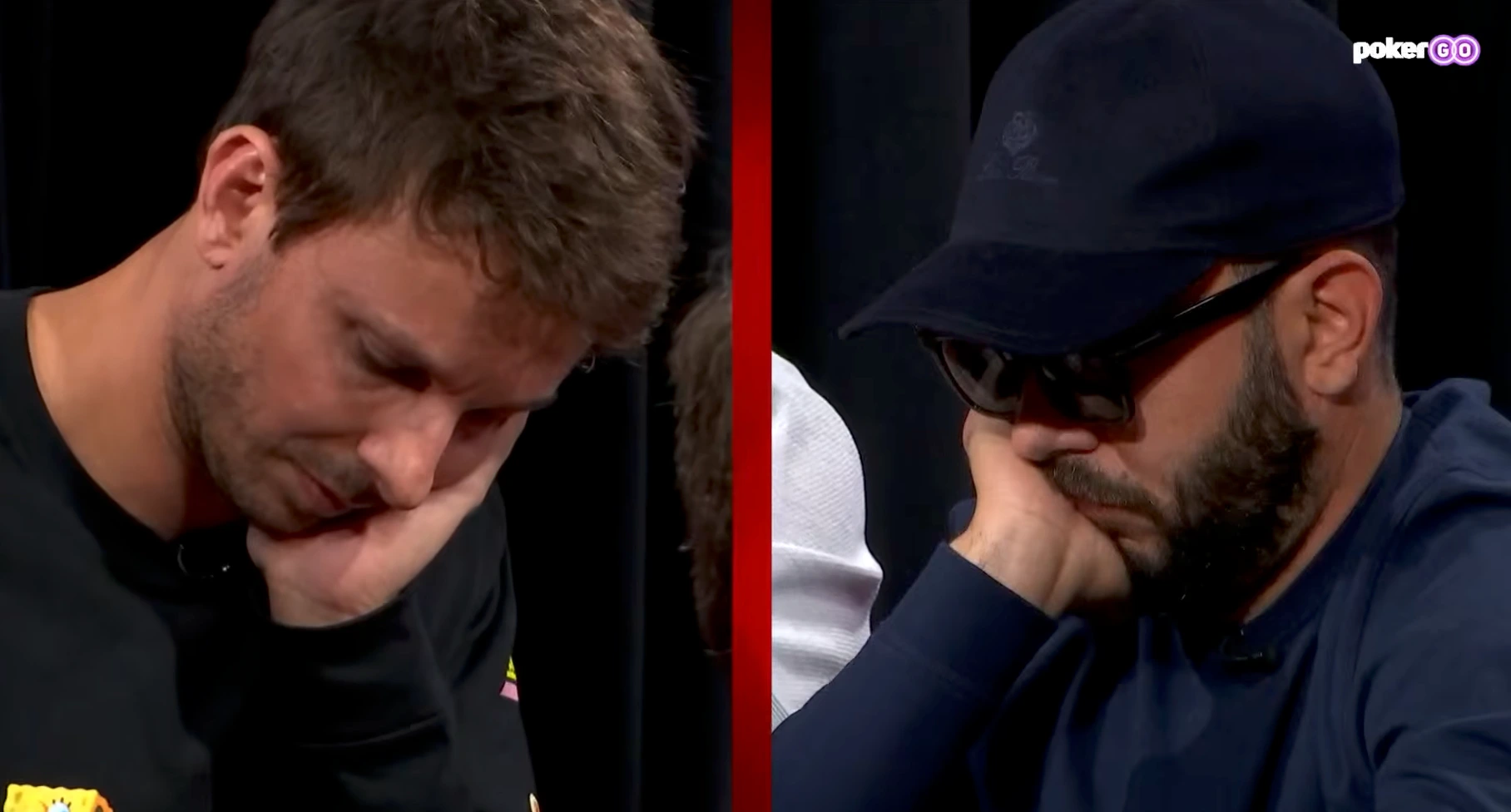
By the end of the hand, the action narrows down to a heads-up battle between Sam Kiki – better known as Senor Tilt – and Eric Wasserson. At this point, it’s not just about hand strength, but about the story each player is telling throughout the streets.
Let’s break it down step by step and see how we got to a pot of over $720,000 – and what we can learn from it.
Watch the hand and decide: easy fold or call?
Want to test your skills in similar high-pressure spots? Check out our list of the best online poker sites with soft games, fast payouts, and trusted platforms.
Who is Senor Tilt Poker? The Story Behind Sam Kiki
Sam Kiki – better known as Senor Tilt (often stylized as Señor Tilt) has recently become one of the most polarizing figures in the high-stakes live cash game scene.
For those analyzing Senor Tilt poker highlights, his style is heavily loose-aggressive (LAG), characterized by a high VPIP and frequent speculative calls.
Beyond the felt, his massive bankroll is fueled by his business ventures. He is the founder and CEO of Monkey Tilt, and his crypto-based platform has quickly gained traction among players interested in high-risk, high-reward environments. Thanks to the success of his business and sportsbook, he is not just a player but a major industry figure who brings serious financial firepower to the table.
He thrives in high-variance situations, which has led many to label him as a classic “high-variance whale.” His sessions often swing dramatically; there have been instances where he went from a big winner to being stuck hundreds of thousands within hours. Emotionally, he’s also highly reactive at the table, sometimes displaying visible frustration and tilt. But one thing is certain: whenever Senor Tilt is involved, something crazy is likely to happen.
Situation and Stack Sizes
The hand takes place in a $500/$1,000 high-stakes cash game with deep stacks, giving players significant flexibility in their postflop decisions. Based on the action, the hand likely starts in a straddled pot. Senor Tilt completes from the hijack with a small pocket pair (44). Calling with a small pair in this position is primarily set-mining, especially profitable in multiway pots due to implied odds.
A player to his left, Kirk Brown, raises to $14,000 with 8♠9♠. After UTG folds, Alan Keating calls, and both Senor Tilt and Eric Wasserson call with A-3 of hearts, resulting in a four-way pot going to the flop.
The pot is already around $60,000 before the flop, setting up a significant multiway scenario.
This is crucial, as multiway pots typically involve stronger ranges, and bluffs become less effective. Players are more likely to continue with real value hands, making aggressive actions riskier.
After the flop, the hand eventually becomes heads-up between Senor Tilt and Eric Wasserson, setting up a classic dynamic: high-variance aggression versus controlled, patient play.
Flop: 4♥ T♥ Q♥ (Multiway Pot)
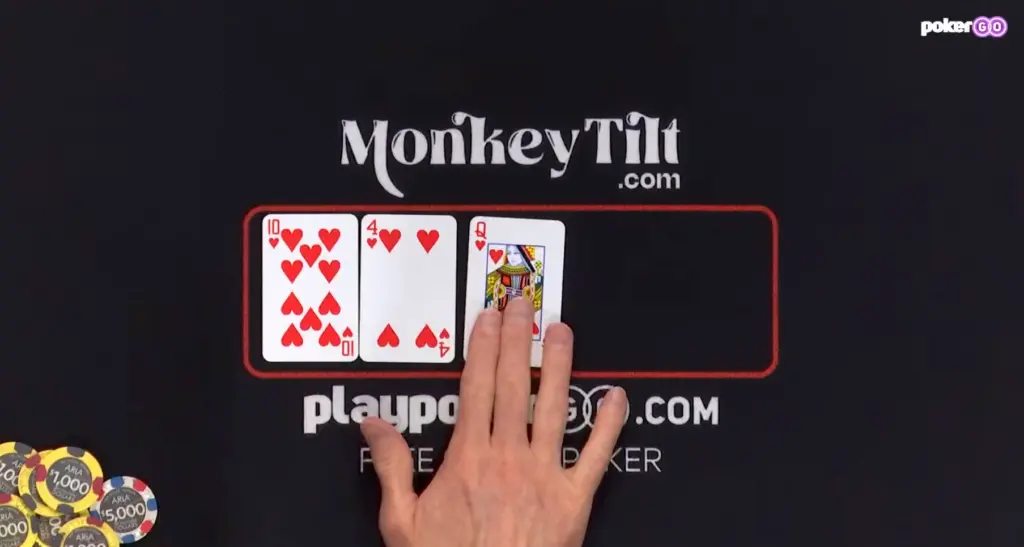
The flop is extremely draw-heavy: three hearts on the board already represent a possible made flush, alongside numerous draws and combinations. Against four players, this is a highly dangerous texture, as ranges tend to be significantly stronger in multiway pots.
Alan Keating checks with K4, which is completely standard. While he pairs his four, the hand has very little value on such a board, especially against multiple opponents.
Senor Tilt continues with a $30,000 bet into a roughly $60,000 pot. The sizing itself is standard, but it’s important to note that continuation betting on this texture in a multi-way pot is far less effective than heads-up. His bet can represent strong made hands (like a flush), draws, or even pure bluffs, especially given his aggressive, high-variance tendencies.
The next player folds, and Eric Wasserson calls with the nut flush. This is one of the most interesting decisions in the hand.
Why not raise? The slowplay makes sense for several reasons:
- Senor Tilt has a wide, aggressive range and is likely to continue bluffing
- The board is so dangerous that worse hands rarely continue versus a raise
- In multiway pots, a raise often shuts down the action immediately
By calling, Wasserson maximizes value while keeping weaker hands and bluffs in the pot. Keating folds, and the hand continues heads-up with a pot of $120,500.
Turn: J♣ – The Critical Overbet
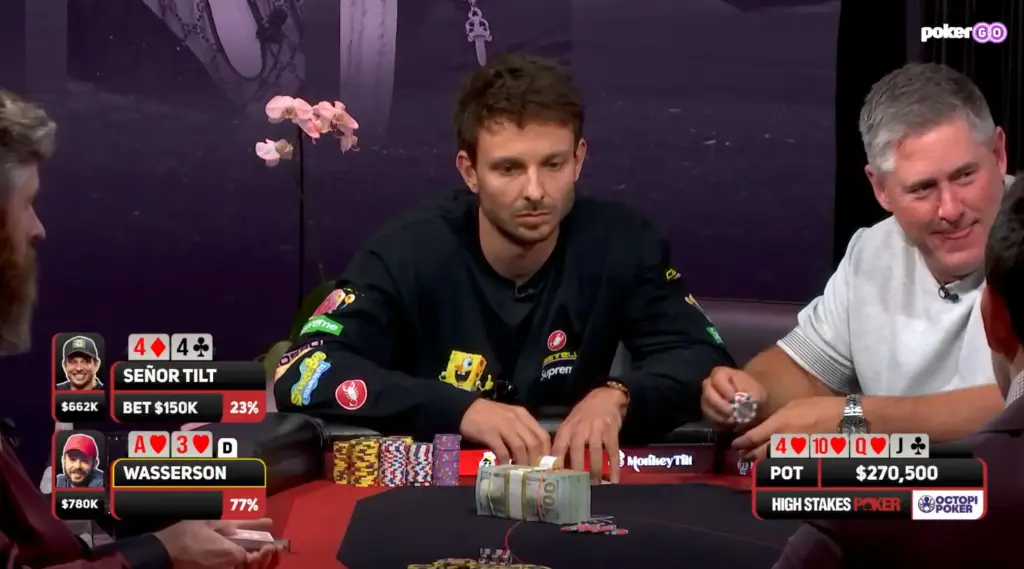
The turn brings the J♣. While it doesn’t drastically change the board, it does introduce additional straight possibilities and increases the number of combinations that can continue aggressively.
Senor Tilt doesn’t slow down, he fires a massive $150,000 overbet into $120,500.
Executing a proper poker overbet strategy in spots like this immediately polarizes a player's range and forces opponents into difficult decisions.
What does this overbet represent? Typically:
- very strong hands (flushes, possibly sets)
- or bluffs trying to maximize fold equity
Starting from a multiway pot makes this even more significant.
What’s the issue with this play? There are several problems:
- The board was already “locked” on the flop with many flushes available
- Very few worse hands can call (Qx or Tx struggle here)
- Better hands – especially flushes – almost always continue
In other words, this bet often keeps in exactly the hands that beat you.
What does this say about Senor Tilt poker style? This play perfectly reflects his methodology:
- applying maximum pressure with large sizing
- willingness to build huge pots with marginal or bluff hands
But this approach can easily turn into spew on textures like this.
Wasserson’s decision. Wasserson once again just calls with the nut flush. This is key:
- He doesn’t isolate himself against stronger ranges
- He allows further bluffs
- He keeps control of the pot
A raise here would often fold out weaker hands and only get action from stronger ones. The pot now grows to $420,500, setting up a crucial river decision. This is a defining moment in this Senor Tilt poker hand, where aggression starts to work against him.
Want to analyze spots like this with solver-level precision? Tools like GTO Wizard can help you break down complex decisions and understand whether an overbet is actually profitable.
Senor Tilt Poker River Decision: Easy Fold or Costly Call?
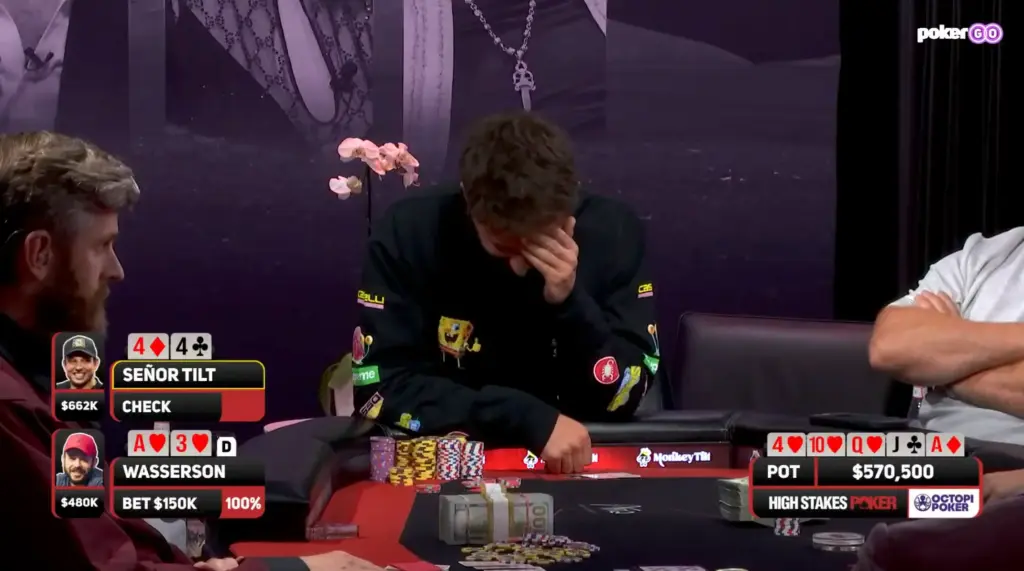
The river is the A♦, which doesn’t significantly change the dynamic on an already completed flush board. While straights are now possible, the core structure of strong hands remains the same.
Senor Tilt checks, giving up the aggression, and Wasserson makes a relatively small but very telling $150,000 value bet into $420,500.
At first glance, this is exactly the kind of spot we described earlier: a classic “easy fold”.
What story does this line tell?
- flop: bet → call
- turn: overbet → call
- river: check → bet
Wasserson plays passively throughout, then value bets on the river – this is very often a strong made hand in live poker.
What does Senor Tilt beat? This is the key question.
- missed draws? → very few remain
- weaker made hands? → rarely value bet
- bluffs? → unlikely given the line
There are very few hands he actually beats.
And what beats him?
- all flushes
- straights
- stronger sets
Most importantly: This started as a multiway pot, which significantly increases the likelihood of strong hands.
Would you call? For most players, this is a clear fold:
- strong turn aggression
- passive opponent line
- river value bet
Everything points toward folding.
So why does he call? This is where psychology comes in. Possible reasons:
- “too much money in the pot” mindset
- overvaluing his own story
- overestimating bluffs
- natural curiosity from his playing style
This decision reflects his high-variance approach – but also its downside. Senor Tilt calls, and Wasserson shows the nut flush and wins the $720,000+ pot, while Senor Tilt throws his cards away in frustration.
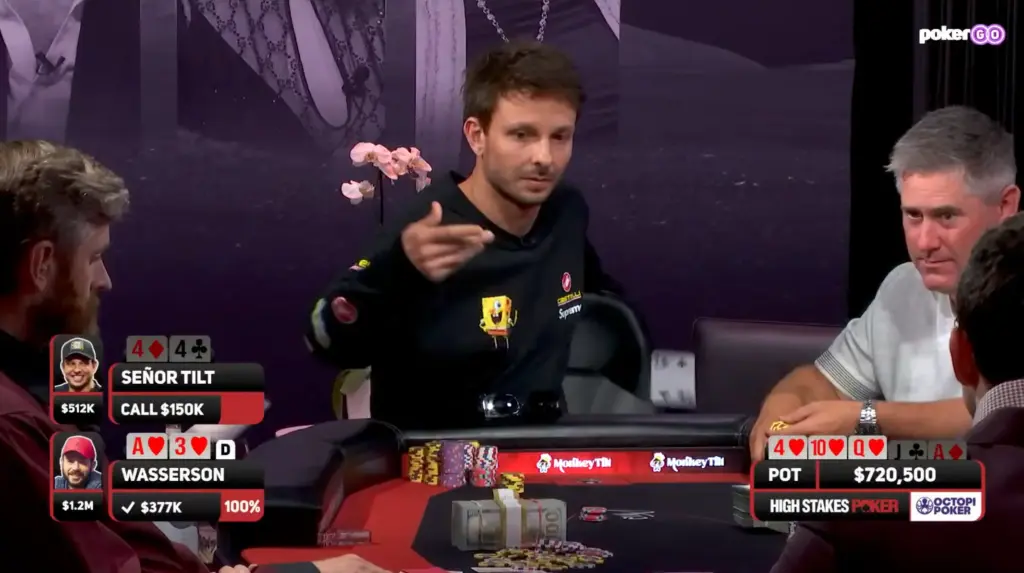
What does the table talk reveal?
One of the most interesting aspects of the hand is that Senor Tilt verbalizes his thought process: “KJ with a J of hearts… KJ with a K of hearts…”
At first, this seems logical, but it reveals a key mistake: focusing on very specific hands instead of considering the entire range.
Meanwhile, Wasserson briefly smiles and covers his mouth – a subtle but classic live tell of strength.
Shortly after, Senor Tilt says the line many players recognize: “Too much money in the pot”.
This mindset often leads to bad calls. In reality, the pot size is irrelevant; what matters is whether your call is profitable.
What can we learn from this Senor Tilt Poker Hand?
- Multiway pots mean stronger ranges and fewer successful bluffs
- Overbets are not effective on every board, especially not on completed textures
- Slowplaying against aggressive opponents can be highly profitable
- River value bets after passive lines are often very strong
- Recognizing “easy fold” spots is crucial for long-term success
Final Thoughts
Fun fact, Sam Kiki himself later commented on the hand on PokerGO’s Instagram: “I played this hand so badly it’s insane”.
That single sentence perfectly sums up the hand. Even experienced high-stakes players make mistakes, especially in emotionally charged, high-pressure situations.
And perhaps that’s the most important takeaway: It’s not about never making mistakes, but about recognizing them, learning from them, and avoiding them in the future.
Frequently Asked Questions