

The WSOP Player of the Year is poker's longest-running test of all-around tournament excellence. A single bracelet can come down to one hot run. The Player of the Year title rewards something much harder to fake: strong, high-level results across an entire series of events. It works like a season-long MVP award, and the list of past winners reads like a who's who of the modern game.
For all its prestige, the WSOP Player of the Year race is also widely misunderstood. The points system has changed many times since 2004. The events that count have shifted. And in 2026, the format underwent its biggest overhaul yet. If you have ever looked at the leaderboard and wondered how someone with zero bracelets can outrank a two-time winner, this guide is for you.
Below, we break down what the award is, how the points actually work, how the format evolved over two decades, every past champion, and what the winners' records teach us about tournament strategy, consistency, and variance.
What is the WSOP Player of the Year?
The WSOP Player of the Year award goes to the player who collects the most ranking points across a defined set of World Series of Poker bracelet events in a calendar year. The award was first introduced in 2004, and it has been given out every year since, apart from 2020, when most events were cancelled due to the COVID-19 pandemic.
Winning it is about breadth, not a single score. A typical Player of the Year posts a cluster of deep runs, with several cashes, multiple final tables, and usually at least one bracelet, rather than one spectacular result. That is the whole point of the award. It isolates the player who performed best over the long haul, when variance has had the most time to even out.
The rewards have changed over the years, but the modern package is meaningful. The winner traditionally receives a seat to the following year's WSOP Main Event, a custom trophy, and a personalized banner that hangs during the WSOP in Las Vegas. The 2026 edition added a seven-figure prize pool on top of that, which we cover below.
It helps to be clear about what the title is not. It is not the same as topping the all-time bracelet count, and it is not the Main Event championship. A player can win Player of the Year without winning the Main Event, and plenty of legends have stacked bracelets for decades without ever taking the POY crown.
How WSOP Player of the Year Points Work
At its core, the WSOP Player of the Year points system rewards three things: how deep you finish, how large the field is, and how big the buy-in is. The formula has evolved over the years, but it typically awards points based on performance in bracelet events, using buy-in, finishing position, and the number of entries.
In plain terms, the deeper you run in a big, expensive event, the more points you bank. Winning a 2,000-runner event is worth far more than winning a 200-runner event. Cashing in a $50,000 buy-in tournament carries more weight than cashing in a $1,000 one. Finishing position then scales the reward: winners earn a large multiplier, final-table finishes earn a healthy chunk, and a min-cash earns a modest amount.
Not every event counts, though. Traditionally, the POY race has covered only open bracelet events. That means some categories are excluded, including:
- Online bracelet events (in the current format)
- Non-open events such as Seniors, Super Seniors, Ladies, Tag Team, and Industry Employee tournaments
The exact exclusions can vary from year to year, and the WSOP reserves the right to adjust which events qualify. But the guiding principle has stayed consistent: the award is meant to measure performance in the open, competitive field.
This is why two players can finish a series with similar earnings but very different point totals. Someone who made one enormous score in a small field will trail someone who posted several deep runs in big-field events, even if the big-score player technically won more money. The system is built to reward the grind, not the spike.
Qualifying for the WSOP Online
Some bracelet events also have an online qualifying path. Every year, players win their way into live WSOP events, including the Main Event, through online satellites rather than buying in directly. GGPoker, our partner and the official online home of the WSOP, runs these qualifiers year-round, so chasing a bracelet (and the POY points that come with it) does not necessarily mean paying full price.
How the Format Evolved Over the Years
Understanding the WSOP Player of the Year history matters because the formula has been rewritten so many times that comparing point totals across eras is almost meaningless. What earned you the title in 2007 would not be calculated the same way in 2017. Here is how it changed.
The Early Years (2004-2007)
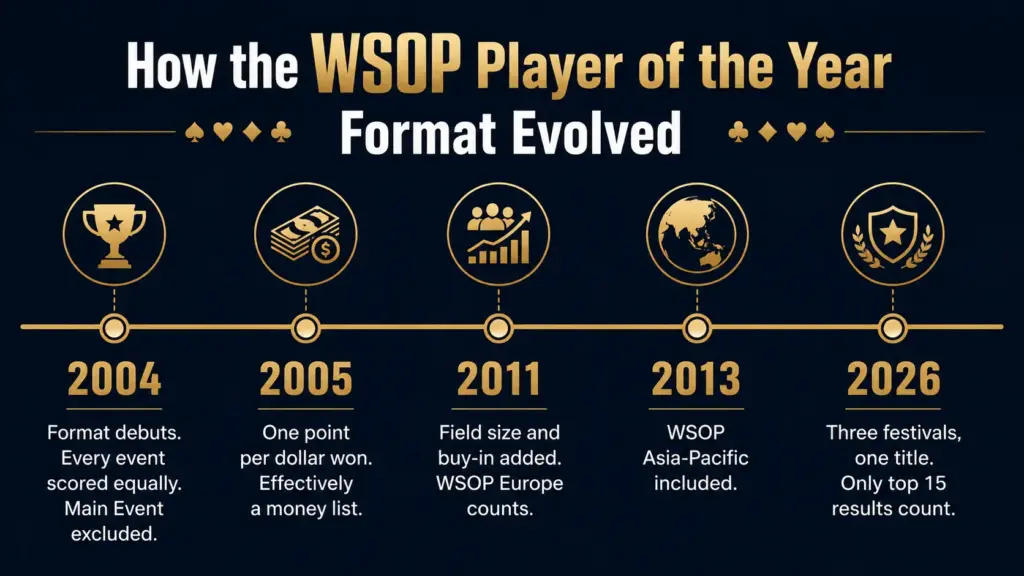
In the beginning, the system was deliberately simple. In 2004, the race debuted, probably inspired by the WPT's award, which began the previous year. Each event earned the same number of points based only on the player's finish, and the Main Event did not count at all. That first year produced a fittingly iconic champion, but the formula had an obvious flaw: it treated a small-field event the same as a massive one.
The next few years were a period of constant tinkering. The 2005 version awarded one point for each dollar in prize money won. A year later, in 2006, the new $50,000 H.O.R.S.E. tournament was excluded from the rankings. Then, 2007 brought a new points system that still lacked any adjustment for field size. Tying points directly to dollars, as the 2005 version did, effectively turned the race into a money list, which rewarded high buy-ins over genuine consistency.
Going Global: Field Size and WSOPE (2011-2013)
The biggest structural leap came at the start of the next decade. In 2011, field size and buy-in became factors in the formula, so larger fields and higher buy-ins were worth more, and WSOP Europe events counted for the first time after being ignored for four years. In 2013, WSOP Asia-Pacific debuted and counted in the standings as well. This is the era when the award started to resemble its modern form: a global, field-weighted race rather than a domestic money list.
The Modern Era
Later refinements pushed further toward rewarding efficiency and consistency, including formulas built around a player's finishing ratio rather than raw cashes. The throughline across every revision is a steady move away from “who won the most money” and toward “who performed best, adjusted for how hard each event actually was”.
The practical takeaway for anyone reading an old leaderboard is simple: never compare a 2008 point total to a 2016 one. They are different units measuring different things. What stays comparable across eras is the shape of a winning season, and that shape is remarkably consistent, as the winners' list shows.
How the 2026 Format Changed the Race
The 2026 series brought the most significant shake-up to the WSOP Player of the Year format in years. It is worth understanding, even if you are reading this much later, because it reshaped what a winning campaign looks like.
First, the race expanded beyond a single summer in Las Vegas to span all three live WSOP festivals in one calendar year: WSOP Europe, WSOP Las Vegas, and WSOP Paradise. A contender can now build a lead at one stop, defend it at the next, and have it challenged at the season finale. The title is decided across a global circuit, not a single six-week grind.
Second, and most importantly for strategy, only a player's top 15 results count toward the leaderboard. Firing into forty events no longer helps you pad a total; the weakest finishes are simply dropped. This rewards deep runs over sheer volume, and it is the single most important rule to understand about the modern race.
Third, the award attached real money for the first time, with a $1,000,000 prize pool shared among the top finishers in the form of WSOP packages and tickets. The points formula itself kept the familiar logic, a finishing-position multiplier (roughly 6x for a win, 4x for a final table, 2x for a cash) combined with buy-in and field-size factors, so one deep run in a marquee event can still move a player up the board overnight.
How the 2026 WSOP Player of the Year Format Changed the Race
The “top 15 only” rule deserves a moment, because it changes the best approach. Under a pure-volume system, the smart play is to enter everything. Under a top-15 system, the smart play is to enter events you can genuinely run deep in, and to treat marginal spots as optional. It shifts the incentive away from grinding for its own sake and toward selective, high-quality aggression, a principle that applies far beyond the WSOP.
Every WSOP Player of the Year Winner (2004-2025)
Here is the complete list of WSOP Player of the Year winners. Two players have won the award more than once: Daniel Negreanu, who won the inaugural title in 2004 and added a second in 2013, and Shaun Deeb, who won in 2018 and again in 2025. The early roll of honor runs from Negreanu in 2004 through Allen Cunningham, Jeff Madsen, Tom Schneider, Erick Lindgren, Jeffrey Lisandro, and Frank Kassela in 2010.
| Year | Player | Country | Notable Series Detail |
|---|---|---|---|
| 2004 | Daniel Negreanu | Canada | Inaugural winner; 6 cashes, 4 final tables, 1 bracelet |
| 2005 | Allen Cunningham | United States | 5 cashes, 4 final tables, 1 bracelet |
| 2006 | Jeff Madsen | United States | Youngest bracelet winner at the time; 2 bracelets |
| 2007 | Tom Schneider | United States | 3 cashes, all final tables, 2 bracelets |
| 2008 | Erick Lindgren | United States | 5 cashes, 3 final tables, 1 bracelet |
| 2009 | Jeffrey Lisandro | Australia | 3 bracelets, all in stud events |
| 2010 | Frank Kassela | United States | 6 cashes, 3 final tables, 2 bracelets |
| 2011 | Ben Lamb | United States | 5 cashes; won PLO Championship, 3rd in Main Event |
| 2012 | Greg Merson | United States | Only player to win POY and the Main Event in the same year |
| 2013 | Daniel Negreanu | Canada | First two-time POY winner |
| 2014 | George Danzer | Germany | 3 bracelets (incl. WSOP APAC) |
| 2015 | Mike Gorodinsky | United States | 1 bracelet, deep mixed-game run |
| 2016 | Jason Mercier | United States | 2 bracelets, dominant summer |
| 2017 | Chris Ferguson | United States | 1 bracelet, 23 cashes |
| 2018 | Shaun Deeb | United States | 2 bracelets |
| 2019 | Robert Campbell | Australia | 2 bracelets; title confirmed after a data-entry correction |
| 2020 | — | — | Not awarded (COVID-19) |
| 2021 | Joshua Arieh | United States | 2 bracelets |
| 2022 | Daniel Zack | United States | 2 bracelets |
| 2023 | Ian Matakis | United States | 1 Bracelet, 3 Final Tables, 22 Cashes |
| 2024 | Scott Seiver | United States | 3 bracelets |
| 2025 | Shaun Deeb | United States | Second POY title, joining Negreanu as a two-time winner |
A couple of entries on this list are especially instructive. In 2012, Greg Merson became the only player to win the WSOP Main Event and the Player of the Year title in the same year, after winning $8,531,853 for the Main Event. And in 2023, Ian Matakis took the title without winning a bracelet at all, proof that consistent deep runs can outweigh a single trophy.
It’s official! Shaun Deeb ( @shaundeeb ) has won the 2025 WSOP Player of the Year! 🏆
👉During the 2025 series he cashed in eighteen live bracelet events, six online bracelet events, reached five final tables, and won his seventh career WSOP bracelet in the $100,000 Pot Limit… pic.twitter.com/t4PMYyVcsi
— WSOP – World Series of Poker (@WSOP) July 19, 2025
There is also a cautionary tale in the runner-up column. Phil Hellmuth has won 16 WSOP gold bracelets, the most by any player ever, yet he has never won Player of the Year. He is also the only player to finish runner-up in the race more than once, placing second on four occasions: 2006, 2011, 2012, and 2021. The most decorated bracelet winner in history has never claimed the season-long crown, and that contrast captures what the award actually measures.
What it Takes to Win POY: The Strategy Lesson
Consistency Beats a Single Heater
Look at the winners' list as a whole, and a clear pattern emerges, one that matters whether you are playing a $100 local series or dreaming of Las Vegas. The players who win Player of the Year are almost never the ones who got hot for a single tournament. They are the ones who stacked cashes and final tables across an entire series.
This is the central coaching lesson of the whole award: consistency beats a single heater. A player who final-tables four events will almost always out-point a player who won one and busted the rest, because the points formula and the top-15 structure both reward repeated deep runs over isolated spikes. The recent winners back this up. They posted high cash and final-table counts, not just one big score.
That has a direct application to your own game. The instinct, especially after a downswing, is to chase one big result to fix everything. The POY data argues for the opposite mindset: focus on putting yourself in good spots again and again, accept that any single tournament is mostly variance, and let a high volume of good decisions do the work over time. The leaderboard is basically a season-long measure of decision quality with the luck averaged out.
The runner-up stories make the same point from the other direction. A player can lead the race for weeks on the strength of one massive win, then slide down the standings as opponents post multiple counting results. One win gets you on the board; it does not keep you there. In a top-15 format, especially, a single score is a foundation, not a finish. You still have to back it up.
Variance, Bankroll, and the Long Game
This is also where variance and bankroll discipline come in. Over a full series spanning three festivals, even the best player in the field will run badly in stretches. The ones who ultimately contend are those who keep entering good spots, manage their bankroll so a cold run does not knock them out of action, and avoid the trap of judging their season by results rather than by decisions. The mental side, staying steady through the inevitable downswings, is as much a part of a WSOP POY campaign as the technical skill.
If there is one habit to take from two decades of WSOP Player of the Year winners, it is this: play to maximize your number of quality deep runs, not to manufacture a single highlight. Do that consistently, and the results, at any stake, tend to follow.
FAQ About WSOP Player of the Year