
If you want to prove that you are a complete poker player, mastering 8 game poker is the ultimate test. While No-Limit Hold'em dominates the mainstream media, the world’s elite professionals regularly test their versatility in high-stakes mixed and prestigious bracelet events, such as the legendary WSOP mixed games $50,000 Poker Players Championship.
To succeed in this format, you cannot rely solely on standard Hold'em tactics; you need a well-rounded mixed game strategy that prevents you from bleeding chips during your weaker rotations. Whether you want to expand your poker horizon or prepare for your first mixed rotation, this guide will give you the edge you need.
What is 8 Game Poker?
8-game poker is an elite rotation format that combines eight distinct poker variants into a single cash game session or tournament structure. Instead of focusing on just one style, players must constantly adapt as the game switches formats, betting structures, and table dynamics.
The mix bridges traditional flop games with stud and lowball draw variants. Mastering the 8-game poker rules means understanding not just how each game is played, but how the flow of the entire rotation impacts your overall win rate.
The 8 Game Mix Rotation Explained
One of the most important mixed game rules to understand is the rotation itself. In a standard cash game or tournament, the game changes after a set number of hands (usually six hands, or after one full orbit).
The transition between these games is where many players make critical errors, particularly when shifting from rigid Limit structures to high-variance Pot-Limit or No-Limit rounds.
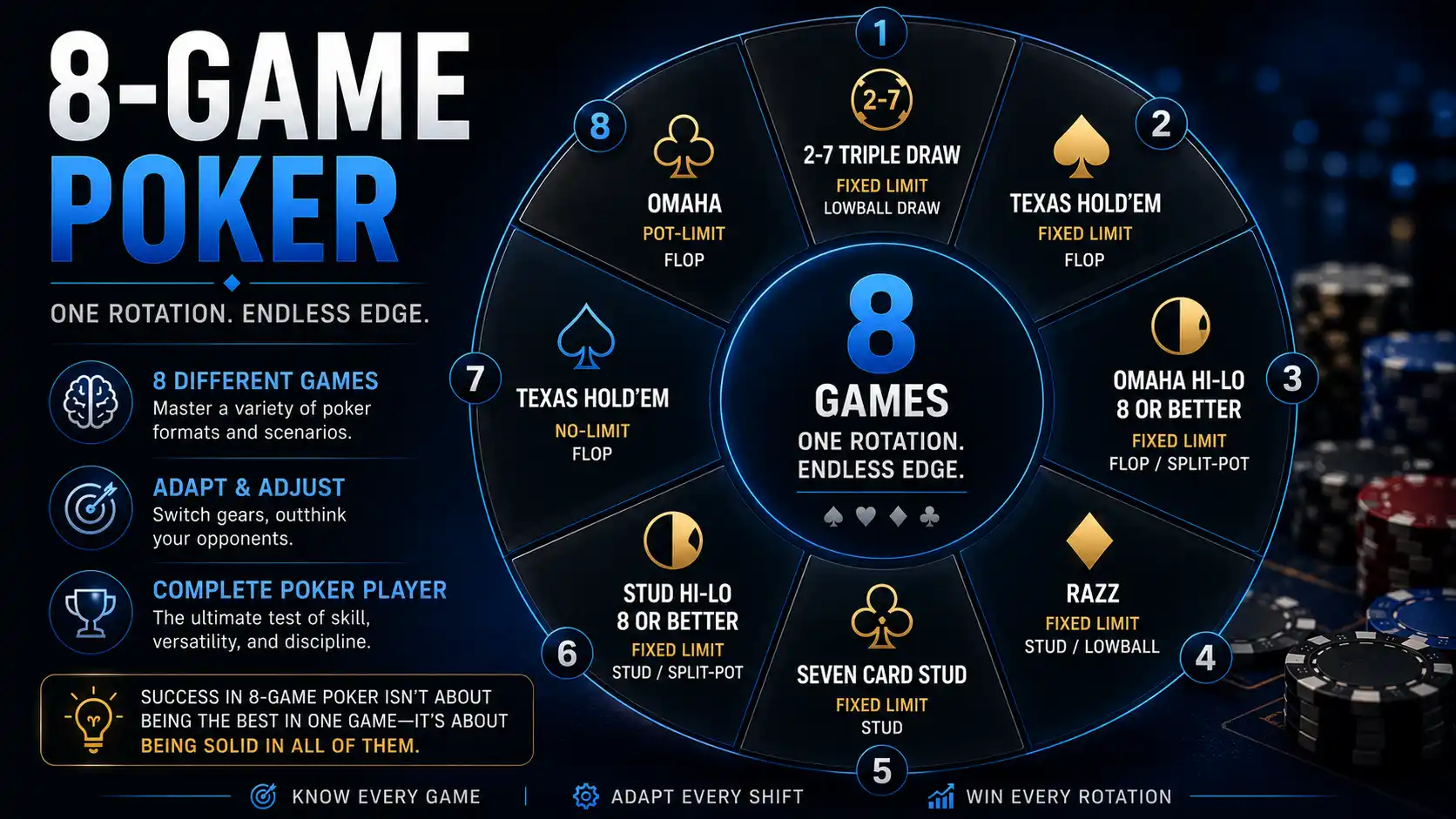
Here is the traditional 8-game rotation order, along with the betting structures and game types you must be prepared for:
| Order | Game | Betting Structure | Game Type |
| 1 | 2-7 Triple Draw | Fixed Limit | Lowball Draw |
| 2 | Texas Hold'em | Fixed Limit | Flop |
| 3 | Omaha Hi-Lo 8 or Better | Fixed Limit | Flop / Split-Pot |
| 4 | Razz | Fixed Limit | Stud / Lowball |
| 5 | Seven Card Stud | Fixed Limit | Stud |
| 6 | Stud Hi-Lo 8 or Better | Fixed Limit | Stud / Split-Pot |
| 7 | Texas Hold'em | No-Limit | Flop |
| 8 | Omaha | Pot-Limit | Flop |
Pro Tip: Always pay close attention to the dealer's plaque in live games, or the game display on your screen when playing online. Accidentally playing a No-Limit Hold'em hand with Fixed Limit strategies, or simply forgetting which game is currently active, is one of the fastest ways to lose a massive pot.
8 Essential Tips for 8 Game Poker
Transitioning from a single variant to an 8-game rotation requires a complete overhaul of how you approach the table. Here are eight essential mixed game strategy tips to help you crush the rotation.
1. Identify Your Weakest Games (and Play Tighter)
No one is an expert at all eight games right from the start. Your first goal is self-awareness. Identify which variants you are least comfortable with (for many, it is 2-7 Triple Draw or Razz) and significantly tighten your starting hand requirements during those rounds. The goal in your weak games is survival; do not bleed chips unnecessarily.
2. Master the Fixed Limit Mindset
Six out of the eight games in the rotation are played with a Fixed Limit betting structure. If you are coming from a No-Limit background, you must adjust your aggression. In Limit poker, you cannot blast your opponents off their equity with massive overbets. You need to focus on thin value betting, extracting extra small bets, and saving bets when you are clearly beaten.
3. Capitalize on the “Big Bet” Rounds
The No-Limit Hold'em and Pot-Limit Omaha rounds are where stacks are made or broken. Because these are the only “big bet” formats in the mix, the pot sizes will naturally skyrocket. Use your deep stack strategy here to pressure opponents who might be tilted or frustrated from the Limit rounds.
4. Exploit the Game Transitions
Pay close attention to the very first hand after the game rotates. Many casual players fail to adjust their mindset immediately. They might play a Limit Hold'em hand with No-Limit sizing logic, or completely misread their Stud starting hands. Being laser-focused during these transition moments presents highly profitable exploitation opportunities.
5. Follow the Legends: Hunt for a Better Edge
Why are so many top professionals abandoning standard Hold'em for mixed games? As No-Limit Hold'em becomes increasingly solved by software, the biggest edges are now found in mixed rotations. Poker legend Gus Hansen is a prime example; known for his wild NLH days, Hansen has famously shifted his focus almost entirely to high-stakes mixed games in recent years, proving that formats requiring raw intuition and adaptability are where the true profit lies.
6. Fight for the Antes in Stud Variants
In Seven Card Stud, Razz, and Stud Hi-Lo, there are no blinds, only antes and a bring-in. Because there is dead money in the pot on every single hand, you must be proactive. If you are the first player to enter the pot and you have reasonable “up cards”, aggressive stealing is a mandatory part of a winning 8-game poker strategy.
7. Track the Folded Cards (Card Removal)
In the Stud and Lowball variants, seeing which cards your opponents fold is crucial. If you are drawing to a flush in Seven Card Stud, but you see three cards of your suit folded by other players, your odds of hitting your draw drastically decrease. Always scan the visible board before making drawing decisions.
8. Practice on the Right Platforms
The only way to master the rotation is to put in the volume. You need a platform that actively supports high-quality mixed game action.
What is the difference between H.O.R.S.E. and 8 Game Poker?
If you are exploring mixed games, you have likely come across both H.O.R.S.E. and 8-game poker. While they share a lot of the same DNA, there is a crucial difference in the volatility, betting structures, and overall skill sets required for each format.
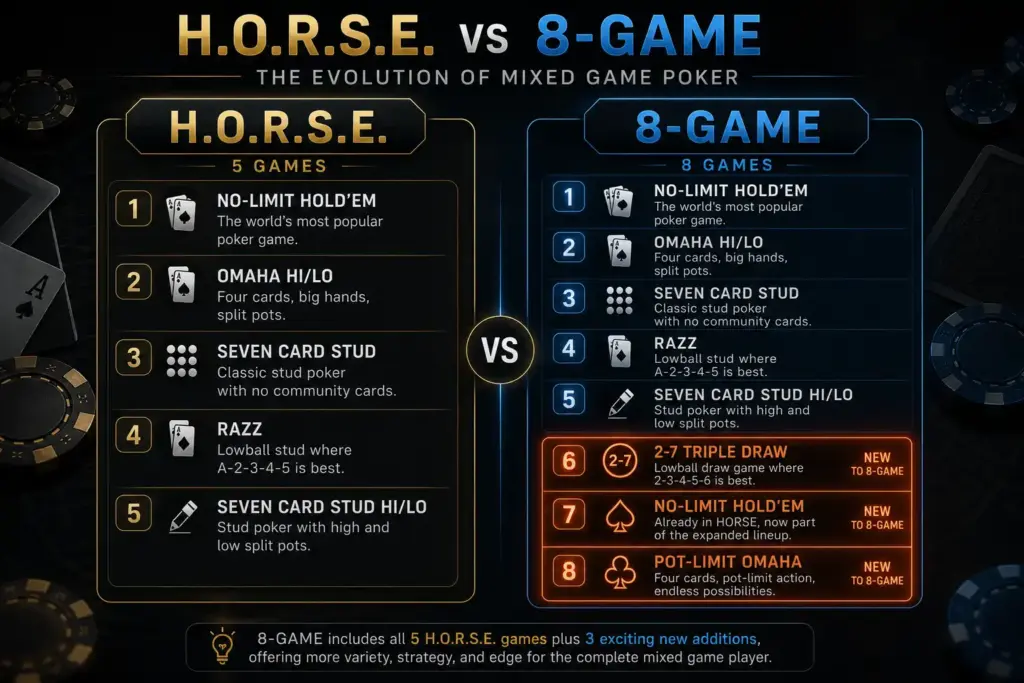
H.O.R.S.E. is an acronym for a classic 5-game rotation consisting exclusively of Fixed Limit games:
- Hold'em (Fixed Limit)
- Omaha Hi-Lo 8 or Better (Fixed Limit)
- Razz (Fixed Limit Stud Low)
- Stud (Seven Card Stud High, Fixed Limit)
- Eight or Better (Seven Card Stud Hi-Lo, Fixed Limit)
8-Game Poker takes the complete H.O.R.S.E. lineup and adds three additional games to the rotation:
- 2-7 Triple Draw (Fixed Limit Lowball)
- No-Limit Texas Hold'em (Big Bet)
- Pot-Limit Omaha (Big Bet)
The Bottom Line: The most significant difference is the introduction of “big bet” dynamics. In H.O.R.S.E., pot sizes grow predictably due to the fixed betting caps, making it a game of mathematical precision and grinding small edges. In 8-game, the addition of No-Limit Hold'em and Pot-Limit Omaha means you can easily double up, or lose your entire stack, in a single hand. This makes the 8-game significantly more volatile and requires players to rapidly shift gears between cautious limit strategies and aggressive big-bet mentalities.
Common Mistakes New Players Make
Stepping into the 8-game mix for the first time can be overwhelming. Even solid NLH players can quickly lose their edge if they do not respect the format. To protect your bankroll, avoid these frequent beginner traps:
- Playing with a “Hold'em Brain”: Beginners often overvalue hands based on Texas Hold'em standards. While a pair of Aces is a monster in Hold'em, in split-pot games like Omaha Hi-Lo or Stud 8, it is a vulnerable holding easily scooped by coordinated draws.
- Misunderstanding Limit Implied Odds: In NLH, calling a flop bet with a flush draw is viable since you might win an entire stack. In Fixed Limit, you only win a few extra bets. Chasing draws without immediate pot odds in Limit rounds will quickly bleed your stack.
- The “Catch-Up” Tilt Trap: Players often lose pots during Limit rounds, get frustrated, and try winning it all back with reckless bluffs once the rotation switches to NLH or PLO. Big bet rounds require calculated aggression, not blowing off steam.
- Ignoring Dead Cards (Card Removal): In Stud and Razz, folded up-cards are vital information. Beginners often chase draws without realizing half their “outs” were already folded. Always scan the visible board before committing chips.
- Losing Track of the Current Game: It sounds amateurish, but playing Omaha Hi-Lo thinking it is standard PLO, or confusing Razz with regular Stud, happens constantly. Always check the game display before looking at your hole cards.
Final Thoughts: Embracing the 8-Game Challenge
Mastering 8-game poker is not something that happens overnight. It requires patience, discipline, and a willingness to constantly learn and adapt. While the transition from single-variant games like No-Limit Hold'em can feel like a baptism by fire, the reward is well worth the effort.
By understanding the rotation, tightening up in your weakest games, and respecting the different betting structures, you will quickly find yourself with a significant edge over players who lack versatility. Mixed games force you to become a fundamentally sound, well-rounded poker player.
Where to Play 8-Game Poker?
It is no secret that finding consistent, high-quality mixed game action in modern online poker can be challenging. While many of the market-leading poker rooms focus almost exclusively on No-Limit Hold'em and standard Pot-Limit Omaha, true mixed game action has shifted to other platforms.
For instance, mixed game specialist and high-stakes legend Viktor “Isildur1” Blom has been playing heavily on Phenom Poker, where he recently made headlines crushing the mixed game tables for approximately $1.75 million in just about 10 days.
8 Game Poker FAQ