

Mastering the best Omaha starting hands is the single most profitable skill you can develop in Pot-Limit Omaha (PLO). Although PLO and No-Limit Texas Hold’em share the same basic hand rankings, they are fundamentally different games, and nowhere is this difference more critical than in your preflop strategy.
In Texas Hold'em, you are dealt two hole cards, meaning there are only 169 distinct starting hand combinations. In Pot-Limit Omaha, you are dealt four hole cards, resulting in a staggering 270,725 possible starting hand combinations.
To an inexperienced player, having four cards feels like an excuse to play almost any hand. With more cards, you have more chances to flop a monster, right? Wrong.
While PLO is undeniably a flop-heavy game where you will see more post-flop action, entering the pot with weak or uncoordinated starting hands is the absolute fastest way to bleed your bankroll. If your preflop foundation is flawed, you will constantly find yourself in dominated, second-best situations post-flop, which is a death sentence in Omaha.
In this comprehensive guide, we will break down the absolute best Omaha starting hands, the four critical pillars of PLO hand selection, and the common preflop traps you must avoid to crush the games.
What Makes a Great PLO Starting Hand? The 4 Golden Rules
When you look down at your four cards in Omaha, you need more than just “some potential” to justify putting chips into the pot. The single most important rule in PLO is synergy: all four cards must work together.
The further you drift from this principle, the lower your hand's equity drops. To quickly evaluate whether an Omaha starting hand is worth playing, run it through these four critical filters:
1. Connectedness (Straight Potential)
How closely related are your four cards sequentially? Hands like Jh 10s 9h 8s (known as a “rundown”) are immensely powerful because they can flop massive straight draws and multi-way wraps across a wide variety of board textures.
2. Suitedness (Flush Potential)
In PLO, suits matter tremendously.
- Double-Suited (DS): Having two pairs of matching suits (e.g., As Ah Ks Kh) is the gold standard. It gives you two separate flush draws to fall back on.
- Single-Suited (SS): Having two cards of one suit and two random suits. Playable, but significantly weaker.
- Rainbow: Four different suits. These hands lose a massive percentage of their playability because you can never flop a flush or a flush draw.
3. Nuttiness (Nut Potential)
In Texas Hold'em, winning a massive pot with the second-best flush or a bottom set is common. In Pot-Limit Omaha, if you don't have the nuts, you are likely losing to someone who does. The best PLO starting hands are those that consistently draw to the absolute nuts, such as Ace-high flushes, top sets, and nut straights.
4. Zero “Danglers”
A “dangler” is a fourth card in your hand that is completely unrelated to the other three. For example, look at As Ks Qh 3c. The Ace, King, and Queen work beautifully together, but the 3 of clubs is a dangler; it provides zero straight potential, zero flush potential, and blocks nothing useful. Holding a dangler effectively means you are playing a three-card hand against opponents holding four fully synchronized cards. Avoid danglers whenever possible.
The Best Omaha Starting Hands
To help you build a stronger preflop strategy, we've grouped the strongest double-suited (DS) Pot-Limit Omaha starting hands into three practical tiers. While the exact rankings can vary slightly between modern PLO solvers, stack depths, and game formats, the hands below are consistently regarded as some of the strongest starting combinations in the game.
Tier 1: Elite Premium Hands (Top 10 PLO Hands)
Premium pocket Aces combined with connectivity and double-suitedness dominate the top of every PLO hand ranking. Unlike Texas Hold'em, pocket Aces alone are not enough; strong side cards and nut potential are what separate good hands from truly elite ones.
| Rank | Starting Hand | Why It Crushes the Games |
| 1. | A-A-K-K (DS) | The undisputed king of PLO. Top set potential plus two nut flush draws. |
| 2. | A-A-J-10 (DS) | Incredible nut straight potential combined with top pair and nut flush draws. |
| 3. | A-A-Q-Q (DS) | Dominates lower pocket pairs and flops massive full house combinations. |
| 4. | A-A-J-J (DS) | Elite top-set potential with strong Broadway straight coverage. |
| 5. | A-A-10-10 (DS) | Excellent interaction with Broadway and middle-board textures. |
| 6. | A-A-9-9 (DS) | Strong connectivity with mid-board wraps and nut flush equity. |
| 7. | A-A-X-X (DS) | Any double-suited Aces with a second pocket pair is an elite starting hand. |
| 8. | J-10-9-8 (DS) | The best non-pair rundown in the game. Flops monster wraps and straight flushes. |
| 9. | K-K-Q-Q (DS) | Massive high-card equity, second-nut flush draws, and top set potential. |
| 10. | K-K-J-J (DS) | Highly coordinated Broadway power with excellent post-flop playability. |
Tier 2: Premium Broadway Hands & Double Pairs (Ranks 11-20)
While not quite in the top 1%, these hands are incredibly powerful and form the core of a winning player's preflop range. They feature excellent Broadway coordination and strong set-mining value:
11. K-Q-J-10 (Double-Suited) – The ultimate Broadway rundown; flops the highest possible straights.
12. K-K-10-10 (Double-Suited) – Excellent double-pair strength with straight connectivity.
13. K-K-A-Q (Double-Suited) – High card power with top pair and nut-blocker utility.
14. K-K-A-J (Double-Suited) – Strong connectivity across high-card board textures.
15. K-K-A-10 (Double-Suited) – Plays exceptionally well in multi-way, inflated pots.
16. K-K-Q-J (Double-Suited) – Premium Broadway interaction backed by second-nut sets.
17. K-K-J-10 (Double-Suited) – Fantastic straight-wrap potential with high equity.
18. Q-Q-J-J (Double-Suited) – A mid-Broadway powerhouse that dominates lower pairs.
19. Q-Q-10-10 (Double-Suited) – Great double-pair structure with straight equity.
20. Q-J-10-9 (Double-Suited) – An elite rundown that consistently flops top-end wraps.
Tier 3: Premium Rundowns & Connected Handsay Combos (Ranks 21–30)
The final tier features hands that derive their strength from connectivity, nut potential, and the ability to flop powerful draws against even premium holdings. While they may not contain pocket Aces, these hands remain extremely profitable when played in the right situations.
21. A-A-K-Q (Double-Suited) – Massive nut-flush and high-card equity, though slightly less connected for straights.
22. A-A-K-J (Double-Suited) – Excellent nut-potential with Broadway straight connectivity.
23. A-A-Q-J (Double-Suited) – Flops nut flushes and top sets easily.
24. Q-Q-J-10 (Double-Suited) – High set value combined with top-tier rundown connectivity. Potentially well post-flop.
25. J-J-10-10 (Double-Suited) – A highly disguised double-pair hand that connects with middle boards.
26. 10-9-8-7 (Double-Suited) – The classic mid-rundown. Absolute poison against opponents overvaluing dry pocket Aces.
27. J-10-9-7 (Double-Suited) – A premium one-gap rundown with excellent straight potential.
28. 10-9-8-6 (Double-Suited) – Strong connectivity across low and middle board textures.
29. 9-8-7-6 (Double-Suited) – A pure drawing monster that dominates low-board textures.
30. A-Q-J-10 (Double-Suited) – Combines Broadway connectivity with nut-flush potential, making it a strong all-around PLO starting hand.
Pro Tip: Even the strongest PLO starting hands should always be played in context. Position, stack depth, table dynamics, and previous action all influence whether a hand should be opened, called, 3-bet, or folded. Use these rankings as a guide to relative hand strength, not as a chart for automatic decisions.
3 Critical Preflop Traps to Avoid in PLO
If you want to protect your win rate, memorizing good hands isn't enough; you also need to know which hands are disguised bankroll killers. Avoid these three common amateur traps:
1. Overvaluing Weak Aces (The “Rainbow AA” Trap)
A hand like As Ad 8c 3h (rainbow) looks pretty because it has pocket Aces. In reality, this is a highly vulnerable, marginal starting hand. Without flush draws or straight potential, if you don't flop an Ace for top set, you are usually forced to fold to any heavy post-flop aggression.
2. Chasing Non-Nut Flushes
In Hold'em, a King-high or Queen-high flush is usually a monster. In Pot-Limit Omaha, second and third-nut flushes are massive reverse-implied-odds traps. If all the chips go into the middle on a flush board in PLO, the player holding the King-high flush is almost always staring at the Ace-high nut flush. Prioritize holding the Ace of the suited suit.
3. Playing Widely Out of Position
Because PLO is a post-flop game with deep stacks and frequent turn and river barrel opportunities, position is exponentially more important in Omaha than in Hold'em. Even premium Tier 2 hands become difficult to navigate when you have to act first on every post-flop street. Tighten your starting hand requirements significantly when in the Blinds or Early Position.
Final Summary: Master the Fold
Learning the best Omaha starting hands is just the first layer of a deeply complex and rewarding game. However, building a rock-solid preflop foundation will immediately eliminate the most expensive mistakes amateur PLO players make.
Always remember the four golden rules: look for Connectedness, Suitedness, Nut Potential, and Zero Danglers.
It can be tempting to jump into every pot when you hold four cards, but if you want to become a profitable, long-term PLO winner, mastering the fine art of folding trash and marginal hands is the single most profitable skill you can develop.
Want to take your PLO and tournament game even further? Explore our advanced poker strategy guides and coaching tools to crush your stakes!
Ready to Crush Modern PLO Games?
Because Pot-Limit Omaha features over 270,000 starting combinations, relying on basic charts and intuition alone won't cut it in today's competitive online poker games. To gain a massive, long-term edge over your opponents, you need to train with a coach or use dedicated training software.
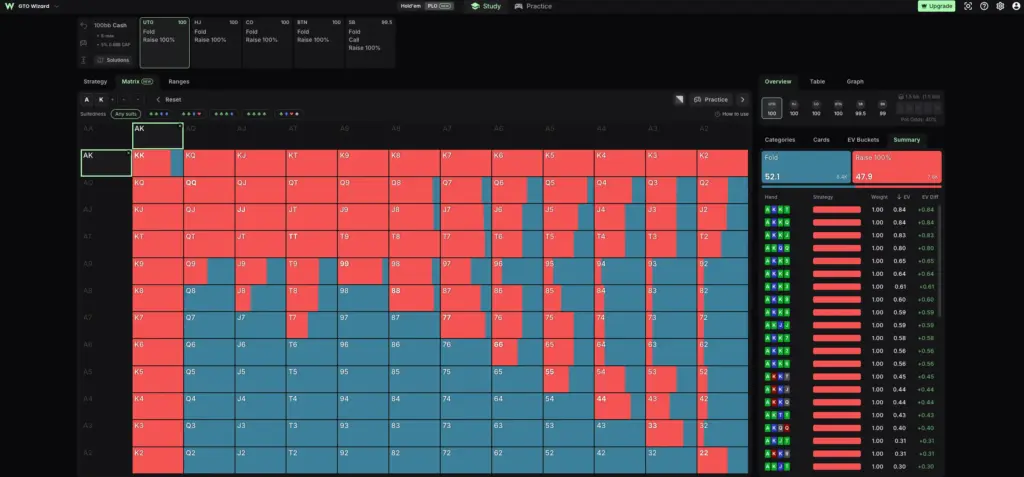
When it comes to studying, GTO Wizard is currently one of the absolute best tools on the market. They recently launched their brand-new, cloud-based PLO solver, allowing you to analyze complex preflop ranges and post-flop board textures directly from your browser, no heavy hardware required.
Best of all, you can test drive the PLO version completely for free (with certain daily limitations) to see how it works.
FAQ About the Best Omaha Starting Hands