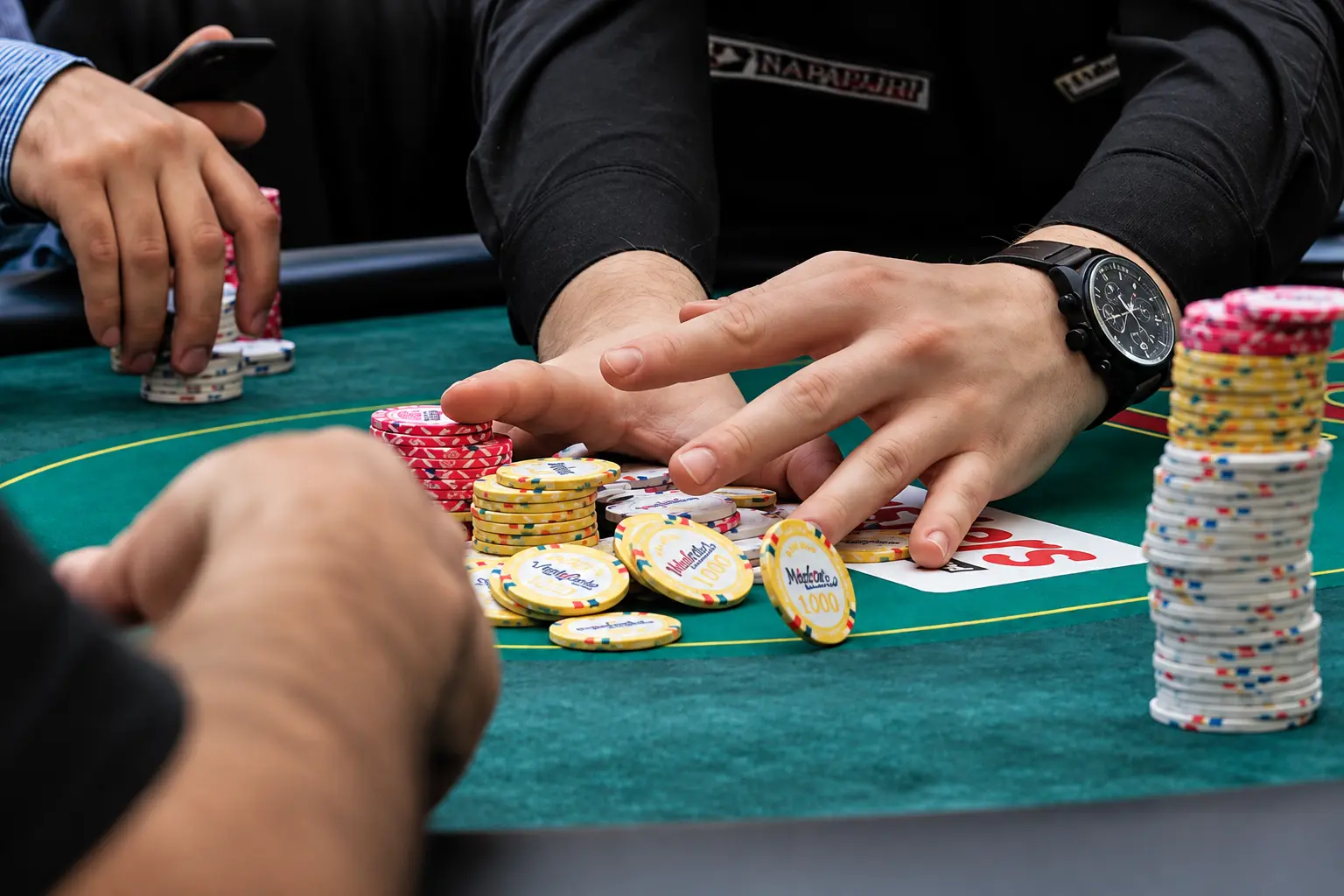

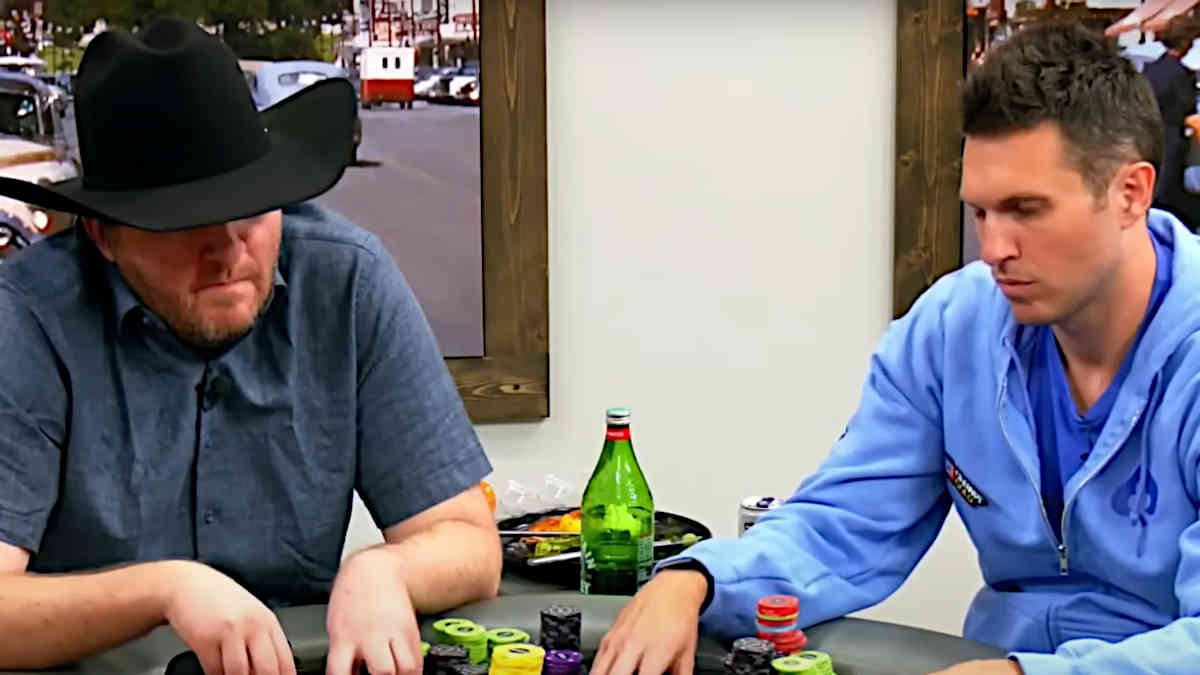
Doug Polk and Taras are two Poker at the Lodge regulars that we’ve become quite used to seeing in big pots. Although their approaches to the game are vastly different, both are action players who aren’t afraid to put their chips to work.
So, what happens when these two pick up strong hands and go head-to-head? We got a pretty good glimpse of that scenario during a recent streamed game.
The blinds are $50/$100, and there is no straddle active in this particular hand. Doug Polk is the effective stack, starting with $87,000.
Preflop Action
The hand begins with seven active players and a player from an early position opening to $300 with 6♠5♣. Taras is in the cutoff with 7♠7♦and decides to 3-bet to $1,000.
Doug Polk picks up J♦10♦ on the button and goes for a 4-bet, making it $3,000 to go. This folds out everyone but Taras, who makes the call, and the two proceed to the flop with $6,550 in the middle.
Preflop Play Analysis
The original open with small off-suit connectors from an early position is certainly on a looser side, and a hand like 6-5 off is really an easy fold.
Facing an open with pocket sevens, Taras can certainly go either way. Just calling in position is fine, but 3-betting to potentially get the pot heads-up and define ranges a bit better is perfectly fine.
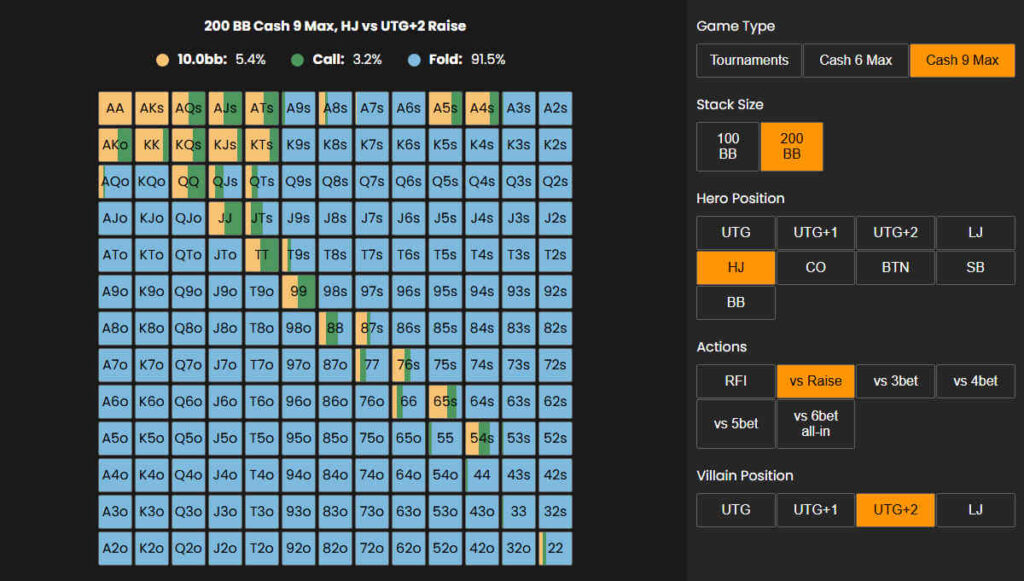
Doug Polk has a very interesting decision with his J♦10♦. Being on the button and playing extremely deep, this hand is way too strong to fold. Calling is a fine option, but taking a more aggressive route and 4-betting has its merits as well.
By 4-betting, Polk not only takes control of the pot, but gives himself a chance to play aggressively on certain board textures that he couldn’t represent as well if he were to just call.
At the same time, his opponents might find it more difficult to put him on a hand on those textures that his actual hand interacts well with.
With heaps of money to still play for, Taras certainly has more than good enough implied odds to see the flop and try to drill his set, so his call is super standard.
Flop Action
The flop comes A♠8♣7♥, so Taras finds his money card. Polk, on the other hand, only has a gutshot.
Taras plays it in flow and checks to Polk, who fires a continuation bet of $1,500. Taras check-raises to $7,000 and Doug calls, bringing the pot to $20,550.
Flop Play Analysis
Despite drilling a set, Taras should always check to the preflop aggressor in this spot, especially on an ace-high board in a 4-bet pot.
Polk didn’t connect with the flop much, but because he picked the aggressive approach, he can represent all strong A-X holdings as well as pocket aces. So, he goes for a relatively small continuation bet, as he would with all his strong hands.
In position, Taras could consider just calling. However, out of position, he wants to start building the pot, so his raise makes sense. It will fold out all of Polk’s bluffs, but Doug is telling a story of a big poker hand, and if that’s the case, he’s not going anywhere.
Facing a raise and with only four outs to the nuts, Polk could certainly fold here, and that would be the easiest way to play this hand.
However, with position and loads of experience playing this particular opponent, he probably believes there are other ways for him to win the hand even if he doesn’t catch the straight.
Turn Action
The turn is the 9♣, making the board A♠8♣7♥9♣. Taras bets out for $10,000, and Polk bumps it up to $30,000.
Taras takes a few moments to go over his options and decides on a call, bringing the pot to $80,550, going to the river.

Turn Play Analysis
The turn brings the gin card for Polk, giving him the nuts. Taras is probably not thrilled to see the nine, as it does complete a couple of straight draws from the flop, although it’s not as bad as a six or a jack. Additionally, with Polk 4-betting before the flop, he’s unlikely to have 6-5.
With that in mind, Taras continues betting, and he goes for a healthy half-pot bet.
Having turned the nuts and with position on his opponent, Polk can certainly just call here. By raising, however, he makes it much easier to get the rest of the money in on the river, leaving himself with just a half pot bet behind if Taras calls.
Despite having a bottom set, this isn’t the most comfortable spot for Taras. Doug is representing a monster, and his set of sevens is starting to shrink a bit. That said, it’s hard to fold against an aggressive, competent player who you know is well capable of making big moves. So, he makes the call.
River Action
The river is the board-pairing A♦, for the full runout of A♠8♣7♥9♣A♥. Taras fills up but checks it over to Polk.
Doug quickly moves all-in for $46,600 with his straight. Taras takes a few moments to think about the situation and then tosses in the calling chips to win the pot of over $170,000.
–
River Play Analysis
The ace on the river is an interesting card. Doug no longer has the nuts, and if Taras had a hand like 9-8 for two pair, he just got counterfeited, which means he won’t be able to extract value. On the other hand, if he has a hand like a set of sevens or eights, Polk’s straight is no good.
Still, once Taras checks, Doug has to go for value and hope his opponent has a lone ace that just improved to trips, or even a weaker hand that he decides to bluff-catch with.
For Taras, this isn’t a snap call. The way Polk played this hand, he can easily have hands that beat him, such as bigger sets and A-9 and A-8 combos that rivered a bigger boat. There aren’t that many hands that Doug can play this way for value that are behind: JT and maybe a hand like AK and AQ.
Eventually, Taras does make the call, largely because he knows Polk is capable of having all sorts of bluffs in this spot, and that call is correct, but not as easy as it may seem at first glance.