

Master poker strategy with PeakGTO. Try this poker solver for free.
Having mostly covered different continuation betting spots in single-raised pots in tournaments, it is time to move on to 3-bet scenarios.
Navigating 3-bet pots in MTTs is somewhat easier than in cash games, as stacks are shallower to begin with, which means the SPR is lower, which simplifies things.
In this article, we’ll focus specifically on the GTO strategy for continuation betting in position in 3-bet pots on different types of dry boards. Our default scenario is button vs. cutoff at 40 big blinds effective, but we’ll also touch on strategies for 25 and 60 blinds.
Like we always do with these lessons, before we dig into specific examples, here are a few main highlights for these spots:
- We are using small, quarter-pot c-bet sizing almost exclusively in all spots
- C-bet over 80% of dry ace-high flops
- With shorter stacks, we are c-betting almost 100% of ace-high flops
- Continue 85%+ on dry high-card boards – dyer the texture, higher the c-bet frequency
- C-bet around 70% of low dry flops
Tip #1: Bet Small on Over 80% Ace-High Dry Flops
On ace-high dry flops like A♠7♥2♣, we should be c-betting at a very high frequency using exclusively small, quarter pot sizing. These are types of flops where we’ll have a significant range advantage over the cutoff player, making our strategy fairly straightforward:
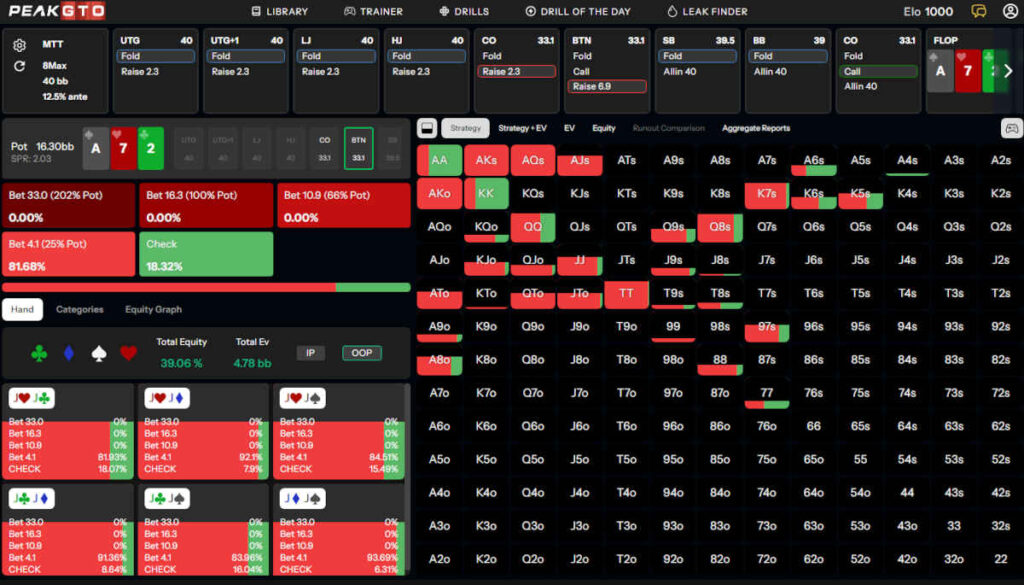
Only hands that we are checking at a high frequency (over 50%) are A4s, pocket aces, pocket kings, A6s, and pocket sevens. Other than this, we are c-betting with pretty much our entire range in this spot, occasionally checking back with hands like K6s, K5s, and T8s for balance.
When playing 60 big blinds effective, our continuation betting percentage increases to 94%. At this stack depth, our 3-betting range on the button is somewhat wider, which is why there are additional hands in our c-bet range as well. You’ll also notice that we are betting much more frequently with hands that leaned toward checking back at just 40 big blinds:
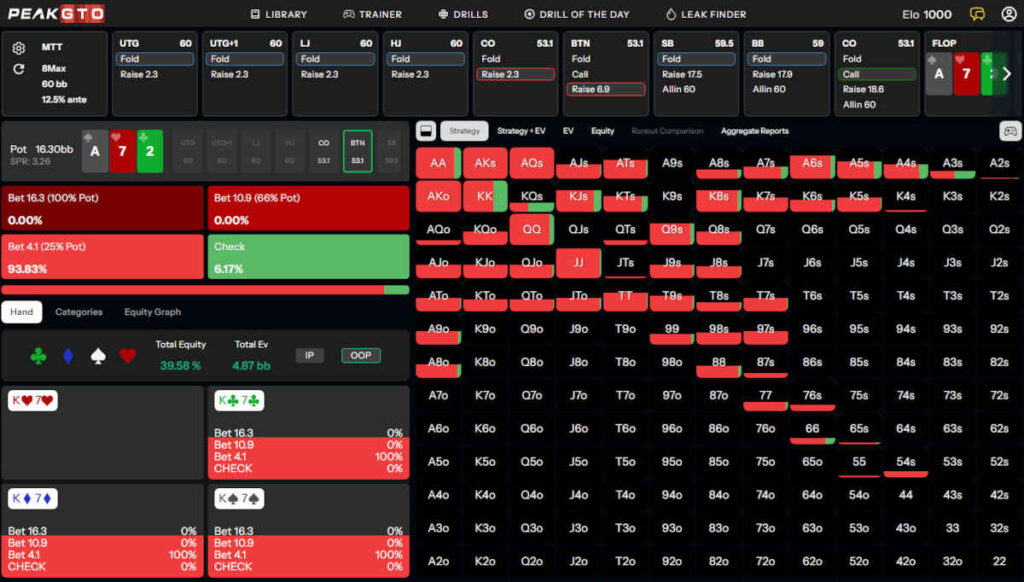
Looking at the above picture, if you wanted to simplify your strategy in these spots and simply always continuation bet after the cutoff checks to you, you would be perfectly fine.
At the stack depth of 25 big blinds effective, our continuation bet percentage goes up even more, going up to almost 98%. Naturally, the total number of combos we’ll have in these spots is smaller, as we our preflop 3-betting strategy is much more conservative, but once we get to the flop, we will continue pretty much always, once again betting a quarter of the pot:
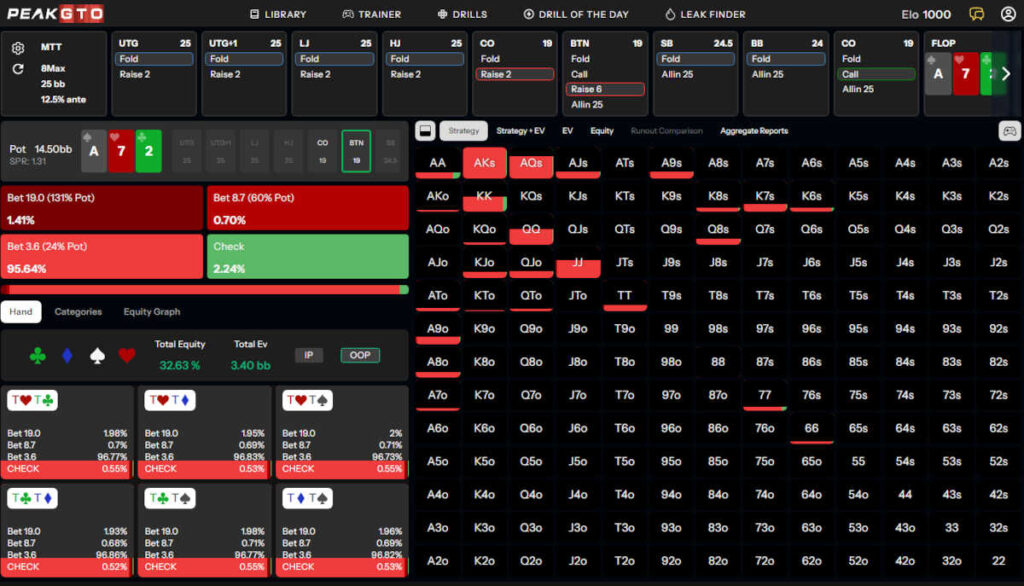
So, to sum up this part, we are c-betting ace high dry boards at a very high frequency, always using a small c-bet sizing. As stacks get shorter, our continuation betting frequency increases, reaching almost 100% when playing 25 big blinds effective.
Tip #2: C-Bet at a Very High Frequency on Dry High Card Flops
When it comes to dry boards containing a high card, the GTO c-betting strategy varies slightly depending on the specific texture, but it always remains very high, ranging from 85% to almost 100%.
For example, on a board like K♠8♥3♦, we are c-betting around 85%, using the 25% of the pot sizing. Our checking range consists mostly of very strong hands (KK, 88), a few medium-strength hands with decent showdown (QQ, JJ), and some bluffs with backdoor potential, such as T9s and T8s.
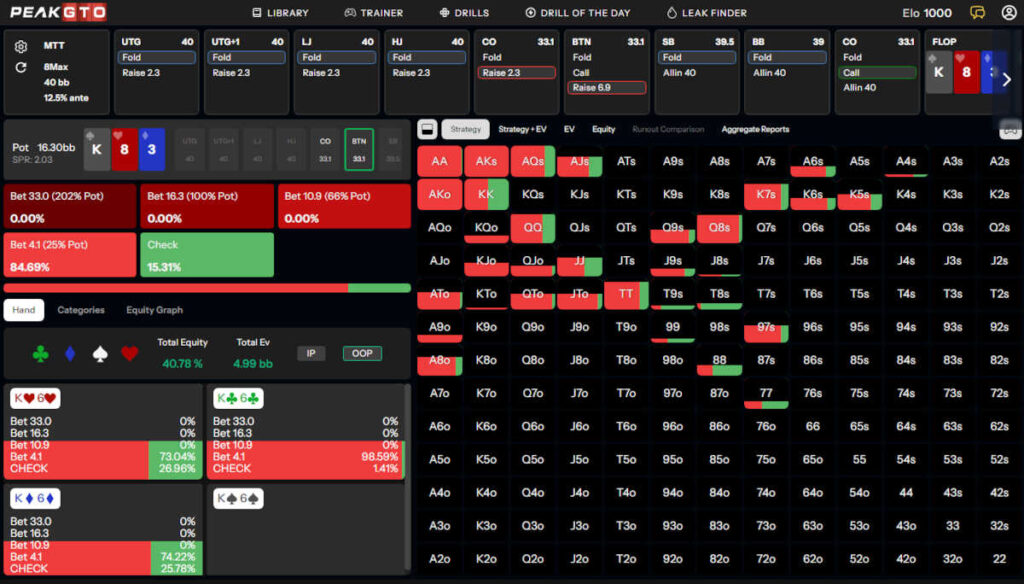
As the board texture gets “dryer,” meaning that the OOP player is less likely to connect with it, our c-bet percentage increases, going up to pretty much 100%, as we can see on the example of the Q♠7♥2♦ flop:
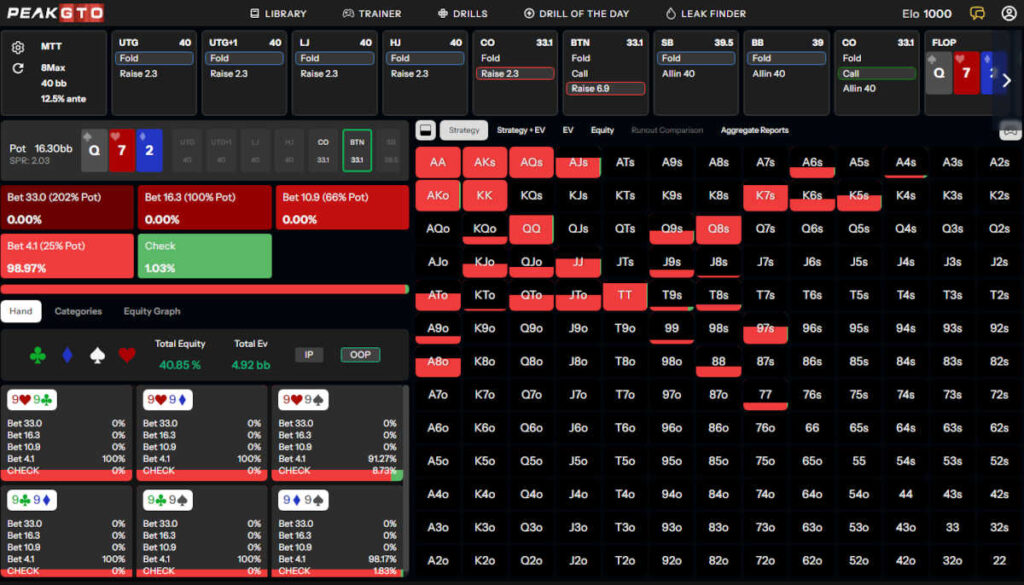
With deeper stacks, our c-bet percentage increases across the board, so if we look at the same texture of K♠8♥3♦ that we continued on at 85% when playing 40 big blinds deep, we see that solver suggests c-betting 100% when playing 60 big blinds effective.
At 25 big blinds effective, the overall c-bet percentage increases (90% to 100%), following the same pattern, i.e. we are continuing more frequently on boards that are dry and contain more lower cards. So, we are once more c-betting 100% on the Q♠7♥2♦ flop and 89% on the K♠8♥3♦ texture:
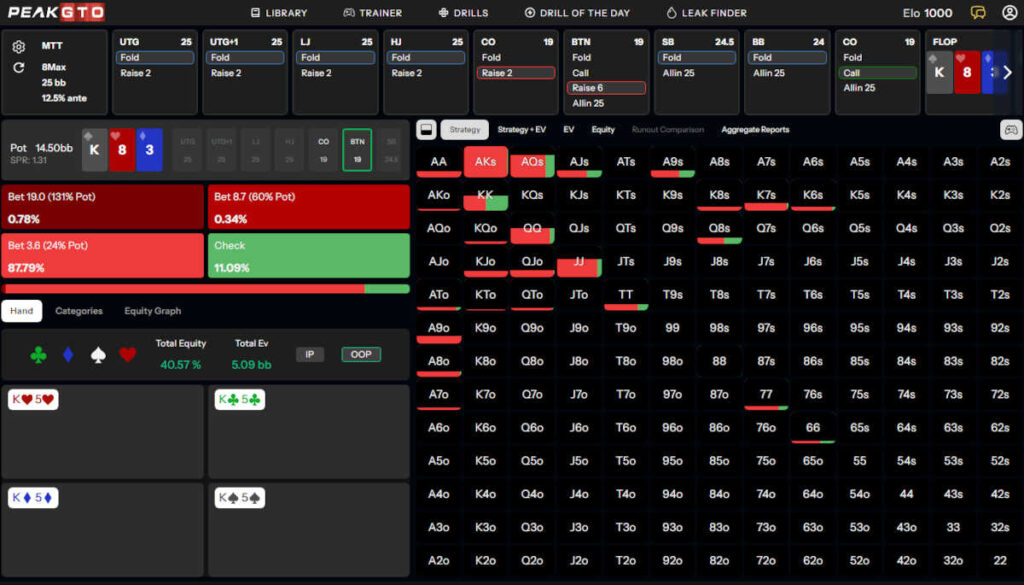
Generally speaking, these are spots that we will be c-betting at a very high frequency and, once again, small (quarter of the pot) sizing is our go-to choice across the board.
Tip #3: Continue Just Over 70% on Low Dry Boards
Dry flop textures containing low cards are the ones that stand out from the rest covered in this article, as these are the boards that we’ll be checking back at a reasonably high frequency.
For example, if we look at the 9♥5♦2♣, the solver suggests continuing at around 72% and checking back almost 28%:
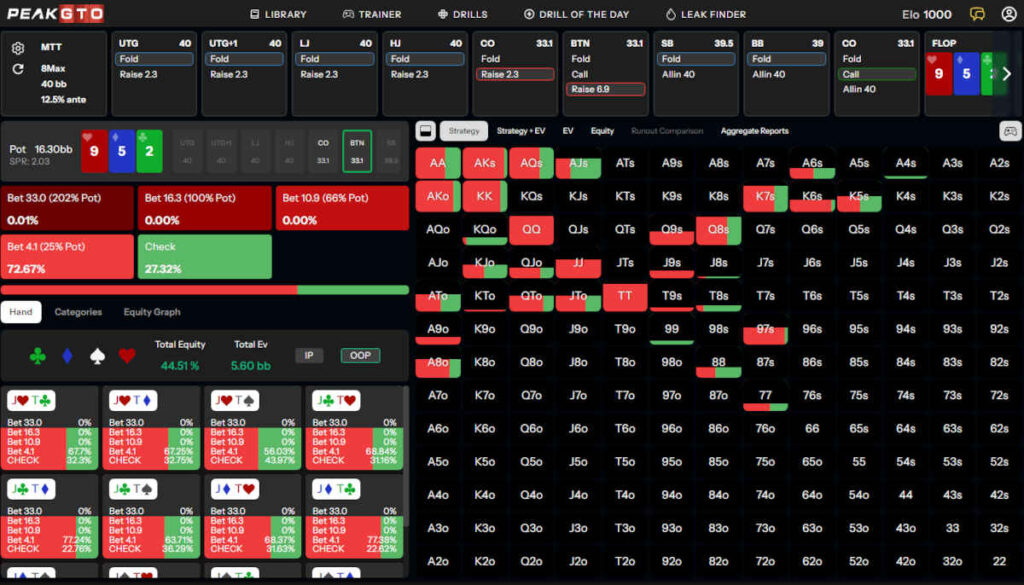
As you can see, our checking range is split pretty evenly across our entire range, as a mix of some strong hands that don’t need much protection and some weaker holdings that we want to get to turns and rivers with while risking as few chips as possible.
Hands that remain 100% in our betting range are strong holdings that can use protection from overcards, such as QQ, JJ, and TT. We are also always c-betting A9 as our strongest top-pair combo.
At 60 big blinds, our overall strategy remains quite similar, but this is the first time that solvers introduce a mixed sizing approach. We are c-betting at around 78%, utilizing 25% and 66% pot sizing:
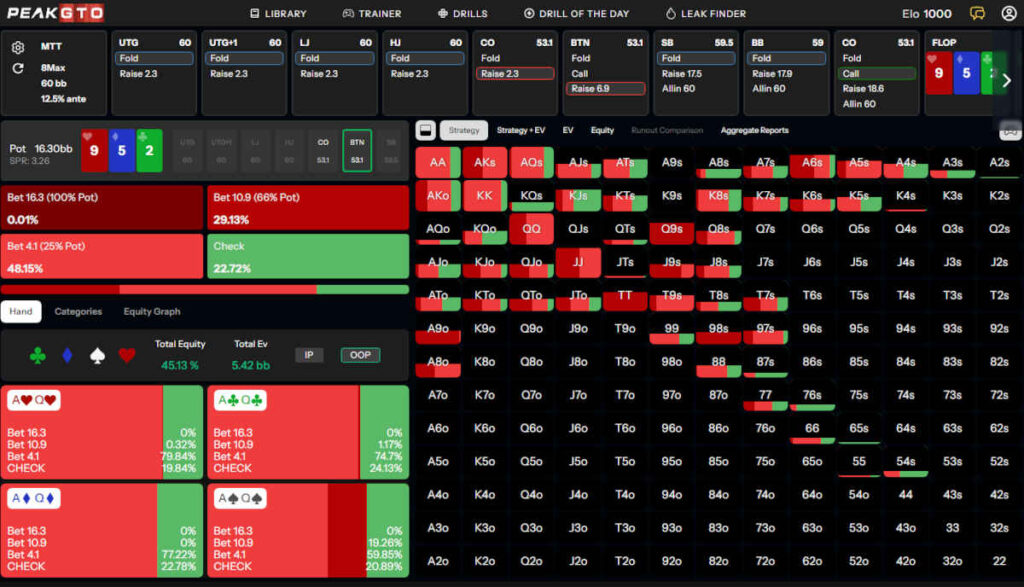
While it is once again a mixed strategy, you’ll notice that the big sizing is weighted heavily toward value hands that need protection, namely A9, TT, Q9s, J9s, and 98s. These are balanced with hands that stand to improve on turns and rivers, like AKs, A8s, Q8s, and QTs.
Finally, at 25 big blinds effective, we are c-betting almost always, with a very tiny percentage of check-backs. Our default sizing is 24% of the pot, with a mix of larger bets and all-ins added to the mix:
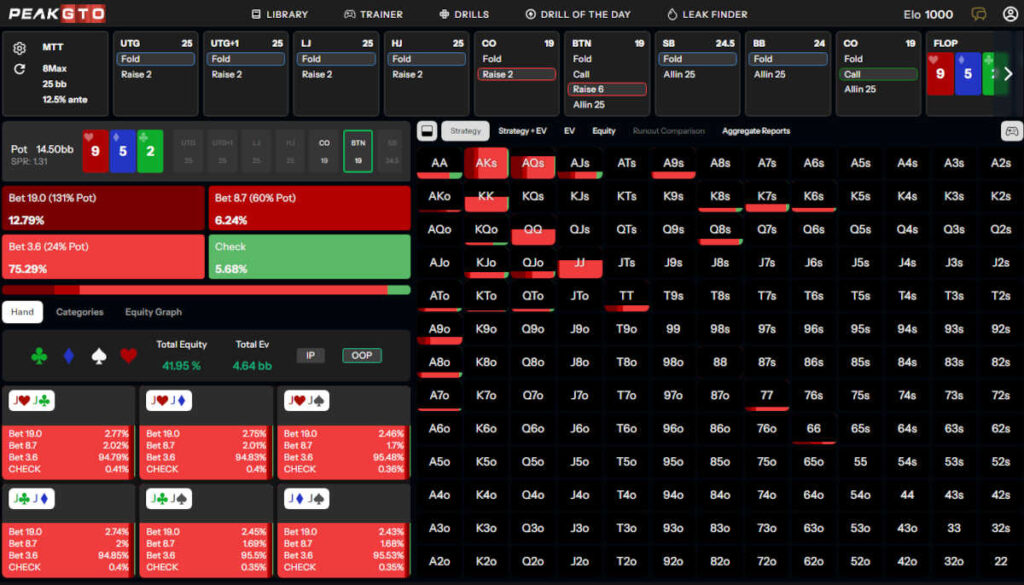
As for the hands that we should use as all-ins, these are a mix of strong, but vulnerable holdings, such as A9o and TT, middling pairs with blocker properties (66, 77), and some of the strongest ace-highs, such as AKs, AQs, and AJs.