
For decades, players improved through raw experience, late-night forum debates, and endless trial and error at the tables. Today, the landscape is entirely different. Understanding how AI changed poker strategy is essential for anyone looking to compete in modern games. With advanced poker AI tools, concepts once reserved for elite professionals are now accessible to anyone. Artificial intelligence didn't just create stronger opponents; it fundamentally transformed how we study and apply knowledge, bridging the gap between guesswork and mathematical certainty.
Studying Before the Poker Solver
Before modern software entered the picture, improving at poker was largely based on intuition. Players had far fewer tools available, so learning relied heavily on classic books by legends like Doyle Brunson and David Sklansky or on advice from peers.
Online communities like Two Plus Two became massive gathering places for strategy debates. While many discussions were insightful, they shared one major limitation: nobody could mathematically prove who was right. Advice such as “never slowplay a monster” or “always c-bet this board” was repeated as gospel, with no real way to verify if it was actually the optimal play.
While today we are lucky to have brilliant, math-backed GTO poker books, such as Michael Acevedo's “Modern Poker Theory“ or Matthew Janda's work, these simply did not exist during the poker boom. Early players had to rely entirely on exploitative experiences.
The Revolution: Enter the Poker Solver
The biggest initial shift in modern strategy didn't come from artificial intelligence, but from the poker solver. Programs like PioSolver and MonkerSolver gave players access to software capable of calculating near-optimal solutions.
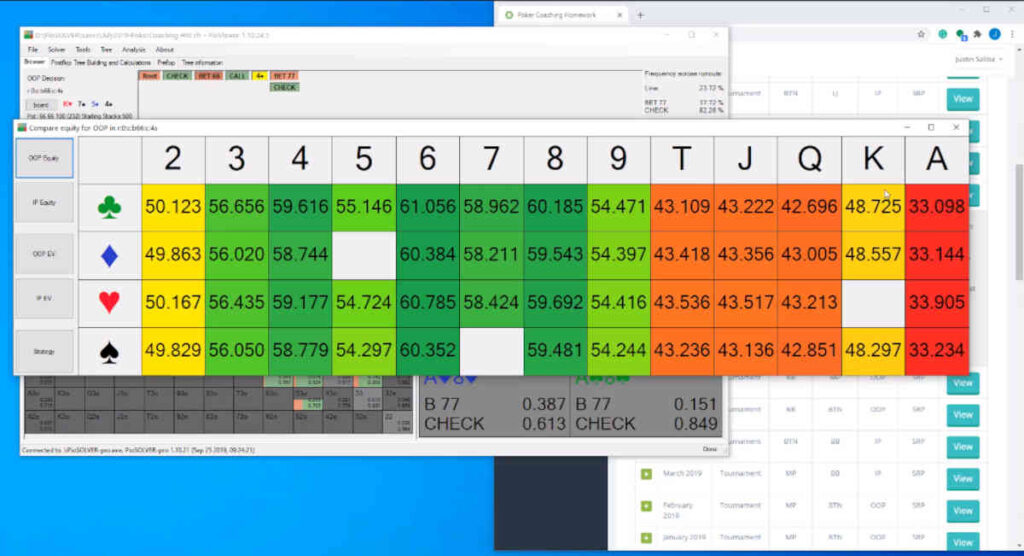
I vividly remember my own early experiences. Years ago, my coach and I used to review my hand histories using PioSolver. Whenever we wanted to analyze a specific post-flop spot, the process was incredibly complex and time-consuming. We had to input exact ranges, set up the bet sizes manually, and sometimes wait a very long time just for the computer to run the simulation. You needed a highly powerful PC just to get a basic answer.
Because of hardware limitations, early solvers could only realistically solve Heads-Up situations. If three or four players saw a flop, the decision tree became too massive for standard computers to handle. Despite these clunky beginnings, solvers proved that poker is far more nuanced than fixed rules would suggest, introducing concepts such as mixed-frequency betting, polarized range betting, and overbetting.
Man vs. Machine: The Evolution of AI in Poker
While players were struggling with slow simulations at home, researchers were building supercomputers to “solve” the game entirely. The idea of a machine outperforming humans in a game of incomplete information, bluffing, and hidden cards once seemed impossible.
That assumption was shattered in 2017. An AI system called Libratus defeated four elite heads-up No-Limit Hold'em pros over 120,000 hands. Because early solvers and AI models focused heavily on heads-up formats, experts wondered if AI could ever master a full ring game. Just two years later, in 2019, an AI named Pluribus successfully competed in and crushed 6-Max No-Limit Hold'em games. This was a monumental milestone, proving that machines could navigate complex, multi-way environments better than the best humans in the world.
Translating the Data: How Poker Players Use AI Today
Thankfully, you no longer need a NASA-level supercomputer or an hour of waiting to analyze a single hand. This is where modern software completely changed the landscape.
If you want to know how poker players use AI in today's ecosystem, think of it as an interactive, real-time tutor. Rather than forcing players to build complex decision trees in a raw solver, platforms powered by AI Poker technology, such as GTO Wizard, have pre-solved billions of situations. You can find the exact solution to your hand in milliseconds.
More importantly, modern poker AI explains the why. You can ask the software why a specific hand prefers a check over a bet, and it will explain the underlying principles instantly. This evolution transformed the software from a complex data engine into an accessible educational tool, dramatically accelerating the learning curve.

If you want to stop guessing and start mathematically proving your strategies, it's time to upgrade your study routine. Check out our comprehensive guide to the best poker training software to find the perfect tools and solvers for your current skill level!
Beyond the Math: How AI Improves Your Mental Game
When discussing poker AI, most players focus entirely on strategy, ranges, and bet sizing. However, one of the most underrated benefits of studying with modern software is its profound impact on your mental game and overall poker psychology.
Poker is a game of high variance. You can make the mathematically perfect decision and still lose your entire stack to a lucky river card. In the past, a devastating bad beat or a prolonged downswing would easily trigger “tilt”, leaving players questioning their entire strategy and losing confidence.
Today, poker AI acts as an objective judge. After a brutal session, you can plug your hand histories into the software. If the AI confirms that your all-in was a highly profitable (+EV) play, the sting of losing the pot disappears much faster. You learn to detach your emotions from short-term financial results and focus entirely on the quality of your decision-making. Studying with AI builds unshakeable confidence, ensuring that when the variance gets tough, you trust your strategy rather than panicking and changing your playstyle.
Exploitative Play: Why Poker Coaching Still Matters
With machines capable of calculating the perfect move in seconds, a logical question arises: do human coaches still have a place in the game? The answer is a resounding yes. In fact, professional poker coaching is more valuable now than ever before.
Solvers and AI assume that your opponent is also playing a perfect, unexploitable strategy. In reality, human beings make massive mistakes. They tilt, they fold too much to 3-bets, and they bluff at the wrong frequencies.
This is where the human element, specifically Exploitative Play, becomes crucial. A quality poker training program teaches you how to deviate from the AI’s baseline strategy to maximally exploit your specific opponents. Coaches help you:
- Identify recurring patterns and psychological leaks in your own game.
- Understand “node-locking”, which is adjusting solver strategies to crush human errors.
- Filter through information overload, ensuring you focus only on the concepts that will actually increase your win rate at your current stakes.
Poker AI can show you the theoretical finish line, but a coach helps you navigate the actual race against flawed human opponents.
The Future of Poker Education
The relationship between artificial intelligence and human strategy is not a competition; it is a partnership. The strongest players of the future will be the ones who leverage poker AI for rapid data analysis and pair it with expert poker coaching to execute exploitative, winning strategies at the tables.

Knowledge once guarded by a select few and requiring hours of tedious simulation to uncover is now available instantly to anyone willing to study. The future of poker education has never been more exciting, and the players who adapt to these new tools will be the ones dominating the leaderboards for years to come.
The true value of studying with a tool is using it to exploit the mistakes of everyday human opponents. Put your knowledge into practice and find the softest games available by visiting our regularly updated list of the best online poker sites!
FAQ About Poker AI Solvers