
Poker hand analysis often becomes far more interesting when the solver-approved play also happens to decide a major title.
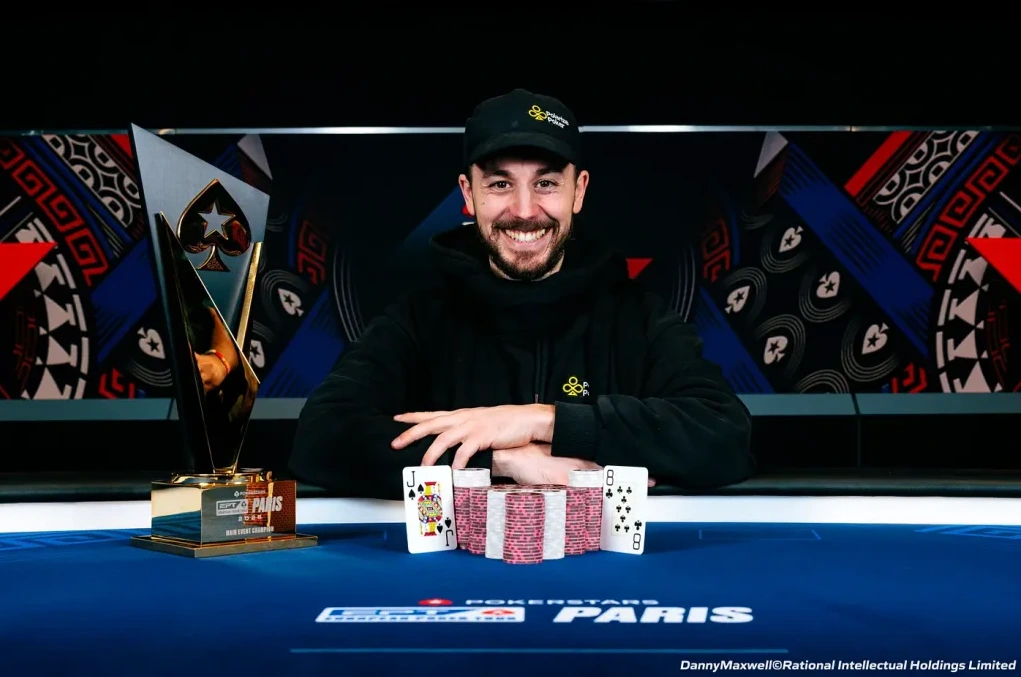
That was exactly the case during the heads-up battle of the 2026 EPT Paris Main Event, where Jorge Abreu and Felix Schneiders collided in a pot that ultimately decided the tournament and a €1.1 million first-place prize.
At first glance, the hand looks relatively straightforward. A heads-up limp pot escalates into a tense postflop confrontation before all the chips eventually go in on the turn.
Several decisions from both players sit in that uncomfortable space between solver-approved theory and real-world tournament pressure, especially with an EPT title and more than €400,000 in pay jumps on the line.
Using solver outputs alongside practical poker reasoning, we’ll break down the key decisions in the hand and examine how closely both players adhered to modern GTO poker strategy under pressure.
The Poker Hand Breakdown
The hand took place during heads-up play at the 2026 EPT Paris Main Event between Jorge Abreu and Felix Schneiders, with blinds set at 150,000/300,000/300,000.
- Jorge Abreu: roughly 40 million chips (133 big blinds)
- Felix Schneiders: just over 4 million chips (14 big blinds)
Although the stack disparity was significant, the pressure remained enormous considering the €431,285 pay jump between first and second place. Before diving into the poker hand analysis itself, here’s a look at the final table payouts from the 2026 EPT Paris Main Event:
| Place | Player | Country | Prize |
|---|---|---|---|
| 1 | Jorge Abreu | Portugal | €1,148,600 |
| 2 | Felix Schneiders | Germany | €717,350 |
| 3 | Enrico Coppola | Italy | €512,400 |
| 4 | Casimir Seire | Finland | €394,150 |
| 5 | Nazar Buhaiov | Ukraine | €303,150 |
| 6 | Tomas Jozonis | Lithuania | €233,200 |
| 7 | Thierry Gogniat | France | €179,350 |
| 8 | Sami Bechahed | France | €137,950 |
The hand itself started relatively quietly. Abreu completed the blind with J♠8♣ before Schneiders raised to 900,000 from the big blind holding Q♦Q♣. Abreu made the call, taking the two players to a flop of J♣6♣3♠.
Schneiders continued for 450,000, and Abreu responded with a raise to 950,000. The German player called.
The turn brought the 7♠. Schneiders checked, Abreu bet 700,000 before Schneiders moved all-in for 2.1 million total. Abreu quickly called with the top pair. The 8♦ completed the board, improving Abreu to two pair and securing him the EPT Paris title.
You can also watch the full hand on the official PokerStars YouTube stream before diving into the analysis below.
Preflop: Standard or Already Interesting?
At first glance, the preflop action looks fairly standard for modern heads up poker strategy. Jorge Abreu completed the small blind with J♠8♣, while Felix Schneiders responded with an isolation raise to 900,000 holding Q♦Q♣. Abreu then called, taking the hand postflop.
From a GTO poker strategy perspective, both decisions are completely reasonable:
- The Limp: At shorter effective stack depths, limping from the small blind/button becomes a very common approach in heads-up play. Rather than opening aggressively with an extremely wide range, players often prefer to protect weaker hands (like J8o) by mixing limps into their strategy.
- The Iso-Raise Sizing: Schneiders’ isolation raise with pocket queens is standard, but the sizing is key. Instead of moving all-in with 14 big blinds, Schneiders chose a non-all-in raise to 3x.
Many recreational players misunderstand short-stacked heads-up situations, assuming that every strong hand should simply be jammed preflop. In reality, modern strategy uses a mixture of non-all-in raises and jams. By raising smaller, Schneiders keeps dominating hands and weaker Jx combinations in the pot while still applying pressure.
Abreu’s call with J8o is also relatively standard according to solver-based preflop ranges.
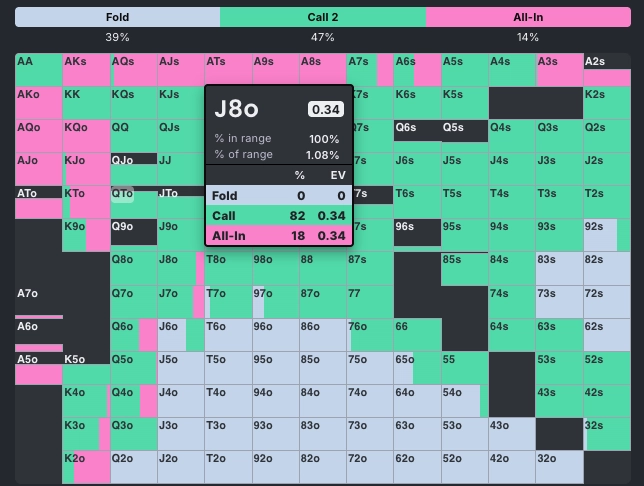
While the solver occasionally mixes in some all-ins at this stack depth, calling remains the preferred option overall.
Flop Analysis: Where the Hand Gets Interesting
The flop came J♣6♣3♠, giving Abreu top pair with J♠8♣ while Schneiders held an overpair with Q♦Q♣ and the queen-high flush draw.
Schneiders continued for 450,000 into 2.1 million, using a relatively small sizing that fits well within modern GTO poker strategy. On dynamic boards like this one, the preflop aggressor wants to c-bet at a fairly high frequency. From a poker solver analysis perspective, pocket queens are a very natural continuation bet here because they:
- Benefit from immediate value
- Deny equity against random overcards
- Block some of Abreu's strongest flush combinations (thanks to the Q♣)
Abreu’s response is where the hand starts becoming strategically more interesting. Instead of simply calling with the top pair, he raised to 950,000.
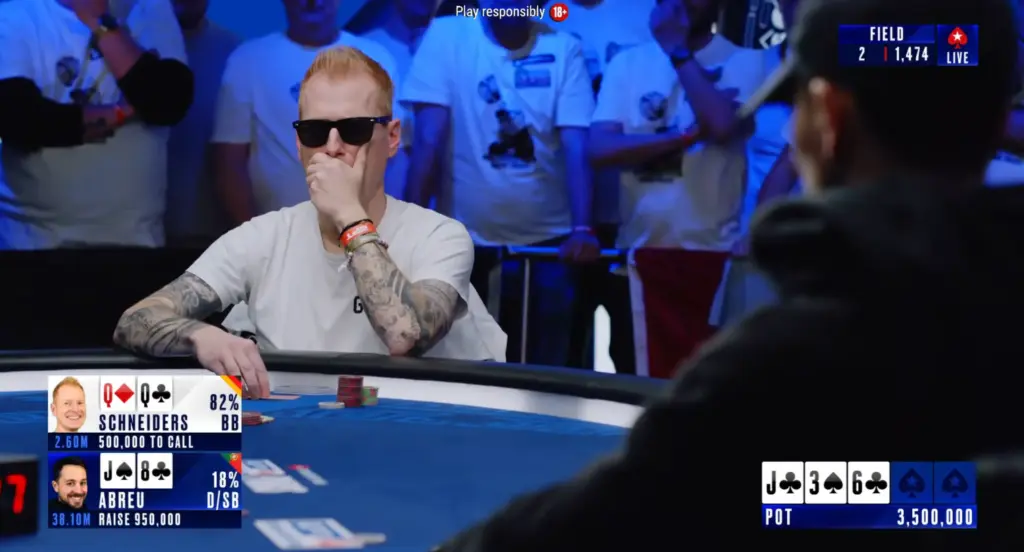
Many players may assume this should always be a call. After all, J8o is not an especially strong top pair holding against the preflop raiser's range advantage. But solver-based strategies often mix aggression into these spots. By raising, Abreu immediately applies pressure to overcards, weaker draws, ace-high hands, and certain pocket pairs, while still getting value from continuing flush draws.
Importantly, this is not a pure raise according to solver outputs. GTO prefers calling most of the time with J8o here, but mixing in some raises makes the range more difficult to play against and prevents the strategy from becoming overly passive.
Why QQ Mostly Calls Instead of Jamming
Schneiders then made the call with pocket queens rather than moving all-in immediately. After facing the flop raise, many players would instinctively expect QQ to jam with only around eight big blinds remaining.
But modern poker hand analysis approaches the situation slightly differently:
- Not all strong hands need the same level of protection.
- While Q♦Q♣ is undeniably strong on J♣6♣3♠, it still blocks several flush draws and performs relatively well on many turn cards.
- Queens are simply less desperate to force the money in immediately compared to weaker value hands or more vulnerable one-pair holdings.
As a result, GTO-based strategies often prefer calling in this exact spot. This is where recreational players tend to oversimplify: treating “strong hand + short stack” as an automatic all-in. High-level strategy is more nuanced. Schneider's flop call keeps Abreu’s bluffs and semi-bluffs alive while protecting his own continuing range.
Poker Hand Analysis: The Turn Jam Changes Everything
The turn brought the 7♠. After calling the flop raise, Schneiders checked to Abreu, who responded with a small bet of 700,000 into 4 million.
With so little left behind, many players would instinctively choose a larger sizing or move all-in. But smaller turn bets in low-SPR (Stack-to-Pot Ratio) situations can still apply enormous pressure while keeping weaker hands within the range. Abreu’s sizing allows Schneiders to continue making mistakes.
Schneiders moved all-in immediately for roughly 2.1 million total with Q♦Q♣. With stacks now heavily compressed, the solver strongly prefers to commit the remaining chips rather than allow difficult river decisions to develop.
Even though Abreu technically holds top pair, his kicker is weak, the board remains dynamic, and the pressure of an EPT title is massive. But Abreu ultimately found the call, and once the 8♦ landed on the river, the tournament was over.
Final Thoughts
This hand is a great example of how modern poker hand analysis goes far beyond simply asking whether a play was “correct” or “incorrect”. From the preflop limp/call strategy to the flop raise and eventual turn jam, nearly every decision in the hand exists in that uncomfortable space between solver-approved theory and real-world execution under pressure.
Many of these decisions may look straightforward when viewed in a solver, but applying them in a live EPT final table environment for more than €1 million is an entirely different challenge altogether.
If you enjoy this type of poker solver analysis and want to study modern GTO poker strategy more deeply, make sure to check out our full Octopi Poker review, where we break down the platform’s features, strengths, and training tools in detail.
You can also visit our guide to the best poker training sites online, where we compare and rank the top poker coaching platforms and study tools currently available for serious players.
Frequently Asked Questions (FAQ)