

If you have ever played against a strong regular, you have probably noticed their ability to make perfectly timed decisions. They know when you are continuation betting too wide or over-folding to aggression on the turn. For years, this level of precision was driven by highly customized poker HUD stats built specifically within third-party tracking software like PokerTracker 4 and Holdem Manager 3. Grinders would spend hours constructing complex, color-coded HUD profiles to expose their opponents' smallest statistical leaks.
Between 2010 and 2020, dedicated Heads-Up Sit & Go (SNG) games were in their absolute prime, and these custom-built HUDs were mandatory weapons. Over time, the regular speed and turbo formats completely dried up, leaving only hyper-turbos on a handful of sites. However, the death of the dedicated HU SNG lobby did not diminish the value of heads-up strategy. Every multi-table tournament (MTT) champion is crowned in a 1v1 battle, and every Spin & Go inevitably reaches a heads-up phase.
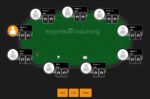
Today, the software landscape has shifted. While custom third-party trackers are still used where permitted, many modern online poker rooms have leveled the playing field by integrating their own analytics directly into the client. Utilizing a poker HUD, whether through a traditional tracker or modern built-in solutions like GGPoker's Smart HUD and the native HUD on CoinPoker, is still the fastest way to build an exploitative edge in any format.
A HUD Is Not Magic: Why You Need a GTO Baseline
One of the biggest misconceptions in poker strategy is that a HUD tells you what to do. It does not. A HUD simply records historical data and shows you exactly how your opponent is playing.
To make that data useful, you must compare it against a baseline. That baseline is Game Theory Optimal (GTO) play. When you know how an opponent should be playing (GTO), and you look at your HUD to see how they are actually playing, the gap between the two is where your exploitative profit lies.
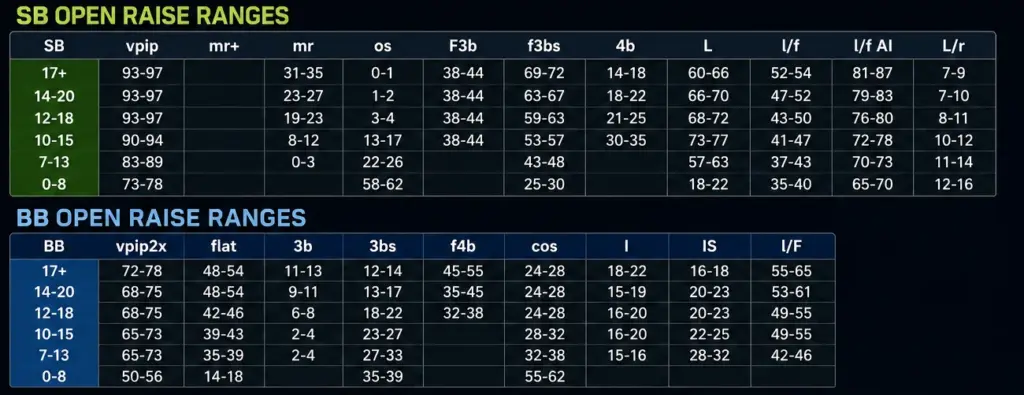
For example, if the GTO baseline suggests an opponent should defend their Big Blind against a min-raise 75% of the time, but your HUD shows they are only defending 50% of the time, you have found an immediate, profitable exploit: you can open-raise relentlessly. You don't need to memorize complex solver outputs; you just need to recognize these major deviations.
Field Adaptation: When to Throw GTO Out the Window
While Game Theory Optimal strategy is the ultimate baseline, it is not always the most profitable way to play. The most successful poker strategy is the one that adapts to the specific player pool you are facing.
In the prime years of Heads-Up SNGs, it was not uncommon to see regulars with massive GTO leaks, such as folding 60%+ to continuation bets or playing an incredibly passive, limp-heavy preflop style with almost no min-raises, posting incredible 6-7% EV ROIs. They were doing this by ignoring balance and purely exploiting the massive mistakes of recreational players (fish).
However, these extreme exploitative styles had a major flaw: they got absolutely crushed when they sat down against a solid regular.
This is why elite players often develop two completely separate approaches:
- An Exploitative Strategy for Recreational Players: Here, you ignore balanced frequencies. If a fish folds too much to C-bets, you bet 100% of your air. If they never fold top pair, you never bluff them and value bet relentlessly.
- A GTO-Based Strategy for Regulars: When facing another strong regular, neither player is making massive fundamental mistakes. In these battles, GTO becomes your armor. The winner is simply the player who uses their heads up poker HUD to spot the subtle patterns and micro-deviations first.
If you spend time studying solvers, your brain naturally becomes wired to recognize these deviations in regular battles. You don't have to be the biggest “fish crusher” in the room to be highly profitable; if you can quickly adapt to the regulars in your field, you will secure a long-term edge in any poker ecosystem.
The Sample Size Myth: Small vs. Large Samples
The most dangerous mistake you can make with a heads up hud is making major post-flop adjustments based on a tiny sample of hands.
Preflop statistics stabilize quickly because every single hand generates preflop data. Postflop statistics, like how often someone check-raises the turn, take thousands of hands to become reliable.
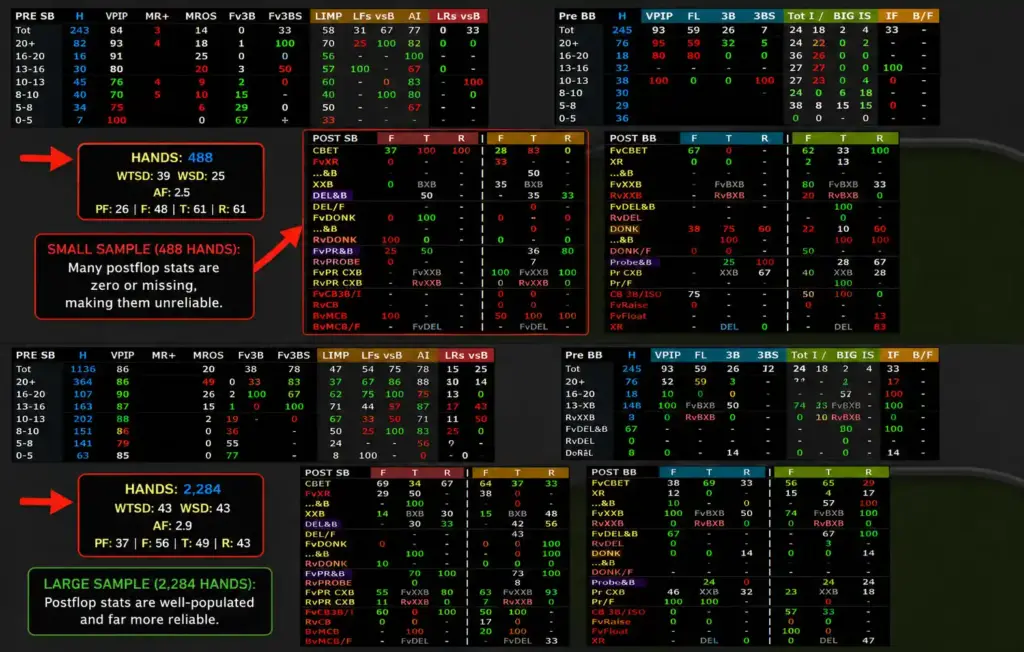
As illustrated above, a 488-hand sample is enough to trust core preflop numbers like VPIP and PFR. However, looking at the postflop section of the smaller sample reveals missing data points and unreliable frequencies. Wait until you have at least 1,500+ hands before trusting specific turn and river defensive stats.
The Core Preflop Heads-Up Poker HUD Stats
Preflop stats give you the quickest read on an opponent's fundamental player type. In Heads-Up play, these numbers will naturally be much higher than in 6-max cash games.
- VPIP (Voluntarily Put in Pot): Indicates how often they play a hand. In Heads-Up, a low VPIP (under 70% in the SB) is a massive leak, meaning they are bleeding chips by folding too much.
- PFR (Preflop Raise / MR+): Shows how aggressively they enter the pot. Comparing VPIP to PFR reveals if they are a passive limper or an aggressive raiser.
- Limp Frequency: Modern heads-up strategy heavily incorporates limping. Pay attention to whether they limp balanced ranges or only limp weak hands that fold easily to isolation raises.
- Fold vs 3-Bet (Fv3B): If this number is excessively high (e.g., 60%+), you can print money by expanding your 3-bet bluffing range.
How Effective Stack Size Dictates HUD Context
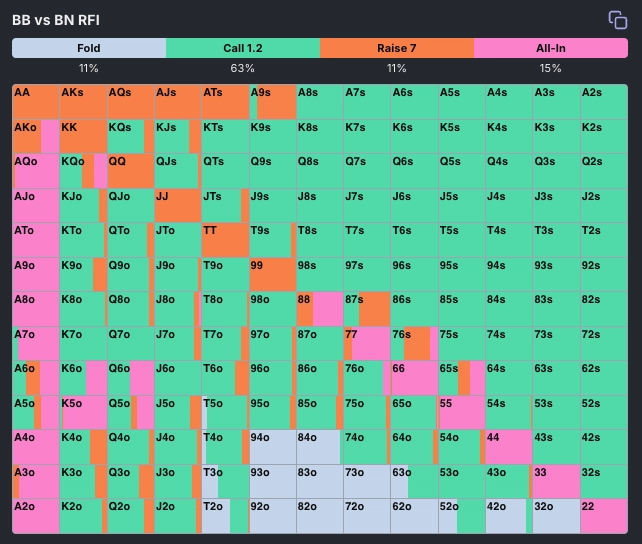
When evaluating poker HUD stats, context is everything. And in heads-up play, the single most important contextual factor is the effective stack size. A statistic that looks completely standard at 100 big blinds can be a massive leak at 15 big blinds.
If you are playing a deep-stacked cash game, preflop strategy heavily revolves around min-raising and complex 3-betting ranges. In this scenario, seeing a player with a high limping frequency usually indicates a weaker, recreational player.
However, if you are battling in the final stages of a Spin & Go or an MTT where the effective stacks are 15-25 BBs, the math changes completely. At these depths, Game Theory Optimal (GTO) strategy dictates a massive amount of Small Blind limping to protect your range and control the size of the pot. A strong regular playing a 20 BB stack might have a VPIP of 85% with a PFR of only 30%, utilizing a heavily balanced limping strategy.
If you ignore stack depth when evaluating your poker HUD stats, you will end up mislabeling elite regulars as passive fish. Always filter your HUD data by stack depth if your tracking software allows it.
The Postflop Secrets: Where the Real Edge Lives
Once your sample size is large enough, postflop poker HUD stats unlock the ability to soul-read your opponents. The best players group these stats into three strategic categories:
1. Aggression (Continuation Betting)
- Flop C-Bet: A player continuation betting 80%+ is betting their entire range, regardless of board texture. You can exploit this by floating wider in position or check-raising aggressively.
- Turn/River Barrel Frequencies: Does their aggression drop off a cliff after the flop? A high Flop C-bet combined with a low Turn C-bet identifies a “one-and-done” player. Call the flop, take the pot away on the turn.
2. Defense (Handling Pressure)
- Fold vs C-Bet (FvCB): If they fold more than 50% on the flop, you should c-bet near 100% of your air.
- Fold vs Check-Raise (FvXR): Identifies players who auto-bet the flop but immediately surrender to resistance.
3. Initiative (Probes and Delayed C-Bets)
- Probe Bet: This occurs when you check back the flop in position, and the out-of-position player leads the turn. A low probe frequency means they play passively when handed the initiative.
- Delayed C-Bet: If your opponent checks the flop to you and you check back, a delayed c-bet on the turn shows they know how to attack weakness.
Real HUD Analysis: Building an Exploitative Game Plan
Elite players do not stare at every number on their screen. They combine 2 or 3 critical stats to build a narrative.
Imagine analyzing a regular in your game. You notice they have a high Flop C-Bet (75%), a low Turn C-bet (35%), and a low Check-Raise (XR) frequency (5%).
You don't need a supercomputer to crack this code. The story is clear: this player fires an automatic continuation bet on the flop with mostly weak hands, gives up immediately on the turn if called, and refuses to check-raise without a premium made hand. Your counter-strategy is incredibly simple: flat-call their flop c-bets with a wide range, bet the turn when they check, and fold to their check-raises unless you hold a monster.
Identifying Player Archetypes Using Poker HUD Stats
Instead of reading isolated numbers, the most profitable poker strategy is to analyze your opponent's poker HUD stats to classify them into specific archetypes. Once you know their player type, your baseline adjustments become automatic. Here are the three most common heads-up profiles you will encounter:
1. The Passive (High VPIP / Low PFR / Low FvCB)
- The Stats: You will see a VPIP of 80%+, a PFR under 20%, and a Fold vs Flop C-Bet of under 35%.
- The Exploit: This player loves to limp preflop and hates folding postflop. Against them, your bluffing frequencies should drop to zero. Never try to run complex multi-street bluffs. Instead, expand your value betting range drastically. If you hit top pair with a weak kicker, bet it relentlessly for three streets.
2. The Aggro Maniac (High VPIP / High PFR / High 3-Bet)
- The Stats: This player will have a VPIP of 90%+, a PFR mirroring their VPIP (e.g., 85%), and a 3-bet frequency well above 25%.
- The Exploit: Maniacs win by applying relentless pressure and forcing you to over-fold. To counter them, you must widen your bluff-catching ranges and introduce more traps. Slowplay your premium hands postflop and let them fire their aggressive barrels into your disguised monsters.
3. The Tight Reg (Low VPIP / High Fv3B / High FvCB)
- The Stats: In heads-up terms, “tight” usually means a VPIP under 70-75% in the Small Blind. They will also have a high Fold vs 3-Bet (60%+) and tend to give up easily on the flop (Fold vs C-bet 55%+).
- The Exploit: This player is playing 6-max strategies in a 1v1 environment, and they are bleeding chips because of it. Steal their Big Blind relentlessly. 3-bet their opens with a highly expanded bluffing range, and fire automatic continuation bets on almost every dry flop.
Common HUD Mistakes to Avoid
Even with the best poker tools, players routinely sabotage their own win rates by misinterpreting their poker HUD stats.
Avoid isolating single statistics. A 75% Fold vs 3-Bet looks highly exploitable until you realize the player also 4-bets aggressively with the other 25% of their range. Always read stats in conjunction with one another.
Finally, respect table dynamics. HUD numbers represent a player's long-term average, not their current emotional state. If you have relentlessly 3-bet a regular five times in the last twenty minutes, do not expect them to fold the sixth time just because their historic “Fold vs 3-Bet” stat is high. Adapt to the flow of the game, use your HUD to spot the underlying leaks, and let the math dictate your adjustments.
Turn the HUD on Yourself: Finding Your Own Leaks
While the obvious benefit of a heads up poker HUD is exploiting your opponents, its most powerful application is entirely inward-facing. Tracking software like PokerTracker 4 or Hold'em Manager 3 acts as a massive database of your own poker history.
Elite players regularly review their “Hero Stats” to find their own strategic leaks. Ask yourself: How are my opponents seeing me?
If you look at your own database and realize your Fold vs 3-Bet is 70%, you can guarantee that the strong regulars in your games have already noticed. They are actively exploiting you by 3-betting you with any two cards. If your Probe Bet frequency is only 15%, you are giving away free equity every time your opponent checks back the flop.
Use your tracking software off the tables. Compare your personal database against the GTO baselines. Finding and plugging just one or two major statistical leaks in your own game will increase your win rate far more than finding a minor exploit in someone else's.
FAQ About Poker HUD Stats