
The hard truth about poker is that you cannot control whether you win or lose a specific hand. The cards fall where they may, and bad beats happen to the best players in the world. What separates long-term professional winners from recreational losers is their obsession with Poker EV (Expected Value).
While amateurs base their decisions on gut feelings and immediate results, professionals make decisions solely based on mathematical expectations. If you consistently make plays that have a positive expected value, the math guarantees that you will be a winner in the long run.
In this complete guide, you will learn what poker EV actually means, how to calculate your expected value in any given hand, and how to combine it with fold equity to crush your opponents.
What is Expected Value (EV) in Poker?
In poker, Expected Value (EV) is the mathematical calculation of what a specific play or decision is expected to win or lose on average over the long run.
Every action you take at the poker table – folding, checking, calling, betting, or raising – has an associated EV:
- +EV (Positive Expected Value): The decision will make you money over the long run.
- -EV (Negative Expected Value): The decision will lose you money over the long run.
- 0 EV (Break-Even): The decision will neither win nor lose money over time.
For example, if a specific call has an EV of +$20, it does not matter if you happen to lose the pot on that particular day. If you make that same call 1,000 times under the same mathematical conditions, you will net an average profit of $20 per attempt.
To understand EV, you must first understand poker equity – your rightful statistical percentage of the pot based on your chance of winning at showdown.
Quick Refresher: How to Estimate Equity with the Rule of 2 and 4
Before you can calculate your Expected Value (EV), you must know your equity – the statistical percentage chance that your current hand will win at showdown.
While you can't check a desktop calculator in the middle of a live hand, elite poker players use a simple mental math shortcut to estimate their equity in seconds: The Rule of 2 and 4.
To use this rule, you simply count your outs (the remaining unseen cards in the deck that will improve your hand to the winning combination) and multiply them by either 2 or 4:
The Rule of 2 and 4
- On the Flop (Two cards left to come): Multiply your outs by 4 to get your approximate winning percentage by the river.
- On the Turn (One card left to come): Multiply your outs by 2 to get your approximate winning percentage on the river.
-
1
 Bonus £40 Freeor £600 bonus
 - Trigger the bonus: You need to deposit at least £10 and generate £10 in rake to trigger the FREE training bonus. | 18+ | BeGambleAware T&Cs Apply
-
2
Bonus $600or $100 tickets
-
18+ | BeGambleAware T&Cs Apply | Read full T&Cs
-
3

Why This Matters for Poker EV
Imagine you hold a standard four-card flush draw on the turn. There are 13 cards of each suit in the deck, and you can see 4 of them (two in your hand, two on the board). This leaves you with 9 clean outs.
Using the rule for the turn:
9 outs x 2 = 18% Equity
If you were on the flop with those same 9 outs:
9 outs x 4 = 36% Equity
Once you have this rough equity percentage in your head, you have the exact mathematical foundation needed to plug into the EV formula and determine whether calling a bet will make or lose you money.
How to Calculate Poker EV?
Of course, just knowing the expected value exists in poker is not enough. You need to be able to actually calculate your expected value to make use of it. The formula for calculating your poker EV does not require any advanced math, but it can require some guesswork at times.
The core formula simply weighs the probability of winning against the probability of losing:
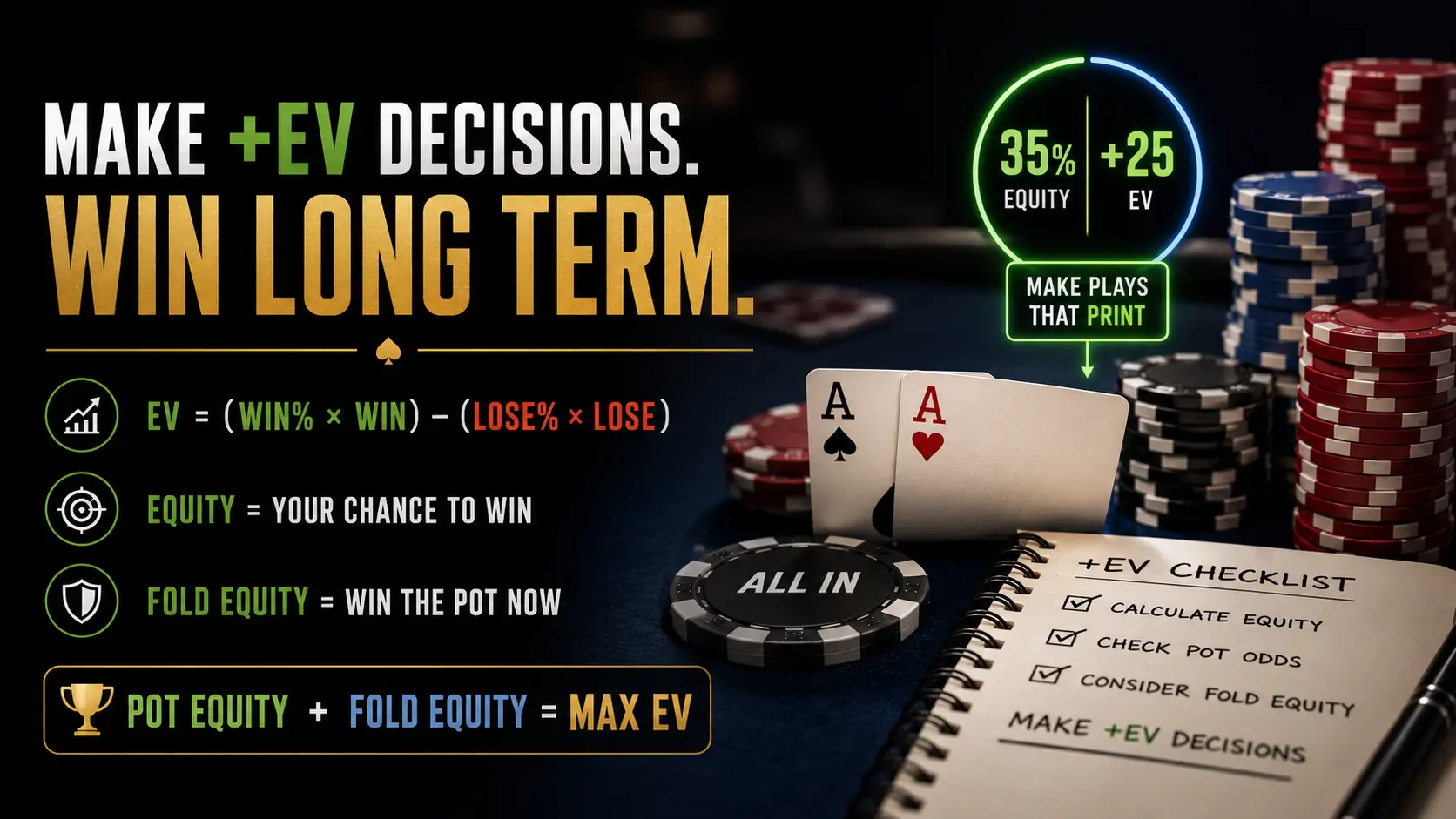
EV = (% Chance to Win x $ Amount Won) – (% Chance to Lose x $ Amount Lose)

Scenario 1: Facing an All-In Bet with a Draw
Imagine you are on the turn holding a flush draw. There is $500 in the pot. Your opponent pushes all-in for their remaining $500.
It costs you $500 to call, and if you win, you will take down the total pot of $1,000 ($500 original pot + opponent's $500 bet). Based on your outs, you calculate that you have roughly 35% equity (a 35% chance to win and a 65% chance to lose).
Let's plug these numbers into our formula:
- Chance to Win: 0.35 x $1,000 = $350
- Chance to Lose: 0.65 x $500 = $325
- Total EV: $350 – $325 = + $25
Even though you are the underdog and will lose this hand 65% of the time, calling is a +$25 EV decision. Over the long run, folding here is throwing away positive expected value!
Now, what if your opponent only had $300 remaining to push all-in? Let's recalculate:
- Chance to Win: $0.35 x $800 = $280
- Chance to Lose: $0.65 x $300 = $195
- Total EV: $280 – $195 = +$85
Because the risk-to-reward ratio improved, your call is now significantly more profitable (+EV). This is how mathematical pros make consistent money while amateurs fold out of fear.
Scenario 2: Maximum Value River Betting
EV isn't just about calling all-ins; it is also about maximizing your profit when you hold the nuts.
Imagine you are on the river holding the absolute unbeatable nuts. There is $500 in the pot, and you must decide between three different bet sizes: a small $100 bet, a medium $300 bet, or a massive $500 bet.
Since you have the nuts, your chance of losing is 0%. To find the highest EV bet, you must estimate how often your opponent will call each size:
- The $500 Bet (Called 20% of the time): 0.20 x $500 = +$100 EV
- The $300 Bet (Called 40% of the time): 0.40 x $300 = +$120 EV
- The $100 Bet (Called 80% of the time): 0.80 x $100 = +$80 EV
The math reveals that the $300 medium bet yields the highest Expected Value (+$120). A smaller bet gets called more often but generates less overall profit, while a massive overbet forces too many folds. Always choose the sizing that yields the highest long-term EV.
How to Stop Leaking EV in Your Games
In modern online poker, even small mistakes, like choosing the wrong bet size or calling a few dollars too wide, are known as EV Loss (or EV Diff). Making slightly negative EV plays over tens of thousands of hands will slowly bleed your bankroll dry.
The best way to eliminate negative EV blunders is to study your game using modern training software.
Supercharge Your Study with GTO Wizard
To know for certain whether your plays are +EV or -EV, we highly recommend training with GTO Wizard, the industry’s leading cloud-based poker solver.
GTO Wizard analyzes your played hand histories and grades every single decision you make. It's built-in trainer shows you exactly how much EV you gain or lose with different bet sizes, calls, and folds across millions of simulated game-theory-optimal situations.
If you want a complete breakdown of its features, pricing, and how to get the most out of the software, check out our comprehensive GTO Wizard Review
The Ultimate Weapon: Combining EV with Fold Equity
Knowing your raw card equity is enough when you are passively deciding whether to call a bet. However, poker is an aggressive game, and the true secret to maximizing your EV lies in Fold Equity.
Fold equity is the additional percentage chance you have of winning a pot simply because your aggressive bet or raise forces your opponent to fold their hand before showdown.
When you are the one betting or raising, your total winning expectation is derived from two sources:
Total EV = Pot Equity (Winning at Showdown) + Fold Equity (Opponent Folds Now)
Why Aggression Skyrockets Your Poker EV
Imagine you hold a flush draw with 35% raw pot equity. If you just call an opponent's bet, you rely 100% on hitting your flush to win.
However, if you choose to raise (semi-bluff), two profitable things can happen:
- Your opponent folds immediately, and you win the pot without needing to hit your draw (Fold Equity).
- Your opponent calls, but you still hit your flush on the river and win a massive pot (Pot Equity).
By adding fold equity to your equation, a hand that might be a slightly negative or break-even call can instantly transform into a massively +EV raise. Mastering the balance between pure equity and fold equity is the hallmark of an elite poker player.
Frequently Asked Questions (FAQ) About Poker EV