
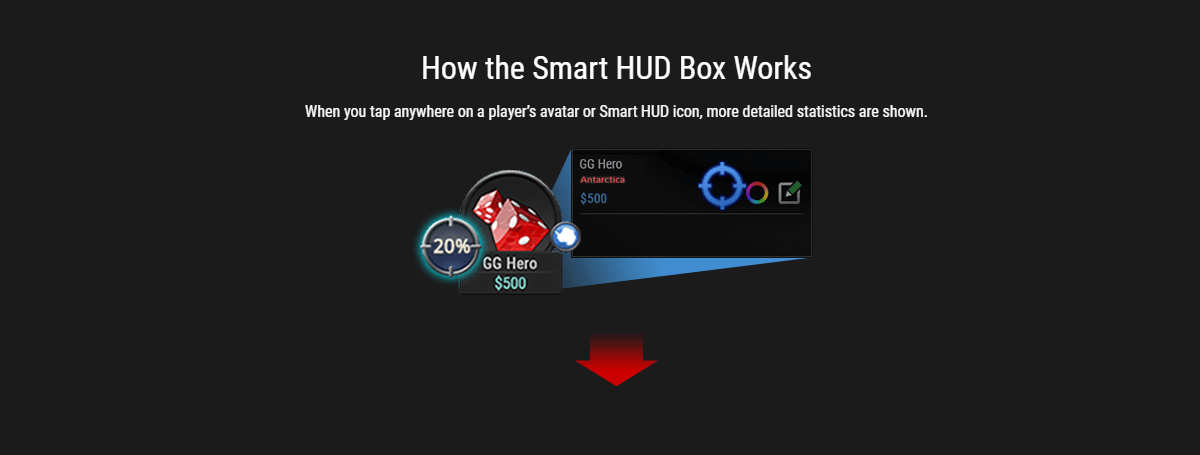
The GGPoker Smart HUD is part of a major shift in modern online poker. In the past, serious grinders relied heavily on third-party poker tracking software and advanced HUDs filled with hundreds of statistics. Today, many poker sites have begun restricting or banning external software to create a fairer, more recreational-friendly environment. GGPoker took a different approach.
Instead of allowing traditional third-party HUDs, the site introduced its own built-in system called Smart HUD. Rather than overwhelming players with endless numbers and complex data points, the Smart HUD focuses on a small set of core statistics to help players make faster, more practical decisions at the table.
Many players see HUD stats like VPIP, PFR, ATS, or 3BET without truly understanding what they actually mean or how to interpret them correctly in real-game situations. Without the proper context, even accurate information can easily lead to bad decisions.
In this guide, we’ll break down exactly how the GGPoker Smart HUD works, explain what the most important poker HUD stats mean, and show you how strong players actually use this information to gain an edge in modern online poker.
What is the GGPoker Smart HUD?
The Smart HUD is GGPoker’s built-in player statistics system designed to provide real-time information directly at the tables. Unlike traditional third-party poker tracking software, the Smart HUD is fully integrated into the client and requires no external programs.
Its main purpose is simple: help players quickly identify basic opponent tendencies during online games.
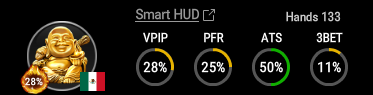
Instead of displaying dozens or even hundreds of advanced statistics, as older poker HUDs do, the GGPoker Smart HUD keeps things intentionally minimalistic. The system currently focuses on a small group of core poker HUD stats, including:
- VPIP (Voluntarily Put Money in Pot)
- PFR (Preflop Raise)
- ATS (Attempt to Steal)
- 3BET percentage
- Total number of hands played
This simplified structure makes the HUD much easier to understand for newer players while still providing useful information for experienced grinders.
At the same time, the limited number of stats is also very intentional from a game ecology perspective. GGPoker has consistently pushed toward a softer, more recreational-friendly online poker environment, where players cannot rely entirely on massive databases and highly advanced tracking software.
The result is a middle ground between having no information at all and the extremely data-heavy HUD systems that dominated online poker during the peak PokerTracker and Holdem Manager era.
How Online Poker HUDs Changed Over the Years
Online poker HUDs have changed dramatically over the last 15 years. During the early poker boom, players had access to an enormous amount of information through third-party poker tracking software such as PokerTracker and Holdem Manager.
Back then, online poker was heavily data-driven.
Serious grinders built massive hand databases, tracked millions of hands, and used highly advanced HUD layouts filled with detailed statistics. Some players displayed dozens of numbers directly on the table, covering everything from VPIP and PFR to highly specific stats like Fold to Flop C-Bet in 3-Bet Pots or River Check-Raise Frequency.
Over time, this created a major imbalance in the online poker ecosystem.
Experienced regulars gained increasingly large edges against recreational players simply because they had access to far more data and analysis tools. Data mining, seat scripts, and advanced tracking software became common at higher stakes, making games significantly tougher and less enjoyable for casual players.
As a result, many poker sites started changing their policies.
Some rooms introduced anonymous poker tables, while others completely banned external HUDs and tracking software. The goal was simple: to create a healthier gaming environment and reduce the gap between professional and recreational players.
This is where GGPoker took a very different approach compared to older poker sites.
Instead of fully allowing traditional HUDs or removing all player information, GGPoker introduced the Smart HUD system. The idea was to provide players with a small amount of useful information without turning games into a battle of massive databases and overly complex statistics.
In many ways, the GGPoker Smart HUD represents the modern direction of online poker.
What Do the GGPoker Smart HUD Stats Mean?
At first glance, the GGPoker Smart HUD may seem extremely simple compared to traditional poker HUDs. However, the few statistics it provides can still reveal a surprising amount of information about your opponents when interpreted correctly.
The key is understanding what these numbers actually represent and, more importantly, what they don’t.
A player’s HUD stats should never be treated as the absolute truth after just a few hands. Instead, they should be viewed as tendencies that help you build a better overall picture of how someone approaches the game.
Let’s break down the most important Smart HUD stats one by one.
VPIP Poker Meaning
VPIP stands for “Voluntarily Put Money in Pot”. This stat measures how often a player chooses to invest money preflop, excluding forced blinds.
In simple terms, VPIP tells you how loose or tight a player is.
A low VPIP usually indicates a tighter player who enters very few pots, while a high VPIP suggests a looser player playing a much wider range of hands.
For example:
- VPIP 12–18 → typically a tight regular
- VPIP 20–30 → standard aggressive player
- VPIP 40+ → usually a recreational or very loose player
This stat alone never tells the full story. A player with a high VPIP might be highly aggressive or extremely passive depending on their other stats. This is why VPIP should always be interpreted together with PFR.
PFR Meaning Poker
PFR stands for “Preflop Raise”. This stat shows how often a player enters the pot with a raise instead of limping or calling. This is one of the easiest ways to identify how aggressive someone is before the flop.
When you compare VPIP and PFR together, you can quickly recognize different player types.
For example:
- 22/20 → aggressive regular
- 40/5 → A classic passive “calling station”
- 16/14 → tight solid player
The gap between VPIP and PFR is especially important. If someone plays many hands but rarely raises, they are usually passive and easier to exploit postflop. On the other hand, players whose VPIP and PFR are relatively close to each other are generally more aggressive and fundamentally sound.
Even with a simplified system like the GGPoker Smart HUD, VPIP and PFR together already provide a strong foundation for understanding population tendencies.
ATS (Attempt to Steal)
ATS stands for “Attempt to Steal”. This stat measures how often a player raises when action folds to them in late position, typically from the Cutoff, Button, or Small Blind.
This number helps identify how aggressively someone attacks blinds.
A high ATS usually means the player understands positional pressure and is opening a wider range in late position. A lower ATS often indicates a tighter or less experienced player who is not stealing frequently enough.
For example:
- ATS below 25% → usually a tighter approach
- ATS around 30–40% → standard aggressive stealing frequency
- ATS 45%+ → highly active late-position opener
Understanding ATS becomes especially important when defending your blinds.
If a player consistently steals very aggressively from the Button, you can often widen your defending and 3-betting ranges accordingly. Against tighter players with low ATS numbers, however, blind defense should usually become more selective.
What Does 3-Bet Mean?
The “3BET” stat measures how often a player re-raises before the flop after someone else has already opened the action.
In modern poker, 3-betting is one of the clearest indicators of aggression.
Players with very low 3-bet percentages usually have extremely value-heavy ranges, meaning they are mostly re-raising premium hands. On the other hand, players with higher 3-bet frequencies generally apply much more pressure and incorporate bluff combinations into their strategy.
As a general guideline:
- 3BET below 4% → very tight and value-heavy
- 3BET around 6–9% → standard aggressive regular
- 3BET 10%+ → highly aggressive player
A player may have a high overall 3BET percentage but still play very differently depending on position. Some players aggressively attack late-position opens, while others only 3-bet heavily from the blinds.
At lower stakes, one of the most common mistakes players make is overestimating the frequency of bluffs. In reality, many recreational players still 3-bet far too tightly, especially in high-pressure situations.
That’s why the 3BET stat should always be interpreted alongside player pool tendencies, stack depths, and positions rather than treated as an isolated number.
Reading GGPoker Smart HUD Badges
Beyond the raw numbers, GGPoker's built-in tool includes a unique visual element: Smart HUD Badges. These icons change dynamically based on a player's recent run and tendencies, giving you immediate psychological data without opening full charts:
- Fire Icon (Hot Streak): The player has been winning consecutive big pots recently. They might be playing with high confidence or steamrolling the table.
- Ice Icon (Cold Streak): The opponent is on a recent downswing or losing streak, making them a prime target for pressure.
- Target Badge: This indicates a player whose stats heavily deviate from the norm, making them highly exploitable.
Why Sample Size Matters
One of the biggest mistakes players make when using poker HUD stats is trusting very small sample sizes too quickly.
A player might appear to have a VPIP of 80 or a 3BET frequency of 20%, but if that information comes from only five or ten hands, it means almost nothing. Small samples are heavily influenced by short-term variance and random card distribution.
This is especially important in modern online poker, where table dynamics change quickly, and many players do not stay at the same table for long.
For example, a player may simply pick up several strong hands in a row and temporarily look far more aggressive than they actually are over the long run.
As a general rule:
- Under 20 hands → almost no reliable conclusions
- 50–100 hands → basic tendencies start appearing
- 300+ hands → stats become significantly more reliable
Even then, context still matters.
A player’s position, stack depth, game format, and emotional state can all influence short-term behavior. The best players use HUD stats as supporting information rather than blindly trusting raw numbers.
The GGPoker Smart HUD is most effective when you combine the stats with observation and logical reasoning, rather than treating the numbers as absolute truth.
How to Actually Use Poker HUD Stats Correctly
The biggest mistake players make with poker HUDs is treating the numbers as automatic answers rather than as supporting information.
HUD stats are not meant to replace strategic thinking. They are simply tools that help you make better decisions when combined with logic, game flow, and player tendencies.
For example, seeing a player with a high VPIP does not automatically mean you should start bluffing aggressively against them. A loose recreational player may call far too often, while a loose aggressive regular may fight back constantly. The same stat can lead to completely different adjustments depending on the type of opponent you are facing.
Position also matters heavily. A player opening 30% of hands from the Button is completely normal. The same frequency from UTG would be extremely loose. This is why strong players never look at HUD stats in isolation.
Another common mistake is overreacting to small samples.
Many players see an opponent 3-bet once or twice early at the table and immediately assume they are hyper-aggressive. In reality, variance can heavily distort short-term stats, especially in fast-paced online games.
One of the biggest leaks among inexperienced HUD users is becoming too robotic. They stop thinking about actual ranges and start making automatic decisions purely based on numbers. This often leads to over-adjustment and the creation of entirely new leaks in their own game.
The best players use HUD stats very differently.
They combine:
- statistical tendencies
- positions
- stack sizes
- population reads
- game flow
- and recent dynamics
The GGPoker Smart HUD works best when used as a decision-support tool rather than an autopilot system. Because at the end of the day, poker is still played by humans, not spreadsheets.
Try the Smart HUD on GGPoker
Ready to put your new knowledge of VPIP, PFR, and 3-bet stats to use? Since the Smart HUD is an exclusive feature, GGPoker is the perfect place to practice your reads and exploit table dynamics. Check out our full GGPoker Review for all the details.
Final Thoughts
The GGPoker Smart HUD represents the modern direction of online poker.
Instead of overwhelming players with massive databases and hundreds of statistics, the system focuses on a smaller set of practical HUD stats that can still reveal valuable information when interpreted correctly.
Strong players combine HUD data with position, player tendencies, game flow, and solid strategic fundamentals. The stats simply help complete the bigger picture.
For newer players, the GGPoker Smart HUD offers an accessible way to start understanding population tendencies and opponent behavior. For experienced grinders, it remains a useful decision-support tool in a poker ecosystem where external software is becoming increasingly restricted.
At the end of the day, poker HUDs don’t make winning decisions for you. They simply help you make better ones.
GGPoker Smart HUD FAQ