
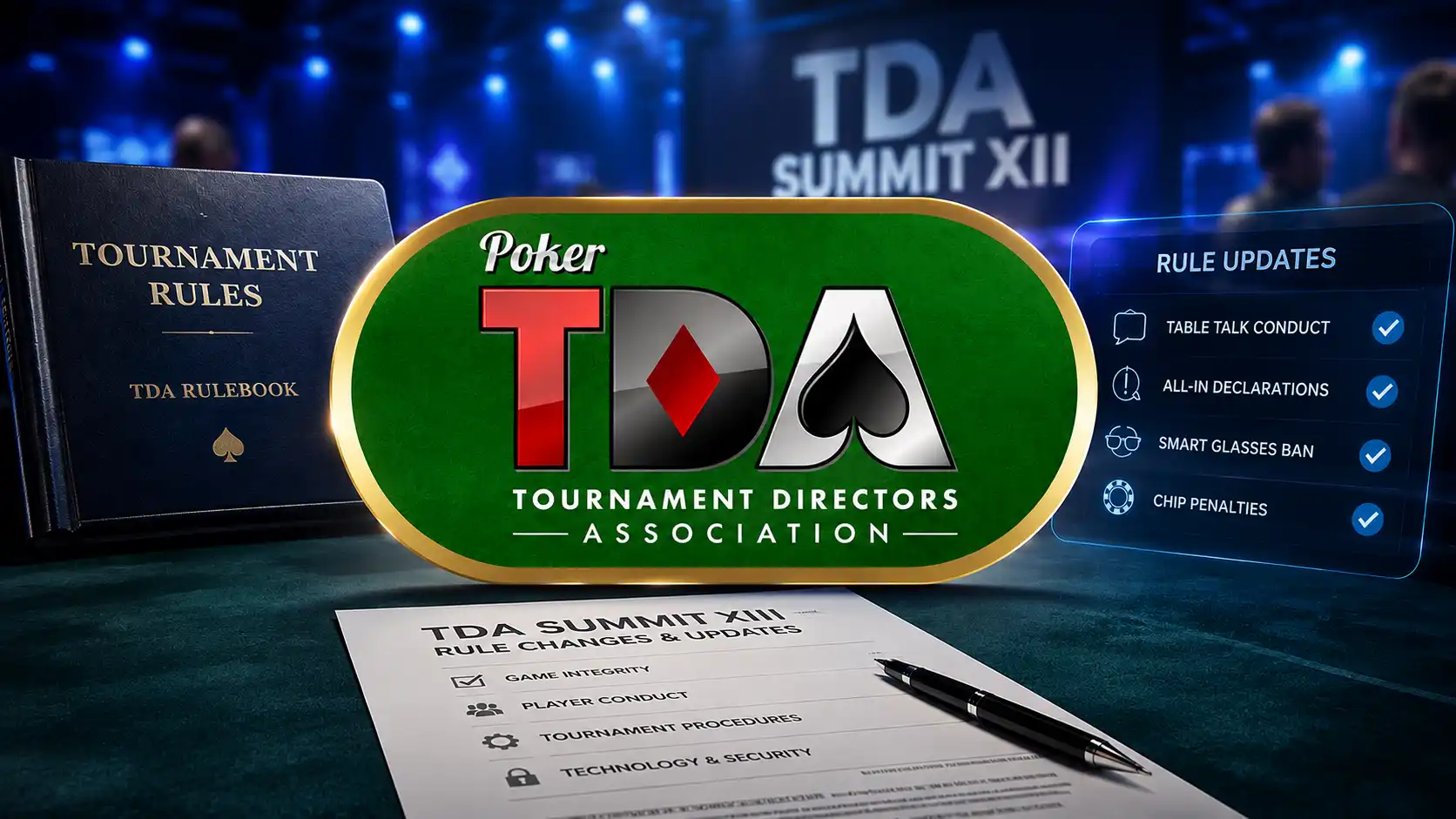
Every two years, some of the biggest names in live poker gather to shape the future of tournament poker. That meeting is the Tournament Directors Association (TDA) Summit, where tournament directors, industry professionals, and poker experts discuss how the official rules should evolve alongside the game.
The TDA Summit XII, held at the PokerGO Studio in Las Vegas, brought together more than 200 representatives from card rooms and tournament operators worldwide. Led by Matt Savage, who also celebrated 25 years with the organization, the summit focused on improving game integrity, player conduct, and consistency across live poker events.
New @PokerTDA procedure:
When levels go up, the dealer is now permitted to raise the blinds and the floor while they should still be announcing it is not the ONLY way the blinds will be raised.
Players not in big blind will help dealers I’m sure, 😅https://t.co/16wG7yg3Fg— Matt Savage (@SavagePoker) July 11, 2026
While this latest edition didn't introduce sweeping overhauls, several critical updates were approved. From stricter table talk rules and clearer all-in procedures to the official ban on Meta smart glasses, these decisions will directly influence how major tournaments are run.
Rather than simply listing the updates, this guide explains what changed at the TDA Summit 2026, why it matters, and how each new rule will affect your next live poker tournament.
What Is the Poker TDA?
The Tournament Directors Association (TDA) was founded in 2001 with a straightforward goal: to establish a consistent set of poker tournament rules that could be applied uniformly across poker rooms worldwide.
Before the TDA, tournament procedures often varied drastically from one casino to another. Unlike in online poker, where software automatically enforces betting limits and turn order, live tournaments rely on standardized human rulings to prevent confusion for both players and staff.
Today, the TDA's rulebook serves as the foundation for the world's biggest live poker festivals. Major tours such as the World Poker Tour (WPT), European Poker Tour (EPT), and countless regional events use the TDA rules either in full or with only minor adjustments. While the World Series of Poker (WSOP) maintains its own official rulebook, many of its procedures closely align with TDA recommendations.
Every two years, tournament directors meet at the TDA Summit to review existing rules, discuss new situations that have emerged in live poker, and vote on potential updates. As new technology, player behavior, and tournament formats emerge, the TDA regularly adapts its guidelines to keep live poker fair, transparent, and enjoyable.
The Biggest TDA Summit XII Rule Changes
1. Stricter Table Talk Rules
One of the most notable updates from TDA Summit XII focuses on player conduct at the table. While tournament rules have long prohibited abusive or disruptive behavior, the language has now been strengthened, with a particular emphasis on zero tolerance for hate speech.
The updated wording gives tournament staff clearer authority to intervene immediately when conversations cross the line from normal table banter into abusive or discriminatory language. The goal isn't to eliminate friendly interaction; table talk remains an integral part of live poker, but to ensure that every player feels comfortable and respected.
Player Takeaway: Competitive table talk is still part of poker, but abusive language and hate speech are now more explicitly and strictly prohibited. If you're unsure whether a comment could be considered inappropriate, it's better to avoid it altogether.
2. All-In Declarations Must Be Crystal Clear
Another important update addresses a situation that has occasionally confused players and led to accusations of angle shooting.
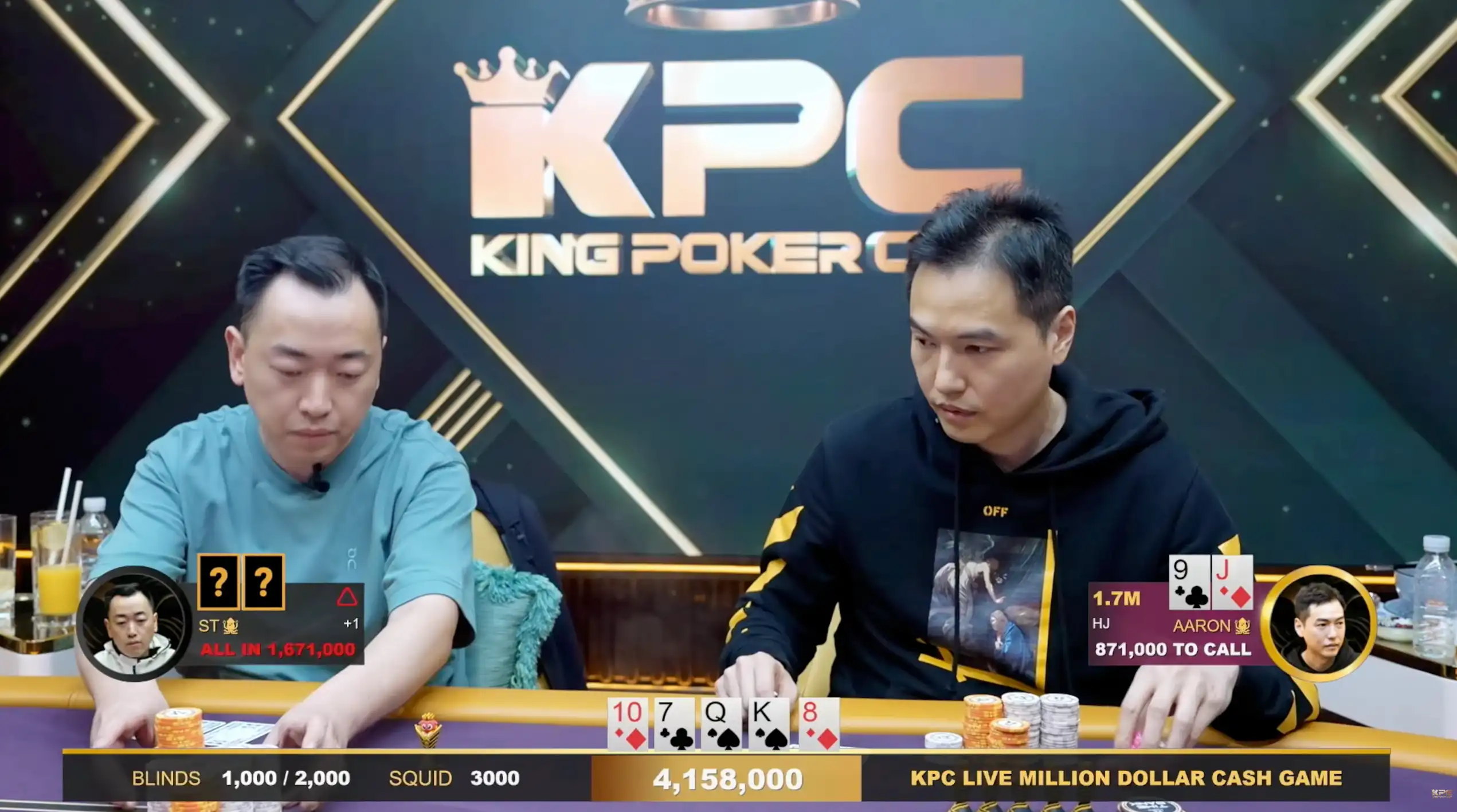
Under the new TDA rules, players declaring all-in must either commit their entire stack or none of it. Leaving a single chip behind after verbally announcing “all-in” is no longer permitted under any circumstances.
In the past, situations occasionally arose where a player would announce all-in while intentionally or accidentally holding back one chip, creating unnecessary confusion about whether the wager truly represented their tournament life. By standardizing the procedure, tournament directors hope to eliminate ambiguity and make all-in situations seamless for both dealers and players.
Player Takeaway: If you verbally declare “all-in”, every chip in your stack is committed to the pot. Double-check your stack before pushing it forward to avoid technical penalties or misunderstandings.
3. Meta Smart Glasses Are Officially Banned
One of the most modern additions to the TDA rulebook is the official ban on Meta smart glasses and similar AI-powered wearables during tournament play.
As wearable technology continues to evolve rapidly, tournament organizers are becoming increasingly aware of the potential risks these devices pose to game integrity. While there is no public evidence that Meta glasses have been used to cheat in major poker tournaments, they are capable of recording video, capturing audio, and could eventually support real-time AI assistance.
Rather than waiting for a scandal to emerge, the TDA has chosen to address the issue proactively. The updated rule gives tournament staff clear authority to prohibit smart glasses at the table to maintain player confidence.
Player Takeaway: If you own Meta smart glasses or similar wearable devices, leave them in your bag during tournament play. Even if you only use them for recording content or listening to music, they are no longer permitted at the tables under the updated TDA rules.
4. Chip Penalties Replace Orbit Penalties
Another practical change introduced at TDA Summit XII gives tournament directors much-needed flexibility when issuing penalties.
Traditionally, players who committed certain rule violations were required to sit out for one or more full orbits. While effective as a punishment, orbit penalties often came with a brutal unintended consequence: players continued to bleed blinds and antes while forced away from the table, significantly crippling their stack without playing a single hand.
The updated rules now allow tournament staff to issue direct chip penalties in appropriate situations instead of automatically enforcing orbit penalties. This creates a fairer system by allowing the punishment to match the severity of the offense, without accidentally ending a player's tournament life simply because they couldn't defend their blinds.
Player Takeaway: Not every rule violation will result in missing an entire orbit. Depending on the situation, tournament staff may now deduct chips instead, creating a more proportionate penalty while keeping the action moving.
5. Stacks of 20 Are Now Mandatory
One of the more subtle yet impactful changes introduced at TDA Summit XII concerns how players organize their chips.
For years, keeping chips in stacks of 20 has been considered standard etiquette to help dealers and opponents quickly estimate stack sizes. The latest update takes that recommendation one step further by making it an official tournament rule rather than simply a guideline.
When chip stacks are neatly organized and consistent, players can make more informed strategic decisions without repeatedly asking the dealer for chip counts. It also dramatically speeds up dealer counts during all-in situations.
Player Takeaway: Always arrange your chips in stacks of 20. It is now an official TDA requirement, keeps the game running efficiently, and makes stack sizes transparent for everyone involved.
6. Out-of-Turn Action Gets Stricter
The TDA also clarified how out-of-turn actions should be handled, particularly in heads-up situations.
Under the updated rules, if a player checks or calls out of turn in a heads-up pot, they lose the option to take an aggressive action once the turn officially reaches them. In other words, they will not be allowed to change their premature check or call into a bet or raise.
The objective is to eliminate situations where someone might try to gain positional information by acting before it is their turn, discouraging both accidental and intentional angle shooting.
Player Takeaway: Always wait until the action is officially on you before touching your chips or speaking. Even an innocent check out of turn will now limit your available betting options once the action reaches you.
7. Updated Dealer Button Procedures
Another adjustment approved during TDA Summit XII affects the movement of the dealer button after table breaks or eliminations.
Previously, many tournaments treated the dealer button as belonging to a specific seat. Under the updated guidance, tournament staff now have greater flexibility to move the button when necessary to ensure that the maximum number of players are dealt into each hand.
By prioritizing the number of active players rather than rigid button placement, tournaments can avoid awkward situations where someone might unintentionally miss a hand or receive an unfair positional advantage.
Player Takeaway: Don't be surprised if the dealer button moves slightly differently after a table break or elimination. The updated procedure is designed to keep as many players in each hand as possible while maintaining overall fairness.
What the New TDA Rules Mean for Poker Vloggers
While most of the updates announced at TDA Summit XII are aimed at standard tournament operations, the ban on Meta smart glasses has naturally caught the attention of poker vloggers and content creators.
Since devices like Meta glasses allow for hands-free, first-person point-of-view (POV) recording, many assumed they would become the future of poker vlogging. However, because protecting game integrity takes absolute priority over content creation, the TDA drew a hard line.
What should creators do instead? For the vast majority of vloggers, including popular names like Brad Owen, Rampage Poker, and Mariano, the practical impact will be minimal. The industry standard remains using traditional smartphones, chest mounts, or dedicated filming equipment to document hands. These traditional recording methods remain unaffected, provided players:
- Obtain explicit permission from the card room or tournament organizer beforehand.
- Keep devices in airplane mode or ensure they cannot receive external communications.
- Respect the privacy of opponents who do not wish to be filmed.
The updated rule simply sends a clear message: as AI-powered wearable technology becomes more sophisticated, live poker will proactively ban the hardware rather than risk potential cheating scandals.
Do Major Poker Tours Follow TDA Rules?
A common misconception is that the Tournament Directors Association writes a mandatory rulebook for every poker tour. In reality, the TDA provides a widely respected, industry-standard framework.
Many of the world's largest live tournament series, including the WPT, EPT, and major regional festivals, adopt the TDA rulebook almost in its entirety.
The World Series of Poker (WSOP) operates slightly differently. While the WSOP publishes its own official tournament rules each year, its procedures share the same underlying principles as the TDA recommendations. When the TDA updates its rules at events like TDA Summit XII, the WSOP, and independent casinos almost always follow suit shortly after.
Whether you are grinding local daily tournaments or travelling for a prestigious international series, understanding the TDA rules is the single best way to protect your stack, avoid costly penalties, and navigate the poker table with total confidence.
Still have questions about the latest TDA rule changes? Here are answers to some of the most common questions tournament players have following TDA Summit XII.
FAQ About TDA Summit XII