

Bankroll management is almost as important as learning poker rules or poker hand rankings when starting. If you want to be a winner, this is not something you can take lightly, and understanding the most important principles will help you reach success in any poker game.
However, you must consider that you need to be a winning player to maximize the benefits of this concept. Otherwise, bankroll management will not help you much, and you will simply be losing money.
Before analyzing specific numbers and buy-in amounts, you should understand how to maximize your chances of succeeding with proper poker bankroll management. Therefore, we will start with a few fundamental rules.
Right Poker Bankroll Management Based on Game Type
It could be a big mistake to think that you can get away with the same bankroll management strategy for every poker format there is.
Of course, it is not the case, and you need different tactics depending on your game. Remember to take all the tips listed above and adjust them to your strategy for the chosen format.
| Game Format | Online (Standard) | Online (conservative) | Variance |
|---|---|---|---|
| Cash Games | 50–75 BI | 100–150 BI | Low / Mid |
| SNG (STT) | 60–80 BI | 80–120 BI | Low |
| MTT (Small Field) | 150–250 BI | 250–400 BI | High |
| MTT (Large Field) | 250–400 BI | 400–700 BI | Extreme |
| Spin & Go | 120–200 BI | 200–350 BI | Very High |
Bankroll Management for Multi-Table Tournaments (MTT)
What separates MTTs from other formats is the sheer size of the tournament field. In other games, you face a consistent number of opponents, allowing for a fixed bankroll strategy. In MTTs, however, the massive total number of participants changes everything.
To manage your MTT bankroll effectively, you must always consider two key factors:
- The tournament field size: How many total participants are there?
- Your edge (ROI): What is your expected Return on Investment against this specific competition?
While there is no universal magic number that fits all situations, massive fields require a highly conservative bankroll strategy. Even as a winning player, you might endure long stretches without cashing, leading to huge swings. Conversely, smaller fields allow you to operate with a smaller bankroll.
The same logic applies to your ROI. A significant edge reduces dramatic swings and variance, allowing for a smaller bankroll. However, if you are barely beating the games with a 5% ROI, you should not even think about playing with less than 100 buy-ins.
To set realistic targets, remember that lower stakes feature much weaker competition. Here, you can afford a slightly more liberal approach, sticking to 100–120 average buy-ins (BIs). As you move up in stakes and face tougher opponents, you should scale up to at least 150 average BIs to stay safe.
Finally, you can dynamically adjust this strategy based on table selection. If you spot a tournament with exceptionally weak competition, you can occasionally bend the rules and take a shot, even if you are slightly under-bankrolled. Vice versa, if a field is notoriously tough, you should strictly avoid it unless you have a massive bankroll cushion.
Poker Bankroll Management for Cash Games
It is a bit easier to build a concrete bankroll management strategy for cash games because only the win rate needs to be considered.
The most common stat to measure it is EV bb/100 (how many big blinds you win per hundred hands).
Therefore, you can build an effective strategy for moving up stakes. For modern online cash games, a safe and highly recommended bankroll management strategy is to have 100 to 200 buy-ins for your current stake. For example, to comfortably grind NL10 ($10 max buy-in), you should aim for a bankroll of $750 to $1,000.

If you are playing live cash games where the competition is generally softer, or if you are aggressively taking a ‘shot' at higher stakes, you might get away with a traditional 40 to 50 buy-in rule. However, online fields require a deeper financial cushion to handle the inevitable downswings.
Learn to analyze your game, understand the correct usage of your poker stats, and get essential poker software! All of this will help you to become a better poker player and save money for what matters!
Spin & Go Bankroll Management
While the initial ‘boom' of Spin & Go might be behind us, this fast-paced format remains highly beatable and offers a clear path to high stakes for those willing to put in the work. However, the days of easy money are gone, and if you want to play it, you need to follow strict guidelines.
Remember, this is a game of very small margins, so it's better to be safe than sorry. Contrary to MTTs, you will always be playing against just two other players, so field size is not a concern. However, as with cash games, the most important factor is your ROI.
You should be aware that massive, double-digit ROIs are a thing of the past in today's tough fields. Even a 3% to 6% return on investment is considered superb for a top regular.
Because of the significant short-term variance, this specific format requires a much larger bankroll compared to others.
However, if you are beating these games and putting in the necessary volume, you will have no problem over the long run, and your profit graph will steadily climb through sheer consistency.
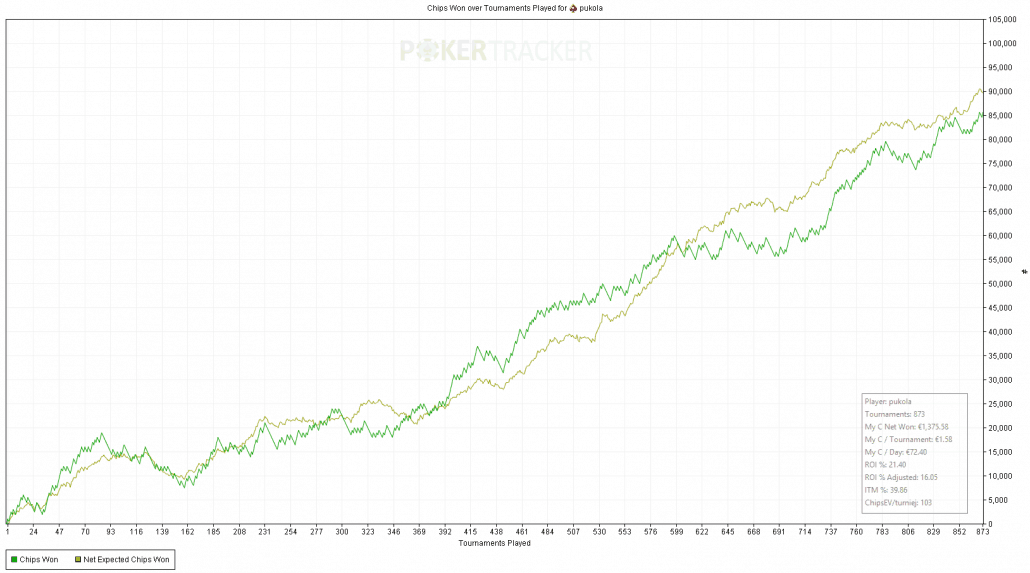
While achieving such massive double-digit ROIs is nearly impossible in today's tough fields, capturing a heater like this historical graph from a player was quite common during the early years:
Poker Bankroll Management for Sit & Go’s
Before diving into the numbers, it is crucial to address the reality of modern online poker: traditional Sit & Go (STT) traffic has largely dried up. Today, these formats are heavily populated by regulars and grinders, making it incredibly difficult to realize a significant profit. Most recreational players have migrated to Jackpot SNGs (Spins) or MTTs, leaving traditional SNGs with razor-thin margins.
However, if you still choose to grind this format, your bankroll strategy must adapt to these tough conditions. Here are the core guidelines:
- Lower Variance, Lower ROI: Because of the smaller field sizes, your ITM (In The Money) percentage will be much higher than in MTTs, meaning you will experience less variance.
- Razor-Thin Edges: The trade-off for higher ITM is a significantly lower ROI. With the modern SNG landscape being so reg-infested, your edge over the competition is minimal.
Because your expected ROI in today’s dried-up SNG pools is so low, you cannot afford to play with a short bankroll. Even if you are a winning STT player, the lack of recreational players means you need a large cushion to absorb the inevitable downswings.
While you might get away with slightly relaxed guidelines at the absolute micro-stakes, moving up requires strict discipline. To safely navigate the modern SNG ecosystem and account for the extremely low ROI, you should aim for a highly conservative bankroll.
Maximize Your EV: Understand Your Win Rate
There is one hugely overlooked factor that you need to understand. Your win rate influences the variance and requirement for your bankroll.
Obviously, your win rate will depend on the level of your opponents, so it is very connected and applies to all poker formats. You can get away with a smaller bankroll in poker if your competition is weak because you will experience smaller swings.
Let us say you are a regular in NL100 cash games. You stick to a 50 buy-in bankroll management strategy and have $5400 in your bankroll right now.
However, you notice a huge fish in NL200 who is just spewing money around. Let us take an extreme example and say that he is open to showing any two cards every single hand.
Does this mean that you cannot play with him, because you do not have 50 buy-ins for that level?
Obviously not! You should be willing to take the risk because this player will be losing money at a very fast pace, and even if you are not better than other regulars in that game, you will surely be a winner in the long run, having such a weak player in your field.
Remember that it is critical to take into consideration the level of your competition when considering playing higher than normal or making a shot. You should be willing to take calculated risks if the potential reward is worth it.
Poker Bankroll Management Tips For 2026
It is one thing to know the buy-in amount that you need to move up, yet another one to actually understand bankroll management strategy and how to implement it in real-life situations.
We will talk about the actual buy-in levels based on your game, but firstly, you need to understand the essential rules for managing money in poker.
1. Keep poker bankroll separated from everyday cash
Even if it does not look crucial, it is. It will help you to stay more focused and calm, even when things are not going your way.
If you can keep money dedicated to poker apart from your daily balance, you will be one step ahead already. Knowing that you do not need to win to pay the bills will give you all the time that you need, and you can concentrate on what is vital – making the right decisions.
Moreover, it will influence your life quality in general – you will be feeling better and have more confidence in yourself even in awful times when you are running bad, and that is what separates winners from the rest.
2. Do not withdraw money from your bankroll
It will help you build your bankroll without wasting money on unimportant things. In addition to this, you will be able to move up stakes much quicker as well.
Having an option to do that will enable you to improve your game and learn much faster than you would otherwise.
You will be able to implement new strategies in your game at a much better pace because you will have more money to make that extra play. Therefore, if you have the opportunity to keep all your money in your poker bankroll, do that!
If you need that money to cover living expenses, you will have to withdraw some. However, even if this is the case, do not take it too far and do not cash out more than you need.
To be honest, you should have some strict rules about this and know in advance how much you need and plan accordingly.
3. Don't Be Afraid To Drop Down In Stakes To Regain Your Confidence
Sometimes, you’ll want to drop to lower stakes even if your bankroll allows you to play higher. I know this may sound counterintuitive, and like you’re losing out on your hourly, but it’s still something to consider in some circumstances.
Poker comes with its many challenges. A streak of bad variance (or bad luck, if you will) can shake your confidence. This, in turn, can lead to you playing sub-optimally without even noticing it.
Say you moved to NL200 a couple of months ago and are now on a bad streak and stuck 15 buy-ins.
- Severe Downswings: You've lost a significant portion of your buy-ins for that limit (e.g., stuck 15+ buy-ins).
- Shaken Confidence: You start second-guessing your strategy against regular opponents.
- Playing “Scared Money”: You are feeling financial pressure and making sub-optimal, overly tight folds.
In these situations, dropping down to your previous stakes and playing there for a while can be a good thing. You won’t feel as much pressure in terms of money, and you’ll be able to regain some of your confidence.
While you might be leaving some cash on the table in theory, you want to play your best game, and if spending some time at lower stakes is what it takes to get you there, just do it.
Keeping Track of Your Bankroll in Live Games
Unlike online poker, playing live comes with its challenges when it comes to bankroll management. Buy-ins aren’t always set in stone, especially when it comes to cash games, and you don’t have the luxury of checking your transaction history.
In an ideal world, you would have a separate bank account dedicated solely to your poker money.
Many pros handle their finances this way because it makes tracking effortless. However, if you are just starting out or don't want to open a separate account, you absolutely must find a reliable way to record your sessions manually.
While you could use a basic notepad or an Excel spreadsheet, the most efficient method is to download a dedicated live poker tracking app on your smartphone. There are dozens of great options available in the app stores (such as Poker Bankroll Tracker or Live Poker Manager Lite).
The exact app you choose comes down to personal preference. The crucial part is that you use something to consistently log your:
- Buy-ins and cash-outs
- Session lengths and hourly rates
- Locations and specific game types
Using a tracking tool will automatically generate graphs and statistics, helping you identify exactly where your edge is highest and keeping your bankroll management strictly on point.
Be in Control of Your Poker Bankroll Management
Now that you have the right guidelines, you know exactly how to manage your funds and when to take shots at higher stakes. However, remember that having the money is only half the equation when moving up.
Even if you have a sufficient bankroll, if you are barely beating your current stakes, moving up should not be your priority. You must have a proven edge before risking more money.
If you find yourself in this situation, stay at your current level and concentrate on studying. Reviewing your hands, mastering new strategies, or checking out advanced Poker Training sites will give you the edge needed to comfortably crush tougher games.
Ultimately, proper bankroll management is about peace of mind and surviving the inevitable swings of poker. If you want to give your starting stack an instant boost and ease the pressure of variance, check out our top recommended online poker sites. Taking advantage of their welcome bonuses and exclusive rakeback deals is one of the smartest ways to build and manage your bankroll from day one.
Frequently Asked Questions (FAQ)