

Texas Hold’em is an ever-evolving game. Over the last couple of decades, we have seen an incredible shift in the way the best players in the world approach and play the game. Even a decade ago, most players were relying heavily on an “exploitative” style of poker – constantly trying to adjust to their opponents' specific leaks. Today, however, the landscape has changed, and understanding optimal GTO preflop ranges has become an absolute necessity.
While playing an exploitative style can still be extremely beneficial (especially against very weak players), the Game Theory Optimal (GTO) model is designed to be mathematically unexploitable against everyone. Whether you want to play a strict GTO style or not, dedicating time to learning these poker preflop ranges is mandatory if you want to crush modern games.
Let's break down exactly why mastering these charts will drastically improve your win rate, regardless of your overall playstyle.
Why GTO Preflop Ranges Are the Ultimate Baseline
1. GTO as the Perfect Starting Point
Many poker players, especially those playing at live tables, will often tell you that exploitative poker is better than GTO because it allows you to capitalize on mistakes. There is no question that if you can find good ways to exploit a specific “fish”, you will make a higher bb/100 win rate than you would by playing strict GTO.
However, the GTO approach is the mathematically perfect baseline. For that reason, optimal GTO preflop ranges are the ideal starting point to build your entire game from. When looking for the most reliable poker preflop ranges to memorize, this math-based approach offers the most solid foundation.
The Unknown Factor: When you first sit down at a new table, you don’t know your opponents’ tendencies, their bluffing frequencies, or how wide their ranges are. At this stage, playing the optimal GTO baseline ensures you are mathematically protected.
It prevents you from making foundational mistakes that will bleed money. Once you learn more about certain players and the table dynamic, you can then start manually adjusting your strategy to exploit their specific tendencies.
2. Protecting Yourself Against Strong Players
Whether we like to admit it or not, you will eventually run into players who are simply better than you. An important trait of a profitable poker player is recognizing when you are at a tough table.

When I find myself in a difficult lineup filled with regulars, I find that the best approach is to play as close to GTO as humanly possible. Trying to play exploitative against great players is dangerous; they will catch on to your unbalanced plays very quickly and counter-exploit you. Furthermore, many solid players today use specific GTO poker ranges to ensure they remain balanced and unpredictable.
Sticking to solid GTO preflop ranges keeps you protected, safe from being outplayed before the flop even hits.
3. Are Your Exploits Actually Working?
One of the most difficult things to decipher in poker is whether the creative plays you are making are actually effective, or if you are just experiencing positive or negative variance.
When you deviate from mathematically proven charts, it becomes incredibly hard to analyze your game. For example, if you decide to exploit an opponent by 3-betting them with a massive, unbalanced range, and you suddenly face three 4-bets in a row – are they making a read on you, or did they just wake up with premium hands?
This is exactly why having a baseline of GTO preflop ranges is so valuable. If you ever feel lost or start running bad, reverting to standard Texas Holdem preflop ranges based on GTO math will protect your bankroll and reset your mindset.
4. How to Learn Optimal GTO Preflop Ranges
It is easy to say that you should memorize the best starting hands, but the question of how to do it remains. Memorizing exact GTO poker ranges might seem daunting at first, but it is highly structured.
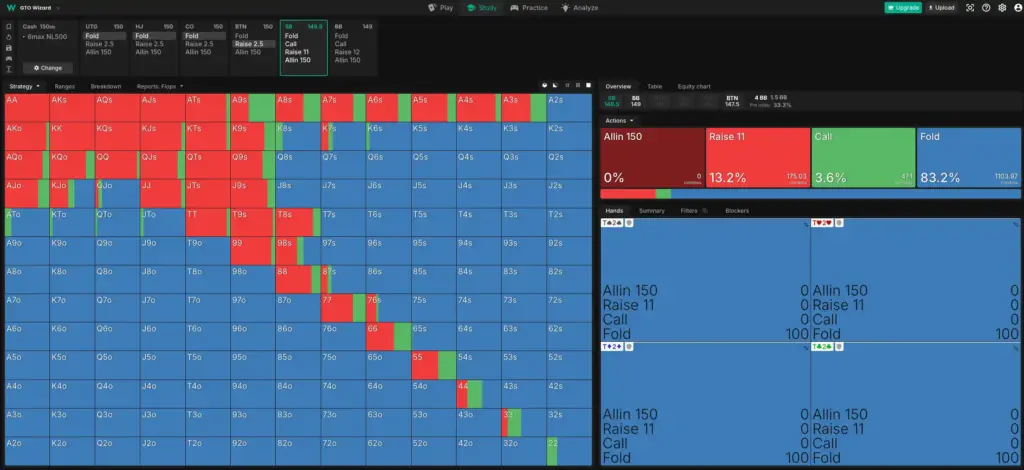
In my personal experience, the fastest way to master Texas Holdem preflop ranges is by using modern software. Tools like GTO Wizard are the industry standard for learning the exact optimal frequencies for every position, whether you are playing heads-up, 6-max, or full ring.
What you need to study:
- Standard unopened preflop raising ranges (RFI).
- 3-betting and 4-betting ranges (both for value and as bluffs).
- Defending ranges against 3-bets and 4-bets.
- Adjustments for different stack depths.
The good news is that studying GTO preflop ranges is the easiest part of game theory to learn, as the scenarios are completely static before the community cards are dealt.
Studying is only half the battle; putting your knowledge into practice is where you truly improve. If you are looking for a great place to test your new charts, check out our highly recommended Best Online Poker Sites to find games that fit your skill level and claim a welcome bonus along the way.
FAQ