

SharkScope is one of the most widely used tools for tracking online poker tournament results and analyzing player performance. The platform allows players to search for opponents, review tournament histories, compare statistics, and study long-term results across a wide range of online poker sites.
One of SharkScope's best-known metrics is the Ability Rating, which provides a quick way to assess a player's overall performance based on the data available in the database. However, the Ability Rating is only one part of what SharkScope offers.
In this guide, we'll explain how SharkScope works, what its main statistics mean, how to search for and analyze players, and how to interpret the SharkScope Ability Rating. We'll also cover the platform's latest features and explain how you can use SharkScope during and outside your poker sessions.

What Is SharkScope?
SharkScope is an online poker tournament database that collects and organizes player and tournament results from supported poker networks. Players can search for a username to review tournament histories, long-term performance statistics, and other information about their results.
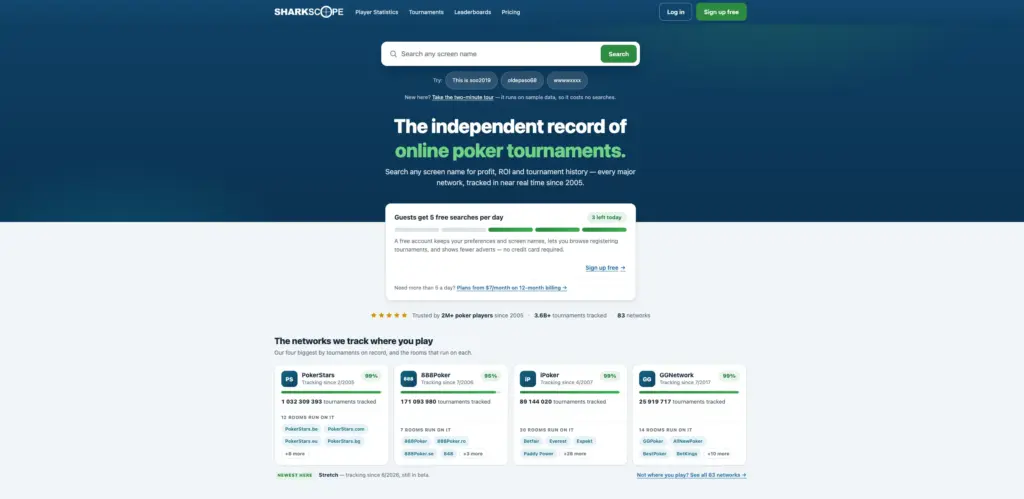
The database covers both Multi-Table Tournaments (MTTs) and Sit & Gos (SNGs), with results from active poker rooms as well as some online poker sites that have since closed. SharkScope tracks results from major platforms such as GGPoker, PokerStars, and ACR, making it possible to research players and review tournament results across different networks.
Beyond its player database, SharkScope also offers tournament search and analysis tools, leaderboards, player groups, and the SharkScope Desktop application. This makes the platform useful not only for looking up an opponent's results, but also for analyzing your own performance and researching tournaments.
What Does SharkScope Show?
SharkScope provides a detailed overview of online poker players and their tournament results. By searching for a player's username, you can access their tournament history and a range of statistics that can help you understand their performance.
For example, if you are playing in a tournament and come across an unfamiliar opponent, SharkScope can help you learn more about their experience and results. You can see how frequently they play, the stakes they typically play, and how profitable they have been over time.
How to Search for a Player on SharkScope
Searching for a player on SharkScope is straightforward:
- Visit the SharkScope website.
- Enter the player's nickname or username in the search bar.
- Select the appropriate search option to view the player's available results.
SharkScope also offers advanced search options that allow you to apply additional filters when analyzing player and tournament data.
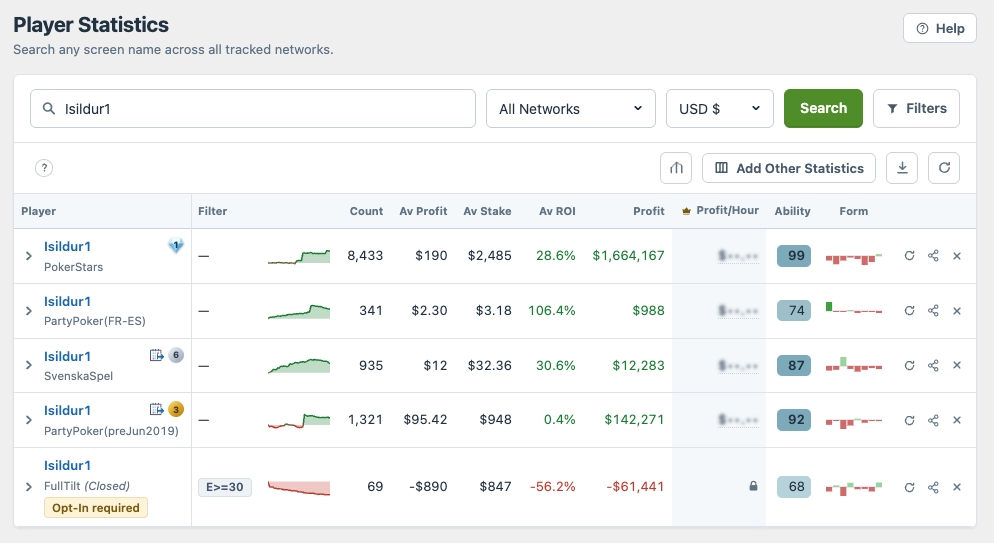
Once you search for a player, SharkScope can display a range of statistics and information depending on the data available for that player.
What Information Does It Show?
Some of the main statistics and information available through SharkScope include:
- Profit History – A record of a player's tournament results and how their profit has developed over time.
- Number of Games – The number of tournaments included in the player's SharkScope results.
- Average Profit per Game – The player's average profit or loss per tournament.
- Average Stake – The average buy-in of the tournaments included in the results.
- Average ROI – A percentage showing the player's average return relative to their tournament buy-ins.
- Total Profit – The overall profit or loss recorded in the available results.
- Ability Rating – SharkScope's rating designed to provide a quick indication of a player's tournament performance.
- Form – A metric that provides additional information about a player's recent performance.
These statistics can be used to build a clearer picture of how a player approaches online tournaments. However, individual statistics should always be considered in context, as factors such as sample size, tournament stakes, and game selection can significantly affect the numbers.
Note: SharkScope gives five free searches per day, and the results for these searches come with limited information. Additional searches and more detailed results come with paid subscriptions to their website.
How to Analyze SharkScope Player Results
SharkScope statistics become much more useful when you look at several metrics together rather than focusing on a single number. Tournament volume, profit history, average stake, and ROI can help you understand how experienced a player is, what stakes they typically play, and whether their results have been consistently profitable.
This is particularly useful when researching an opponent before or during an online tournament. However, SharkScope results should always be viewed in context. A player's sample size, the period covered by the data, and the stakes they play can all have a significant impact on the numbers.
Player Profit History
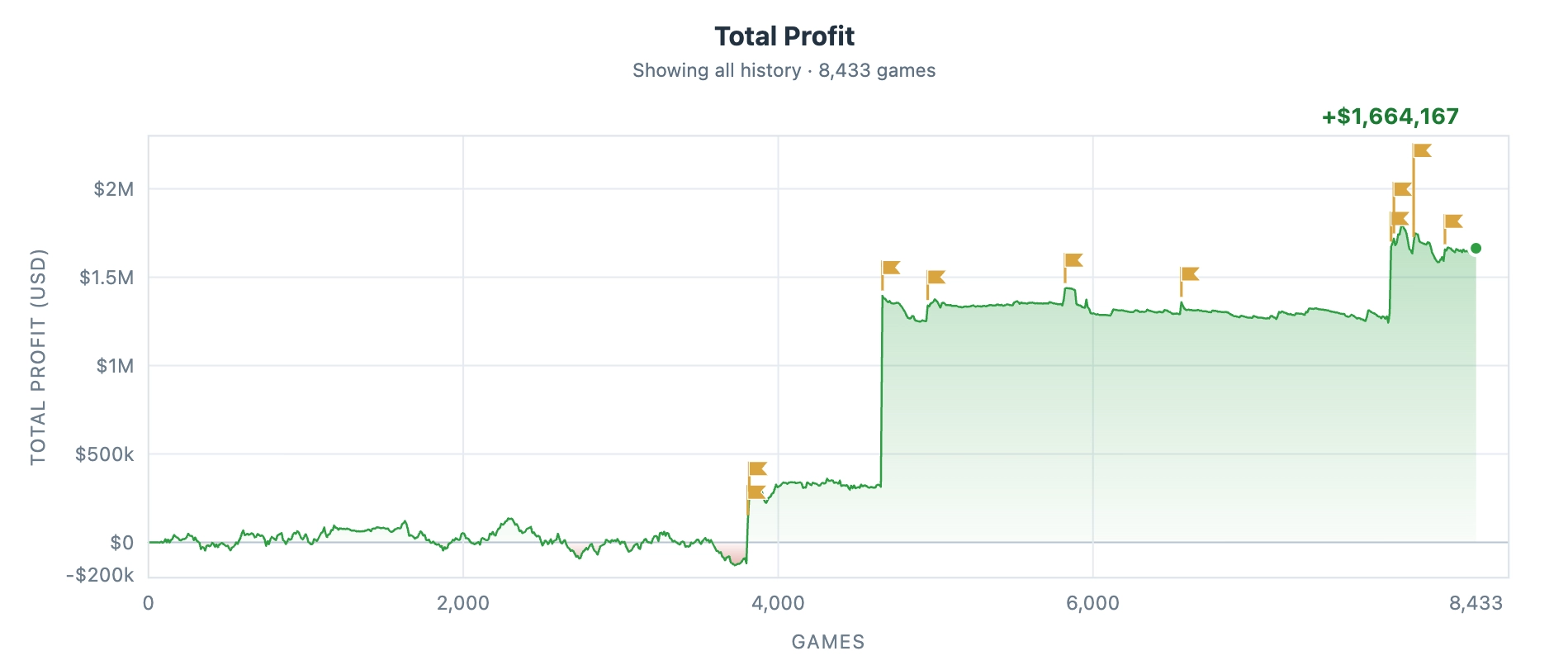
The Profit History graph shows how a player's tournament results have developed over time. It can give you a quick idea of whether a player has been consistently profitable, breaking even, or losing money in the tournaments tracked by SharkScope.
SharkScope also provides additional options for analyzing the data:
- Graphs
- Tournaments
- Breakdown
- Statistics
- Leaderboards
- Insights
These options allow you to look deeper into a player's results. For example, if a player appears to be profitable, you can check their tournament history to see whether most of their winnings came from one or two large scores.
This is particularly important when a player has a major tournament result that is well above their usual buy-in. For example, someone who normally plays $20 tournaments may have a large profit spike after winning a major event they qualified for through a satellite. In that case, their overall profit may not accurately represent their typical results.
Game Count
The count graphics shows how many games (Tournaments or MTTs) a player has played in his lifetime on a specific poker site. It can give you a quick indication of how active and experienced a player is.
This data can help you tell apart professional poker players from the amateur ones, but you will have to combine it with additional information from other graphics (such as the Profit History > Tournaments > Oldest) to get a better idea of the player's volume.
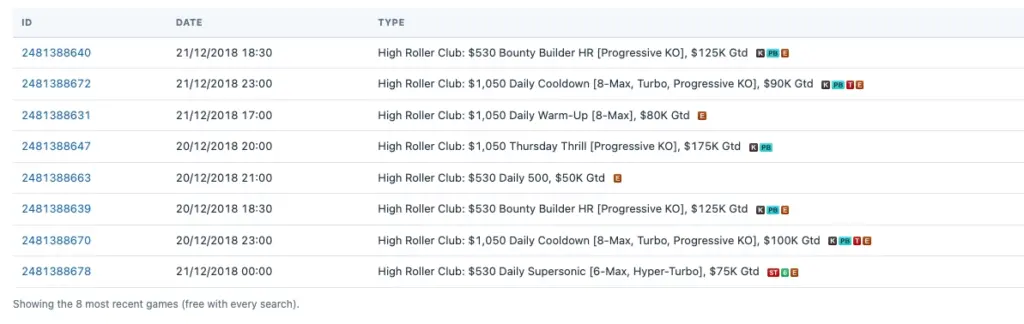
The number of games should always be considered alongside the period covered by the results. Some players may have a large number of games accumulated over several years, while others may have a smaller sample but have played most of those tournaments within a much shorter period.
For example, a player with a winning Profit History and a large Game Count is likely to have significant experience playing tournaments and a substantial sample of results. However, Game Count alone does not tell you how strong a player is, so it is best used together with other SharkScope statistics.
Average Profit, Average Stake, and ROI
Average Profit and Average Stake can help you understand which buy-ins a player typically plays, while ROI provides additional context about how profitable those results have been relative to the player's investment.
These statistics are most useful when considered together. For example, imagine two players who have played a similar number of tournaments over the same period:
- Player A: $15 average buy-in and 9% ROI
- Player B: $100 average buy-in and 5% ROI
Looking only at ROI, Player A has the higher percentage return. However, the Average Stake shows that Player B is playing at significantly higher buy-in levels. This is why comparing ROI without considering the stakes can give you an incomplete picture of a player's results.
Average Profit adds another useful piece of information, as it shows how much a player has won or lost on average per tournament. Taken together, Average Profit, Average Stake, and ROI can give you a much clearer picture of a player's typical tournament results.
Profit Column
The Profit column shows the total profit or loss recorded for a player on a specific poker site. While useful as a quick reference, it should not be viewed in isolation, as the figure can be heavily influenced by the player's sample size, stakes, and individual tournament scores.
SharkScope Useful Filters
SharkScope also provides advanced filters that allow you to narrow down a player's results and get a more specific view of their tournament history.
By using the available filters, you can focus on particular types of games, stakes, tournament structures, or time periods. Some of the most useful options include:
- Site: Filter results by poker network or site.
- Game: Choose between game types such as MTTs and SNGs.
- Entrants: Filter tournaments based on the number of participants.
- Stake: Focus on tournaments within a specific buy-in range.
- Tournament Type: Filter by characteristics such as table size, structure, speed, payout structure, and game format.
- Date Range: Limit the results to a specific period.
These filters can be particularly useful when you want to compare a player's results under specific conditions rather than looking at their entire tournament history.
Sharkscope HUD and Features
The Sharkscope HUD (Heads-Up Display) is designed to display key tournament statistics directly at your table while you are playing online poker. Instead of manually searching for a player’s profile on the Sharkscope website, the HUD overlays relevant data next to each opponent. This allows you to quickly assess their experience level and overall results without interrupting your session.
Some of the main statistics displayed through the HUD include:
- Ability Rating
- Average buy-in
- Total profit
- ROI
- Number of tournaments played
This information can be particularly useful in large-field MTTs, where you may regularly encounter opponents you have never played against before. For example, a high average buy-in combined with a large tournament sample and strong ROI can indicate an experienced regular, while a smaller sample and lower average stakes may suggest a less experienced player.
The SharkScope HUD should be used as a quick reference rather than as a replacement for normal poker decision-making. Tournament results can vary significantly over smaller samples, so statistics should be considered alongside the actual action at the table.
Important Considerations
Before using the SharkScope HUD or other third-party poker tools, check the rules of the poker site you are playing on. Some poker rooms restrict or regulate the use of external software during play.
It is also important to remember that SharkScope statistics are only one source of information. A player's results can be affected by sample size and variance, so the numbers should provide context for your decisions rather than determine them on their own.
New SharkScope Features
SharkScope has expanded significantly beyond its traditional player database and Ability Rating. The platform now includes additional tools for tournament research, player analysis, and poker study, giving users more ways to use SharkScope before, during, and after their sessions.
Some of the newer features include:
- Tournament Edge – SharkScope can estimate a player's expected ROI and profit per entry for a specific upcoming tournament. The calculation takes factors such as the player's previous results at the relevant stake and format, field strength, overlay, and rake into account. It can also provide a likely range and supporting evidence for the estimate.
- Tournament Search and Calendar – SharkScope provides tools for finding and analyzing tournaments, including registering and completed events. This allows players to research tournaments based on factors such as format, field size, and other tournament characteristics.
- AI Hand Analysis – SharkScope's current platform also includes AI-assisted hand analysis, which can assess an individual hand history and provide a natural-language analysis of the decision-making in the hand.
These features show how SharkScope has evolved from a tool primarily used to look up player results into a broader platform for tournament research and poker analysis. The exact features available depend on the SharkScope subscription and the type of tool being used.
Sharkscope Ability Rating Explained
The SharkScope Ability Rating is one of the platform's most recognizable statistics. It is designed to provide a quick indication of a player's overall tournament ability based on the other statistics SharkScope has collected for that player.
SharkScope describes the Ability Rating as a rating that goes up to 100 and is based on an assessment of the other statistics available for the player.
The rating can be useful when you need to make a quick assessment of an unfamiliar opponent, but it should not be treated as a standalone measure of poker skill. The context behind the number matters, particularly the amount of data SharkScope has available for the player and the types of tournaments included in their results.
The first thing to note is that although the Ability Rating goes up to 100, it does not use the full 1–100 scale. The rating starts at 50, meaning that the effective range of the SharkScope Ability Rating is 50 to 100.
A rating of 50 does not necessarily mean that a player is an average or break-even player. It represents the bottom end of the Ability Rating scale, so the number needs to be considered alongside other statistics such as Profit, ROI, Average Stake, and Game Count.
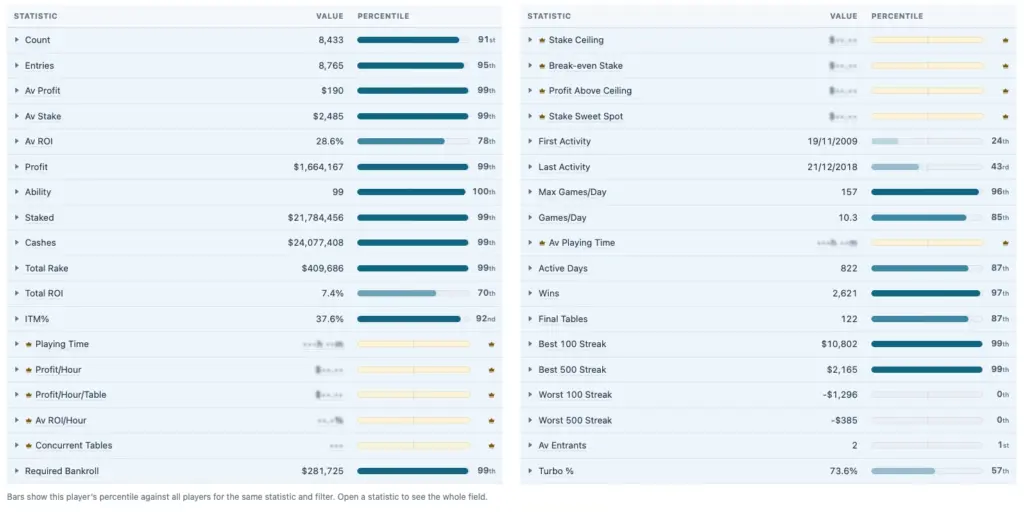
This becomes particularly important when comparing players with very different sample sizes. A player with thousands of tracked tournaments provides considerably more data for analysis than someone with only a small number of recorded games.
For this reason, the Ability Rating is best used as a starting point rather than a definitive assessment of a player's skill. Looking at the rating together with the player's tournament volume, stakes, ROI, and profit can give you a much clearer picture of their overall results.
How to Use the Ability Rating Accurately
The SharkScope Ability Rating is most useful when you compare it with the other information available about a player. Since the rating takes multiple statistics into account, it can help you compare players who compete at different stakes and in different tournament formats.
For example, imagine two players with a large number of tracked tournaments:
- Player A is a small loser in high-stakes tournaments.
- Player B is a small winner in micro-stakes tournaments.
In this situation, Player A can have a higher Ability Rating than Player B. This is because the rating is not simply a measure of how much money a player has won or lost. The stakes and other characteristics of the tournaments included in their results also matter.
When evaluating an opponent, consider the Ability Rating alongside:
- Game Count – How large is the player's tracked sample?
- Average Stake – What buy-in levels does the player typically play?
- ROI – How profitable have their tournament results been?
- Profit – How much has the player won or lost?
- Tournament Type – What formats and structures make up their results?
Sample size is particularly important, as a rating based on thousands of tracked tournaments provides more context than one based on a small number of games.
The best approach is to use the Ability Rating as a quick starting point and then examine the underlying statistics to understand the player's results.
Summary
Sharkscope is one of the most powerful tools you can use when playing online tournaments, and it can even come in handy in a live setting, provided you know players’ online handles. It can help you gauge who the good players at your table are.
While it will cost you some money to gain full access to everything Sharkscope has to offer, the wealth of information you’ll gain access to by doing so will make it well worth your while.
Where to Play Online Poker Tournaments in 2026
The information available through SharkScope can vary between poker rooms, while tournament traffic, field size, and player pools can also differ significantly from one platform to another.
If you're looking for a new place to play, check out our regularly updated list of online poker sites and find a platform that fits your preferred tournament formats and stakes.
FAQ About Sharkscope Ratings