

Master poker strategy with PeakGTO. Try this poker solver for free.
Knowing how to properly defend against continuation bets playing in position is just as important as knowing your out-of-position strategy. In one of our previous articles, we’ve already covered this scenario for cash games, when effective stacks are 100 big blinds.
However, this situation also occurs in tournaments, albeit probably not at the same frequency. Shorter stacks usually dictate more of a 3-bet or fold strategy, but you’ll still find yourself flat calling a bet IP to make studying these spots worth your while.
This is an extensive topic if we cover all possible scenarios. Thus, we’ll focus on the most common one, which is when you flat a cutoff’s open on the button, playing with 40 big blinds effective. We’ll also touch on a couple of other stack depths, namely 25 and 60 big blinds. The focus of this article will be on dry flop textures.
As always, before we proceed to specific examples and solver explanations, here are a few main tips to guide you through this lesson:
- We are defending over 80% on dry ace-high flops, mostly calling in position
- Flat call c-bets on high-card flops, defending between 50% and 65% depending on the sizing
- Defend at around 65% on dry low-card flops
Tip #1: Defend Over 80% on Dry Ace High Flops
We’ll address ace-high flops first, as these are the ones that most players tend to struggle with. On dry ace high flops like A♠9♥4♣, we can expect to face a continuation bet just around 30% of the time.
Your opponent will be using the small, 25% pot sizing almost exclusively, given that these textures connect pretty well with your in-position defending range. Facing this small bet, we’ll continue 85% of the time, with calling being our default action, although a small percentage of raises is also in the mix.
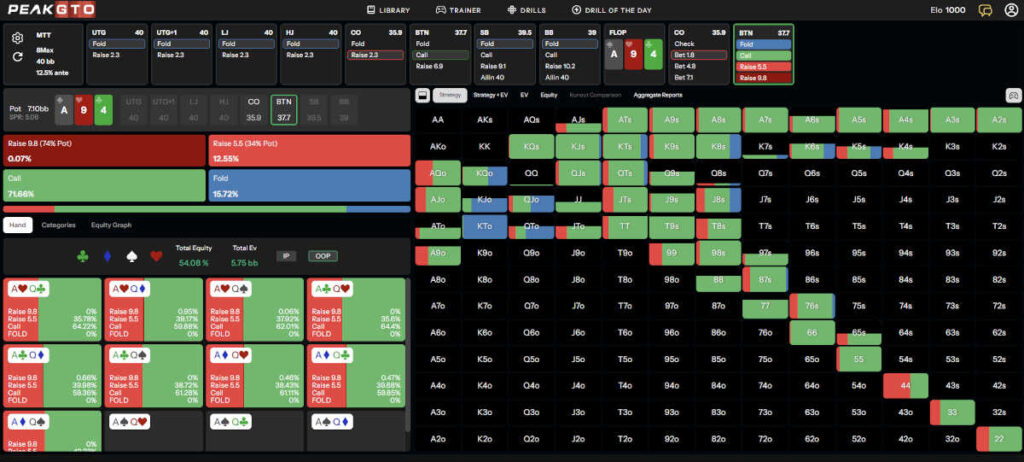
As you can see from the percentage and the picture above, in these scenarios, we are only folding the absolute bottom of our range. Even hands like QJo and KQo, which really connect poorly with this board, will continue about half the time.
Our raises are reserved primarily for our strongest hands in this spot, namely, middle and bottom sets, as well as two pair combos. These are offset by “bluff” raises with some weaker aces, low pairs, and hands with backdoor potential.
It’s essential to note that all these hands are included, but they only raise at a very low frequency, so you shouldn’t go crazy and raise every time with your pocket deuces here.
Given the stack depth, once you raise, your decision is easy on future streets. You’ll be ready to commit the rest of the chips to the pot with all of your strongest hands and slow down or fold facing aggression with the weakest parts of your range.
At the stack depth of 60 big blinds, the cutoff player will continuation bet at a higher frequency, so you can expect to face a c-bet at almost 55%. They’ll still be using the small sizing, though, so our defense strategy doesn’t change that much. We are still defending around 83%, and raising a bit more, but overall percentages are very similar to those at 40 big blinds.
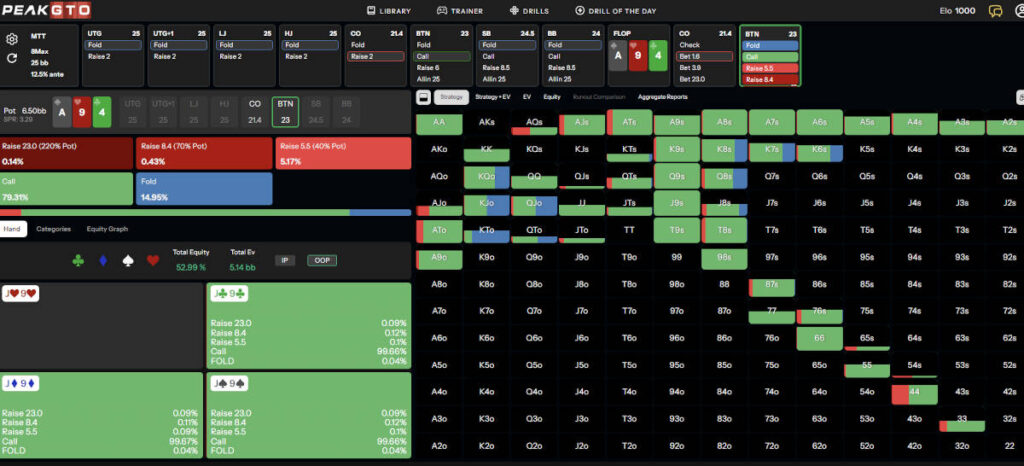
With shorter stacks, namely at 25 big blinds effective, the cutoff reverts back to c-betting at a low frequency, firing only 25% of the time. What’s interesting is that our own defense strategy remains almost unchanged compared to 40 big blind scenarios.
The biggest difference is that we are calling more and raising becomes very rare. With this shallow stack depth, getting all the chips in the middle is not a problem by the river, and we’re not as concerned about being outdrawn.
Tip #2 High Card: Default to Calling as Main Defense Strategy on High Card Flops
Having covered ace-high flops, we can move on to another important segment, which is flops containing a single high card.
On dry high card textures in a Texas Holdem game, such as K♥8♦2♣, you can expect the cutoff to continuation bet at around 29% when playing 40 big blinds deep. In most instances, they’ll be using a larger, 67% of the pot sizing.
Our defense strategy in this particular spot is fairly straightforward as our only GTO actions are to call or to fold. We are calling with 65% of the range and folding the rest:
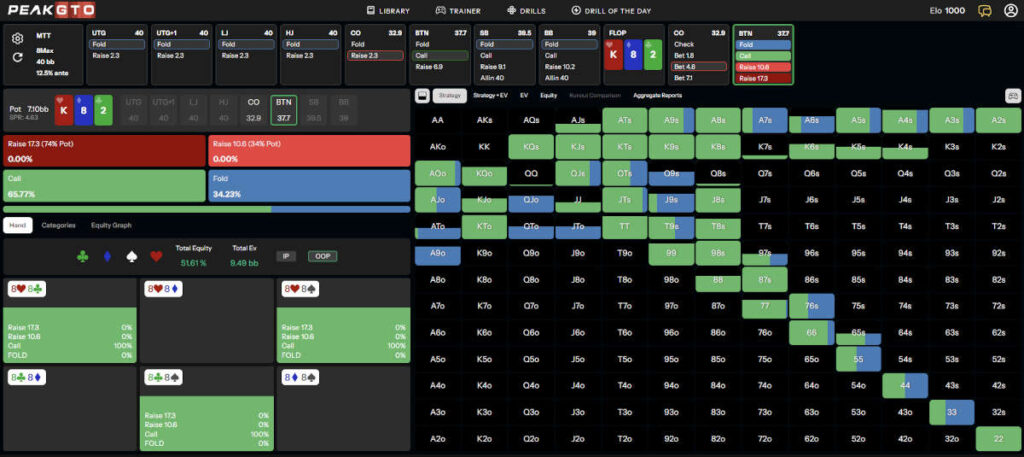
The biggest takeaway here is that, somewhat surprising, we are never raising. Even the top of our range, such as flopped sets and top two pair combos, are happy to continue as a pure call. As for the hands we are folding, these are the ones with no current showdown value and very little backdoor potential. You’ll also notice that with small pairs, such as 55 and 44, we balance between calling and folding at about 50%.
Once the cutoff passes on the opportunity to c-bet and checks, we can take over the betting lead about 60% of the time. There is virtually no hand in our range that doesn’t bet at some frequency in this spot, with strong aces actually preferring to check back, while vulnerable hands with showdown value lean towards betting:
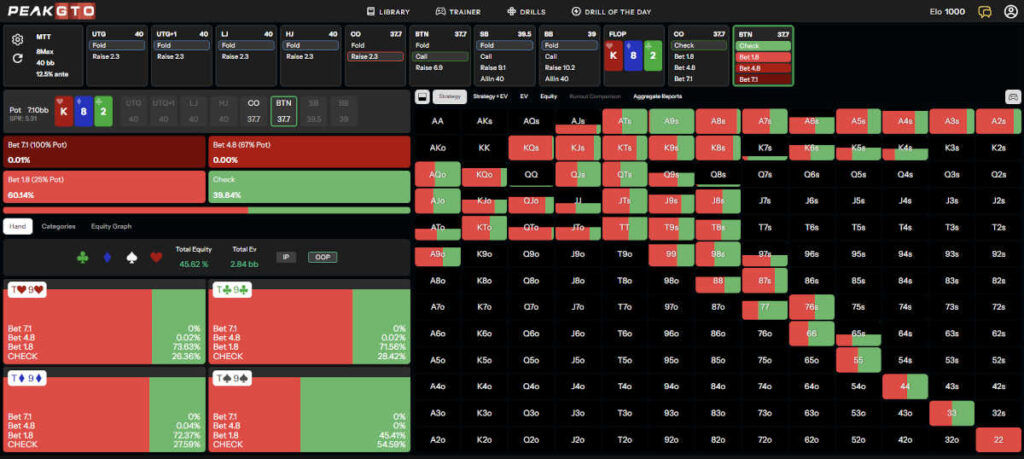
At 60 big blinds effective, the cutoff’s c-bet frequency remains pretty much unchanged, as they are betting out 29% of the time. What does change, however, is the preferred sizing when they do c-bet. About half the time, they’ll utilize the full pot bet, and the other half balances between 67% and 25%.
As for our defense strategy, we are once again just calling. However, with the increased c-bet size, our defense range drops somewhat, so we are sticking around with 54% of our range and folding the rest.
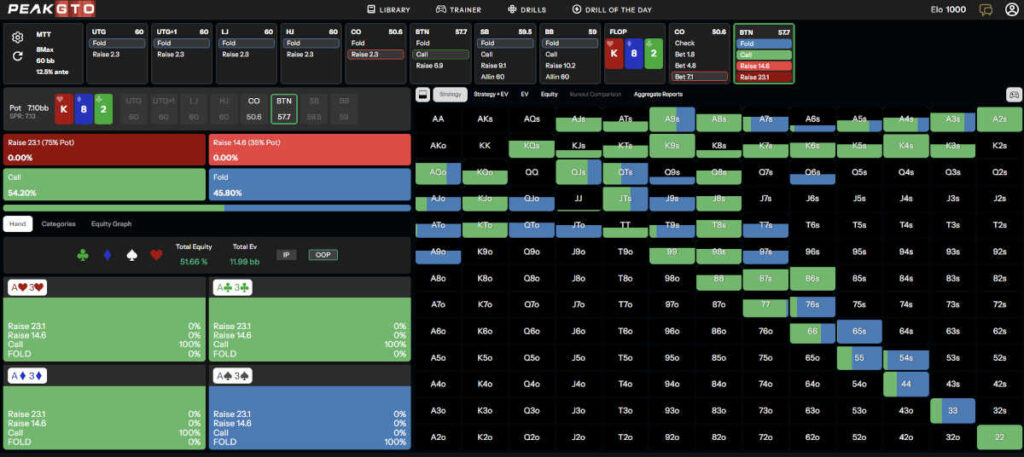
Finally, looking at effective stacks of 25 big blinds, the cutoff’s c-betting frequency drops significantly to just 19%. With much shallower stacks, they have to be much more careful about facing the raise.
When they do c-bet, they’ll use the 67% sizing about two-thirds of the time and 25% for the rest.
Against the big bet sizing, we should continue as a pure call around 67% of the time and fold the rest. Facing a smaller size, we can incorporate some raises with hands like KQ, KJ, KT, A8, and even A3s.
Tip #3: Low Card Flops: Defend Around Two-Thirds of the Time on Low Card Flops
Finally, we arrive at low card flops. These are a category of their own, as low cards, in general, don’t interact that well with ranges in raised pots.
However, on dry low card boards, like 9♠6♦2♣, the original raiser holds the range advantage. On these types of textures, there aren’t many strong poker hands that the in-position caller can have, which is why the cutoff will c-bet at around 45%, defaulting to the large, 67% pot sizing.
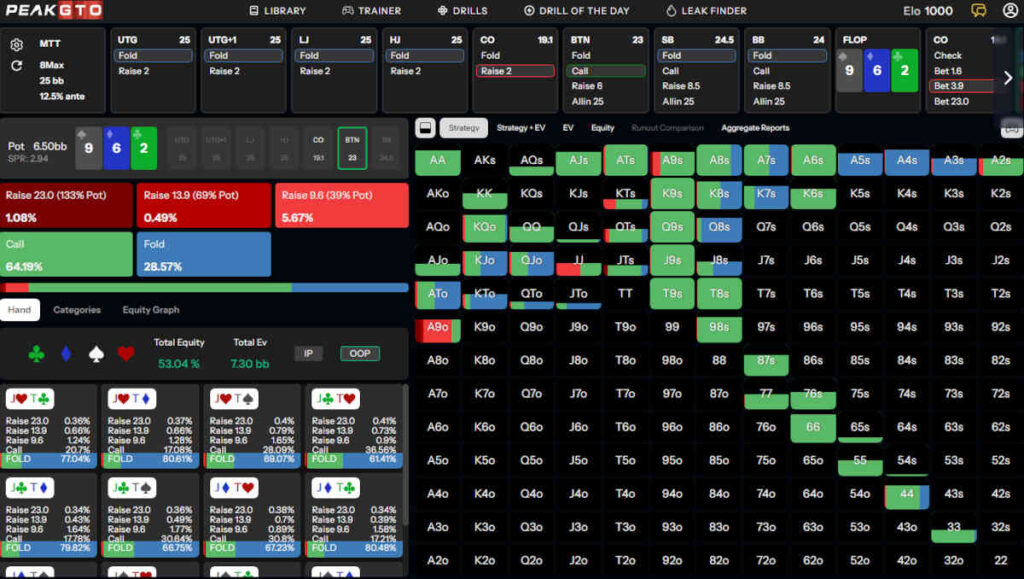
Despite the fact that we don’t have a super-strong range in these spots, facing the c-bet, we should be defending around 66% of the time, mainly calling, as has been the case in most spots we’ve covered in this lesson:
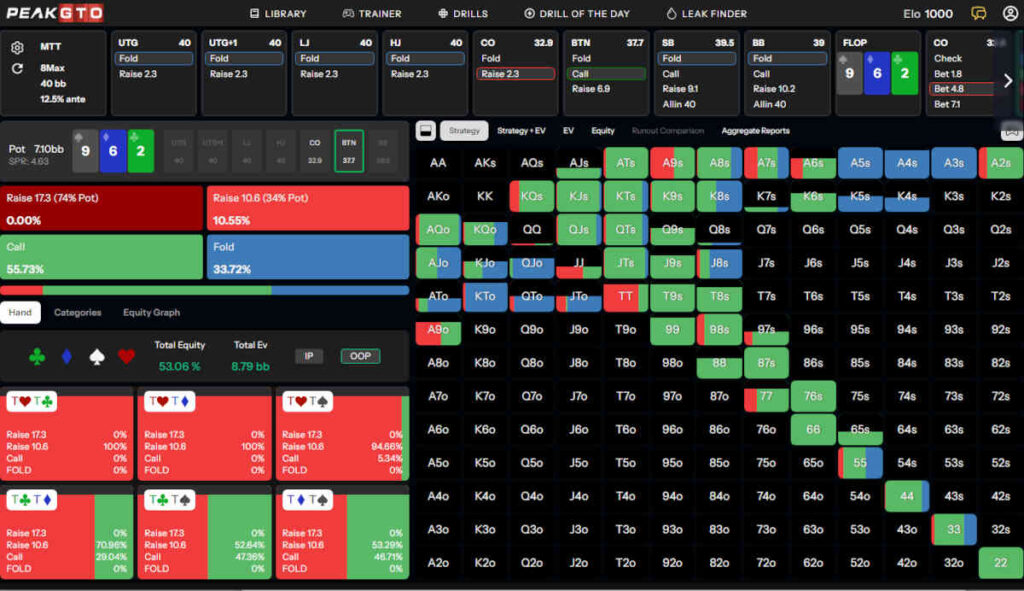
Our small raising range consists primarily of top-pair, top-kicker combos as well as overpairs like TT and JJ. As you can see, flopped sets never raise in these spots when playing 40 big blinds effective.
At 60 big blinds, the cutoff c-bets slightly more often, at a frequency of 49%. Their main go-to sizing is still 67% of the pot, which means that our defense strategy remains pretty much unchanged. The main adjustment is that we lean even more towards calling with almost the entire range, and raising becomes an even lower-frequency play.
Finally, with 25 big blind effective stacks, the cutoff c-bets at around 28%, and they will still be using a large sizing of 60% of the pot. Against that, we are defending just over 70%, still calling with all reasonable hands in our range, with only a very rare raise added to the mix.