
The check raise is one of the most powerful moves in poker, and one of the most misused. Done well, it wins bigger pots with your strong hands and forces folds you have no right to get. Done badly, it turns into spew, bloating pots with hands that cannot stand the heat.
So what separates a good check raise from a bad one? It comes down to knowing why you are doing it, which hands to use, and which boards actually support it.
This guide breaks down the check-raise from the ground up: what it is, why it works, the two main types, and the spots where it earns its money. We will also look at what a poker solver says about check-raise frequencies, so you can see how the theory holds up against real GTO output.
What Is a Check Raise?
A check raise is exactly what the name suggests. You check to your opponent, wait for them to bet, and then raise over the top in the same betting round.
It only works when you act before the other player. You give up the lead by checking, let them commit chips with a bet, and then come back with a raise they did not expect. That two-step move is what makes it so effective.
The power comes from the trap. When you check, most opponents read it as weakness and bet, either for value or as a bluff. Your raise flips the situation on its head. Suddenly, they have money in the pot and a tough decision, often with a hand that is now in bad shape.
A quick example. You are in the big blind with a flopped set on a board that misses most of the preflop raiser's range. You check. They fire a continuation bet with two overcards. You raise. Now they have to decide whether to continue with a hand that has very little equity against your check raise, and you have built a big pot with the best hand.
That is the check raise in its simplest form: check to invite a bet, then raise to punish it.
Why the Check-Raise Works
A check raise is not just a fancy way to build a pot. It works because it attacks your opponent on two fronts at once, and that is what makes it so valuable in poker.
- Value: When you flop a strong hand, checking looks weak, which encourages your opponent to bet. Once they have committed chips, your raise lets you build a much bigger pot than you ever could by leading out yourself. You are letting them pay you off before they realize where they stand.
- Fold Equity. Not every check raise is made with a monster. A well-timed check-raise bluff can force better hands to fold, turning a losing pot into a winning one. When you check and then raise, you represent enormous strength, and most players cannot continue with a marginal hand against that kind of pressure.
The best part is that these two purposes protect each other. Because you sometimes check-raise with the nuts and sometimes with low equity air, your opponent can never be sure which one they are facing. That uncertainty is your real weapon.
Value Check Raise vs Bluff Check Raise
Every check raise falls into one of two camps, and knowing which one you are making is the difference between a profitable move and a costly one.
- A value X/R is made when you expect to have the best hand and want to build the pot. You have flopped something strong, a set, two pair, a big made hand, and you raise to get more money in against worse holdings. Your opponent's bet gives you the perfect opportunity to grow the pot while they still have a hand they feel good about.
- A bluff X/R is the opposite. Here, you do not have a strong made hand, but you raise anyway to make a better hand fold. Often, this is not pure air. The best bluffing candidates are semi-bluffs: flush draws, open-ended straight draws, or hands with a couple of overcards and a backdoor draw.
The reason both types matter is balance. If you only ever raised your monsters, observant opponents would fold everything weak and pay you off with nothing. If you only ever bluffed, they would call you down light.
A simple rule of thumb: A value X/R wants a call, a bluff X/R wants a fold. If you are not sure which outcome you want, that is usually a sign that the spot is not right for a check raise.
When to Check Raise: The Best Spots
Knowing how a check raise works is one thing. Knowing when to check raise is what actually makes it profitable. A few conditions turn a marginal spot into a great one:
- When the board hits your range harder than theirs: Low, connected boards like 7-6-5 or paired low boards connect well with the hands you defend in the big blind and miss most of an opener's range.
- When you are out of position against a wide c-bettor: Many players fire a continuation bet on almost every flop. Against that kind of opponent, checking is a trap. You let them make their automatic bet, then raise to punish a range full of air.
- When you have a strong draw: Semi-bluff check raises work best when you hold a hand with real equity, like a flush draw or an open-ended straight draw. Even if you get called, you have outs to improve.
- When your opponent's bet sizing is small: A tiny continuation bet often signals a wide, weak range trying to see a cheap turn. Raising over a small bet puts maximum pressure on hands that cannot stand it.
The common thread is simple. You want to check-raise when the board favors you, when your opponent is betting too often or too small, and when your hand either dominates their range or has the equity to back up the aggression. Miss those conditions, and the move usually costs more than it gains.
What the Solver Says
Theory is one thing, but it helps to see how a solver actually handles these spots. Using GTO Wizard, we looked at a common flop check raise scenario in a 100bb MTT: the button opens, the big blind calls, and the button fires a continuation bet on the flop. The question is not simply whether the big blind should check-raise, but how often the optimal strategy changes depending on the board.
Coordinated Low Boards Encourage Aggression
Take a coordinated low board like 6-5-4 rainbow. This is exactly the kind of texture that favors the big blind, and the solver knows it. Against the button's continuation bet, the big blind check raises around 13% of the time, calls with about a third of its range, and folds the rest.
That 13% might sound low, but it is a carefully constructed, polarized range rather than a random selection of hands. The value portion consists of hands like sets, two pair, and straights, while the bluffing portion is built around semi-bluffs such as open-ended straight draws, gutshots with backdoor equity, and other hands that can continue barreling on later streets.
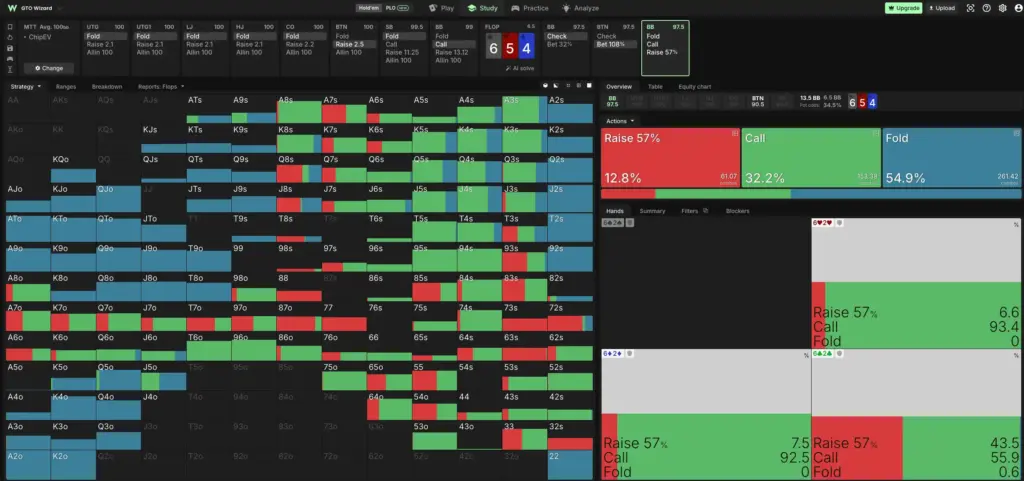
Meanwhile, medium-strength hands, such as weak pairs or marginal showdown value, mostly remain in the calling range. The solver is doing exactly what strong players try to emulate in practice: combining premium value hands with equity-rich bluffs while avoiding unnecessary aggression with hands that sit somewhere in the middle.
Dry Paired Boards Change the Strategy
Now compare that with a seemingly harmless board like 7-7-2 rainbow.
At first glance, many players assume this texture should produce fewer check-raises because there are fewer obvious draws. Interestingly, the solver takes the opposite approach. Here, the big blind check-raises roughly 32% of the time, calls about 25%, and folds the remaining 42%.
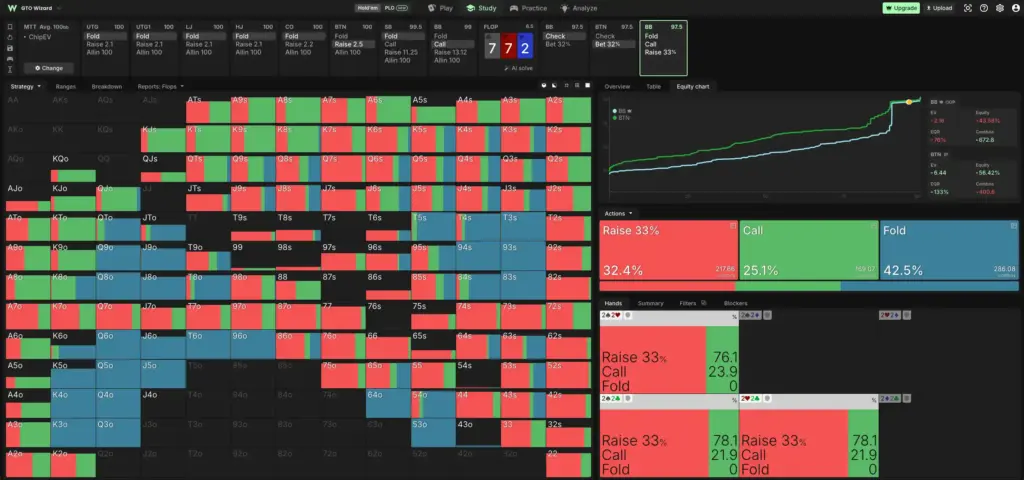
The reason is that this paired low board interacts differently with both players' ranges. The button arrives on the flop with many high-card combinations that completely miss this texture, while the big blind can credibly represent trips, full houses, and other very strong hands. As a result, many of the button's automatic continuation bets become vulnerable to immediate pressure.
Despite the higher frequency, the solver is still far from raising randomly. Strong value hands remain the foundation of the check-raising range, supported by carefully selected bluffs and hands with useful backdoor equity. The strategy becomes more aggressive, but it remains highly structured.
The comparison between these two boards highlights one of the biggest lessons about check-raising: board texture matters far more than the move itself. Rather than memorizing exact solver frequencies, players will improve much faster by understanding why certain boards allow for frequent check-raises while others require a much more selective approach.
Common Check Raise Mistakes
Even players who understand the theory leak money by check-raising in the wrong way. A few mistakes show up again and again.
- Doing it too often: When you X/R almost every time you face a bet, observant opponents stop respecting it and start calling or three-betting light. The move only works when it is credible.
- Only ever doing it with monsters: If you never bluff, your raise screams strength, and good players fold everything except the hands that beat you.
- Choosing the wrong board: A check raise on a texture that favors your opponent, like a dry A-K-high flop, runs straight into their strongest range.
- Bluffing with no equity: A bluff raise with a hand that has no outs is a one-way gamble. Semi-bluffs with a draw are far better, because you can still win when called.
- Ignoring the opponent: A check raise against a player who never folds is not a bluff, it is a donation. Bluff the players capable of folding, and value raise the ones who cannot let go.
The theme across all of these is intention. A good X has a clear purpose behind it, either value or a fold, and fits the board and the opponent. Raise without that plan, and the move works against you.
FAQ