
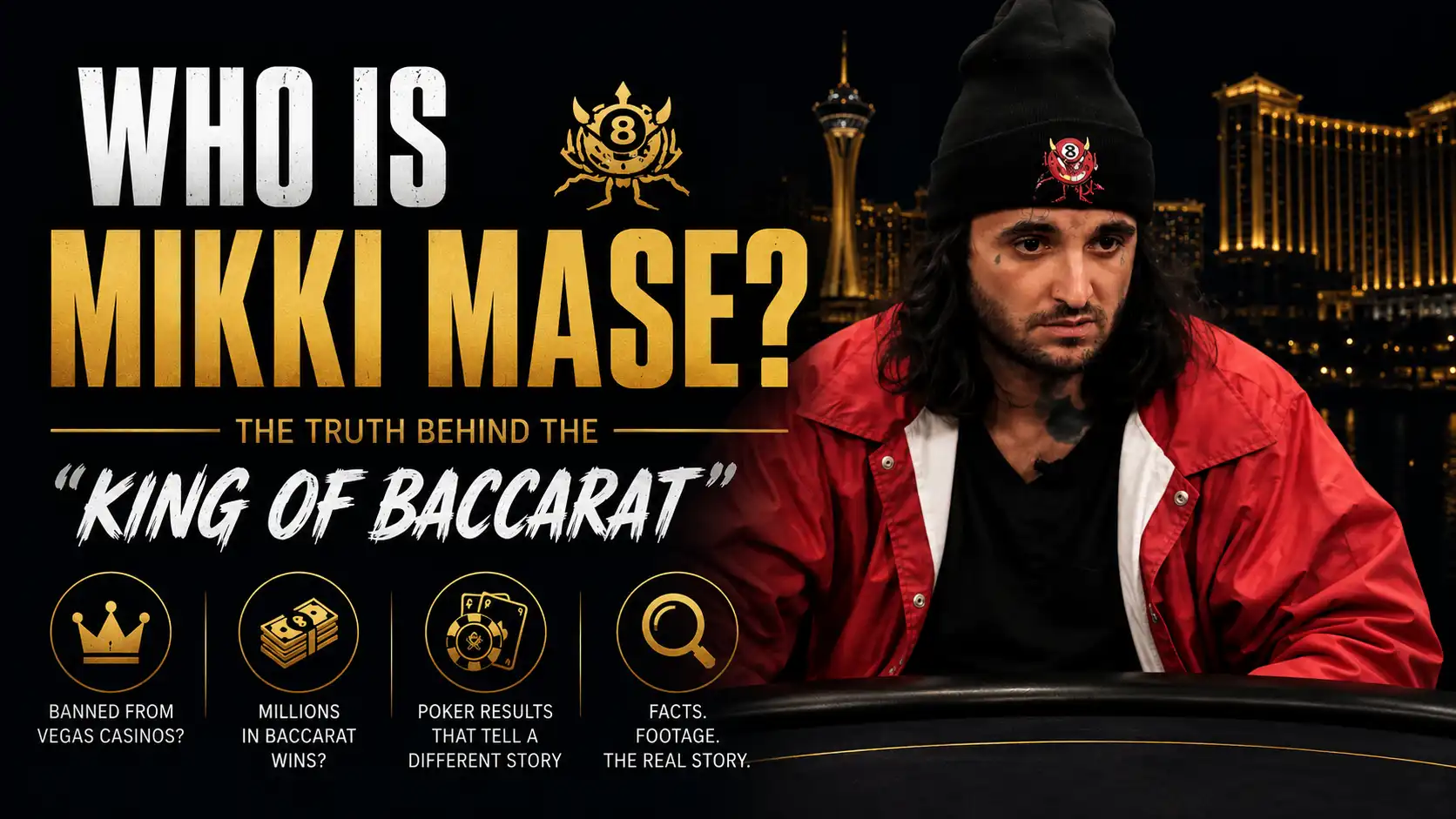
Few names in modern gambling spark as much curiosity, or as much doubt, as Mikki Mase. He calls himself the “King of Baccarat”. He posts photos with stacks of cash, rubs shoulders with celebrities, and claims to have beaten Las Vegas casinos out of tens of millions of dollars. To some, he is a genius who cracked the game. To others, a showman whose numbers do not add up.
So who is Mikki Mase, and is any of it real? Here is the interesting part. His reputation was built on baccarat, a game that cannot be beaten with skill over the long run. However, when he stepped into televised poker games, he entered an arena where results are tracked and footage is permanent. And those numbers tell a very different story from his carefully crafted image.
In this article, we look past the hype, using public records and verified footage, at what Mikki Mase's poker actually reveals. We answer the questions people search for: where his money comes from, why casinos banned him, and whether he is any good at the game. Along the way, his career turns into a lesson in one of poker's most misunderstood ideas, the gap between beating a casino and beating other players.
Who Is Mikki Mase? From Rehab Businesses to Baccarat
Mikki Mase is the public persona of Michael David Meiterman, an American gambler born in 1991 in New Jersey.
He did not come from poker. Before the casinos, he built and sold a group of addiction-recovery businesses in Florida, exiting around 2018 with the capital that would later fund his gambling. That detail matters because it means his first real bankroll came from business, not from beating any game.
What made him famous was baccarat. Mase claims to have won tens of millions from Las Vegas casinos using what he calls a pattern-reading system, and he brands himself the “King of Baccarat”. He says he is banned from most major Vegas properties as a result.
His reach is real, whatever you make of the claims. Under the handle @dirtygothboi, he has more than a million Instagram followers, and his YouTube channel has pulled in hundreds of millions of views since 2024. Heavily tattooed and rarely far from a stack of cash, he built an image designed to stand out.
The money itself is harder to pin down. Mase's headline figure, often repeated as around $32 million in lifetime baccarat winnings, is largely self-reported. An outside source has backed up a single win of roughly $10 million at The Venetian, but his overall profit has never been independently verified. That gap between claim and proof is exactly why so much doubt follows him, and it is a thread we will pull on throughout this article.
How Mikki Mase Got the Poker World's Attention
Mikki Mase did not earn his poker reputation by grinding results. He earned it with a few unforgettable moments on camera.
His breakout came on Hustler Casino Live, the popular high-stakes stream. Sitting in games with some of the biggest names in live cash poker, Garrett Adelstein, Alan Keating, Phil Ivey, and others, Mase started making enormous, fearless bluffs and showing them off.
The Famous Bluff Against Garrett Adelstein
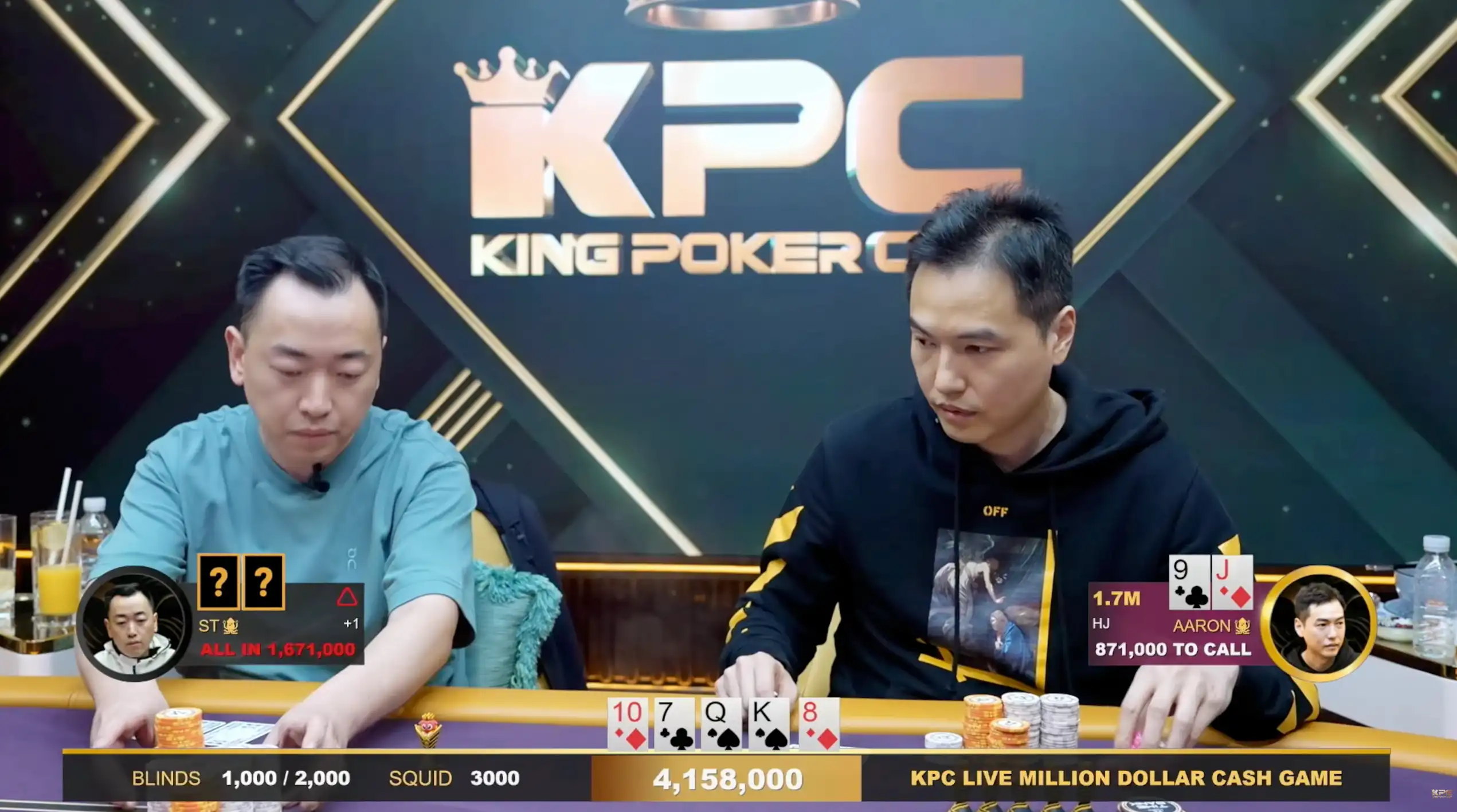
The most famous came against Garrett Adelstein. Adelstein opened with Ace-King, and Mase 3-bet from the small blind with 54 offsuit, a very weak hand to play out of position. Adelstein 4-bet, and Mase called.
- The flop came T-9-K all hearts, giving Mase nothing, but he led out anyway and kept firing on every street.
- By the river he had missed completely, with no pair and no draw.
- He bet big into Adelstein one last time, and Adelstein, holding Ace-King, folded.
- Mase took the pot with nothing and then showed the bluff.
It made for incredible television, but it is worth being honest about the play itself. 3-betting 54 offsuit out of position, then barreling every street with a busted hand, is not a line any GTO based solver would recommend. It was a high-variance, largely speculative gamble that happened to work. Winning a huge pot off a world-class player like Adelstein looks like proof of brilliance, but a bluff that gets through is not the same as a well-founded edge, a distinction we come back to later.
The poker community split on him immediately, and has stayed split ever since. Was this a fearless natural, or a reckless gambler running hot on camera? That question, whether he is actually good or just brave with a big bankroll, is what the tracked results help answer. We turn to those next.
What Mikki Mase's Poker Result Actually Shows
The bluffs made great clips on social media. The results tell a different story.
Across his tracked appearances on Hustler Casino Live and Live at the Bike, Mikki Mase is down roughly $925,000. That figure comes from public trackers like Highroll Poker, covering about 69 hours of recorded play. The bulk of it, over $915,000, was lost on Hustler Casino Live alone.
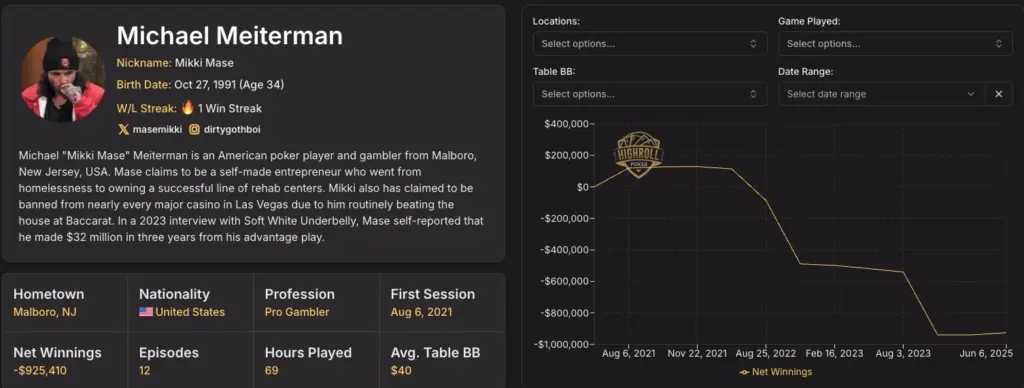
His only recorded tournament result on The Hendon Mob is a single $600 cash prize. Whatever happens in his private games is unknown, but the on-camera record is clear and consistent.
Understanding His Playstyle
The trackers also hint at why. His VPIP, the share of hands he plays, sits around 36% across these sessions, and higher still on HCL. That is a very loose, high-action style, the kind that produces spectacular clips and heavy swings in equal measure.
Now, a 69-hour sample is small by professional standards. No serious player would judge a career on it, and variance alone can explain a losing stretch that size. But the direction is steady, and it lines up with how Mase himself talks about the game.
Mikki Mase Own View on Poker
He has never presented himself as a poker specialist. In interviews, he calls poker slow and boring, a game he plays for action rather than profit, and saves his real claims for baccarat. As he put it in one interview, betting on baccarat is like skydiving, while “poker's long and drawn out; it's like taking the stairs down from the plane”.
That honesty is what makes the story credible. A fraud would claim to win everywhere; Mase does the opposite. The bluffs were spectacular, but they never built a winning poker career.
Advantage Play vs Poker Edge
Here is the real lesson buried in the Mikki Mase story, and it applies to your own game.
Beating a casino and beating other poker players are two completely different skills. They are so different that being great at one tells you almost nothing about the other.
Two Different Types of Games
An advantage player, in games like baccarat or blackjack, is trying to find a flaw in the house: a pattern, a dealer tell, a mechanical weakness. The opponent is the casino and its math. The edge, if it exists, comes from exploiting a fixed system.
Poker is the opposite. There is no house to beat. Your profit comes entirely from making better decisions than the other people at the table. The edge is relative, and it moves every time the lineup changes.
This is why Mase's story makes sense once you separate the two. Whatever he does or does not do at a baccarat table, it does not transfer to poker, where he is up against thinking opponents rather than a fixed system. His huge bluff against Adelstein was memorable, but a single bluff working is not an edge. An edge is winning consistently over thousands of hands, and the tracked results show he does not.
For a developing player, the takeaway is to be honest about where your edge actually comes from. Winning a big pot, or pulling off one spectacular bluff, feels like proof of skill. It is not. Real edge in poker is quiet and slow: better decisions than your opponents, repeated over a large sample.
That kind of edge is not built on a livestream. It comes from studying, reviewing hands, and putting in volume, whether in live games or online poker, where you can play far more hands and sharpen your decisions faster than any single cash session on camera allows.
The Final Takeaway
For a developing player, the takeaway is to be honest about where your edge actually comes from. Winning a big pot, or pulling off one spectacular bluff, feels like proof of skill. It is not. Real edge in poker is quiet and slow: better decisions than your opponents, repeated over a large sample. That is far less exciting than a hero bluff on a stream, but it is the only thing that makes a winning player.
FAQ